Which Buyers in Türkiye Does the 2026 Peugeot e-3008 Appeal To?
Share This Page
The 2026 Peugeot e-3008 is a fastback-bodied electric model in the C-SUV segment sold brand-new in Türkiye in both hybrid and fully electric versions, and it appeals to buyers whose daily use stays under 100 km and who can charge at home, with 525-527 km WLTP range from a 73 kWh battery, 160 kW DC fast charging and a 21-inch curved panoramic i-Cockpit. Its long-range 700 km version, however, has not yet arrived on the Turkish market; this directly shapes the model's identity and target audience.
Highlights
- Peugeot e-3008: One of the first products of the STLA Medium platform in the C-SUV segment.
- The only version sold in Türkiye: 210 hp / 73 kWh / 525-527 km WLTP.
- DC charging power of 160 kW; the 20-80% range takes about 30 minutes.
- The 21-inch curved panoramic display and the go-kart-style small steering wheel are standard.
- Battery warranty of 8 years / 160,000 km.
Exactly Which Class Does the e-3008 Belong to and Where Does It Come From?
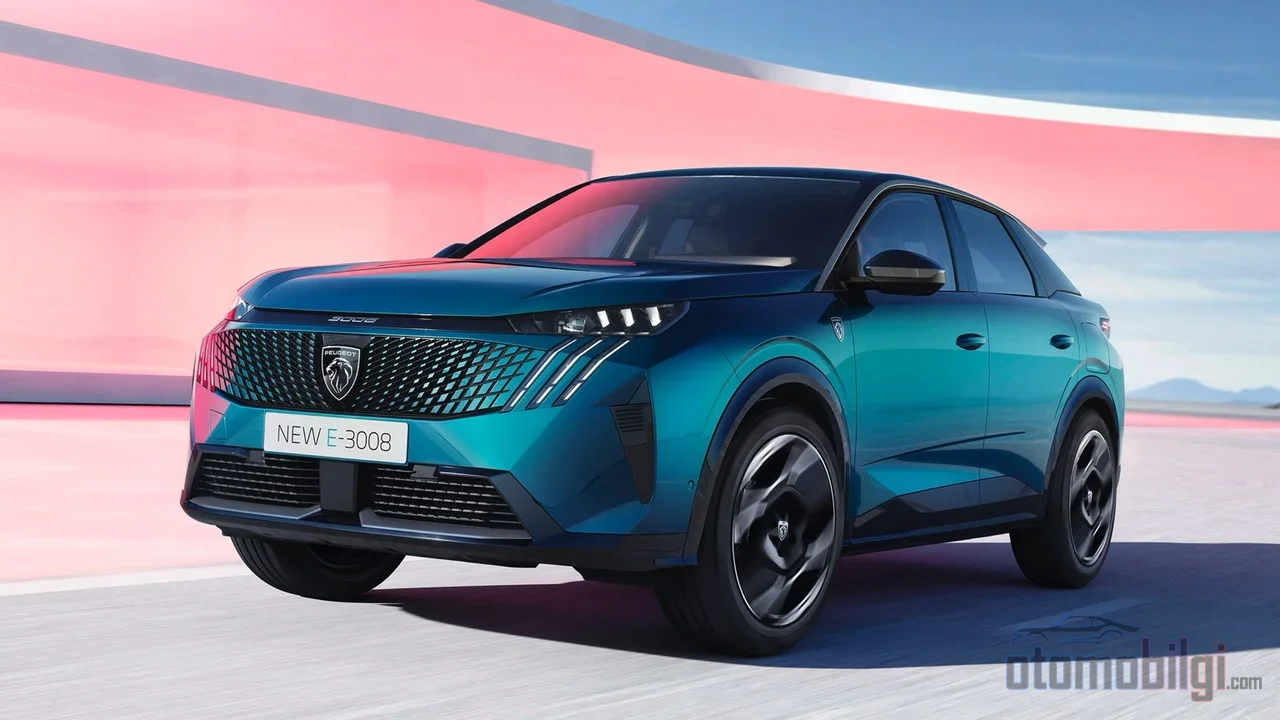
First, let's clarify the definition. The e-3008 is the fully electric member of Peugeot's 3008 family, and its body shape derives not from a classic SUV but from a fastback: the roofline slopes toward the rear with a coupe-like tilt. While this tilt may look like an aesthetic choice, it directly serves aerodynamics; with a drag coefficient of 0.28 Cd, it sits at a good value for its class, and this coefficient is precisely one of the most critical variables in range calculations.
The real news on the technical side is the platform. The vehicle is one of the first models built on Stellantis' new STLA Medium architecture, and it is produced at the Sochaux plant in France. The platform architecture is the fundamental layer where an electric vehicle's range, battery layout and charging characteristics are determined; the e-3008's range option of up to 700 km is the product of the battery flexibility this platform provides.
The weight the 3008 name carries must not be forgotten either. Including the current generation, this name has reached more than 1.32 million buyers in 130 countries over the past seven years. So the e-3008 is not an electric concept written on a blank page; it is the electrification of a model with a deep customer base. This background is an important context for understanding the vehicle's identity.
Motor and Battery Options: Three Versions, But Only One in Türkiye
In Europe, the e-3008 is sold with three different powertrains. The most basic option is a front electric motor producing 210 hp (155 kW) of power and 345 Nm of torque, paired with a battery of 73 kWh net capacity; the 0-100 km/h time is 8.7 seconds. The second option, in the same front-wheel-drive layout, uses the large 96.9-98 kWh battery with 230 hp of power and, with 700-701 km WLTP of range in Europe, is one of the longest-range vehicles in its class. The third option is the dual-motor AWD version with 325 hp; the detail to note is that all-wheel drive is sold only with the small battery.
For the Turkish market, the situation is narrower: the only version sold, the 73 kWh / 210 hp combination, i.e. the front-wheel-drive option with 525-527 km WLTP range. The 700 km Long Range version is not currently coming to Türkiye. For this reason, all the performance and range assessments in this article focus on the version you can buy with warranty coverage in Türkiye.
The battery chemistry is NMC, i.e. nickel-manganese-cobalt based lithium-ion. Compared to LFP, this chemistry offers higher energy density in the same volume; and density means range. On the warranty side, alongside the 8 years / 160,000 km battery warranty, all e-3008s come with a battery preconditioning system as standard: this function brings the battery to the ideal band in terms of cell temperature before fast charging, and it has a direct impact on charging times, especially in the winter months.
Range and Charging Characteristics: What Do the Numbers Say in Real Life?
The WLTP laboratory cycle gives 525-527 km; but this value is measured under near-ideal conditions around 23°C. In Türkiye, when winter conditions, highway speeds and air conditioning load are taken into account, it is normal for the range to run 15-20% lower; in other words, a range of 400-450 km in daily use should be the realistic expectation. Let us separate the temperature and speed factors: in low-speed urban use, the 73 kWh package delivers results close to 450-480 km, while at a constant highway speed of 130 km/h this figure drops to the 300 km band. Mixed usage is around 420 km.
The consumption figure is consistent with this: in the 73 kWh version, 16.7-17.4 kWh/100 km is measured. Weight is an effective variable here; the kerb weight is around 2,183 kg, which is one of the typical upper values of the C-SUV class. Every car whose weight increases consumes more energy in acceleration and on inclines; the 8.7-second 0-100 km/h time should also be read in this context - an efficiency-focused setting, not a performance-focused one.
Charging Times: The Reality of the 400-Volt Architecture
The e-3008's DC fast charging peak power is 160 kW, and the 20-80% interval is completed in about 30 minutes. As with all electric vehicles, it is normal for the charging speed to drop noticeably after 80%; in that region the waiting time increases but the energy added to the battery decreases, so it is a rational habit to treat 80% as the departure point in trip planning.
For comparison, it must be clearly stated: rivals with an 800-volt architecture, such as the Hyundai IONIQ 5 and Kia EV6, complete the 10-80% interval in about 18 minutes. The math of the difference is simple: 12 minutes at the start of each long-distance stop. For a user who takes long road trips a few times a year, this difference is manageable; for someone who travels between cities several times a week and depends entirely on public DC charging, it means tens of hours of difference on an annual basis. On the AC side, the onboard charger is limited to 11 kW; even if you connect to a 22 kW station, the power drawn does not exceed 11 kW, and a full charge of the 73 kWh battery takes about 7.5 hours. In the home/wallbox scenario, the 20-80% range corresponds to a window of 4.5-6.5 hours.
Interior and Technology: How Functional Is the Panoramic i-Cockpit?
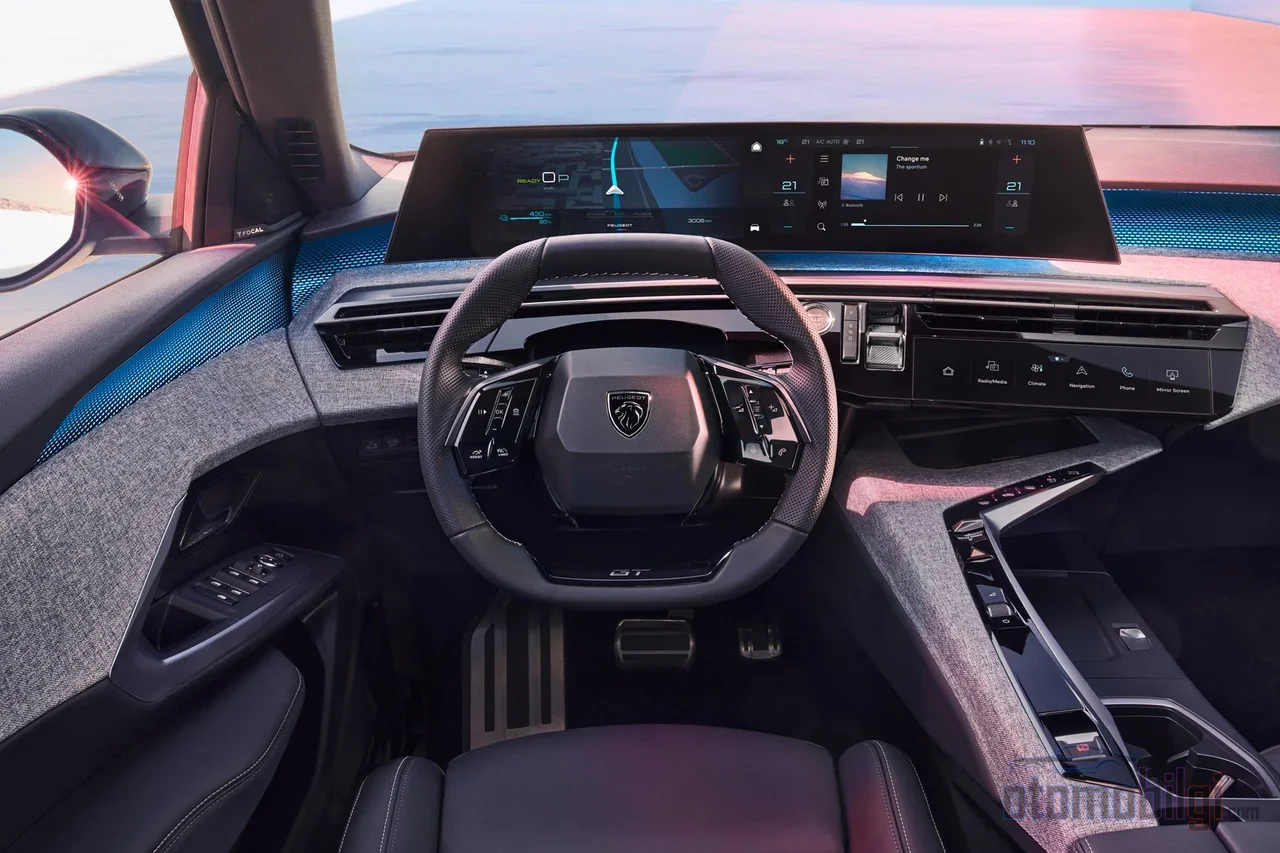
The defining element of the cabin is the next-generation PEUGEOT Panoramic i-Cockpit: a 21-inch curved HD screen stretching in an arc across the top of the panel, a second screen for widgets and shortcuts, and the brand's signature go-kart-sized small steering wheel. Behind the wheel there are paddle shifters that adjust the regenerative braking level - you will use these paddles frequently when building one-pedal driving habits in an electric vehicle. The slim stalk controls and aluminum pedals complete the standard look.
In GT trim, Pixel LED headlights, 3D connected navigation, hands-free power tailgate, Alcantara upholstery and multicolor ambient lighting are offered. At the Allure level, LED headlights, a driver attention camera, the Safety Plus Pack and dual-zone climate control are standard. On the connected services side, ChatGPT integration and the 10-year Peugeot Connect ONE connectivity package are important details; in a software-defined vehicle, a long connectivity period means the features will genuinely work for 10 years.
Practical figures: cargo volume is 588 liters with the rear seats upright (544 liters in the dual-motor version), rising to 1,663 liters with the seats folded, and the loading floor extends up to 1,843 mm. A five-seat layout is standard. But for a balanced assessment, the cons must also be written: the cabin interface is found confusing by some users, and rear-seat knee and headroom are slightly below the class average. The price of the sloping roofline is paid precisely in these dimensions.
How Does It Differentiate Itself from Rivals?
Let's compare it with its main rivals in the Türkiye market on a spec basis:
| Model | Battery | WLTP Range | DC Charging |
|---|---|---|---|
| Peugeot e-3008 | 73 kWh | 525-527 km | 160 kW |
| VW ID.4 | ~77 kWh | ~529 km | ~135 kW |
| Kia EV6 | ~84 kWh | ~528 km | ~260 kW |
| Škoda Enyaq | ~77 kWh | ~581 km | ~165 kW |
The table shows that on range the E-3008 competes neck-and-neck with its rivals, while on charging speed, 800-volt vehicles like the EV6 are clearly ahead. Compared in a smaller segment: Against the Kia EV3 Long Range, the e-3008 comes with more range and a longer body (4,542 mm) despite similar power (204 hp versus 210 hp); however, it weighs roughly 230 kg more. Against the Hyundai Kona Electric, the range advantage is 73 km (527 versus 454 km); against the Volvo EX40, it is 51 km (527 versus 476 km), but the EX40 is ahead in acceleration with a time of 7.4 seconds. So the e-3008's positioning is not a speed or charging championship; it is the balance of range, cabin quality and equipment richness.
Looking across Europe, the picture is even clearer: the Long Range version with 700-701 km WLTP range is ahead of the Tesla Model Y (609 km), Renault Scenic (623 km), Škoda Enyaq (581 km) and VW ID.4 (559 km) in its class. Since this version is not sold in Türkiye, this advantage must remain, for now, an argument of the European market alone.
The e-3008's Position in the Türkiye Market and Its True Cost
Peugeot's electric lineup in Türkiye currently consists of four models: E-208, E-2008, E-3008 and the seven-seat E-5008. The e-3008's position is in an interesting range: With its price of 3,384,500 TL, it comes within only 189,000 TL of the seven-seat E-5008 (3,573,500 TL). For a family that fits in five seats, this gap raises a serious question in the decision-making process. The hybrid version of the same body (1.2 Hybrid 136 HP) is sold in a lower price band, and at the new 3008 launch Peugeot had targeted 6,000 sales in Türkiye in the last four months of the year; about 20% of those sales were expected to be electric.
On the running cost side, calculations can be made using October 2026 tariffs: with AC charging at home or at work, the cost of 100 km is roughly 153 TL; if public DC charging is used, this figure rises to 220 TL. A DC charging session (20-80%, about 43.8 kWh) costs 480-720 TL, while a near-full charge on AC (about 65.7 kWh) falls in the 590-790 TL band. These three lines summarize the essence of electric vehicle economics: For a user with AC charging access, the e-3008's running cost is almost a third lower than that of a user dependent on DC charging.
Which Buyers Does the e-3008 Appeal To, and Which Ones Does It Not?
Reducing the data to a decision: The e-3008 is a sensible choice for the buyer whose daily driving stays under 100 km, who has AC charging available at home or at work, and who prioritizes a quality cabin with C-SUV comfort. Its quiet and comfortable driving character, a realistic city range above 450 km that eliminates long-range anxiety in urban use, and the 8-year / 160,000 km battery warranty are concrete arguments supporting this profile.
The scenario where the model falls short is equally clear: the user who makes intercity trips several times a week and has to meet most of their charging needs from public DC stations. In this usage pattern, the 400-volt architecture's 30-minute stops become a notable annual time loss compared to the 18 minutes of 800-volt rivals. In addition, the small steering wheel imposing a driving position different from the usual SUV seating and the tightness of the rear seat space are points that families carrying more than three adults must absolutely check during a test drive.
The concluding formula is simple: for the buyer who lives where a charging outlet is available, who plans their range, and who puts the balance of design and technology ahead of speed, the e-3008 occupies a distinctive and defensible position in the Türkiye electric SUV market. For profiles where long-distance travel weighs heavily, alternatives that charge faster for the same money should be considered instead.
Sources
- PEUGEOT E-3008 | All-Electric | Fastback Compact SUV
- NEW PEUGEOT E-3008: NEXT-LEVEL ELECTRIC FASTBACK SUV – Stellantis Media
- NEW PEUGEOT E-3008 AND E-5008 LONG RANGE – Stellantis Media
- Peugeot E-3008 in October 2026
- Range of the Peugeot E-3008: Everything You Need to Know!
- Peugeot E-3008 Review & Buying Guide 2026
- Peugeot E-3008 73 kWh
- Peugeot E-3008 Review 2026 | Performance & Pricing
- Peugeot E-3008 SUV specs & dimensions
- 2024 Peugeot E-3008 vs 2024 Kia EV3 Long Range
- Peugeot E-3008 vs Hyundai Kona Electric Comparison
- Peugeot E-3008 vs Volvo EX40 Comparison