Don't Miss the 2026 Renault Megane E-Tech
Share This Page
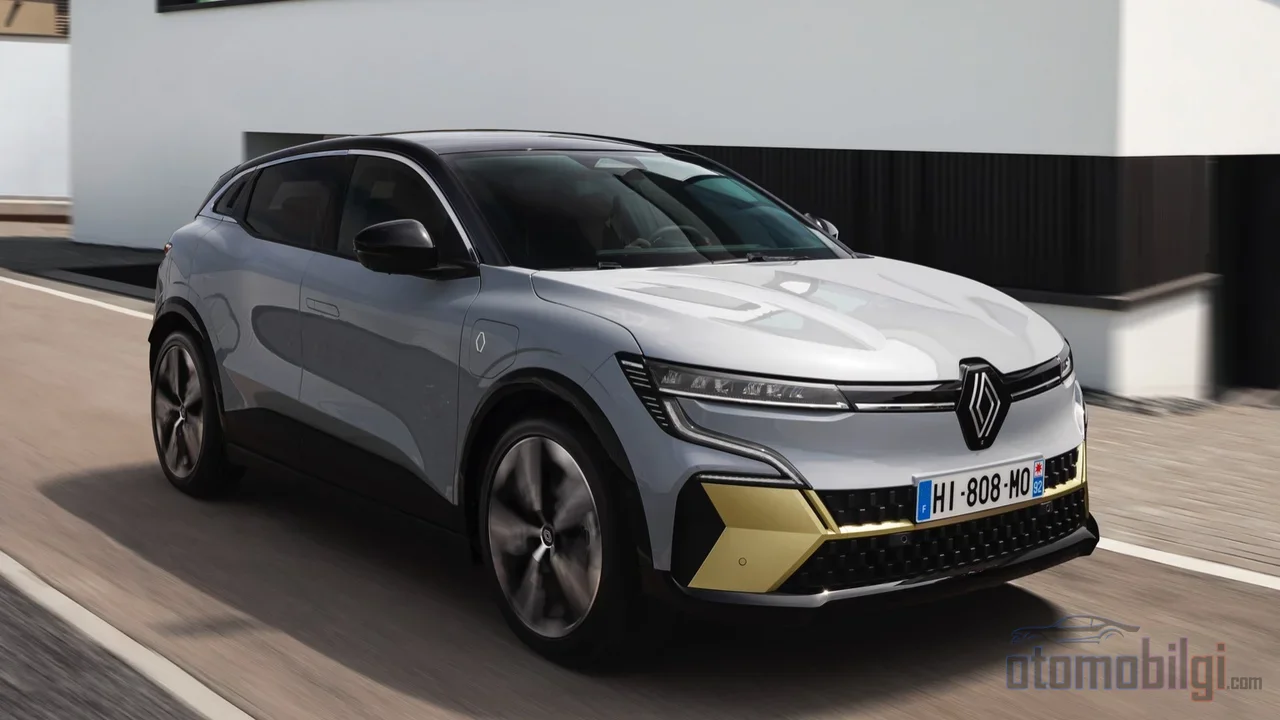
The Renault Megane E-Tech is one of the least talked about yet technically most well-rounded models in the electric SUV market in Türkiye: 4.21 meters in length, 468 km WLTP range and a 100% electric compact produced entirely in Europe. Although this model remains in the shadow of rivals like the ID.4 and Ioniq 5, it offers a formula unlike anyone else's.
Highlights
- 220 hp of power and 300 Nm of torque; 0-100 km/h in 7.5 seconds
- WLTP range 468 km, in real-world use around 360-400 km
- DC fast charging at 130 kW; roughly 1.5 hours of highway range in 30 minutes
- CMF-EV platform, shared with the Nissan Ariya; production in France
- The facelifted version is expected to arrive in Türkiye in the fourth quarter of 2026 is expected to arrive
What is the Renault Megane E-Tech, and which segment does it belong to?
The Megane E-Tech is a 100% electric compact model that Renault launched in 2022. Behind the familiar name lies a completely different technical foundation: the vehicle is built on the CMF-EV platform shared with the Nissan Ariya. This platform is an architecture developed by the Renault-Nissan alliance for electric models; the battery is placed in the floor and the center of gravity sits noticeably lower than in a classic internal combustion Megane.
Dimensions are in line with the compact class: 4.21 meters in length. This is a measure below the segment's two big names, the VW ID.4 and Hyundai Ioniq 5, and is the detail that truly defines the vehicle's identity. On the power side, there is a 160 kW (220 hp) synchronous electric motor, front-wheel drive and 300 Nm of torque. 0-100 km/h in 7.5 seconds, top speed 160 km/h - figures that will leave rivals waiting at the lights but that never amount to a performance-focused vehicle.
Production is entirely in Europe: assembly at the Douai factory, battery cells in Europe, and the motor produced at the Cléon facility in Normandy. Instead of the battery imports from the Far East commonly seen in the electric segment, a cross-continental supply chain has been established.
Range and charging: the gap between the WLTP figure and the real world
The official data is clear: 60 kWh usable capacity NMC battery and 468 km WLTP range. Renault Türkiye also lists the same figure on its official page as the achievable range on a single charge. However, this measurement reflects ideal laboratory conditions. In the real world, depending on temperature and driving style, the 360-400 km range is a more honest expectation. Heavy highway use and cold weather can pull this value even lower.
How fast is the DC charging curve?
The Megane E-Tech supports DC fast charging up to 130 kW. This is a modest figure compared to rivals with 800-volt architectures; vehicles like the Ioniq 5 can go up to 350 kW. But in practice the picture is not that bad: 150 kW DC station for 30 minutes restores roughly 1.5 hours of highway driving of range at an average speed of 110 km/h. In other words, it covers your needs on a long-distance stop; it is just not at the fastest end of the competition.
On the AC side, home charging is 11 kW done with a three-phase onboard charger; a full charge at home takes about 6 hours. Additionally, a heat pump, regenerative braking that engages with a single press of the pedal, and both V2G and V2L bidirectional charging support are among the standard features. V2L means the vehicle can transfer energy from its battery to the outside - a practical safety net for camping or power outages.
Interior and technology: OpenR display and camera-based side mirrors
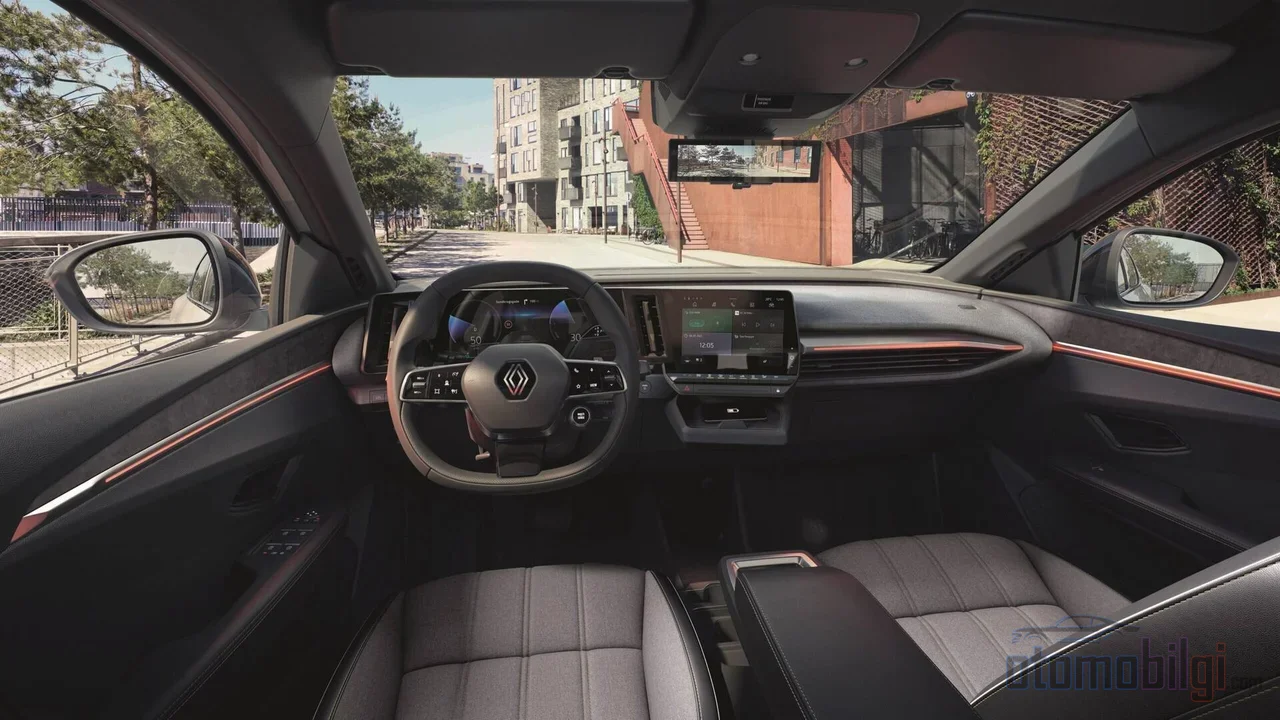
At the center of the interior OpenR Link system: dual 12-inch displays, with a total 774 cm² surface area, positioned on the vertical console. The system is based on Android Automotive OS, with Google Maps, Assistant, and the Play Store embedded directly into the vehicle. This is a true built-in ecosystem that reduces dependence on your phone; you don't need to grab your phone to update the map.
The hardware list is rich at the Iconic level: Harman Kardon 410-watt sound system with 9 speakers, a 360° 3D camera and smart rearview mirror - meaning a digital mirror that displays a camera image instead of the interior rearview mirror. User feedback highlights that the camera mirror does not create glare issues and has good resolution; those who prefer the classic mirror, however, may complain about the small rear window. Under Renault's "Human First Program," more than 30 safety features and 19 advanced driver assistance systems are listed. On the safety side, there is a 5-star rating from Euro NCAP.
How does it differ from the ID.4 and Ioniq 5?
In this segment, comparisons almost always revolve around the VW ID.4 and Hyundai Ioniq 5 axis. The Megane E-Tech's difference lies largely in its dimensions: at 4.21 meters, it is more compact than both. The ID.4 is a classic compact SUV, while the Ioniq 5 gives the feel of an almost stretched hatchback for its size. The Megane is not squeezed between these two, but represents a consciously smaller European spirit - parking in tight city spots and maneuvering in narrow streets is an easier task for it.
| Feature | Renault Megane E-Tech |
|---|---|
| Length | 4.21 m |
| Platform | CMF-EV (shared with the Nissan Ariya) |
| Motor / Power | Synchronous electric, front-wheel drive, 160 kW (220 hp) |
| Torque | 300 Nm |
| 0-100 km/h | 7.5 seconds |
| Battery | 60 kWh usable NMC |
| WLTP range | 468 km |
| DC charging | up to 130 kW |
| AC charging | 11 kW three-phase, full charge in ~6 hours |
| Safety | Euro NCAP 5 stars, more than 30 features |
Renault's pricing strategy is also consistent with this positioning: it aims to remain competitive against Chinese rivals and offer an entry point below its German counterparts. In Europe, the starting price after incentives is at the 34,670 € level.
Why are sales quiet in Türkiye?
Here is the interesting part: the model is experiencing a silence in the EV conversation that no source openly analyzes. There is no definitive explanation for the reason analysis; but the context tells its own story. The renewed version is expected to arrive in Türkiye in the fourth quarter of 2026 expected to go on sale - it is natural for consumers, who are in their right mind, to see no valid reason to buy today a model that will be fully refreshed only months later. This expectation can also have an effect of delaying current sales.
Rather than giving an official current price list, reading the table is more honest: the model's entry price has moved noticeably upward over time, and options like a dual-color roof in dealer price lists can quickly push the total upward with the impact of the SCT. Türkiye's unique tax mathematics takes the affordable price perception in Europe and moves it to a completely different place here. This puts the model into the same budget discussion as large-screened rivals like the Tesla Model 3 or Togg T10X in terms of price - while in terms of identity it occupies a completely different place.
Sales figures are running low: in the first five months of 2026, approximately 301 sales stand out. This data comes from secondary channels and should not be read as a verified official figure; but the order of magnitude is consistent with the model's low visibility in the market.
When is the facelifted version coming, and what does it bring?
The official launch of the refreshed Megane E-Tech will take place at the Paris Motor Show (October 12-18, 2026). According to Renault's press release, the new front design, a diamond-patterned eight-element daytime running light signature, full-width 3D lens-free rear lights, and 20 mm of added height to the vehicle body are coming. Equipment levels are being simplified: Techno and Esprit Alpine.
The battery-side claims have not yet been made official: the press is talking about 60 kWh LFP and an optional 87 kWh NMC (approximately 570 km WLTP, a package inherited from the Scenic); DC charging is expected to rise to 150 kW. Definitive technical data will become clear with the launch. As a practical criterion, it is possible to say this: if your priority is a range above 600 km, waiting for the 87 kWh version makes sense; if your priority is compact size and a current price advantage, the existing vehicle is still a valid choice.
The design debate and the weak points you should know about
The Megane E-Tech, which carries the design line of the Gilles Vidal era, is being debated in user forums as "a blend of the old and the new." Renault's official narrative, on the other hand, uses the description "sporty, modern, and strong road stance" for the vehicle. Both readings are legitimate; the design does not make everyone happy, but it does not leave anyone indifferent either.
There are individual records titled "problem that does not inspire confidence while driving" on consumer complaint platforms. These are qualitative, individual feedback items - they do not prove a systematic failure tendency, but they do remind us of the importance of a test drive before purchase. The more concrete engineering reality, however, is charging speed: the 130 kW DC ceiling makes a noticeable difference in long-distance scenarios compared to rivals with an 800-volt architecture. In urban use, however, this difference practically disappears.
Conclusion: Little talked about, but unlike anything else
The Megane E-Tech is one of the quietest books on the most crowded shelves of the electric SUV market. But its silence is not a sign of worthlessness, rather the natural result of its positioning: more compact than the segment's giants, not the fastest in charging, and not the most talked-about either. In return, it offers a mature platform, European production, a built-in Google ecosystem, and a range that is sufficient in real-world use. It resembles no one - and the arrival of the refreshed version in Türkiye in the final quarter is the strongest step that could make this quiet model a talking point again.
Sources
- New Renault Megane E-Tech electric, even more character, dynamism and technology – Renault Newsroom
- Megane E-Tech Electric – Renault Türkiye
- 2026 Mégane Electric: Price, Range, Specs, and Upcoming Facelift – Electra
- OpenR: touchscreens and tech blend – Renault Group
- Renault Megane E-Tech EV60 220hp (TU2025) – EV Database
- Renault Megane E-Tech – ev-monitor
- Renault Megane E-Tech long-term test review – Fleet News
- RENAULT Megane E-Tech (2021-2026) – autoevolution
- New Renault Megane E-Tech in Türkiye – arabakarsilastirma.com.tr
- European price of the new Megane E-Tech with 500 km range – DonanımHaber
- Megane E-Tech ELECTRIC prices – Günerler Otomotiv