2026 Hyundai IONIQ 9 in Türkiye
Share This Page
The Hyundai IONIQ 9 is Hyundai's first three-row, fully electric SUV and the brand's flagship built on the E-GMP platform. 110.3 kWh battery and 19-inch wheels up to 620 km of WLTP range The model offers charging from 10% to 80% in about 24 minutes at a 350 kW DC station thanks to its 800-volt architecture. The IONIQ 9, which has been sold brand-new in Türkiye since November 2025, positions itself as the most direct rival of the Kia EV9 in the large family E-SUV segment with two trim levels (Progressive and Calligraphy).
Highlights
- Hyundai's first three-row, up to 7-passenger electric SUV
- 110.3 kWh battery, 620 km up to WLTP range
- 800-volt architecture; 10% → 80% charge in about 24 minutes
- Cargo: without folding the seats 620 liters, when folded 1,323 liters
- Türkiye launch: November 6, 2025, two trim levels (Progressive / Calligraphy)
In which segment is the IONIQ 9 sold in Türkiye and where?
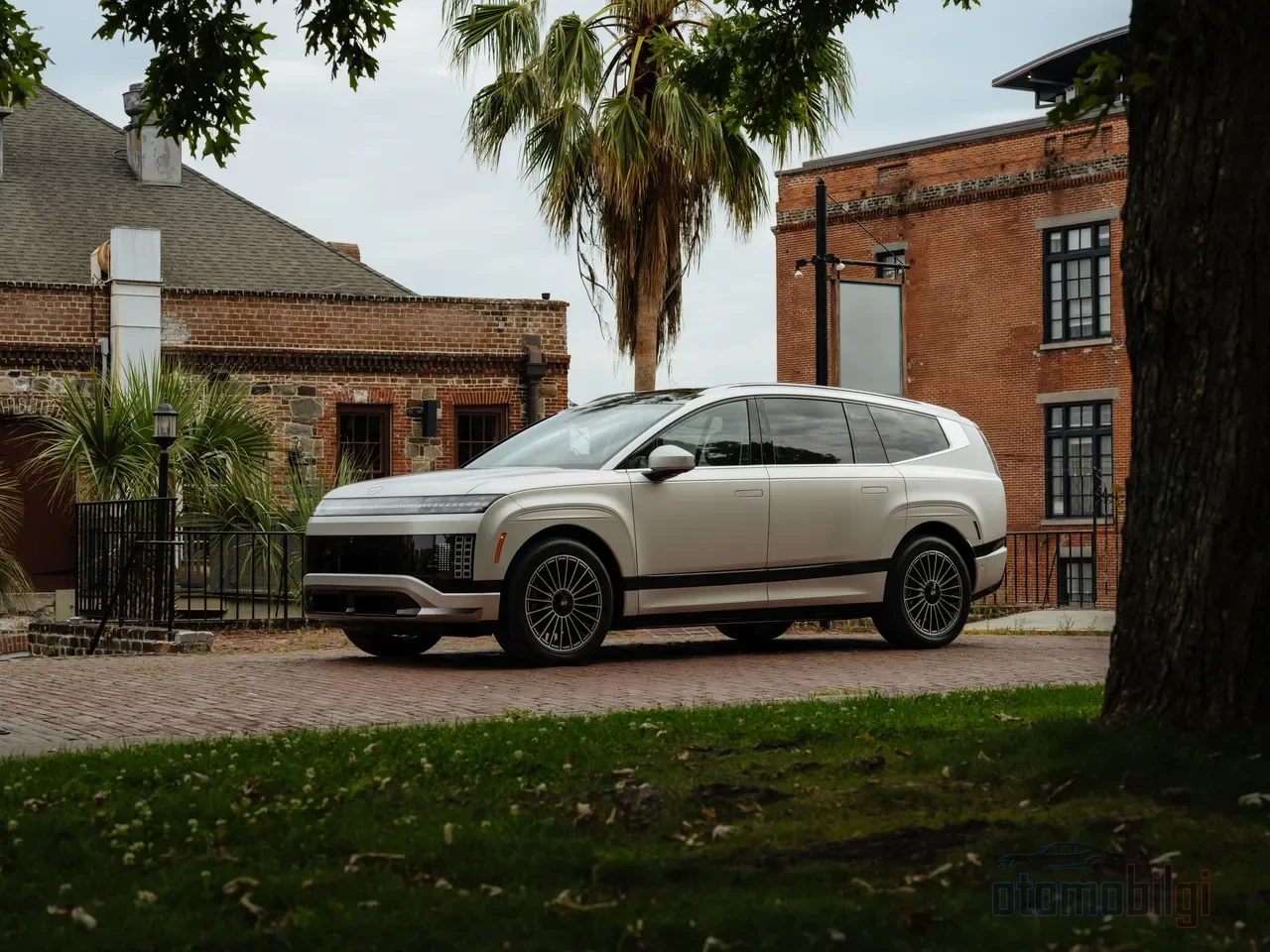
The IONIQ 9 entered the Turkish market in November 2025 and has been sold brand-new at dealers since that date. Hyundai Türkiye positions the model with the description "three rows of seats, up to 7 passengers" and also offers a 21-inch alloy wheel option. On paper, there are two trim levels: Progressive 160 kW front-wheel drive (4x2) and Calligraphy 226.1 kW all-wheel drive (4x4).
In terms of segment, what we are talking about here is a completely different category from the Ioniq 5 or Kona Electric in the classic C-SUV class: a large, family-oriented E-SUV. On Hyundai's own scale, the IONIQ 9 is similar in size to the gasoline seven-seat Palisade; that is, the brand's largest and most expensive vehicle on the electric side. Although mid-size E-SUVs such as the Tesla Model Y and VW ID.4 are plentiful in Türkiye, the three-row large E-SUV space is rather sparsely filled - and the IONIQ 9 naturally finds a place in this gap.
Range and battery: how far does 110.3 kWh take you?
The IONIQ 9 has a single battery option: 110.3 kWh lithium-ion. This is a significantly larger pack than the Ioniq 5's 84 kWh long-range battery - a sensible choice to compensate for the consumption brought by the weight and size. According to official European data, with 19-inch wheels the WLTP range goes up to 620 km . This figure drops depending on the chosen trim and wheel size: according to technical data from the Canadian market, the RWD version is listed with 539 km, AWD with 515 km, and the more well-equipped AWD+ with 500 km of range.
As a practical note: the 620 km figure is the laboratory cycle result of the most efficient configuration. For a vehicle with a mass of about 2.7 tons, it is normal to fall somewhat below this figure in the real world; the range loss becomes particularly pronounced in combinations of all-wheel drive and large wheels. Still, any configuration above 500 km represents a strong picture in this class in terms of long-distance capability.
Is charging really 24 minutes? Details of the 800-volt architecture
The IONIQ 9 uses the same 800-volt architecture as the Ioniq 5 uses it. The practical meaning is this: unlike rivals with 400 Volt systems, it can charge at high power for longer at high-power DC stations. According to Hyundai's official figure, 350 kW at an ultra-fast DC station, going from 10% to 80% takes about 24 minutes to achieve. Independent consumption data confirms the same order: charging from 49 km to 396 km takes 24 minutes.
However, an honest note from an engineer's perspective is needed: the phrase "24 minutes at a 350 kW station" refers to the maximum power the station can deliver; the vehicle's actual peak draw is somewhat lower. The official UK page states that the vehicle draws up to 233 kW at a 350 kW charger; user measurements also show the ceiling stays in the 235-244 kW band. This is still a class-leading value - you just shouldn't confuse the "350 kW" figure in the brochure with the vehicle's actual charging power. The system is also compatible with both 400V and 800V charging infrastructure and supports Autocharge.
Three-row interior: how practical is the 7-seat cabin?
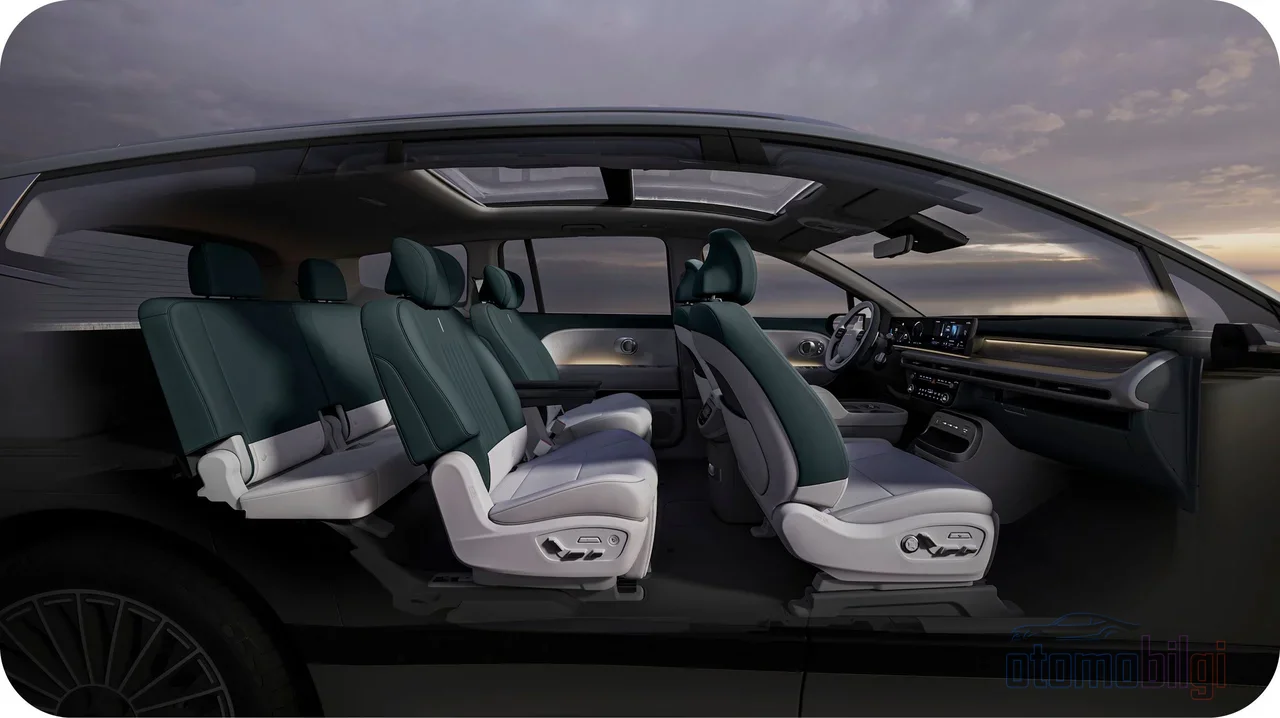
The IONIQ 9's main selling point is the cabin. Hyundai launches it with a claim of "best-in-class interior space," and the numbers support this claim: without folding the rear seats, 620 liters of luggage capacity is available; when all seats including the third row are folded, this value rises to 1,323 liters. Additionally, at the front there is an 88-liter front trunk (frunk); in all-wheel-drive versions this drops to 52 liters, because there is also a motor at the front.
On the technology side, at the center of the cabin is a multimedia system combined with a curved panoramic display featuring a 12-inch instrument cluster; the Türkiye market version specifies a 12.3-inch multimedia display and an active noise cancellation system. Among the eye-catching details are camera-based Digital Side Mirrors and a Digital Center Mirror - this system, which improves night vision, makes a tangible difference in managing the blind spots of a large SUV. Connectivity is also plentiful: across three rows there are a total of seven USB-C ports, and these can be fed directly from the high-voltage battery; the front row has a wireless charging pad and wireless Apple CarPlay / Android Auto to a degree that can be called standard.
On the software side, the ChatGPT-based Hyundai AI Assistant stands out: with the "Hey Hyundai" command, you can get voice assistant help finding charging stations and EV route planner with real-time charging station information (occupancy, connector type, arrival SOC estimate). Digital Key 2 premium and Bluelink connected services are also part of the package.
How does it differ from the Ioniq 5?
Both share the E-GMP platform and the 800 Volt architecture, but the target use case is completely different. The Ioniq 5 is a compact, two-row, efficiency-focused vehicle; designed for those seeking a reasonable balance of size and range in city and medium-distance use. The IONIQ 9 combines the same electric architecture with a large, three-row family cabin.
The difference in numbers is clear:
| Feature | Ioniq 5 | IONIQ 9 |
|---|---|---|
| Seating layout | 2 rows, 5 people | 3 rows, up to 7 people |
| Largest battery | 84 kWh | 110.3 kWh |
| Platform | E-GMP, 800V | E-GMP, 800V |
| Segment | Compact E-SUV | Full-size family E-SUV |
In short, IONIQ 9 owners should not see the IONIQ 9 as a "bigger Ioniq 5"; it is a separate product that answers a different lifestyle need. What is shared is the charging architecture and electric infrastructure; what differs is the size and mission of the vessel.
Where does the IONIQ 9 stand against the Kia EV9 and premium rivals?
Its most direct rival is undoubtedly the Kia EV9 - because both are products of the same E-GMP platform and of similar dimensions. The EV9 is about 5 cm shorter and somewhat narrower than the IONIQ 9; in return, it has slightly more ground clearance. The consistent finding of comparison tests is this: while the EV9 offers a more sporty character and better driving dynamics, the IONIQ 9 pulls ahead in range, cabin comfort, spaciousness and quietness. On the power side as well, the EV9's all-wheel-drive versions stay above the IONIQ 9 AWD on paper.
In Germany, the "Car of the Year 2026" jury answered "Yes" to the question of whether the IONIQ 9 can truly be considered premium compared to its German rivals. This is an important reference point, because a buyer looking for a large E-SUV in Türkiye will compare it with names such as the Kia EV9 as well as premium models like the BMW iX and Mercedes EQE - and the IONIQ 9 is one of the few vehicles that promises an experience close to the premium segment with a Hyundai price tag. The Tesla Model Y, on the other hand, answers a different problem: it is more compact, has two rows, and appeals to a different audience.
| Model | Positioning | Difference compared to the IONIQ 9 |
|---|---|---|
| Kia EV9 | Same platform, 3 rows | Sportier dynamics; the IONIQ 9 is more spacious and quieter |
| Tesla Model Y | Mid-size, 2 rows | More compact; no third row |
| BMW iX | Premium large E-SUV | Premium brand positioning, different price segment |
Conclusion: Who does the IONIQ 9 appeal to in Türkiye?
To summarize the IONIQ 9's identity in Türkiye in a single sentence: it is a full-size family E-SUV offering three rows, a range of up to 620 km and 800-volt charging speed in a single package, carrying a Hyundai price tag. Compared to the EV9 on the same platform, it stands out with comfort and spaciousness, and it differentiates itself from premium German rivals with its price/positioning balance. For the Turkish buyer looking for a seven-seat electric family vehicle, it is currently one of the few options - and one of the most advanced examples of the market in terms of charging infrastructure.
Sources
- IONIQ 9 | Highlights - Hyundai Türkiye
- IONIQ 9 | Features - Hyundai Türkiye
- IONIQ 9 | Highlights - Hyundai Europe
- IONIQ 9 | New Cars - Hyundai UK
- IONIQ 9 Overview - Hyundai USA
- 2026 Hyundai Ioniq 9 Review, Pricing, and Specs - Car and Driver
- Hyundai Ioniq 9 - Technical Specs, EV Search
- Hyundai IONIQ 9 Long Range AWD - EV Database
- Hyundai IONIQ 9 Long Range - Dolubatarya
- New Hyundai IONIQ 9 in Türkiye - DonanımHaber
- Kia EV9 vs Hyundai Ioniq 9 - InsideEVs
- EV9 vs IONIQ 9 Comparison Test - Motor Illustrated
- IONIQ 9 vs Kia EV9 - AutoGuide
- Kia EV9 vs Hyundai Ioniq 9 Size Comparison - A Girls Guide to Cars
- 2026 Hyundai Ioniq 9 Interior & Tech - Ontario Hyundai