Why is the 2026 Hyundai Kona Electric the Smart Choice for Türkiye?
Share This Page
The Hyundai Kona Electric is a B-segment electric SUV that continues to be sold new in Türkiye: with its 48.6 kWh battery and approximately 380 km WLTP range, it offers a measured but consistent package primarily for urban use. On this page, we examine the model's segment identity, its range and charging characteristics, its interior equipment, how it differs from the Ioniq 5, and its position against rivals, backed by data.
Highlights
- Version sold in Türkiye: 48.6 kWh battery, WLTP combined range of approximately 380 km
- Urban range goes up to 512 km, with combined consumption of 512 km 14.6 kWh/100 km
- DC fast charging 10-80% range: 41 minutes
- 12.3-inch digital instrument cluster + 12.3-inch touchscreen panel
- 5 years / unlimited km vehicle warranty, 8 years / 160,000 km battery warranty
Why Does B-Segment Identity Matter?
Most electric models on the market sit in the C segment or above; the B-segment electric SUV is a relatively less crowded field. In this field, the Kona Electric is a model with a long history for Hyundai: the electric version of the model that the manufacturer describes as the world's first mass-produced B-SUV, with its current generation, maintains its place on sales lists in Türkiye today. Its compact dimensions are not a shortcoming here, but part of the model's definition: parkability and everyday maneuverability are the segment's core product values.
Hyundai is offering the Kona Electric in Türkiye in the 2026 model year with at least two equipment options; the version arriving in the Turkish market has a 48.6 kWh battery and 135 PS of power. There is no need to look for a battery option below this; the larger battery above it is not standard in the official Turkish configuration and is the European market's long-range option.
Range: How Many Kilometers on Paper and in Reality?
To read the figures correctly, two distinctions need to be clarified. The first is battery capacity: the version sold in Türkiye has 48.6 kWh, while Europe's long-range version has 65.4 kWh. The second is the definition of range: the WLTP combined cycle gives the vehicle's consumption in mixed use through a standardized measurement; the urban cycle is the scenario where the efficiency advantage of electric vehicles is most pronounced.
In light of these two distinctions, the official figures are as follows: the 48.6 kWh version has a WLTP combined range of approximately 380 km (377 km per dealer data), urban range of 512 km, and combined consumption of 14.6 kWh/100 km. The 65.4 kWh long-range version goes up to 514 km in the WLTP cycle. The 0-100 km/h acceleration in the Turkish market version is 8.8 seconds; this is a description of sufficient and predictable driving rather than a performance-focused character.
In the real world, the main variables affecting the WLTP figure are temperature and speed profile. Independent consumption models project the actual range between cold weather and city conditions for the 48.6 kWh version in a band of 210-440 km. The reason for this width is not technological but physical: at low temperatures the battery's internal resistance increases, cabin heating is added to consumption, and range drops. User feedback stating that the range indicator works consistently shows that the vehicle's prediction algorithm is reliable.
| Specification | 48.6 kWh (Türkiye) | 65.4 kWh (long range, Europe) |
|---|---|---|
| WLTP combined range | ~380 km | up to 514 km |
| DC charging power | 74 kW | 101 kW |
| 10-80% charging time | 41 minutes | 41 minutes |
| Range added in 15 minutes of charging | 114 km | 162 km |
Charging Character: How Long Do You Wait on the Open Road?
The Kona Electric's charging curve is designed to ease long-distance scenarios: in both battery versions, reaching 80% from 10% takes 41 minutes. The difference emerges in DC charging power and the range gained in that time; the 48.6 kWh version with 74 kW adds 114 km in 15 minutes, while the 65.4 kWh version with 101 kW adds 162 km in 15 minutes.
A critical engineering detail is the behavior after 80%: as with every lithium-ion pack, charging power drops significantly in the final portion of the battery's charge. The region up to 80% is where the cell chemistry's voltage curve is accepted most quickly; therefore, waiting above 80% in route planning is practically inefficient. In daily use, slow charging from home or a standard Type 2 CCS socket should be the norm; considering that a full charge from a 10-amp regular outlet will take about a day, this figure is of no practical importance for a user with a wall charging unit.
Interior and Technology Equipment
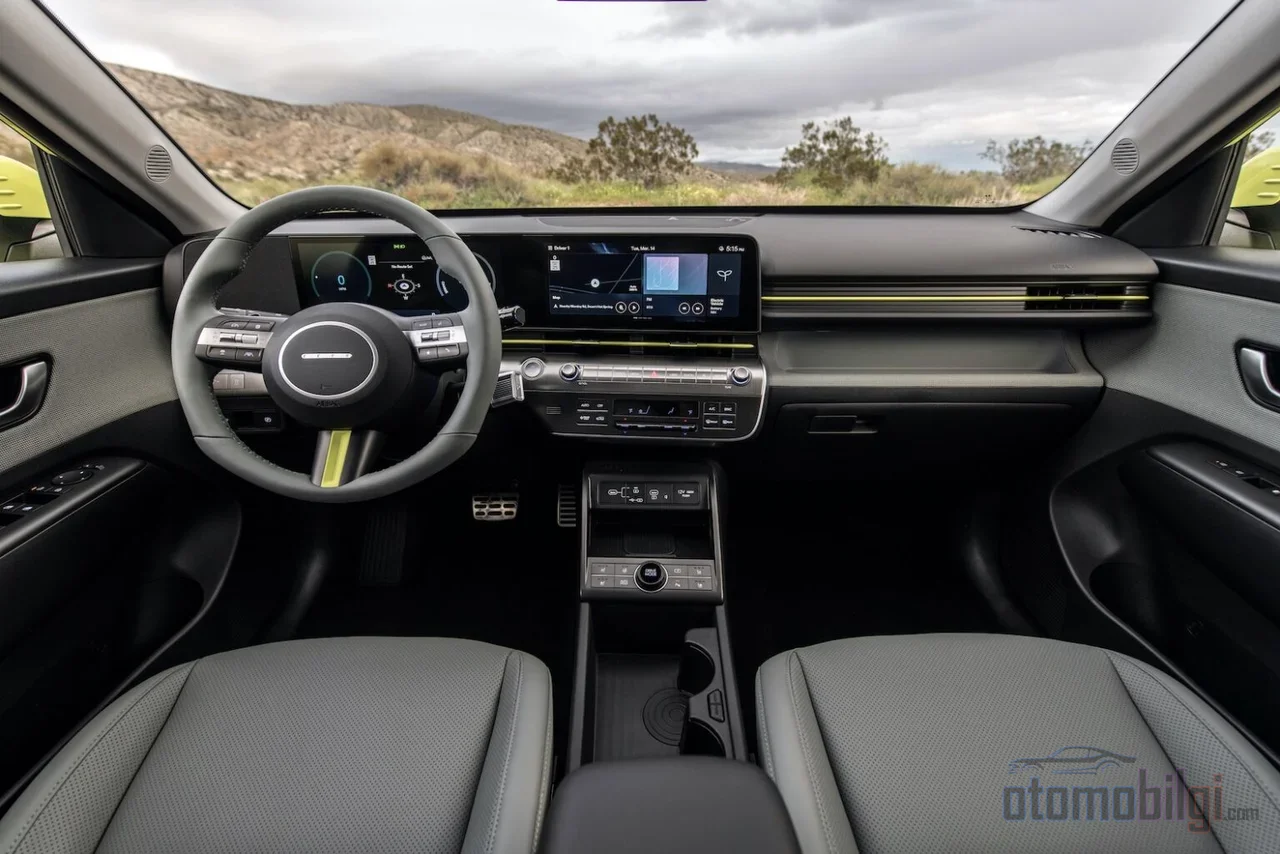
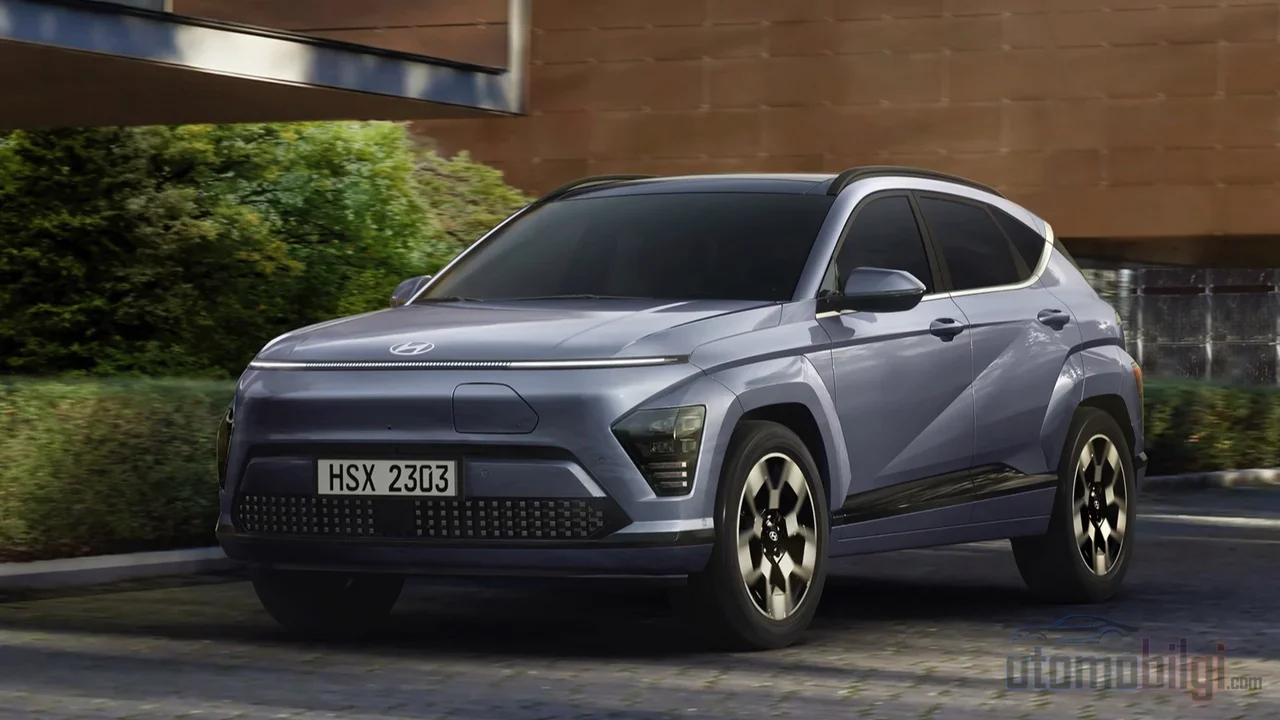
The new-generation Kona is based on an EV-origin universal architecture, and this is directly reflected in the cabin: a more spacious living area and a driver-focused layout. At the center of the visual signature is a panoramic curved dashboard; the 12.3-inch touchscreen infotainment display and the 12.3-inch digital gauge combine in a single panel. At the front, the Pixel Seamless Horizontal Headlamp design language stretching along the hood is the model's most distinctive exterior detail.
The equipment list includes current technologies such as wireless Apple CarPlay, a 360-degree camera, phone-as-key feature, and driver attention monitoring. Interior craftsmanship and technology density are also cited as the model's strengths in European press reviews. Offering a screen and driver assistance package at this level is the hardest part of striking a price balance in the B segment; it can be said that the Kona makes an ambitious choice here.
Why Is It a Different Vehicle from the Ioniq 5?
Two models in Hyundai's electric lineup share different roles. The Ioniq 5 is larger, has more interior volume, and especially 800 volts a C-segment crossover offering much higher DC charging speeds thanks to its architecture; a vehicle better suited for intensive long-distance users who require sustained fast charging. The Kona Electric, on the other hand, is a more compact, more efficient and more accessible implementation of the same technology family. In user comparisons, observations that the Kona runs with lower energy costs on the same budget confirm the efficiency gains of the small battery and lightweight body.
Practical result: for a user with city-weighted usage and home charging, the Kona's 48.6 kWh pack is a sufficient and economical solution; for someone who frequently uses the vehicle between fast-charging stations, the Ioniq 5's charging architecture is a concrete advantage. The two vehicles are two differently scaled implementations of the same brand's same philosophy, not alternatives to each other.
Kona Electric's Position Against Its Rivals
In Türkiye, the main rivals of the Kona Electric in the B/compact electric SUV class are the Kia EV3 and the Renault Megane E-Tech. In direct comparisons, the Kona moves ahead with an approximately 70 km WLTP range advantage over the EV3 on paper; however, in city usage, consumption characteristics narrow this gap. On the Megane E-Tech side, the 60 kWh battery, 218 HP version is the natural counterpart of the comparison; all three models are mentioned side by side in the same class evaluations.
We can summarize the positioning as follows: the Kona Electric is an option that offers measurable advantages in its class with its range-consumption balance and warranty package, relying on consistency rather than showmanship. Hyundai's 5-year/unlimited km vehicle and 8-year/160,000 km high-voltage battery warranty is a concrete difference that reduces, in the long term, the risk of the battery, which is the longest-running cost item in an electric vehicle. The brand's smaller end is now filled by the INSTER; the Kona continues to hold the middle ground of this game.
Is It Worth Buying in Türkiye? Evaluation
The Kona Electric, currently on sale in the Turkish market with the 2026 model year, is a logical choice for this profile: a user who drives limited kilometers per day, has charging access at home or at work, or prefers city/inner-city road usage over long highway trips. The 512 km city range, combined with the compact body's parking and maneuvering advantages, is the figure that best supports the model's identity. Usage weighted toward long highways, on the other hand, requires a more planned experience due to the dropping charging power after 80%; this is not a weakness of the model, but the common character of every vehicle with a compact battery in the 400-volt class.
Clear conclusion: the Kona Electric is a balanced, predictable package for users seeking a B-segment electric SUV in Türkiye, with its range, charging time, equipment and warranty. For someone who centers city usage, it continues to be one of the most rational options in its class.
Sources
- KONA Electric | Highlights – Hyundai Türkiye
- KONA Electric | Performance – Hyundai Türkiye
- KONA Electric | Performance – Hyundai Motor Europe
- The KONA Electric – Hyundai Ireland
- HYUNDAI Kona EV – Technical Specifications (dealer)
- Hyundai Kona Electric 65 kWh (MY24-25) – EV Database
- Hyundai Kona Electric (Standard Range) – JET Charge
- Hyundai Kona Electric versus Kia EV3 – Highmotor
- KONA Electric Electric 48.6 kWh 135 PS Advance – arabakarsilastirma.com.tr
- Hyundai Kona Electric Review – Auto Express