Rain Setup: Track Width and Weight Distribution
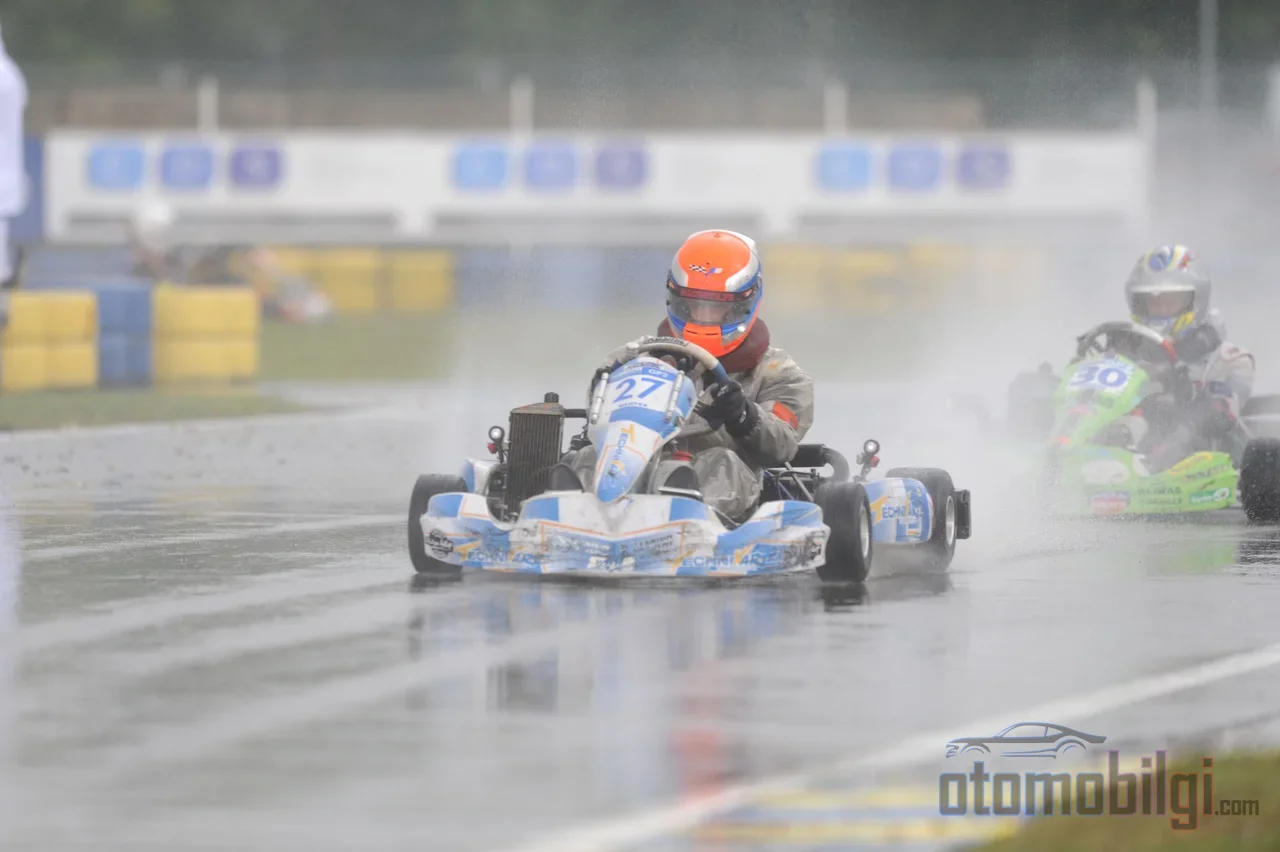
The rain suddenly hit, it's your turn... and there are two sets of tires waiting at the pit wall: one as smooth as if it were polished, the other scored with channels like a raked surface. Which one will you fit, and when? The question of when to fit wet tires in karting sounds easy, but it is a puzzle whose answer changes with every meter of the track. Because a wet track is never a fixed thing: a stretch that was like a lake a minute ago can dry out within minutes once the sun comes out. And here's the catch - fitting the wrong tire at the wrong moment can make a difference of more than 10 seconds in lap time. Yes, 10 seconds. With a gap like that, you forget who is even leading.
On this page we will start from the fundamentals: the structural difference between a wet tire and a slick, the matter of temperature and pressure, then the moment of decision - what to do as the track gets wet and as it dries - and finally the CIK/FIA rules along with chassis and engine setups in the rain. If you're ready, put on your rain gear and let's begin.
What Is the Difference Between a Wet Tire and a Slick?
First, a simple analogy: a slick tire, like a table tennis paddle, wants maximum contact with a flat and smooth surface. A wet tire, on the other hand, is more like a kitchen grater - the channels on it drain the water away, allowing the tire to truly touch the asphalt. Without channels, the tire skates on top of the water; we call this aquaplaning, and it is the last thing you want in karting.
The second big difference is the compound. Wet tires slick... sorry, they have a softer compound. Why? Because on a wet surface the tire does not heat up as much as it does on a dry track; a soft compound comes alive at low temperatures and provides grip in the cold and in the wet. A hard tire, however, needs time to warm up - in cold rain you don't have that luxury. Of course, softness has its price: it wears out faster, especially once the track starts to dry.
The third difference is the tire's own unique working window. Just like slicks, wet tires also work optimally within a certain temperature and pressure range. But in the wet it takes longer to reach that window - a stationary kart cools down quickly, so weaving left and right on the warm-up laps, making short but hard braking maneuvers, and using a dry line on the track if there is one, all help.
Full Wet or Intermediate?
Wet tires are not all the same. The full wet tire is designed for heavy rain and standing water on the track; the intermediate, on the other hand, is for a damp or drying track. The choice is made not by rule of thumb but according to the actual amount of water on the track. If there is little water, intermediate; if there are lakes, full wet. Being caught in between is the worst option - you lose the advantage of both tires.
For a Tire to Officially Count as a Wet Tire
The FIA/CIK technical regulations draw a clear line: for a tire to count as a wet tire, it must have at least 2 mm of tread depth at every point along the center line. So simply cutting a channel into the tire is not enough; a measurable pattern that meets the standards is required.
Highlights
- According to FIA/CIK, a minimum tread depth of 2 mm at the center line is required for rain tires.
- In a final declared wet, a brand-new set of rain tires is mandatory - June 2026 FIA decision.
- Reference cold pressures: For the Mojo W5, 1.00 ±0.10 bar; for the CW, 0.85 ±0.15 bar.
- In the wet, raise the kart, widen the front track, and narrow the rear track by 10-15 mm per side.
- In the wet, the wrong tire can make a difference of more than 10 seconds in lap time.
How Is Pressure and Warm-Up Managed on Rain Tires?
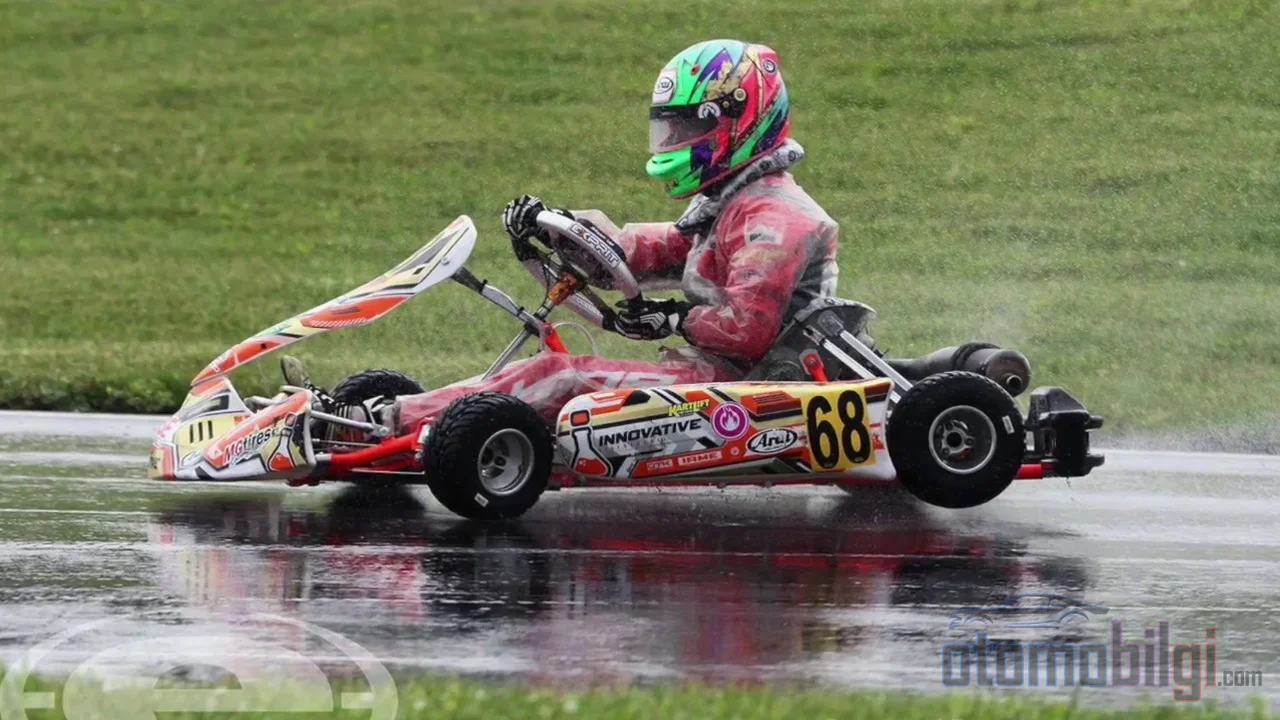
Just like on dry ground, there is no universal correct pressure in the rain; the value changes depending on the tire, the track, and the amount of water on the track. But you need to know the reference points. For the Mojo W5, a common tire in cold measurement, 1.00 ±0.10 bar in the Rotax Junior, Senior and DD2 categories; for the CW used in Micro and Mini, a starting point of around 0.85 ±0.15 bar is reasonable.
Pay attention here: on a very wet track, some teams use values above 1.5 bar on tires like LeCont and Vega, even reaching up to 3 bar. The logic is this - high pressure quickly brings the tire up to operating temperature and helps water dispersal. On the other hand, there is also an approach that argues for lowering only 0.1-0.2 bar from the dry setup. Although it seems contradictory, it is not: which one works depends on how wet the track is and how quickly the tire warms up. In conclusion: the team that plays with a thermometer and pressure gauge in the pit wins; those who play with guesses are left behind.
Driving on a Wet Track: Why Should You Leave the Line?
That polished ideal line everyone chases on a dry track betrays you in the rain. Because when the rubber accumulated along the line combines with water, it becomes as slippery as soap. Grip is hidden in the rough, open asphalt off the line. That's why in the wet you need wide entries, late apexes, and crossing the dry line as perpendicular and short as possible. In other words, forget half of the line knowledge you learned on dry ground - relearn the rest.
Braking speaks a completely different language too: earlier, gradual, and without locking the wheels. The kart brakes from the rear axle, and in the wet the rear axle is very prone to locking; the locked wheel keeps going straight on top of the water, just when you want to turn. Every input should be smooth: smooth steering, gradual throttle, patience. Painted kerbs, shiny areas, expansion joints, and concrete patches turn into ice rinks in the wet - keep them in mind like a map.
One more little tactic: getting into the spray of the driver ahead wipes out your vision. Often, staying in your own clean line is faster than following.
The Moment of Decision: What to Do When the Track Is Getting Wet and Drying?
Now let's get to the heart of the matter. If the track tends to get wet, the decision is simple: in rental-recreational karting, the practical rule is to switch to rain or intermediate tires as soon as the track gets wet. In racing karts, the logic points the same way - slicks are both slow and dangerous in the wet.
The really hard decision comes in the opposite direction: when the track is drying. Here are a few facts:
- The general tendency is to switch to intermediates as soon as conditions allow; the drying track is its domain.
- A driver using slicks on a mixed track (part dry, part wet) flies on the dry sections but takes risks on the wet ones. Strategy is built on weather forecasts and track analysis; it is not gambling.
- Rain tires used on a drying track round off at their edges; once the sharp edges between the grooves disappear, the tire seriously loses performance. In karting parlance, the tire dies.
So when should you switch? The best indicator is lap times: if they keep dropping between sessions, the track is coming toward you, and it is time to start moving toward dry setup. Another setup tip that is worth its weight in gold: on a drying track, keep the rear track narrow from the dry setup, and leave the weight distribution 1-2 points forward until the track is consistently dry everywhere.
CIK/FIA Wet Race Rules: Fitting the Tire Is Not Enough, Permission Is Required Too
Here is the point most beginners overlook: you do not always get to decide whether you can fit rain tires. If the race director or Clerk of the Course has not declared the session wet, using rain tires is outright prohibited - yes, even if it is raining. Conversely, warming up rain tires in a dry session is also forbidden. Running on the wrong tire can end with the black flag.
The other basic rules are as follows:
- Fitting slicks and rain tires together on the same kart is prohibited under all circumstances - no mixed sets.
- In some series, rain tires become mandatory once a Final is declared a wet race, while in some classes everyone runs on slicks even in the rain; always check your class regulations.
- Rain tires must be wet-weather tires produced for that purpose; cutting grooves into dry tires afterwards is prohibited.
- In some series, the rain tire quota is limited to 2 sets (4 front, 4 rear).
And a recent development: According to the new regulation approved by the World Motor Sport Council in June 2026, FIA Karting requires that when a Final is declared a wet race, all drivers in the final must start on a brand-new set of rain tires. The strategy of running a wet final on used tires is thus off the table.
How Do Chassis and Engine Setup Change in the Rain?
The tire is right, the rules are set - now comes adapting the kart to the wet. The general direction is this: when grip decreases, the kart needs to be loosened up accordingly. The adjustments to apply:
- Raise the kart: a high center of gravity loads the outer tire more, increasing cornering grip. But do not overdo it - excess creates instability under braking.
- Widen the front track, narrow the rear track: experienced drivers narrow the rear track by 10-15 mm per side.
- Increase the caster: it helps turn-in grip.
- Shift the weight 1-2 points ahead of the dry baseline (for example, from 43% front to 44-45%); move the seat 10-20 mm forward or add front weight. Keep the left/right balance close to 50/50.
- Switch to a softer, thinner, or hollow rear axle; remove the rear stabilizer reinforcements.
Let us note: some champions recommend keeping the front-rear balance at 50/50 in the wet, and flipping the ratio to send more force rearward on very slippery surfaces. So there is no single sacred setup - two different philosophies, two different gates of speed, depending on how greasy the track is.
On the engine side things are more practical: the air filter and usually part of the radiator are taped over to prevent water ingestion, and the engine is kept warm. On geared karts, going up 3 teeth or more at the rear when switching to rain tires is reasonable; this compensates for the engine whose revs drop on long straights due to the rolling resistance of the rain tire.
In Short, the Answer: When Do You Fit Rain Tires on a Kart?
Let's sum it up, because you won't have time to think in the pit: when the track starts getting wet and the technical declaration declares the session wet rain tires go on; full wets in heavy standing water, intermediates on a damp-drying track, and once the track starts drying and lap times begin to drop, you switch back to slicks. Stubbornly fighting the wet on slicks is the recipe for 10-second lap losses and unnecessary risks.
Rain is the great equalizer in karting, resetting everyone to the same line. The driver who fits the right tire at the right moment and re-tunes the kart for the wet gains as much - sometimes even more - than on a dry track. Next time there's a rainy race day, don't hesitate at the pit wall; you already know the answer.
Sources
- FIA Karting: New tyre regulations approved by the World Motor Sport Council
- Appendix 70.2 - Kart General Technical Regulations
- FIA Karting Technical Regulations 2023
- RFEDA Sporting Regulations 2024
- IWF 2023 Sporting Regulations
- Driving a Kart in the Wet: Lines, Tyres and Grip Management
- Wet Kart Setup: Weight, Ballast and CG for Rain Racing
- Karting in the rain: tips & tricks
- Champions of the Future 2023 Sporting Regulations
- How the kart's set-up changes in rainy or sunny conditions