How to Maintain Chains and Bearings in Karting?
You brake hard into the last corner and catch the apex, everything on your kart running like clockwork... but is it really that way? Many karters spend hours on setup, gear ratios, and tire choice, yet never find time for that 5-minute chain check. Yet the chain, one of the cheapest and simplest parts on the track, can burn both horsepower and your nerves when poorly maintained. In this guide, we will cover the three core maintenance areas of a kart chassis - chain, bearings, and brake system - step by step, without ever touching the engine. If you're ready, let's head to the garage.
How to Adjust Chain Tension?
The backbone of chain maintenance is the tension adjustment, and it's done with a surprisingly simple measurement: press down with your finger at the midpoint between the sprocket and pinion and check the vertical play of the chain. The correct value is about 5-10 mm. If it's within this range, relax; if not, it's time to adjust.
When adjusting, you usually loosen the mounts under the engine and slide the engine to tighten or loosen the chain. There's a critical distinction here: tension and alignment are not the same thing. Tension refers to the play in the chain, while alignment describes the position of the rear sprocket relative to the engine sprocket. Correct tension never compensates for incorrect alignment. You should check alignment especially whenever you change the sprocket or engine; teeth wearing on only one side is almost always a sign of misalignment. Even a slight misalignment wears out the chain and sprocket twice as fast. Laser-based alignment tools make this job easier, but the ultimate reference is always the kart manufacturer's instructions and the specified torque values.
Highlights
- The correct vertical play in the chain is 5-10 mm at the midpoint between sprocket and pinion.
- The chain should be lubricated after every track session, while it's still warm.
- Brake pads must be replaced when their thickness drops to 2-3 mm.
- Regular brake maintenance should be done at least once a month.
- Racing chains operate with up to 98% efficiency; ordinary chains are about 95% efficient.
Too Tight or Too Loose?
Both extremes are bad, but in different ways. An overtightened chain loads the bearings and shafts, heats up, and steals power from the engine on the way to the road. Excessive tension damages the clutch and causes horsepower loss. A too-loose chain whips around and wears down the sprocket teeth; on its worst day, it skips or jumps off the track entirely. So don't stretch it like a violin string, but don't leave it swinging like a swing either.
There's a small detail when a new chain is installed: standard chains settle during the first few sessions, meaning you need to recheck the play after a few laps. Pre-stretched factory chains, on the other hand, stay as adjusted. For those who want precise tension, there are practical adjustment tools that take up all the chain's slack and lock it to the correct value.
How to Lubricate the Chain and When to Replace It?
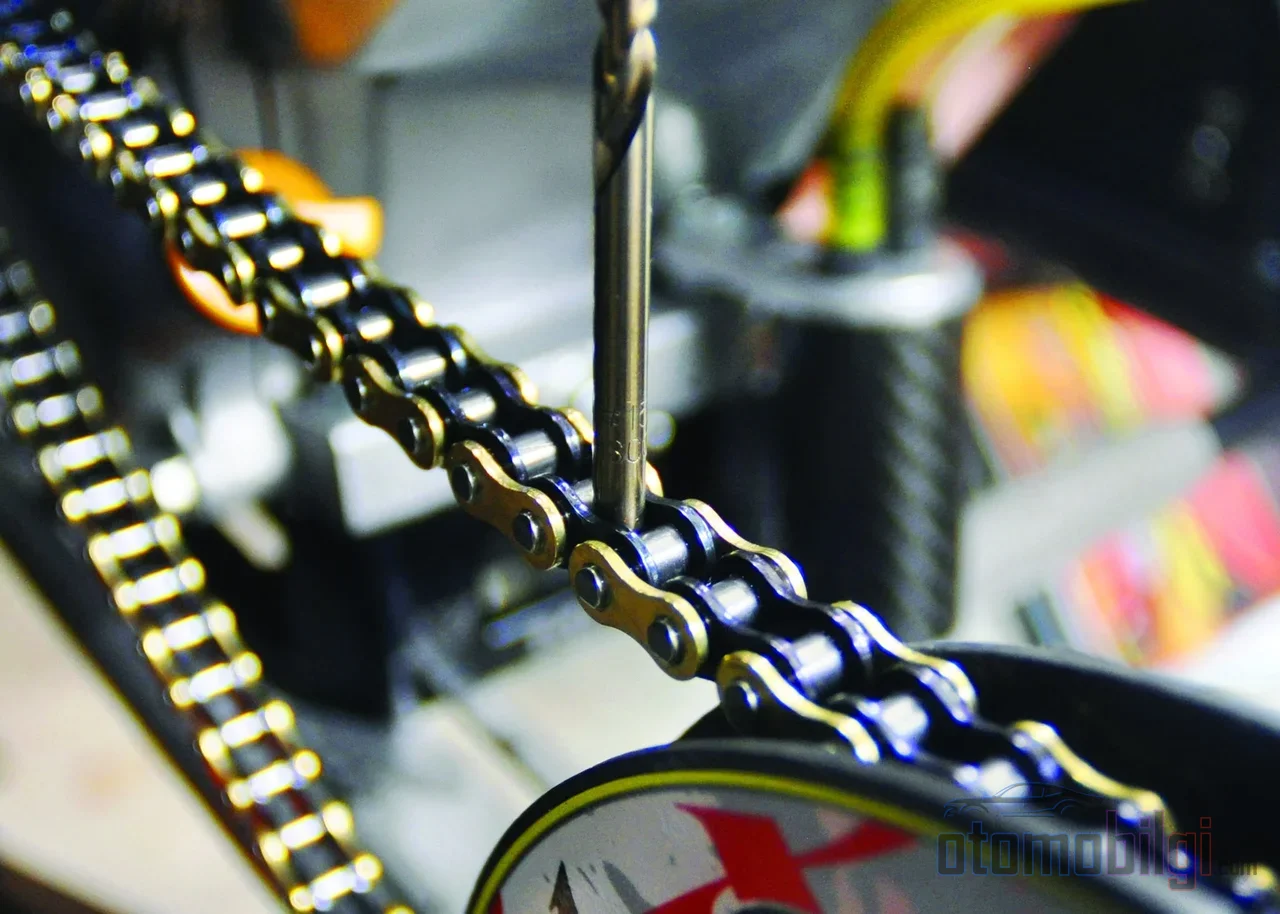
In karting, the rule is clear: the chain is lubricated at every track session, and the best moment is right after the session, while the chain is still warm. Hot metal allows the lubricant to penetrate much better between the rollers and rings. Rotate the axle by hand and apply chain spray to the inner side of the chain. The golden rule: never lubricate the engine while it is running. Spraying oil onto a dirty chain is also forbidden; oil on dirt turns the lubricant into an abrasive paste. First clean with degreaser and a stiff-bristled brush, then dry, then spray.
Chain elongation is not stretching like a tire; it is the wear of the contact surfaces between the pin and bushing, and its only cure is regular lubrication. The old-school way to diagnose uneven elongation is this: turn the rear wheel by hand; if the lower run sags once per full revolution, it reveals the elongated section. When the chain is turned by hand, it is healthy if it runs freely and has no binding section.
219 or 428? Chain Types
Direct-gearbox karts (such as Rotax MAX, Junior, Mini) use 219 pitch chain; lengths are generally between 98 and 120 links. Karts with KZ gearboxes, on the other hand, use 428 pitch chain, and a 428 chain can be shortened or lengthened by opening the connecting links and adding or removing an even number of links. A note: In the Rotax DD2 there is no chain at all, because the gearbox passes directly through the axle from the engine case.
A standard, that is, O-ring-less racing chain offers maximum fluidity and power transfer but requires frequent lubrication. An O-ring chain traps oil inside the pin and bushing, lasts noticeably longer and gets by with little maintenance; in return it produces slightly more friction. Manufacturers claim up to 98% efficiency for racing chains; on ordinary chains this figure is around 95%. A three-point difference means roughly 1 horsepower in a kart engine. The answer to the question of performance versus longevity depends entirely on usage intensity: if you are at the track every weekday one chain makes sense, and if you go out one day a month another does.
There are quite a few brands worth mentioning on the market: DID is the reference in direct gearboxes, RK is known for its pre-stretched chains from the factory, Regina stands out with its 428 series in KZ, CZ offers a hardened pin surface, and Panther claims long life in the O-ring-less class. Prices can double in the top segment, but this picture needs to be read on an hourly basis: a quality chain both lives longer and wears the sprocket less, which in the end is cheaper for frequent users. Serious kart sprockets are made of 7075-T6 Ergal; the pinion, since it bears more load, should be made of high-strength hardened steel.
How Are Front and Rear Bearings Cleaned and Greased?
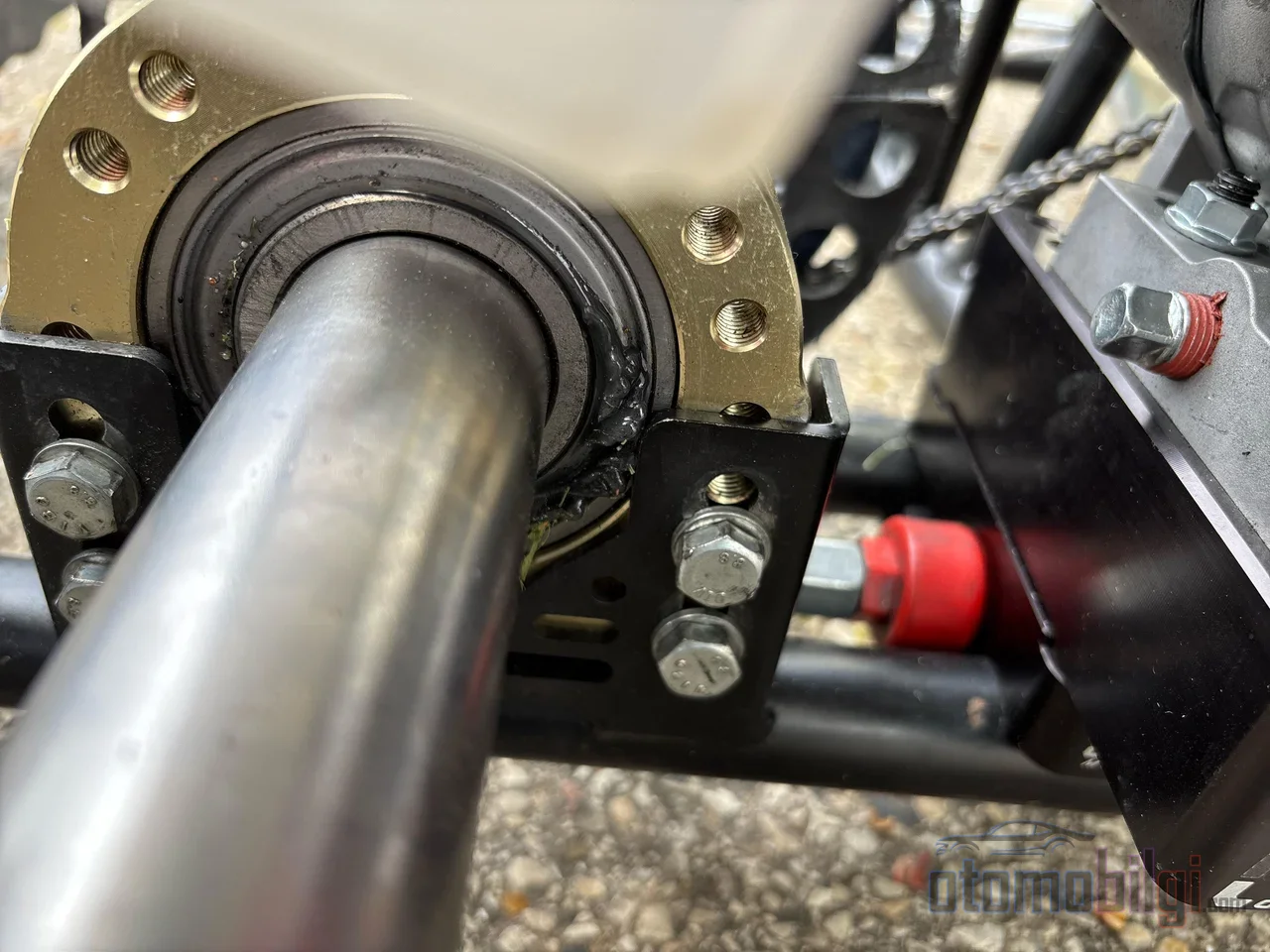
Bearings are the least noticeable but most constantly spinning parts of the kart, and their maintenance is often neglected. The basic method is simple: apply lubricant with a grease gun and continue until fresh grease appears around the seals. In paddock practice, a bearing cap is sometimes punctured and solvent is injected inside for cleaning, then gear oil is pumped in; some prefer quick cleaning by puncturing the metal shields between races. When reinstalling the tire covers, make sure the bead side faces outward.
Ceramic bearings require special treatment: they should be cleaned with mineral thinner, rinsed with diluted alcohol, and ceramic bearing oil should be used. Oils that leave a film on ceramics are not recommended, because the film layer disrupts the ceramic's operating characteristics. Special packing tools make the job considerably easier when greasing axle bearings; it is hard to find content explaining the greasing side instead of replacement, but once you learn it, it pays off for a lifetime.
Brake System Maintenance: Disc, Pad, Hose
The brakes are the entirety of the kart's safety system; here you work with measurements, not guesses. The golden rule is this: the pads are replaced when their thickness drops to 2-3 mm. Do not wait for the metal to contact the disc, because when that moment comes the disc is ruined, and a disc costs far more than pads. A visual inspection alongside the caliper should be one of the fixed steps of your pre-race routine.
Regular brake maintenance should be done at least once a month and the system should be bled; brake fluid darkens and degrades over time. For a metallic pad and steel rotor to work correctly, friction material transfer from the pad must exist on the rotor surface, meaning the pair gets accustomed to each other. Pad replacement is a frequent task, and not neglecting cleanliness when removing them determines the quality of the job. Adjusting the gap between pad and rotor, on the other hand, is a fine-tuning matter that varies by caliper brand; here too, trusting the manufacturer's documentation is the safest bet. One general principle: pads are replaced roughly twice as often as rotors, but the most efficient result comes from replacing them as a set.
Watch Out for Oil Splatter
If some chain and bearing oils get onto the brake disc or clutch drum, they can cause serious problems. That is why you should do the lubrication work far from the brake side, carefully and with control; if you spray it everywhere instead of onto the chain, you are entitled to suspect the braking in the next corner.
How Often Should Maintenance Be Done? Season Traffic and Weather Conditions
Here is the most frequently asked question and its most honest answer: there is no universal service interval; your maintenance schedule is shaped by how much the kart runs. A weekend karter doing 8-12 track days a year with 20-minute sessions cannot have the same schedule as a racer who trains every week. A kart running on dirty, dusty, or wet tracks demands every task more frequently than a kart lapping in clean weather. This is also why rental fleet operators keep records per kart and separate hour-based servicing with daily checks.
To establish a practical framework: chain lubrication is the job of every session's end; tension checks are done at the start of every track day; brake checks are done once a month, and pad measurements are repeated before every race. Plan bearing greasing for the start of the season and periods of intensive use. At the end of the season, check the pads and replace them if necessary, scan the chassis for cracks and damage, and put the kart away for winter clean and well-maintained. Weather conditions also take priority over the schedule: after rain, all cleaning procedures on a wet and muddy track are moved up a notch.
Short Answer: Summary of Chain, Bearing and Brake Maintenance
Let's wrap up: the chain should have 5-10 mm of vertical play in the middle of the sprocket-pinion, should be lubricated while warm at the end of every session, and its alignment should be checked whenever sprockets are replaced. Bearings should be greased until fresh grease appears, while ceramics should be cleaned with their own dedicated products. Brake pads should be replaced once they wear down to 2-3 mm, and the brake system should be serviced at least once a month. Although these three items do not deliver results as fast as an engine tune, they reflect on every one of your sessions; both on your wallet and on your lap times. Set aside half an hour in the garage before your next track day and see the difference for yourself.
Sources
- Kart Chain: Tension, Lubrication and Replacement
- Adjusting a kart chain - tension, alignment and lubrication
- How to Set the Tension of your Kart's Chain
- Go Kart Chain Care and Adjustments
- Kart Brake Pads: Check, Replace and Bleed
- Kart Maintenance: Brakes, Tyres and Checks
- How to Lube a #219 or #35 Kart Chain Before Race Day
- Kart maintenance schedule
- How To Clean and Change Your Go Kart Chain