How Does a Two-Stroke Kart Engine Work?
Share This Page
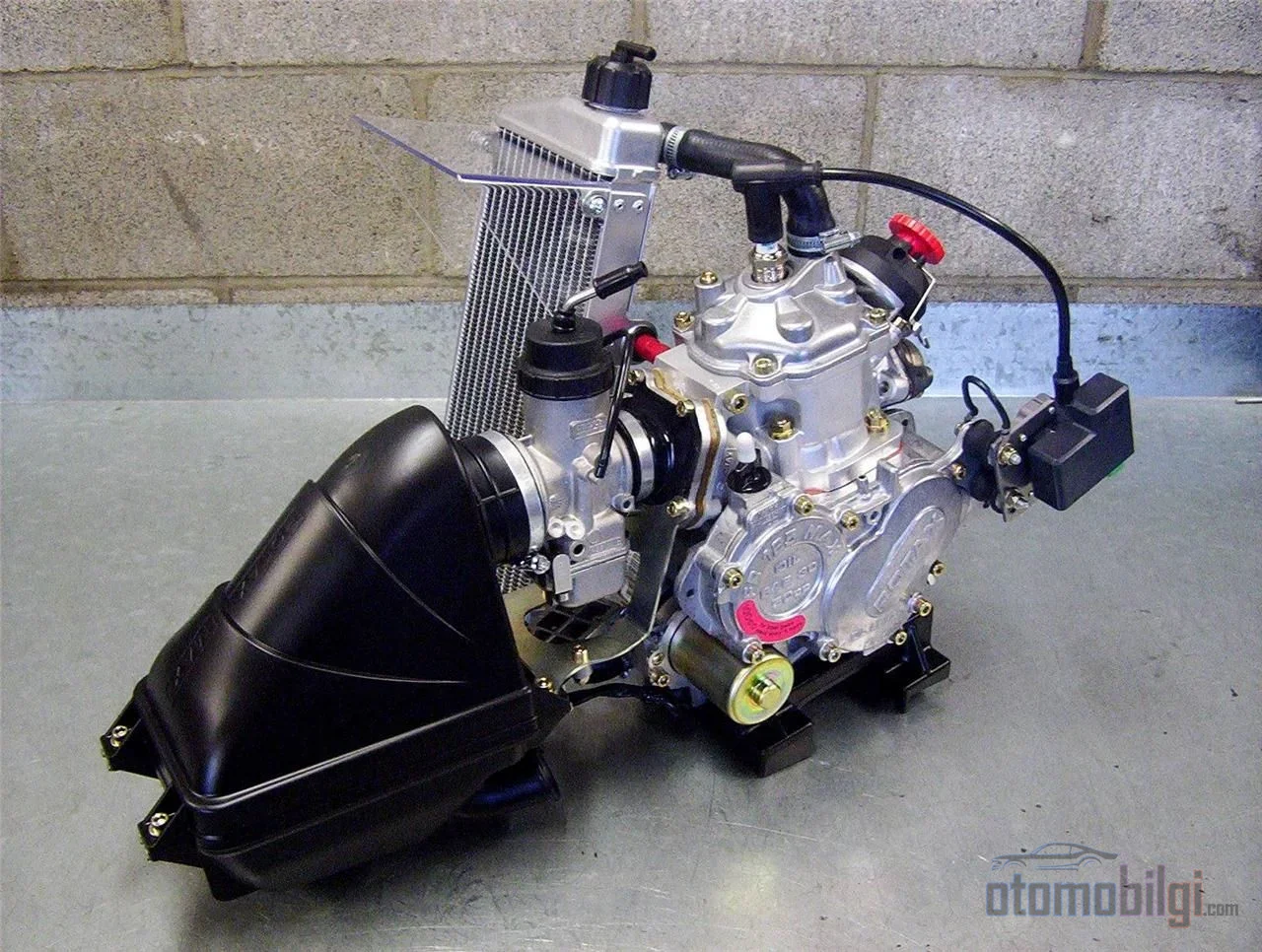
A two-stroke kart engine is an engine that completes the power cycle with a single up-and-down movement of the piston, i.e. in just one revolution of the crankshaft It has no valve system; it manages the intake, compression, combustion and exhaust processes through ports that the piston opens and closes with its own movement. This simplicity is the secret of the high power/weight ratio that made it karting's favorite, and that famous sharp buzz. So how exactly does this little monster work? Let's dive in!
Highlights
- A two-stroke engine fires once per crankshaft revolution; a four-stroke fires once every two.
- They have no valves; that's why they are lighter, simpler and cheaper.
- Lubrication is done by mixing oil with gasoline; oily ratios like 16:1 are common in racing karts.
- High-performance racing engines require a rebuild every 20-40 hours.
- The main difference between Rotax Junior and Senior is the power valve found in the Senior.
Everything in One Stroke: The Working Principle of the Two-Stroke Engine
Think of a four-stroke car; the engine waits for four separate strokes and two crankshaft revolutions to produce power. In a two-stroke, there is no such luxury - the piston goes down, comes up, and the work is done in between. At the top, compression and ignition take place, while at the bottom the intake process happens at the same time. As the piston rises, a fresh fuel-air mixture is drawn into the crankcase; as the piston descends, this mixture is compressed there and pushed into the cylinder through the transfer port.
In its most polished form, this is called loop scavenging : the moment the exhaust opens, the fresh mixture coming in sweeps the burnt gases out of the cylinder. This method is based on a principle developed in the 1920s and is still the standard solution in modern two-stroke engines today. No surprise; we haven't managed to do better in about a hundred years!
Crankcase Compression and Reed Valve
Most kart engines are of the crankcase compression type; that is, the fuel mixture is first drawn in beneath the piston and compressed there. On the intake side, there is usually a lamellar reed valve (reed valve) - thin lamellae open only at the right moment, preventing the mixture from escaping back. This is a clever detail that increases both power and efficiency at the same time.
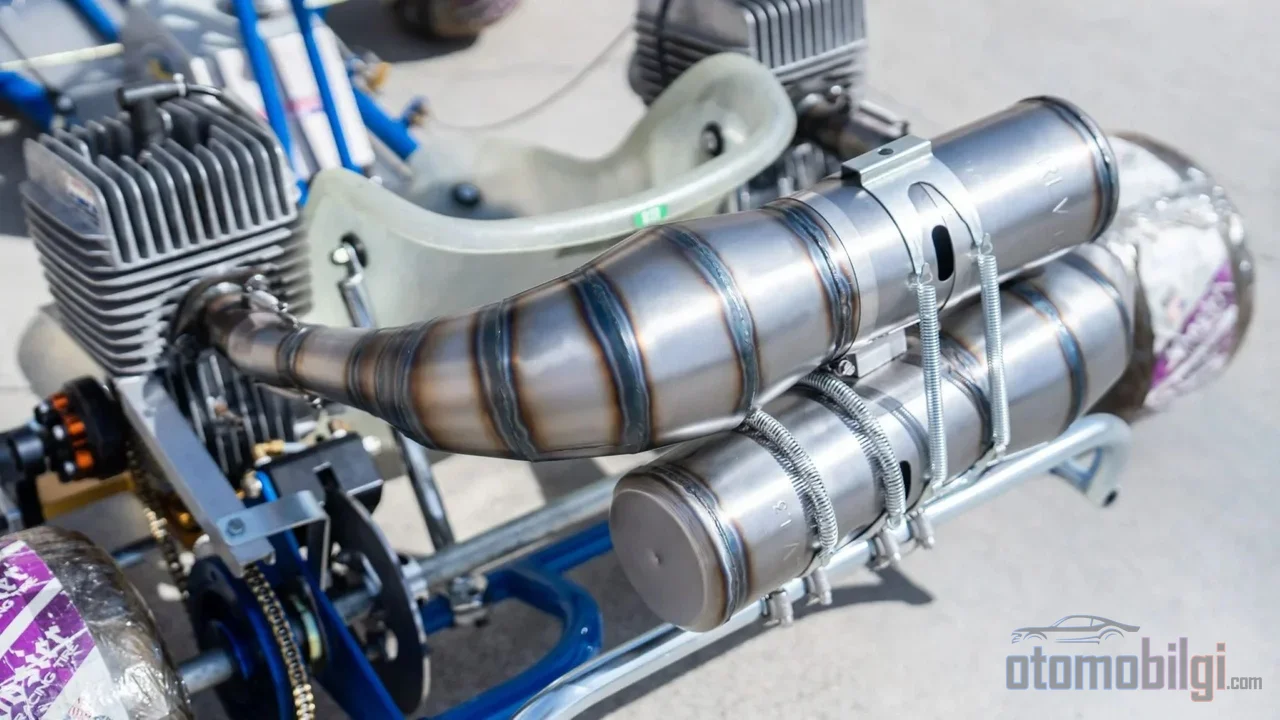
Then there's the exhaust side, which is exactly the part most beginners skip. A two-stroke exhaust is not an ordinary pipe, it is effectively a part of the engine: the shock wave leaving the exhaust reflects back from the end of the pipe and pushes the fresh mixture, about to escape, back into the cylinder. Expansion chamber exhausts increase power precisely because of this. Choose your exhaust wrong and the engine's lungs collapse - I'm serious!
Why Is the Gasoline-Oil Mixture So Critical?
There is no separate oil tank inside a two-stroke engine; lubrication is provided by the oil mixed into the gasoline, and that oil burns away. This is called a total-loss lubrication system. That's why the mixture ratio is a matter of life and death: too little oil burns up the engine, while too much oil beats up the spark plug and disturbs the carburetor's balance. Always set the mixture ratio according to the manufacturer's instructions - the rule is that clear.
So which ratio will you use in practice? For Rotax MAX engines, the recommended ratio for normal use is 2% oil to gasoline, i.e. 1:50; during the first 10-liter run-in period, it goes up to 3%. In the racing kart world, the table is much oilier: many teams use aggressive ratios like 16:1. Here's your measuring helper:
| Mix Ratio | Oil per 1 Liter of Gasoline |
|---|---|
| 16:1 | 63 ml |
| 20:1 | 50 ml |
| 25:1 | 40 ml |
| 33:1 | 30 ml |
| 40:1 | 25 ml |
| 50:1 | 20 ml |
A small detail but worth its weight in gold: always prepare fresh fuel and stay away from ethanol blends, because ethanol can cause deposits in the engine. Also don't forget to shake the mixture well after preparing it!
Carburetor Tuning: Rich or Lean?
Carburetor tuning (jetting) is the fine adjustment of the fuel-air balance the engine breathes. A rich mixture means too much fuel, a lean mixture means too little - and the lean side is the dangerous side, because it overheats the engine. Now the most beautiful question: how do you notice this on the engine? By its sound! Really, the engine speaks.
- Delayed response and bogging: If the engine responds sluggishly while you slowly open the throttle from 1/4 to 1/2, the mixture is too lean.
- Order of adjustment: First the idle and near-closed-throttle area, then move on to full-throttle tests; mixing up the order complicates the job.
- Air screw: The screw closest to the air intake controls the high-rpm mixture; turning it counterclockwise enriches the mixture.
- Spark plug reading: The color of the spark plug gives you the most honest clue for adjusting according to temperature, humidity and altitude.
It's also connected to the oil ratio: if you prepare an oilier mixture, the amount of gasoline decreases and the carburetor needs to be adjusted to compensate for it. So the mixture and jetting are not two independent topics - they go hand in hand.
What Is a Power Valve, and What's the Difference Between Rotax and OK?
When choosing a karting engine, the biggest comparison you'll face is usually between Rotax MAX and the OK class. Rotax MAX engines have set the benchmark with their reliability, ease of use and low cost of ownership; the manufacturer offers 5 different models in the 125cc class. The fundamental technical difference between Rotax Junior and Senior is the power valve found in the Senior: by changing the opening of the exhaust port, this system gains high-rpm power without sacrificing low-rpm power. The Senior version's horsepower is published as 28 HP. Since these valves pass through hot gases, they require regular maintenance - don't forget.
OK, on the other hand, is under the patronage of CIK-FIA and is the primary direct-gearbox class of FIA championships for drivers aged 14 and over. So if you dream of an international career, that's exactly where OK's door opens. Other common two-stroke racing classes include KZ and X30. Although Rotax seems expensive, its revision intervals are longer, so it can balance out in the long run; for a beginner, it usually stands out as the path with the fewest surprises.
Kart Engine Maintenance: When Is Rebuild Time?
Two-stroke engines produce brilliant power, but there is a price for it: that price is regular maintenance. High-performance racing engines every 20-40 hours may require a rebuild; total life until a major overhaul is around 50-100 hours. For example, at 50 operating hours, a full teardown inspection is carried out, including the piston, connecting rod and crankshaft bearings. In shifter engines, pilots can change the piston almost once every half season. Yes, these engines want to be loved like dough!
Things to Do After Every Track Session
- Clean the air filter - every 3-5 hours, especially after off-track excursions.
- Prepare fresh fuel; stale mixture degrades both performance and the engine.
- On the chassis side, remove the exhaust, stand the kart upright, apply lubricant and wipe off rust residue.
- Do not hold the throttle open for long while the kart is stationary; the vibrations cannot be released and may damage the engine.
When the season closes, the work is not over: clean the fuel tank, renew the fuel line and filter, change the exhaust mat, check the spring tension. I think the podium photo of the next season is actually taken in that off-season workshop.
Where Do These Engines Race in Türkiye?
The stage in Türkiye for all this technical world is the MOTUL Türkiye Karting Championship, followed through TOSFED point standings. In the 2026 calendar, the 3rd round was run at the BUMOSK track in Bursa, the Tuzla round opened its doors on June 27-28, and the 4th round was run in Cappadocia on July 18-19. There are clubs running a round of the championship with 55 drivers across four categories - the field is truly alive.
On the teams side, Borusan Otomotiv Motorsport opened its season at İzmit Körfez Circuit; in Senior, Demir Sağım, Oğuz Marangoz and Kaan Ballık are competing, while in Junior, Süleyman Cem Karakömür and Efe Ayhan are battling, and drivers also take to the track in the Mini category. One more piece of good news: the Junior Max winner of RMC Türkiye this season earned a spot at the RMC Grand Final in Portimao in November. So young people who really know these engines are indeed stepping onto the world stage. Structures like the Tuzla Motorsporları Club, founded in Istanbul in 2017, are also contributing to the development of this ecosystem for the growth of Turkish karting.
In Short: Loving This Engine Begins with Understanding It
A two-stroke kart engine looks like a simple machine, but it contains scavenging physics, exhaust wave dance, mixture math and carburetor art. Mix the right ratio, tune the jets according to its sound and spark plug, keep track of the hour meter - and in return it gives you incredible energy every lap. Now I ask you: did you feel that buzz when you first heard this engine, or are you just getting started? Both are a great starting point!
Sources
- Two-stroke engine - Wikipedia
- How a two-stroke engine works - How a Car Works
- How Two-stroke Engines Work - HowStuffWorks
- Rotax Kart Fuel Mix: Petrol, Oil and Ratios - TKS Race Lab
- Oil Mix Chart - Lightning Karts
- 2 Stroke Fuel Ratios - Flow Racers
- How To Mix 2 Stroke Fuel - Generator Pro
- Carburetor Tuning By Eric Gorr
- Carb Tuning for Two Stroke basics from Group K
- Original Kart - Wikipedia
- Go-Kart Engines | Rotax 125 MAX - Rotax Racing
- How to Choose the Right Engine for Your Go-Kart - TKS Race Lab
- Kart maintenance schedule - MotorSigma
- Go Kart Maintenance & Safety - Riiroo
- Kart & Gear Maintenance Tips - Rotax Racing
- Go-Kart Maintenance Guide - Kartbay
- Shifter Kart Engine Maintenance Tips - FZ Shifter
- 2026 MOTUL Türkiye Karting Championship - TOSFED
- 2026 Türkiye Karting Championship Calendar - TRF1
- BOM Karting 2026 Season - Borusan Otomotiv Motorsport
- RMC Türkiye - Kronos Motorsports
- About Us - Tuzla Motorsports Club