What Does the Final Drive Ratio Do? The Big Impact of a Small Gear
Share This Page
The kart gear ratio is the setting found by dividing the number of teeth on the engine sprocket by the number of teeth on the rear axle sprocket, determining how engine power is transferred to the wheels: A short ratio favors acceleration, a long ratio favors top speed. In other words, that small gear change that varies from track to track is your most powerful weapon seriously affecting your lap time. So which ratio should you choose and when? Let's take a look step by step.
Highlights
- Ratio = rear axle sprocket ÷ clutch sprocket; for example, a 60-tooth axle with a 12-tooth clutch gives a 5:1 ratio.
- A short (low) ratio means more low-end power and acceleration, a long (high) ratio means higher top speed.
- Two-stroke engines operate in a narrow power band between 10,000-15,000 RPM; fine-tuning the ratio is critical.
- The common starting point is around 6:1; on tight, twisty tracks, 4:1-5:1 is preferred.
- The wrong ratio directly ruins engine temperature and lap times; as the weather cools, the setup is reconsidered.
What Exactly Is Gear Ratio and How Is It Calculated?

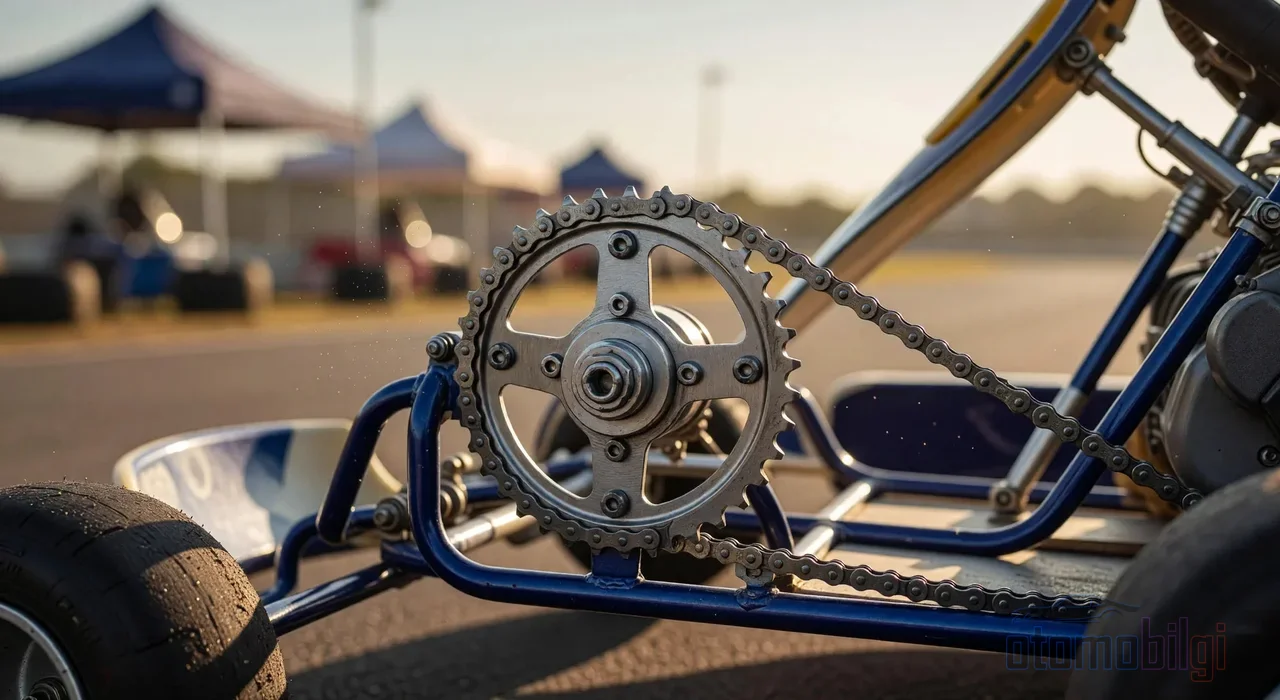
Think of it this way: have you ever wondered about shifting gears on a bicycle? When you use the small sprocket uphill, you climb easily but pedal a lot; on flat ground, shifting to the large sprocket takes you farther with each pedal stroke, but getting started becomes harder. The gear ratio on a kart works on exactly this logic. The small sprocket attached to the engine (the clutch sprocket) carries power via the chain to the large sprocket on the rear axle, and the relationship between their tooth counts determines how power is transferred to the wheels.
The calculation is very simple: you divide the number of teeth on the rear axle sprocket by the number of teeth on the clutch sprocket. 60 ÷ 12 = 5, meaning a 5:1 ratio. This means that with every engine revolution, the axle turns one-fifth of a revolution. And when you're talking in the paddock, you'll hear two words: short and long. A short ratio means more teeth on the rear sprocket; it brings more low-end power and generally higher revs. A long ratio means a smaller rear sprocket; top speed increases, but acceleration off the corner slows down.
A word of caution here: the terminology can be confusing; even on forums, drivers make the distinction between low and high ratio the wrong way around. Let's speak clearly on this page: as the number of teeth on the rear sprocket increases, the ratio shortens and acceleration improves; as the tooth count decreases, the ratio lengthens and top speed increases. Burn that sentence into your head once, and the rest follows.
Long Ratio or Short Ratio? How Do You Choose Based on the Track?
The answer lies in the character of the track. On a very twisty track with short straights, where you need to brake right after exiting onto the straight, you'll never reach that top speed with a long ratio. On tracks like this, using a rear axle with more teeth - that is, shortening the ratio - gives you an acceleration that hits like a rocket on corner exits. On a track with few corners and long straights, you do the opposite: a smaller rear sprocket, a lower ratio, a higher top speed. You want to use full power before hitting the rev limiter at the end of the straight.
So when you go to a new track, where do you start? A common starting point is a ratio around 6:1. On tight and twisty tracks, ratios like 4:1 or 5:1 prioritize acceleration. But the real method is this: start with a baseline ratio, see how the kart behaves on the track, and adjust from there. It is a bit of a trial-and-error process; every track, even every day, has its own answer.
To list the factors that affect the starting ratio:
- Engine displacement and performance character
- Driver weight - a heavier driver generally goes for a shorter ratio
- Weather and track conditions, grip level
- Track layout: number of corners, length of straights
Also don't forget the chain size: on most go-karts, a 219 pitch chain is standard; on corporate karts and large Honda engines, you'll see 420 pitch, and on some setups 428 pitch. When buying a sprocket, always make sure it matches your chain.
How Do Air Temperature, Grip and Tires Change the Ratio?
Here's the frustrating yet equally exciting side of karting: the most accurate ratio is not fixed. If the weather changes, the track changes too. In cold weather, the engine takes longer to warm up and performance drops; karts perform at their best once they reach a certain operating temperature. In hot weather, things reverse: the tires heat up faster, the track becomes grippier, and lap times get shorter. So a ratio that works perfectly in the morning practice may behave differently in the afternoon final.
Grip is also a critical variable. On a grippy, sticky track, the ratio you've set works at full capacity; but as the tires wear out, grip is lost, the kart starts to slide, and a ratio that was previously sufficient can no longer be fully utilized. A ratio tuned for a grippy track can also cause wheel spin on a slippery surface - you're revving the engine, but part of the power is going to waste. The tire compound (whether you run prime or option), asphalt condition, grip level and tire circumference form the two fundamental axes of fine-tuning.
So how big is the effect on lap time? Examples from paddocks show that seemingly small sprocket changes make differences at the level of tenths; but it's also fair to say this honestly: since the weather, tire residue on the track, and dozens of other variables change at the same time, reading the lap time gain attributed to a single ratio on its own can be misleading. The most reliable approach is to evaluate the data with multi-lap comparisons and GPS-based data systems like Mychron. These systems use RPM analysis to let you compare the sections where the engine falls below or above the optimal range, the relationship between speed and RPM, and the times of the laps you set with different ratios.
Why Is the Ratio Strategy Different in 2-Stroke and 4-Stroke Engines?
The engine type literally writes the rules of the ratio game. 2-stroke engines like Rotax, IAME and ROK generally operate in the 10,000-15,000 RPM range and have a narrow power band. What does this mean? If the revs drop below that narrow band, the engine falls asleep; if they go above it, it hits the limiter. That's why gear ratios on 2-strokes need to be adjusted frequently, and even a small sprocket change seriously affects performance. A single tooth difference is felt on the track - in these classes, ratio selection is almost a science of its own.
4-stroke engines, such as Briggs & Stratton, are far more relaxed: revs stay around 6,000 RPM but the torque range is wide. So the engine delivers pull even at low revs. This makes ratio selection forgiving; you don't need to adjust as often as on a 2-stroke. If you're a beginner, this forgiveness is actually good news: the penalty for a wrong ratio is much softer on a 4-stroke.
Class Rules and Ratio Preferences in OK, X30, and Rotax Classes
Another important detail: not everyone can fit whatever gearing they want; in some classes and organizations, ratios are limited by the rules. For example, in some official race regulations, the front sprocket for Rotax MicroMax is fixed at 15, and the rear sprocket between 69-73; for MiniMax, a range of front 14 and rear 73-77 is defined on wet surfaces. So if you're racing in that category, you don't pick with tweezers - you look at the rulebook.
| Engine / Class | Ratio approach |
|---|---|
| 2-stroke (OK, X30, Rotax) | Narrow power band, frequent and precise adjustment per track |
| 4-stroke (e.g. Briggs & Stratton) | Wide torque range, more forgiving and less frequent adjustment |
| Rotax MicroMax (rule-based example) | Front 15 / rear 69-73, non-adjustable range |
| Rotax MiniMax (rule-based example, wet) | Front 14 / rear 73-77 |
Let's also state this clearly: For single-speed 2-stroke classes like OK, X30, and Rotax, a widely prepared typical ratio table for each track cannot be compiled into a definitive list, because it depends on the track and conditions. Every track imposes its own character; that's why setups that change from driver to driver, and from day to day, are discussed. Sooner or later you'll start keeping your own track notes - an incredibly valuable habit.
What Does a Wrong Ratio Do? Its Effect on Engine Temperature and Lap Times
The most telling sign of a wrong ratio is the engine's temperature behavior. If the ratio is too long, the engine constantly hits the rev limiter or never reaches its target rev band; the load on the engine changes and the temperature balance is disrupted. If the ratio is too short, the rev ceiling is breached early on the straight, and the power runs out before reaching the fastest point. Since karts perform at their best at a certain operating temperature, heading down the straight with an overly long ratio in cold weather puts even more strain on the engine's already slow-warming body.
On the lap times side, a practical question should stay with you: at the end of the lap, at the end of the straight, exactly where do you reach top speed? The ideal answer is well before the corner entry; to be settled at top speed by the middle of the straight. If you only approach top speed at the corner entry, the ratio is too long for your track, and you need to go a few teeth shorter. If the kart floats at corner exits and hunts for bottom-end power, it may be time to consider a step toward a shorter gearing direction.
A small warning here too: changing the front sprocket is a less frequently used but highly impactful move; it is preferred for fundamental changes like switching from a technical track to a high-speed circuit. Routine fine-tuning is almost always done with the rear sprocket. That's why the sprocket is one of the components racers buy most often - seating the sprocket correctly on the axle during installation and choosing the correct overall size are the most common problems.
Practical Decision Steps at Tracks in Türkiye and Your Home Track
Let's look at the Türkiye side. Körfez Karting Track hosts rounds of the Türkiye Karting Championship run under TOSFED; round 2 of the 2026 season was held here with 55 drivers across 4 categories. In Istanbul, Tuzla Karting Park stands out as the city's professionally licensed karting track, offering training programs ranging from beginner to professional with 30 HP professional racing karts. Unfortunately, there is no ready-made list of gear ratio recommendations specific to Türkiye's tracks; so the most reliable path is to apply the general principles to your own track and ask the questions above every lap.
Here is a practical step list you can apply trackside:
- Inspect the track: choose a short or long base ratio depending on straight lengths and corner character (6:1 is a safe starting point).
- Do a few laps, listen to the engine's rev range, and note where it sits on the RPM gauge.
- Check where you reach top speed on the straight: if it stretches toward the corner entry, shorten the ratio.
- If there is wheel spin or a lack of bottom-end power at corner exits, review your choice.
- When weather and tire conditions change, re-evaluate the setup; if you can use a data system, compare with multi-lap data.
Although the gear ratio seems intimidating at first, it is actually one of karting's most satisfying setups: two small sprockets, one chain, and a big difference. That ideal ratio you find with your own hands, on your own track, with your own engine teaches you more than any other setup ever has. The next time you go to practice, ask yourself the first question: is my kart using its full potential on the straight today? If you don't know the answer, you now know where to start.
Sources
- Selecting the Right Gear Ratio for Kart Racing
- How to fine-tune your kart's sprocket-to-gear ratio
- What Are the Best Go-Kart Gear Ratios? (UPDATED 2025)
- Gear Ratio rules – Bruck
- Körfez Yarış Pisti
- Great Contention at the Körfez Karting Race - TOSFED
- Tuzla Karting Park
- The Impact of Weather Conditions on Kart Racing
- How Gear Ratios Work
- Choosing the Right Sprocket for Your Go Kart