Why Do Karts Slow Down in Cold Weather? The Relationship Between Track, Air, and Setup
Share This Page
Karts slow down in cold weather because engine efficiency drops before the engine reaches its proper operating temperature, tires warm up late so grip is lost, and the cold track surface makes traction harder. In fact, cold air gives the engine an advantage: in dense air the engine takes in more oxygen. The real source of the slowness is not the engine, but the cold tires and track. With the right setup, this difference can be largely closed.
Highlights
- The ideal cooling water temperature in two-stroke kart engines is 48-52°C range
- On a cold/low-grip track, tire pressure is raised to higher values such as 0.65-0.70 bar is raised to higher values such as
- Ambient temperature 15°C when it drops below, the engine may barely pass even 40°C in the first laps
- Hot weather calls for low pressure and a weak mixture for tires and engine
- The truly important measure is not cold, but hot tire pressure
Does Cold Air Harm the Engine or Reduce Its Speed?
You will be surprised, but the answer is not a clear "no", rather a somewhat roundabout "yes". Cold air alone does not harm the engine; in fact, physics favors the engine. Cold air is denser, meaning more oxygen in every cylinder cycle. On hot summer days, air density drops, the engine takes in less oxygen and efficiency visibly decreases. As drivers say among themselves, on cool days the engine feels stronger; all the track needs to be "sticky" is sunshine.
So if the engine is stronger in the cold, why does the kart slow down? The answer lies entirely elsewhere: the engine struggles to reach operating temperature, the tires do not warm up, and the track remains hard and gripless. In other words, what slows the kart down is not the engine being cold, but the entire system still being asleep.
Why is the engine's operating temperature so critical?
In two-stroke liquid-cooled kart engines, the ideal range for the cooling water is 48-52°C. This window is necessary for correct combustion and stable engine operation; when the coolant stays too cold, combustion efficiency drops and internal parts such as the piston and cylinder expand incorrectly. When the ambient temperature falls below 15°C, things get serious: especially after a long wait on the grid and in the first laps, the cooling water may not even pass 40°C. That is why one of the fundamental tips of cold-weather karting is proper radiator management; the aim is to minimize the effect of cold air so the engine can reach the right temperature. The thermostatic valve also helps the engine warm up faster under these conditions.
Why Do Cold Tires and a Cold Track Reduce Grip?
Tires operate within a temperature window - think of it like a running shoe: a cold shoe sole cannot grip on an icy surface, and an overheated sole softens like gum and fails. It is the same with kart tires. In cold weather, tires warm up late, grip decreases in the first laps and the kart feels slippery. The cold track surface also makes it harder to maintain traction, especially during acceleration and braking.
The temperature window is limited both from below and above. In summer heat, a tire that overheats also loses grip and, directly, speed. A cold track doesn't mean a bad session; it only means that the tires, the warm-up laps, the braking points, and what to expect from the engine feel all change.
Should Tire Pressure Be Increased or Decreased in Cold Weather?
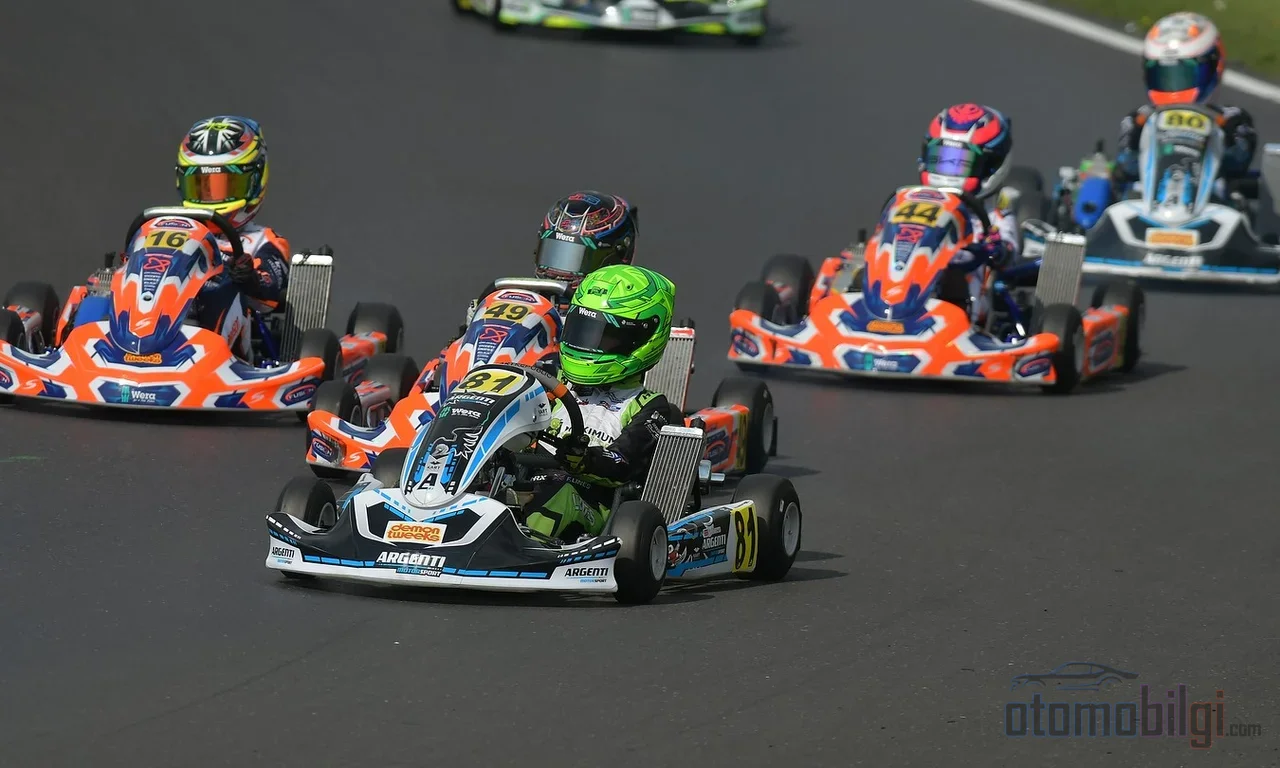
Here is one of the most contentious debates in the karting community. To understand the logic, look at what the tire is doing: on a cold/low-grip track, the tire isn't warming up enough. Higher pressure stiffens the tire's carcass and reduces the contact surface, so the tire heats up faster through friction. That's why most guides recommend increasing pressure on a cold or low-grip track - for example 0.65-0.70 bar or so. The fact that higher pressure generates heat faster in the tire on asphalt also fits this logic. In the opposite case, that is, on a high-grip and hot track, pressure is reduced and roughly 0.45-0.50 bar is used, because the tire already generates plenty of heat and needs to be cooled to avoid losing grip.
As a reference: kart tires cold, at full size, generally run at 0.5-0.6 bar, and in the Mini category around 0.7-0.8 bar . A practical temperature-based table looks like this:
| Condition | Approximate Cold Pressure | Logic |
|---|---|---|
| Cold weather | 12-15 PSI | Heat is generated and grip is stabilized |
| Hot weather | 8-11 PSI | Pressure already rises quickly once running |
| Slippery track | 10-12 PSI | Warm-up is accelerated with higher pressure |
| High-grip hot track | 0.45-0.50 bar | Overheating is prevented |
And there's a nice nuance: while some sources suggest lowering pressure in cold weather, there are also those who recommend increasing starting pressure by 1-2 PSI on days below 60°F (approximately 15°C). The difference actually stems from the definition: one approach aims to compensate for the track's lack of grip, while the other, in short, aims to remedy heat hunger in cold weather by addressing the slowdown of heat build-up. The dominant practice is to heat the tire quickly by increasing pressure in the cold. If the rules allow, a softer tire compound is also a good choice in the cold since it warms up faster.
The right way to measure hot pressure
The most common amateur mistake is hidden here: checking the cold pressure and calling it done. Yet what really matters is the hot pressure - that is, the pressure inside the tire while it's on the track and turning laps. The correct method is as follows: start the cold pressure at around 8-15 PSI depending on the compound, and measure the hot pressure immediately after the out-lap. Take the measurement within 60 seconds of the kart stopping, record the values, and adjust the cold pressure for the next session based on this difference. After a few sessions, you'll find the correct starting value for your own track and weather.
Why Do Adjustments Reverse Completely in Hot Weather?
When summer comes, everything on the setup table turns upside down. Since air density drops, the engine receives less oxygen; the carburetor is tuned for a leaner mixture. As for the tires, pressure rises rapidly as soon as they start working, so the cold starting pressure must be kept low. If grip conditions are good, pressures are generally lowered; this is affected by both the air and the track temperature.
Also, since weather conditions change track conditions, they directly affect gear ratio selection. The gear ratio determines how many times the engine turns for each rotation of the wheel; when the engine no longer breathes as well as before, or the track is less grippy, the same ratio may no longer be the right answer. Engine type (two-stroke or four-stroke) is also a decisive factor in ratio selection. In cold weather or on a slippery track, it even happens that drivers always go with the same ratio on certain tracks - for example 11-81; the real task is to find which ratio the track "speaks" with on that day.
How Should the First Laps on a Cold Track Be Done?
The biggest mistake on a cold track is pushing hard for fast laps from the very first lap. If you brake hard and apply the throttle aggressively while the tires are not yet warm, the kart starts to slide; both your lap times suffer and you run the tires at the wrong temperature. What to do is actually very clear:
- In the first laps, give the tires time to warm up gradually.
- Brake earlier and more gently; keep throttle transitions smooth.
- Avoid entering corners early and aggressive steering - on cold tires the price of that is sliding.
- As the warm-up progresses, gradually raise the braking points and the pace.
The chassis also talks to you, just in a different language. A properly set-up kart lets you feel that it slides when grip is insufficient, and hops when there is too much grip. A strange turn, mid-corner pushing (understeer), or nervous behavior on corner exit usually points to a setup issue, wear, or another problem. And one detail that goes unnoticed: driver weight is a fundamental part of the chassis system, and an incorrect seating position can alter wheel loads and upset the entire kart's behavior.
The Most Common Setup Mistakes Amateur Drivers Make
Behind the performance gap in cold weather, there is usually not one big technical error but a few small oversights. I can list the most common mistakes we see as follows:
- Focusing on cold pressure: If adjustments are made while the tire is on the track without measuring hot pressure, the data is meaningless.
- Not waiting for the engine to warm up: Switching to an aggressive pace before the coolant reaches 48-52°C disrupts performance and the expansion of internal components.
- Not adjusting the mixture according to air temperature: Cold conditions require rich carburetion; cold air leans out the mixture.
- Turning the first laps into fast laps: On cold tires, this is a record in sliding, not grip.
- Neglecting driver position: When the seating position changes, wheel loads and the entire chassis behavior change.
General driving mistakes are also added to the list: not holding the steering wheel correctly, harsh braking instead of smooth braking, not using the full width of the track. None of these are independent of weather conditions - in the cold, the price of all of them becomes more expensive.
Why Does Cold Weather Karting Matter in Türkiye?
Throughout the season, the Turkish karting calendar confronts you with a variety of climates. In the Motul Türkiye Karting Championship, morning practice sessions at northern rounds like Bursa, high altitude and cool mornings in Cappadocia, and windy days in Tuzla force the driver to master car setup. Youngsters competing in the Junior and Senior categories of the championship cannot get ahead without learning to maintain engine temperatures during cold morning grid waits. On the recreational karting side, training seminars are mandatory for track operators; in other words, managing cold and hot weather conditions at tracks is now an official training topic. If the weather is cool at your next practice session, don't panic: your engine is actually holding back the power it owes you, and you simply have to bring your tires and mixture to the right temperature. The driver who learns to listen to what the cold track wants is the one with the advantage on every day of the season.
Sources
- The management of the liquid cooling system of a 2-stroke kart engine
- The Impact of Weather Conditions on Kart Racing
- 7 tips to go karting in the winter, even when it's cold
- Kart Tire Pressure: Complete Guide for Every Condition
- How Weather Conditions Affect Your Kart Setup
- Measure Cold to Hot Deltas: Repeatable Go Kart Tire Pressure
- How Tire Pressure Affects Kart Performance
- Selecting the Right Gear Ratio for Kart Racing
- Kart Setup - Optimize Your Kart
- Basic Kart Setup Guide for Non-Technicians
- Karting tips: 7 mistakes novices make
- Your Kart Feels Different in the Summer Heat
- Karting in Hot Weather: Tips & Challenges
- 2026 MOTUL Türkiye Karting Championship - TOSFED
- Recreational Karting Training Sessions Coming to Istanbul - Türk Motorspor