Why Are Chassis Settings So Important on the Road
Share This Page
Same engine, same tires, same track - but one of the two drivers comes out ahead in every corner. The secret of the difference is usually hidden not in power, but in chassis setup. Settings such as caster, camber, rear track width, tire pressure and seating position directly determine how the kart enters a corner, how much grip it has, and how the tires wear; a properly tuned chassis achieves maximum grip through all corners, and the biggest gain in lap time comes exactly from this.
Key Highlights
- In races, rear track width is limited to a standard 140 cm.
- For competitive kart tires, the typical working range is 0.8-1.5 bar, with a dry-weather starting point of about 1.0 bar.
- The ideal weight distribution is roughly 43% front / 57% rear, with equal values on the sides.
- On dry surfaces, 0-3 mm toe-out is used, while zero toe is preferred on high-speed tracks.
- Only one setting is changed at a time; notes are taken after every session.
How Does a Kart Corner Without a Differential? The Secret of the Jacking Effect
Now let me tell you about karting's sweetest engineering trick. Cars have a differential that makes cornering easier; a kart does not. The kart's rear axle is a single piece and rotates as one. So how does the kart corner? The answer: the jacking effect. When entering a corner, the combination of chassis resistance, axle stiffness and caster angle lifts the inside rear wheel off the ground. With the kart riding on a single rear wheel, it pivots and takes the corner.
This mechanism is also the heart of setup logic: if the inside rear wheel does not lift, the kart struggles to turn and its front end starts to slide. This is called understeer (in drivers' parlance, "push") - there is no front grip, and instead of turning into the corner the kart runs straight off to the outside. Quite the opposite, if the rear end slides outward at corner entry or mid-corner, we call it oversteer. Before heading out on track, you need to know these two words by heart so you can diagnose which end is causing trouble, because the entire setup logic is based on this question: which end is sliding, and where?
Caster and Camber: In Which Part of the Corner Do They Work, and Why?
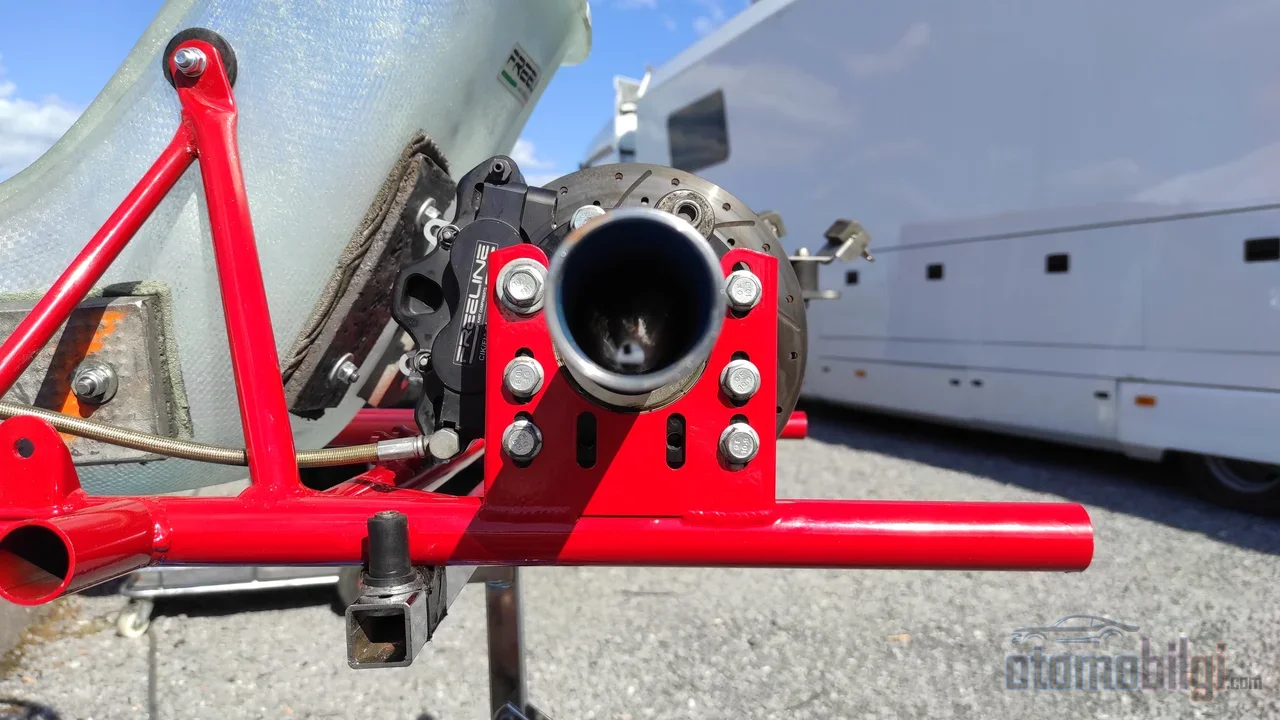
Let's get these two terms clear in your head. Caster is the rearward inclination angle of the steering axis (kingpin) of the front wheel from vertical - you can compare it to the backward rake of a bicycle's front fork; it gives you steering feel and grip at corner entry. Camber is the inward (negative) or outward (positive) tilt of the top of the front tires, and on karts it is discussed in millimeter values.
Caster: The boss of corner entry
Caster has its greatest effect at corner entry and in the first third of the corner. If you increase caster, front grip increases; but there is a price - with increased jacking, the inside rear wheel lifts earlier, and at that moment rear grip drops. The general practice is as follows: caster is increased on cold surfaces and in wet conditions, and reduced on surfaces with high grip. Karts are incredibly sensitive to caster changes; a more forgiving setting compared to camber, so it becomes one of the first points you should try during practice.
Camber: It comes into play in the middle section of the corner
Camber's main job shows itself in the middle third of the corner: it ensures the outer front tire contacts the track with its maximum tire surface. Zero camber is almost always the best starting point; increasing negative camber enlarges the contact surface in the corner. Positive camber, on the other hand, can make the kart respond quicker at corner entry, but this sensitivity won't be useful on every track. Another nice detail: when you turn the steering wheel, caster automatically produces more negative camber on the outer front wheel. So these two settings cannot be considered independent of each other - as one rotates, the other steps onto the stage.
How Is Toe Set? Top Speed or Entry Response?
Toe is the difference in distance between the front edges of the front tires. The rule is simple: as the toe value increases, tire friction increases and top speed drops. Toe-out increases corner entry response and reduces understeer. On dry surfaces, 0-3 mm toe-out is recommended; karts with small engines are kept close to zero. On long, fast tracks, zero toe supports top speed, while on sprint tracks up to 2 mm of toe-out is beneficial, and on wet surfaces this amount increases even more. And there's a fine detail: when the driver sits down, the chassis flexes, so heavier drivers have to leave a bit more "idle" toe-out.
Rear Track Width: Grip or Stability?
Adjusting the distance between the rear wheels (track width) is one of the quickest "race day" adjustments in karting. The general rule is this: if your chassis is working well, the rear track is kept as wide as the technical regulations allow. A narrow track provides more rear grip and faster rotation but makes the kart sensitive and quick to unsettle; a wide track is the exact opposite - more stable but with less grip. In races, the standard maximum width is 140 cm and in senior karts the 1385-1400 mm range is the typical working area; in cadet classes you start narrower.
Patience is essential here: the track is changed in 3-5 mm steps (5 mm per wheel), and if there's a problem, it is gradually widened up to the maximum the rules allow. In wet conditions, however, the diamond shape reverses - the front track is opened to maximum, the rear track is brought in, and the rear part of the seat is raised about 25 mm above normal. It's like memorizing the formula before the exam: when you see a wet track, this should be your reflex.
Seat Position and Tire Pressure: Two Silent Factors That Carry Your Lap Time
Wherever you sit, the kart goes there
The seat is the kart's most insidious adjustment element because it's laborious to change but affects everything. The standard weight distribution is 55-60% at the rear and 40-45% at the front; as a dry-surface starting setup, roughly 43% front / 57% rear is targeted, with even distribution on the sides. If you move the seat forward, front grip increases; if you move it back, rear grip increases; raising the pilot or the ballast increases grip through weight transfer. The most critical diagnosis is this: if caster and camber changes make no difference on track, the seat position is most likely wrong and you are completely outside the setup window. A kart that understeers drifts wide in corners, wears out its front tires and kills entry speed - all the bill for incorrect seating.
The power of half a bar: tire pressure
In competitive karting, tire pressure is typically in the 0.8-1.5 bar range for most applications, starting at around 1.0 bar on dry surfaces. When you hear that even a change of half a PSI can completely alter how the kart feels on track, you understand how fine this range operates. Higher pressure heats the tires faster and increases grip; but if you overdo it, the contact patch shrinks, the tire overheats, and grip and lifespan go away. A cool track calls for higher pressure, while a hot track needs lower pressure to prevent overheating.
The tire is also a great diagnostic tool. If the middle of the tread is excessively hot, the pressure is too high; if the inner edges of the front tire are the hottest, there is too much negative camber; if inner edge temperature is accompanied by entry oversteer, you have increased the caster too much. Wear speaks the same language: inner edge wear is a sign of excessive negative camber or low pressure, while outer edge wear indicates positive camber or overinflation. Taking a minute to look at your tires in the pit tells you more than ten minutes of head-scratching.
How to Determine the Starting Setup According to Track Type?
If you are going to a track for the first time and know nothing about how the kart behaves, ready-made starting packages for the conditions make your job much easier. Here are two extreme scenarios:
| Setup Point | Low-Grip (Green) Track | High-Grip Track |
|---|---|---|
| Front ride height | Raised | Standard/low |
| Rear ride height | Maximum | Minimum |
| Axle stiffness | Medium-stiff | Soft |
| Seat struts | Installed (at least two each) | Removed |
| Rear torsion bar | Flat position | Removed |
| Caster | Increased | Decreased |
| Camber | Standard | Increased negative |
Let me also open a parenthesis about the axle: a stiff axle is preferred on cold and slippery surfaces because it works the tires more and increases grip; a soft axle comes in handy on very grippy surfaces or where the tires are wearing out. High-powered karts generally use a stiff axle, while low-powered karts use a soft one; tall drivers also often prefer a soft axle. As the tires wear on track, it may be necessary to increase the caster again - setup is not a fixed picture, but a process that flows throughout the day.
Golden Rules of Making Setup Changes: One Change at a Time, Plenty of Notes
The practical method that emerges from all this information fits into three items:
- Change only one setting at a time. If you change the caster and camber at the same time, you will never know what worked.
- Take notes after every session. The change made, track conditions and the result - if you don't write down all three, the information evaporates.
- Work on the end that has the problem. If there is understeer, first try increasing front grip; if that's not enough, take grip from the rear.
Let's give one warning its rightful place too: if you're a few seconds off your pace, or your lap times alternate between one fast lap and one slow lap, there's no point in playing with the setup. Setup is the final layer added on top of driving skill; setup changes made before basic pace is established solve nothing but noise. First find a consistent pace, then use the setup to build on top of that lap. While the 2026 Türkiye Karting Championship in Türkiye starts in Bursa and runs over 7 rounds, some of the young pilots who met the track at age 6 through the TOSFED grassroots program learn this setup logic at a very early age with their coaches - and the difference between them turns into lap time as timing comes together.
So of two drivers with the same engine, the one ahead isn't the stronger one, but the more knowledgeable one. At your next practice session, change one single setting, write down the time, and see the difference with your own eyes. That "oh wow, it really works!" moment is one of the finest thrills karting will give you.
Sources
- Kart Setup | Optimize Your Kart
- Kart Setup 101: Understanding Caster, Camber, and Toe
- How Tire Pressure Affects Kart Performance
- The variations of the kart rear track width
- The kart seat, a key variable of vehicle setup
- Quick Setup Changes You Can Make On Race Day
- How Does Rear Track Width Affect Your Go-Kart's Handling?
- Rear End Adjustment
- How to Set Up Kart Caster and Camber
- Kart Set-up Explained
- Kart Scaling & Weight Distribution
- How Changing a Seat in a Go-Kart Can Affect Performance
- Understeer vs Oversteer: How Weight Distribution Controls Balance
- Go-kart tires: choose and maintain for peak performance
- How important is it to change your karts setup?
- 2026 Türkiye Karting Championship Calendar Announced
- How Can I Become a Racer? - TOSFED