The Lifespan and Reading of Kart Tires: How Grip Is Gained, How It Is Lost?
Share This Page
A kart tire's life depends not on how long it is used, but on the heat cycles its compound has endured; and grip is gained only for as long as the tire stays within what we call its operating window, the range of temperature and pressure. So whether you will be fast on track is often determined not by your engine but by how close to the right temperature your tires are running at that moment. Don't worry, translating all of this into a readable science is easier than you think.
Highlights
- A soft compound is faster in about 90% of conditions ; the exception is a long stint on a hot track.
- Cold starting pressure for kart tires is generally in the 8-15 psi range; for hard compounds, the hot operating range is around 14-18 psi.
- A tire waiting in the garage ages too: even a 10-degree change in room temperature counts as a partial heat cycle.
- Graining, blistering, and bluish marks are the three fundamental signs of grip loss read from the tire's surface.
Compound Logic: Soft or Hard?
What creates the performance difference in kart tires is not the tread pattern, but compound hardness. The tread dimensions of brands like Komet, MG, Vega, Levanto, and LeCont are so close to each other that the real difference lies almost entirely in softness. Think of them like phone cases: they are all the same shape, but one stretches like a rubber band while the other behaves like a plastic box.
Soft compounds work at lower temperatures and "switch on" quickly, meaning they start gripping in a very short time on track and produce higher peak grip in most conditions. Hard compounds need heat; on a cold track they never work, and you slide around all lap. Medium is for those seeking a balance between the two.
| Compound | Strength | Weakness |
|---|---|---|
| Soft | Maximum grip, fast warm-up | Fast wear, overheating in hot conditions |
| Medium | Balance of grip and longevity | Never the best in any condition |
| Hard | Long life, consistency | Slow warm-up, less grip |
So is the soft tire always faster? Roughly yes, in 90% of conditions. The exception is a long stint on a hot track: a soft compound delivers a few strong laps and then drops off, while a hard compound stays consistent. A similar truth exists in F1 too; in the 2026 season only 17% of racing laps were run on soft tires, with the vast majority falling to the hard and medium share. One strong qualifying lap and race distance are different games.
What Happens When a Tire Ages? The Silent Effect of Heat Cycles
Here is one of karting's sneakiest truths: a tire ages even if you don't use it. A set waiting in the garage goes through a cold-hot cycle every day; even a 10-degree change in ambient temperature counts as a partial heat cycle. Each cycle hardens the rubber compound a little more.
A real heat cycle means the tire heating up to about 80 degrees on track and then cooling down. As these cycles repeat, the compound's performance characteristics change and grip is lost. In practice this means: a newly purchased set and the same set worn out over 30 sessions feel noticeably different to the touch. The story of friends who grabbed an old set for a short race and slowed down on track usually starts right here.
How to Hit the Working Window: Pressure Setup
Every compound has a temperature and pressure range where it is happy, and what we call grip lives right inside this window. In kart tires, cold starting pressure is typically 8-15 psi while the hot working range of hard compounds settles at around 14-18 psi.
Cold or hot?
What matters is hot pressure, not cold. Take a measurement right after the out-lap and set the cold value according to the target hot pressure. The pressure rises on its own as the tire works on track; this rise is even faster in summer heat, so keeping the cold starting pressure low on hot days is a classic approach. Pressure is the most sensitive adjustment in karting: a change of even 0.02-0.03 bar is enough to alter the balance, the grip phase, and the temperature. Higher rear pressure makes the kart more reactive, but if you overdo it, the tire overheats and grip is lost; higher pressure, on the other hand, means faster warm-up.
Internal overheating of an overworked tire; heat melts the rubber into bubbles. Imagine the tire melting in lumps like a child's dry modeling clay.
It may not seem believable but it is true: taller drivers load the tire more, which becomes an advantage on hard tires and in winter. A short driver with a low center of gravity, meanwhile, is strong on soft compounds in summer heat. A former CIK-FIA World Junior Champion explains that during the same period he had to make completely different tire choices than a rival with a 25 cm height difference. On a soft tire, pressure can be lowered and camber increased; on a hard tire, the center of gravity is raised, caster is increased, and the rear is stiffened.
How to Read Tire Wear?
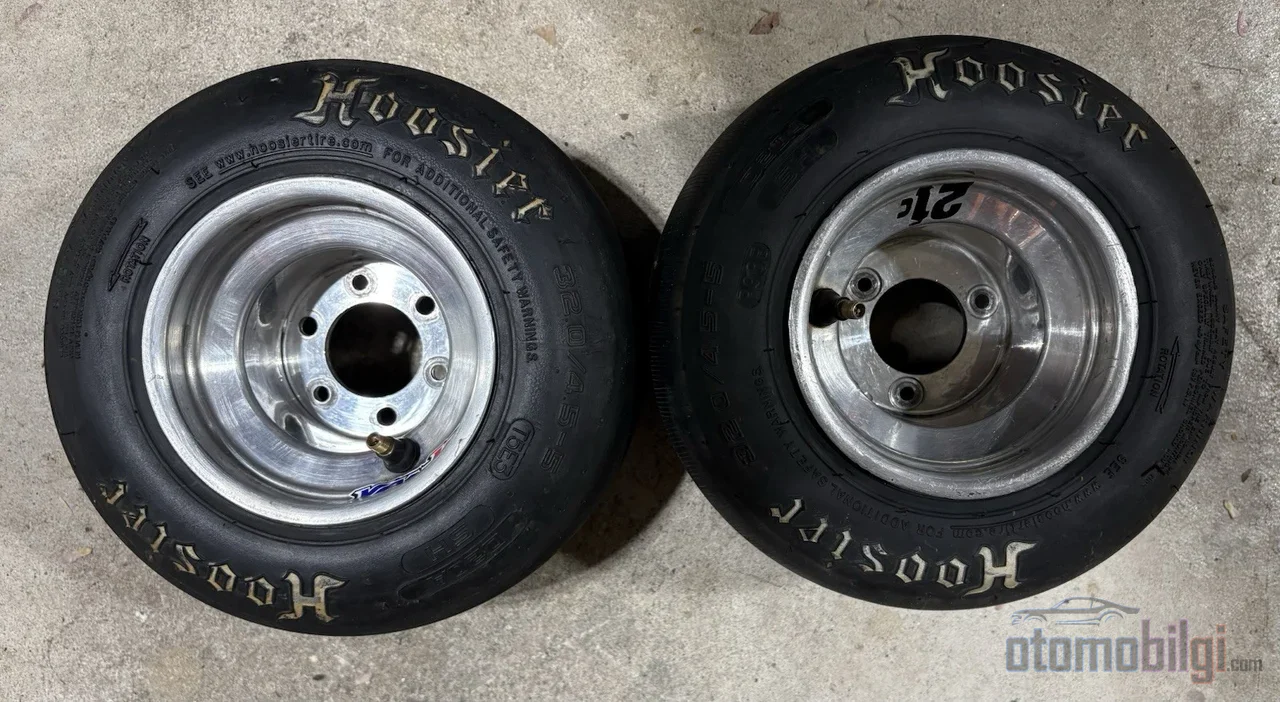
Looking at your tire at the end of a session is like reading a report that tells you, one by one, all the clues the engine and chassis have given you. Here are the three basic signs read from the surface:
- Graining: Surface wear caused by cold rubber tearing as it slides. If you see graining on the inner edge, that compound has overheated on that edge.
- Blistering: Excessive internal overheating of an overdriven tire; the heat melts the rubber into bubbles. Imagine the tire melting away in layers, like a child's dried lozenge dissolving in the mouth.
- Bluish marks: Blue-toned areas on the tread are a sign that the temperature the tire has reached is excessive.
It is also normal for wear to be asymmetric: on a track with six left and two right corners, more wear is seen on the left side because the kart works harder there. As a general rule, heavy wear in the middle of the tread indicates high pressure, while edge wear signals low pressure or alignment geometry problems.
Slick or Rain Tire?
Slick tires are designed for dry surfaces: their smooth tread provides maximum contact area. Full wet tires, on the other hand, channel water away with deep grooves for heavy rain and standing water; intermediate tires come into play for damp or drying surfaces. Wet compounds are extra soft and break down quickly on a dry track; conversely, slicks cannot disperse water in the wet, so they cannot be used in wet conditions. The driving line and weight transfer also change on a wet surface: increasing the front weight share from 43% to 44-45% helps the front tires.
Karting Tire Rules in Türkiye
In Türkiye, things run by the rulebook. TOSFED publishes karting rules updated every season, and in the 2026 National Karting Rules, tire and wheel regulations are defined under a separate heading. In the Türkiye Karting Championship, only bodywork with a current CIK-FIA homologation is permitted; the championship's tire rules are also clarified under the "Tires" heading of the technical rules. In the endurance cup, the Junior category engine rules apply. So whatever class you race in, it is usually not you but the rulebook that determines the tire choice; your job is to extract maximum grip from that compound.
If your kart feels good on the first lap in hot weather but bad as it heats up, the culprit is most likely not you: the tires have exceeded their operating window and graining, blistering, and sliding have begun. The same picture appears in rental karts during long runs; once the tire window is exceeded, grip resigns.
Worth Knowing: The Cheat Window and the Lottery
This business has a shady side too. Mixing softening additives into the compound is not legal, but the effect is striking: a tire whose hardness value drops from 45 to 35-40 can gain 3-4 tenths of a lap time or even more. Because additives are hard to detect, some major series apply parc fermé. There is also the tire lottery problem: inconsistency between compounds of the same series can create differences of up to 2 seconds in the wet; this is why regulators are advised to take measurements with a durometer. So gaining grip is, in most cases, a game played within legal limits by tweaking pressure, temperature, and driving style.
How to Lose Grip (and Get It Back)?
Now let's summarize, because losing grip actually has a well-defined formula:
- Keep the tire below its operating window: cold track + hard compound = sliding all lap long.
- Exceed the window: hot track + soft compound + aggressive throttle = graining, blistering, loss of grip.
- Set pressure by feel: adjusting based on hot pressure instead of cold pressure is the most classic mistake.
- Use an old set: a compound hardened by heat cycles can never match a new set.
The way to get it back is the reverse of the same list: measure hot pressure after the out-lap, choose the compound according to track temperature, and ease off the aggression a bit in the first laps. Next time you head out, take a good look at your tires; what you read on that surface will tell you far more than your lap time.
Sources
- Soft vs Hard Kart Tires: Which Is Actually Faster?
- How Soft, Medium, and Hard Tyres Differ
- F1 Tyre Compounds Explained
- Measure Cold to Hot Deltas: Go Kart Tire Pressure
- How Tire Pressure Affects Kart Performance
- Setting Tyre Pressures: The Updated Complete Guide
- LO206 Tire Pressure: Hot vs Cold
- Tyre Setup
- Tyre Failure: Graining, Tearing, Blistering and Wearing
- What Is Tire Graining and Blistering in Sim Racing?
- Unusual wear of a kart's tyres
- Why do tyres lose grip each heat cycle?
- Wet Kart Setup
- 2026 National Karting Rules - TOSFED
- 2025 National Karting Technical Rules - TOSFED