How to Design a Good Karting Track?
Share This Page
A good karting track is a form of education, designed with run-off areas where a driver can safely manage speed and mistakes, a variety of corner types, and protection lines compliant with CIK-FIA standards; because the track itself is a silent teacher that shapes a young driver's technical development over the years. In other words, in karting it is not only engine power but also how much thought has gone into the asphalt beneath it that makes the difference.
Highlights
- From the start straight to the first corner a minimum of 80 meters of distance is required; the first corner is designed to be as open as possible
- Run-off areas, as a general rule, are kept a minimum of 10 meters away from any solid object
- On straights longer than 80 m, track width must be at least 8 meters must be
- In modern design, providing sufficient run-off area is considered the primary form of protection instead of barriers
- Licensed tracks in Türkiye undergo TOSFED inspection; the Körfez Race Track in İzmit is 1,950 meters in length
What Makes a Good Karting Track Good?
Let me explain this to you with a simple analogy: The track is like an exam paper. It contains very easy questions as well as hard ones that make you scratch your head. A long straight encourages you at full throttle, while a sharp chicane tests your braking and throttle control. If the track has only one type of corner, you become a student who solves only one type of question - and you are not ready for the surprise you encounter in a real race.
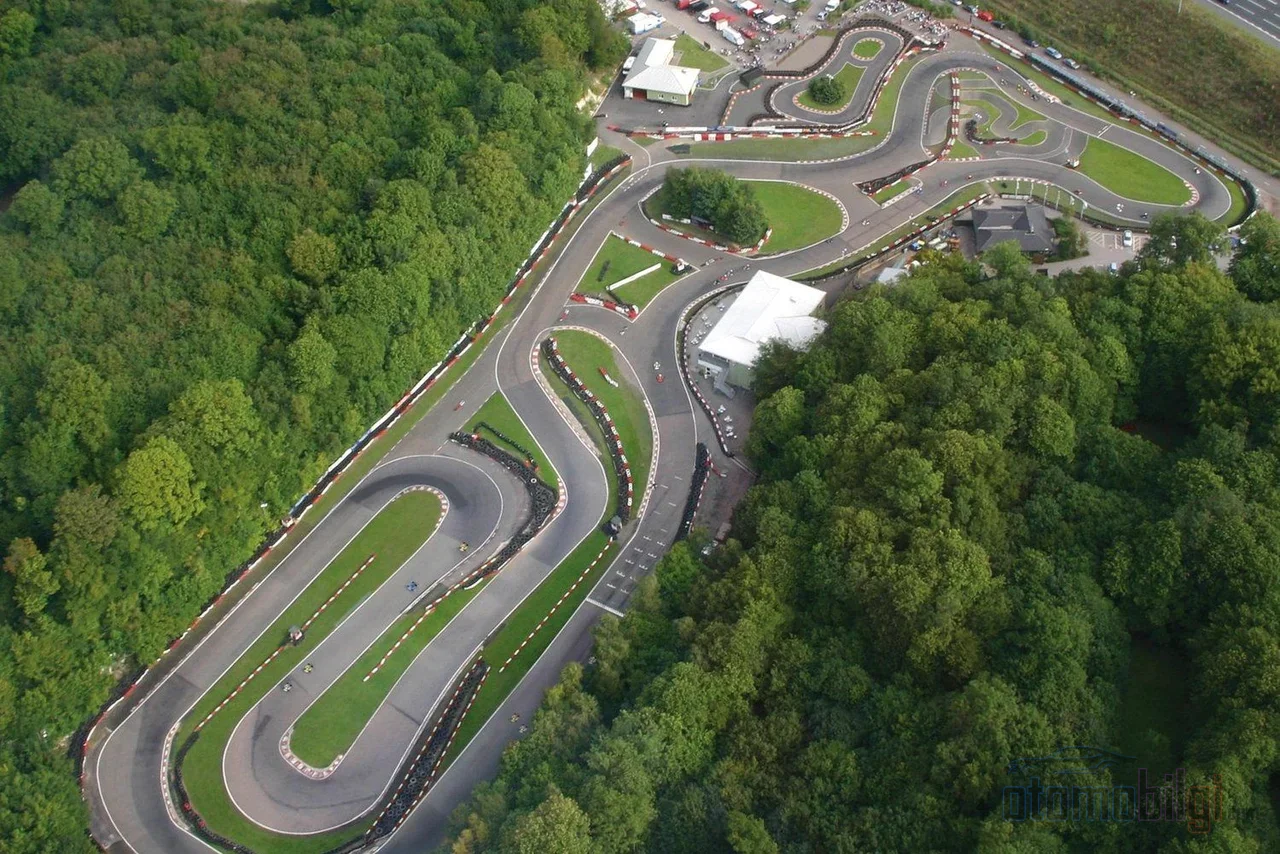
Professional track designers say exactly this, in fact. A good kart track combines exciting corner sequences, elevation changes, variable gradients, sufficient run-off areas, and modern infrastructure. In other words, design is not just saying "let's put a corner here"; every corner needs to teach you something.
There is also the matter of flow. The focus of current discussions about closed-track design is very interesting: the real problem is not the corner itself, but flow interruptions that disrupt the track's rhythm. On a good track, the transition from one corner to the next gives you no trouble; left, right, straight, left again... it all flows like a story. While reading that story, you learn braking, apexes, and exits without even realizing it.
Corner Variety: The Track's School Curriculum
Now let's get to the main point. What types of corners should a track have, and what do they add for you?
- Open corners: Corners taken without braking, with a light steering movement. The first corner after the start is desired to be this style, because a sharp bend while a crowded group has not yet spread out = a recipe for accidents.
- Sharp / hairpin-style corners: They require hard braking, the right gear, and a patient exit. In these places, it is not going fast ahead of others that wins, but going correctly.
- Chicanes: Consecutive left-right transitions; they teach weight transfer and fluidity.
- Elevation-change corners: Corners that go uphill or downhill; they test grip, brake distribution, and visual judgment.
And of course there are inner apex kerbs and outer corner strips. Inner kerbs can be minimum 15°, maximum 20° sloped and a maximum of 300 mm wide; the outer strips, on the other hand, 300-500 mm wide, and can be built with a slight negative slope. These details are not decoration - the kerb is a road companion that lets you feel the limit of the corner.
Straights and Measurements: What Do the Meters Tell You?
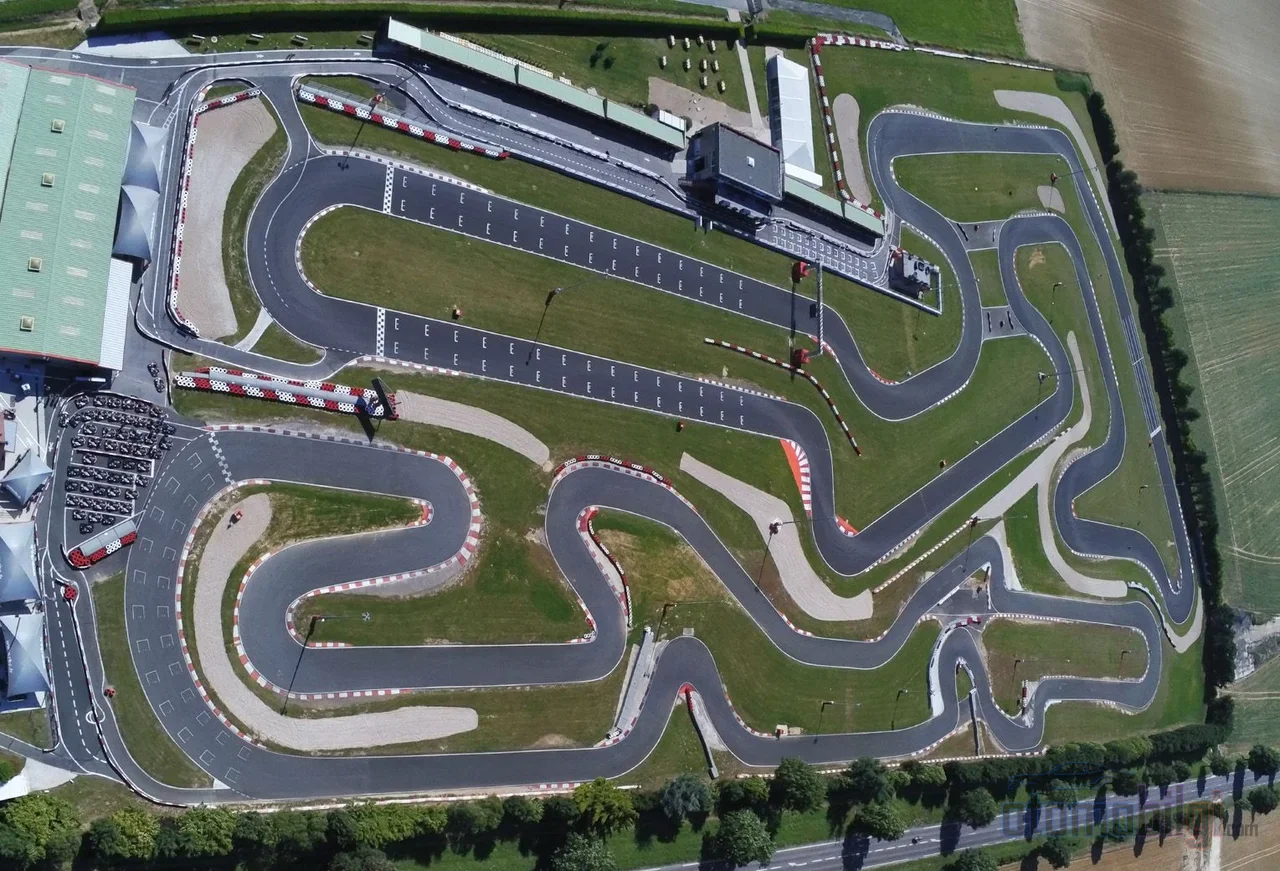
Track dimensions are clearly defined in the guidelines, and each one has a logic behind it. Track width, for example: on long straights at least 8 meters, on other sections 7 meters. Why? Because the place where you need 8 meters is where you can race side by side. Overtaking side by side on a narrow section is already impossible, so 7 meters is enough there.
| Measurement | Rule |
|---|---|
| Maximum track length | 1,700 m |
| Start line - first corner | Minimum 80 m |
| Total start straight | Minimum 130 m |
| Track width (long straight) | Minimum 8 m |
| Track width (other sections) | Minimum 7 m |
| Minimum distance to a solid object | General rule: 10 m |
| Separation between high-speed sections | Minimum 20 m |
Then there is the matter of gradient, which is my favorite. The recommended maximum longitudinal gradient is 5% providing sufficient run-off area is accepted as the primary and optimal protection 10%; the surface needs to be sloped at least 2.5% for drainage. But here is the interesting part: positive camber corners (rising toward the outside) are avoided. Do you know why? Because such a corner has a launch ramp effect on you - it pushes the kart toward the outside of the corner. If a track works against you rather than in your favor, then that track is poorly designed.
Let us also add that competitive tracks need more space: a generous area is essential for long straights and high-speed demands. So on a track longer than 1,000 meters, with a width of 7 meters at the narrowest point, space can be defined for up to about 38 vehicles .
Escape Areas and Tire Barriers: Two Philosophies of Safety
Let us come to the most vital part. What happens when you go off the track? This is where two fundamental concepts come into play: run-off area (escape zone) and barrier.
The run-off area is the zone from the edge of the track to the first line of protection (1LOP). The first line of protection is the barrier that safely stops the forward motion of a kart that has gone off the track; it must be present around the entire perimeter of the track and be at least 1.15 meters high - at some points even 1.8 meters can be preferred. In the modern approach, however, there is an important change: on new tracks, instead of relying on the barrier itself, providing sufficient run-off area is the primary and optimal protection . The logic is very simple: 10 meters of grass that slows you down gently is far kinder than a wall that stops you instantly.
But what if the terrain does not allow this? This is exactly where the debate begins. It is not possible to fit 10 meters of run-off area into every terrain, and then protective structures come into play: deformable buffer structures that partially absorb kinetic energy, and loose-material capture traps preferably 2 meters wide and 250 mm deep (in high-speed zones, at least 4 meters wide)...
Are tire barriers still safe?
The classic image that comes to everyone's mind: stacked car tires. Yes, they have been used for years and there are rules - they must consist of similarly sized car/racing tires, stacked vertically with bolts and at a minimum height of 600 mm ; commercial vehicle and 4x4 tires are banned. But circuit designers say this method has served its time; today, easy-to-install energy-absorbing alternatives such as flexible, eight-section modular systems are coming to the fore. So the tire barrier is not bad on its own, but it is no longer the only option either.
FIA and TOSFED Standards: Who Says What, Who Inspects?
The international reference point is the CIK-FIA construction technical specifications; a relatively open rulebook with separate annexes for run-off areas and protective structures. On the FIA side, circuit equipment homologation regulations and safety standards are constantly updated - the last major update was published in February 2025. It is also worth knowing that homologated outdoor karting tracks are generally "too long and too wide", designed mainly for two-stroke racing karts; a hobby track and a racing track are not the same thing.
On the Türkiye side, the matter is in TOSFED's hands. According to the Hobby Karting Track Instructions, inspection is mandatory for the construction of a new track, the expiry of a license, or a modification to a licensed track. The nice detail is this: the instructions specifically take into account the possibility that inexperienced drivers may pose a danger both to themselves and to other drivers in the design. In other words, the design must be prepared for even your first-day mistake. In addition, TOSFED's 2026 National Karting Rules and the Temporary and Permanent Track Guide dated March 2026 are current - moreover, even if a track is approved, it can be cancelled by a decision of the stewards if it is deemed unsafe on race day. Inspection is not a one-time badge, but a continuous responsibility.
Where Do Tracks in Türkiye Stand Globally?
Let's give a concrete example. The Körfez Race Track in İzmit is 1,950 meters long, 10-12 meters wide and has 9 corners in the clockwise direction (4 right, 5 left). Maximum speeds on the main track can exceed 220 km/h
Let's also touch on the closed versus open track debate, because I get this question a lot. Closed tracks offer stable conditions and technically focused driving; you're independent of the weather and every lap is the same, which is great for technical development. Open tracks, on the other hand, offer longer distances, higher speeds, and design variety. My recommendation? Try both. Polish your lap times on a closed track, and test that polish in the real world on an open track.
One debate is always on the agenda of Turkish motorsport: why can't Türkiye develop drivers for F1? Of course, the answer to this question isn't track design alone, but tracks are at the center of the debate about track access and infrastructure. The better and more accessible the hosted track is, the more realistic the young driver's development path becomes. Talent is about processing information quickly and not repeating mistakes - and for that, you need a safe, varied track that gives you free practice runs.
How Track Character Shapes the Young Driver
This is the section that looks like the conclusion but is actually my main message. A driver's style carries the character of the track they train on. If you grow up on a track with long straights, your top speed and braking side gets stronger; if you grow up on a technical, corner-to-corner track, your rhythm and flow side develops. A driver exposed to both learns both - and that's exactly why track variety is the invisible but most important part of a training program.
In the karting world, everything is fun for someone taking to the track for the first time, but with regular training, it turns into a serious sporting discipline. And one of the things that shapes you most in that transformation is the track you ride every week. So take another look at the corners in your next training session: which one forces you to brake, which one tests your exit technique? The moment you start counting them, the track is no longer just asphalt - it becomes your head coach.
My question to you: which corner at your favorite track taught you the most? Tell us in the comments, I'm curious!
Sources
- Construction Specifications - FIA Karting
- National Track Construction and Safety Guidelines - Karting Australia
- Karting Australia Circuit Regulations and Guidelines (Nov. 2024)
- Circuit Safety - FIA
- 2026 National Karting Rules - TOSFED
- TOSFED Temporary and Permanent Track Guide
- Licensed Hobby Karting Tracks - TOSFED
- Technical Specifications - Körfez Race Track
- Formula Student Held at Körfez Race Track - TOSFED
- Kart Circuit Design - Apex Circuit Design
- The Different Types of Karting Tracks - ProKarting
- How to Design a Go-Kart Track Layout Without Flow Breaking Corners - 360Karting
- Go-Kart Track Barriers - 360Karting
- Go-Kart Track Builders & Design - Protex Karting Barriers
- What Is Karting? - Red Bull Türkiye
- Track Design - Saiqikart
- Indoor and Outdoor Go-Kart Tracks: Pros and Cons - Racehall
- Is Racing More About Talent or Training? - Winfield Racing School