How Do Karting Drivers Train?
Share This Page
Karting drivers strengthen their neck and abdominal muscles against the G-forces felt in corners, do cardio several times a week, systematically replace the fluids lost through sweating, and sharpen their reflexes with reaction drills. In other words, karting is not just a motor sport; it is a full-fledged endurance sport where the body races too. Nobody tells you this truth when you put on your helmet and sit down; that's why we're telling you.
Highlights
- F1 drivers experience 4-5G in high-speed corners, and on some tracks the peak reaches 6G .
- The head and helmet together weigh approximately 7 kg; at 6G this load is felt on the neck as 42 kg .
- Drivers can lose up to 3 liters of fluid in a race.
- During a race, heart rate can climb above 170 bpm .
- F1-level drivers do neck training 5 times a week .
The Load on Your Neck in Corners: What Do G-Forces Actually Do?
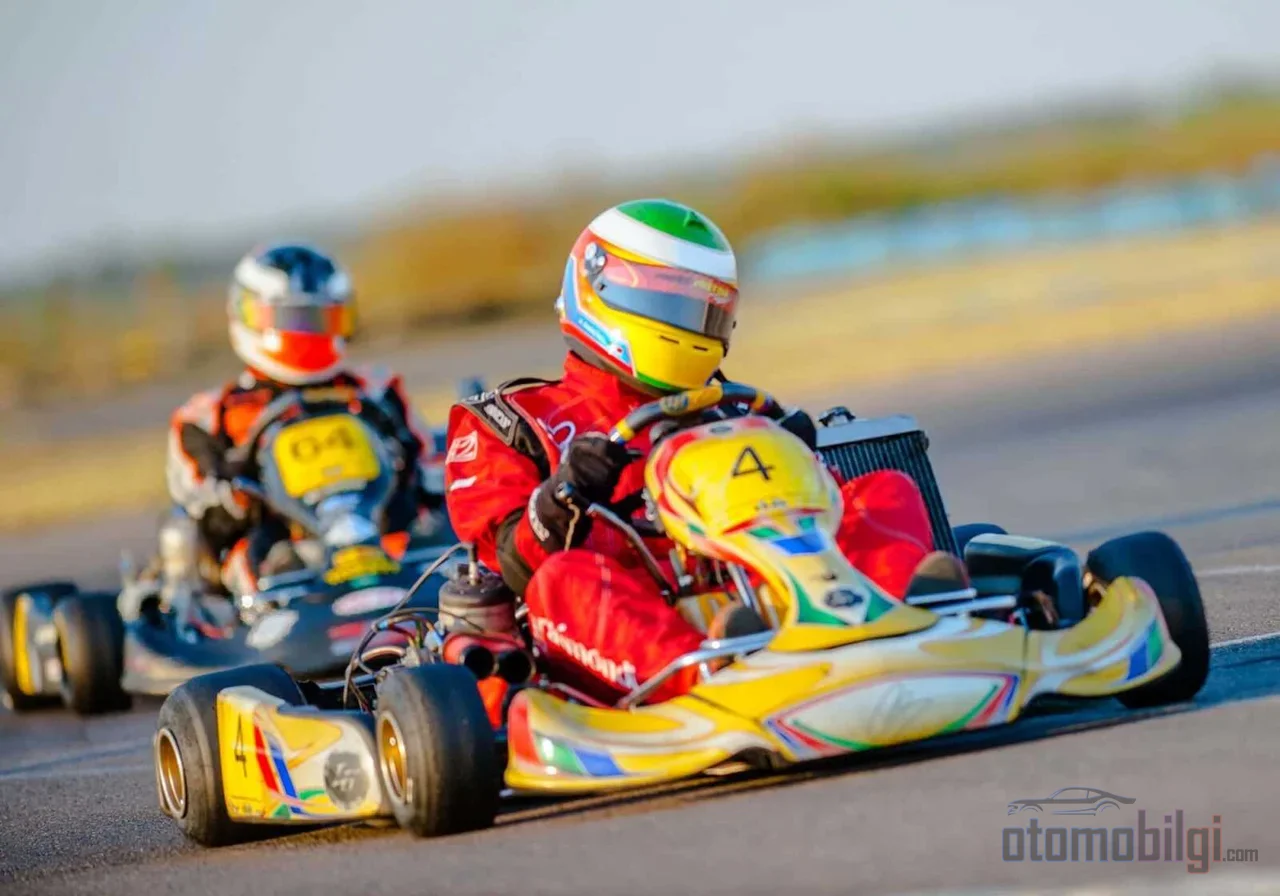
First, let's correct something: karting is not slow. Even on amateur tracks, the force the car presses on you in corners is bigger than you'd think. At the top level, things get truly crazy: in high-speed corners drivers constantly feel 4-5G , and on some tracks the peak reaches 6G. For example, at Mugello in 2020, a peak of 5.6G was recorded in the seventh corner over one lap - which means a force higher than what astronauts feel during rocket launches. Does that sound like an exaggeration? Imagine sitting in the corner of a vehicle that has raced a rocket.
Where does this force target? Mostly your neck. Your head alone weighs about 5 kg; add the helmet and the picture rises to 7 kg. At 6G, this arrives at the cervical spine as a 42 kg multi-directional load. In other words, your neck muscles have to resist as if something were being hurled at your face, and this isn't a one-time event - over a 90-minute race, the cumulative load managed by the neck stabilizers equals several thousand kilograms. That's why it's not at all rare for drivers to be unable to feel how the kart enters a corner in the last five laps of a race.
A moment of honesty: dedicated G-force measurements for karting itself are relatively limited compared to F1 data. So most of the numbers here come from the top categories; in karting, cornering forces are lower, but the mechanism is the same - you just experience a less intense version of it.
How Do Drivers Strengthen Their Neck Muscles?
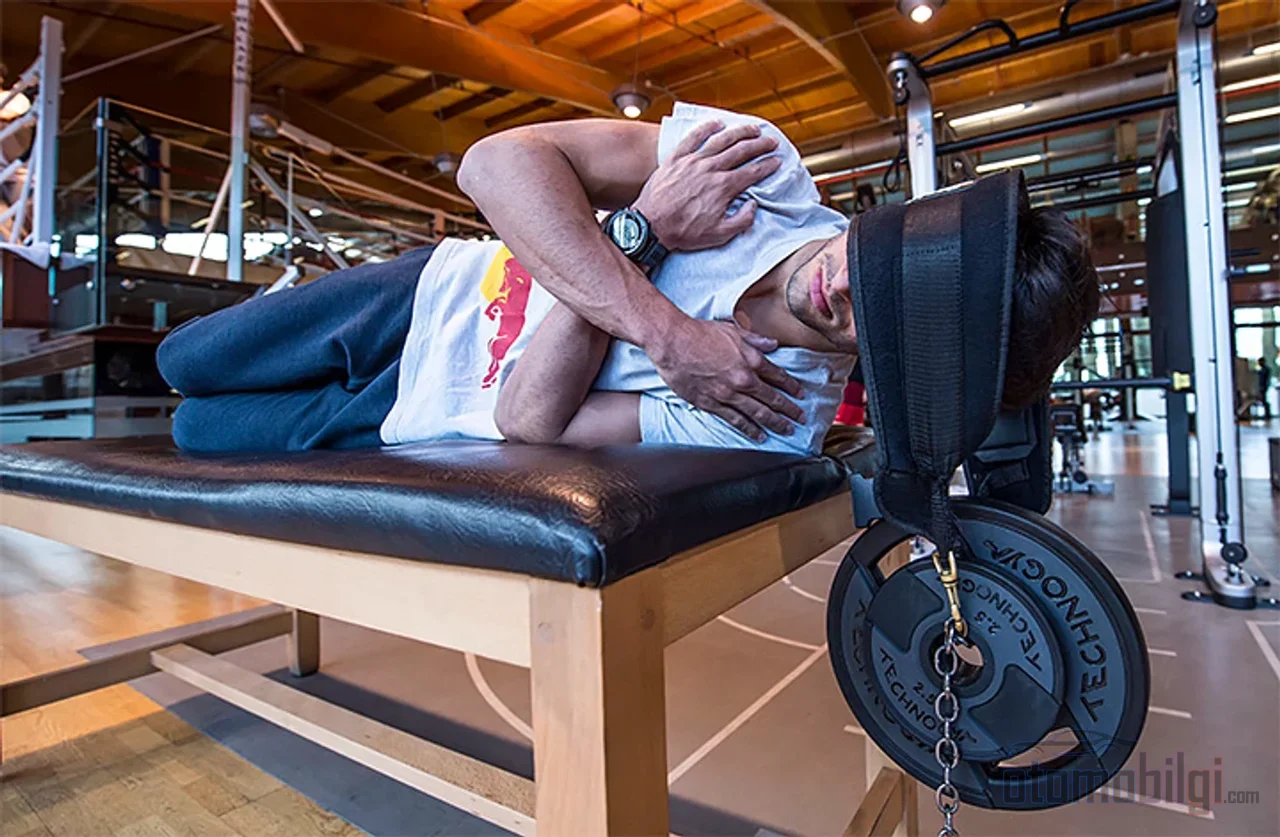
This is where the strength comes from, and this is exactly why neck training is stuck to drivers' daily routine. Top-level drivers do neck work almost every day; some say they train their neck at least 5 times a week. During the racing season, this drops to maintenance mode at 2-3 sessions a week. Think about it: if you train something every day, that thing is probably the first thing that could take you out of a race.
How do they work? The current approach centers on isometric holds. In other words, the muscles are forced to resist without moving - much like your head trying to stay fixed in place with your helmet through a corner. Popular protocols include the "F1 Hold" exercise, held for 30 seconds in four directions, 45-60 seconds figure-8 movements and anti-rotation holds. For hypertrophy, meaning muscle growth, 3-4 sets x 8-12 reps are recommended, while for endurance, 2-3 sets x 15-20 reps or 60-90 second timed sets are suggested. Resistance bands, weighted helmets, and special neck devices become the tools of the trade; with training, drivers can lift up to 40 kg with their neck muscles.
A veteran trainer's summarizing words go like this: "The real reason your neck is so important is that you need to see where you're going. It's all about precision..." In other words, the neck isn't a show-off muscle; if your head doesn't stay steady, you can't see the corner exit, and if you can't see it, you're late.
The real reason your neck is so important is that you need to see where you're going. It's all about precision...
Can You Train Your Neck Without Weights at Home?
Short answer: yes at a basic level, no at F1 level. Even without a resistance band, you can do isometric holds by applying counterforce to your head with your hand; this is enough to keep the neck muscles awake. But reaching the higher tier where you can handle that 42 kg load requires special equipment and structured training. A warning about old-school methods too: the exercise of placing a plate on your forehead and lifting your head in a push-up position is considered a mistake nowadays, because it works in a single plane and puts compressive load on the cervical spine. And the golden rule: every neck workout should be pain-free . Persistent stiffness, headaches originating from the neck, numbness spreading to the shoulder - all of these are red flags of overtraining.
Is Karting a Cardio Workout? The Heart Rate and Breathing Reality
During a race, drivers' heart rates 170 bpm can climb above - equivalent to someone running at a brisk pace on a treadmill, except you're sitting down and your hands are locked on the steering wheel. The fitness tests for top-level drivers are also serious: VO2 max measurement is performed, and in training the goal is to run at full throttle for 3 minutes and cover 900 meters . This isn't simple "just go run and get it over with" preparation; the view that endurance matters more than raw strength for karting is frequently voiced in karting communities too. Because maximum power output helps you for 5 seconds in a corner, but in a 20-minute final, endurance is what does the job.
In conditioning programs, the highlighted areas alongside the neck are the core meaning abdominal-region strength and stability, plus forearm and grip strength. There are also example routines that combine all of these: for instance, a top-level driver's kettlebell program includes reverse lunge press, front squat, kettlebell swing, thruster, sumo deadlift, and military press - 10 reps of each, with 2 minutes of rest between, for a total of 5 rounds. Karting-side examples are more modest but the logic is the same: a combined plan is recommended, such as cross-training with boxing, neck exercises, road running, and core work.
The Price of Sweat: Fluid Loss and Concentration
The unsung hero of karting is sweat. Cockpit temperature can exceed 60°C in some races, and drivers can lose up to 3 liters of fluid in a single race; some names report losses of up to 4 kg especially in hot and humid races. This is not just a karting problem: in a peer-reviewed study in motorsport, nine male drivers racing in hot conditions were measured to have a sweat rate of approximately 1.9 liters per hour, with body weight loss of about 2.3% measured. When short-race data are extrapolated to a 3-hour marathon, these figures become dazzling.
Why is this so important? Because the fluid you lose is not just sweat; it is the fuel of your concentration. Adequate hydration helps maintain your focus and supports your race strategy. In other words, if you start wondering "which corner am I in" in the middle of a race, your problem may be water, not the kart. That is why serious drivers plan their fluid intake before, during, and after races rather than doing it randomly.
Reflex Training: Tennis Ball and Agility Ladder
Karting is not just physical strength; it is also a game of eyes. Drivers work on four main reflex areas: reaction speed, peripheral vision development, shortening focus time, and hand-eye coordination. Simple but effective drills are used for this: having you try to catch two tennis balls dropped by a coach at eye level, 3 sets x 1 minute of tennis ball reaction wall exercise, and agility ladder drills. Cycling, running, and bodyweight exercises are also karting favorites on the endurance side.
Why the tennis ball? Because exactly the same reflex mechanism kicks in when the kart suddenly presents you with a corner on a different line. The kart does not wait for you; you either adapt or end up on the grass. A simple analogy from daily life: like someone holding a pot grabbing the brush next to them before burning their hand - a fast, short, and accurate reflex.
Do Amateur and Professional Drivers Have Different Training Routines?
In short, yes, and the difference is not only in intensity but also in priorities. On the professional side, maximum strength and isometric stability stand out, while in karting communities the view that general fitness and endurance matter more than raw power is widespread. Some recommend cycling and running instead of heavy weight training; F1 sources emphasize strength work such as squats, deadlifts, and pull-ups. The comparison below clarifies this distinction:
| Area | Amateur Approach | Professional / F1 Approach |
|---|---|---|
| Neck | Basic isometric holds, resistance band | 3-5 sessions per week, weighted helmet and special devices, lifting up to 40 kg |
| Cardio | Road running, cycling, cross-training with boxing | VO2 max test, 3-minute full-throttle 900 m run target, heart endurance above 170 bpm |
| General strength | Body weight, core work | Squat, deadlift, pull-up, kettlebell programs |
| Reflexes | Tennis ball drills, agility ladder | Eye-hand coordination, peripheral vision, focus duration exercises |
| Hydration | Water before and after the race | Planned replacement of up to 3 liters of loss per race |
And one practical question: how do you overcome the "my neck turned to cotton" condition after a race? The answer lies in training - regular neck work and adequate rest ease this condition. But if you overdo it, your body sends you a signal: persistent stiffness, headaches originating at the base of the skull, numbness spreading to the shoulder, a feeling of heaviness in the head. These mean it's time to rest.
How Do Young Karting Drivers Train in Türkiye?
In Türkiye, karting starts at a young age, and the training is done completely differently from adults. The common age categories are roughly as follows: 5-7 Kid Karts, 7-12 Cadet, 12-15 Junior, 15+ Senior and, at older ages, Master categories. In some countries, drivers start from age 6 with Bambino or Baby Kart; here, the FAT Karting League accepts ages 5-17 in age-appropriate classes. At these ages, the goal is not to prepare for a 42 kg neck load; it's play-based coordination, basic cardio habits, and reflex development. In other words, training for a 9-year-old driver is not a miniature of the adult routine - it's something entirely different.
And the field really confirms this: while names like 9-year-old Aras Pınar are standing out at the Türkiye Karting Championship, a 13-year-old driver in the mini category is drawing attention as Türkiye's third-ranked racer. The third round of the MOTUL 2026 Türkiye Karting Championship lasted two days hosted by Bursa Metropolitan Municipality, and the fourth round was held in Cappadocia with nearly 50 athletes across four categories; Ali Ersin Yücesan from Dynamic Racing Team won there with a lap time of 40.606 seconds. Additionally, young karting athlete Onur Müldür represented Türkiye at the FIA's Arrive and Drive World Cup, a world first in motorsport. In short, Türkiye's pool of young talent is full, and if these kids learn to grow their bodies the right way, the road to F1 can truly open up.
So whether you're racing in a final in Bursa or with your friends on a rental track, remember: in karting, the winner is not just the fastest, but the best prepared. Take your neck training seriously, plan your hydration, and don't skip your reflex drills. Be ready at the next corner.
Sources
- Neck workouts, cardio sessions and mental exercises – How to train like an F1 driver
- The Ultimate F1 Neck Training Workout: How to Build G-Force Resistance
- Hydration Status and Thermoregulatory Responses in Motorsports (Carlson et al., 2018)
- O-21 Hydration status and thermoregulatory responses in motorsports drivers during competitive racing
- How To Improve Reflexes – KartClass
- Training driver reflexes – VroomKart
- Karting Fitness: Why It's So Tiring and How to Train for It – Senndit
- What is your karting Fitness routine? – Reddit r/Karting
- How to Get Started Karting – Lehigh Valley Grand Prix
- Karting FAQs – Rules, Costs & Age Limits | FKL
- The Science of Hydration in Motorsports – Fluidlogic
- How Can I Become a Racer? – TOSFED
- MOTUL 2026 Türkiye Karting Championship Round 4 / Cappadocia
- Onur Müldür, FIA Arrive and Drive World Cup