What Do the Flags in Karting Mean?
Share This Page
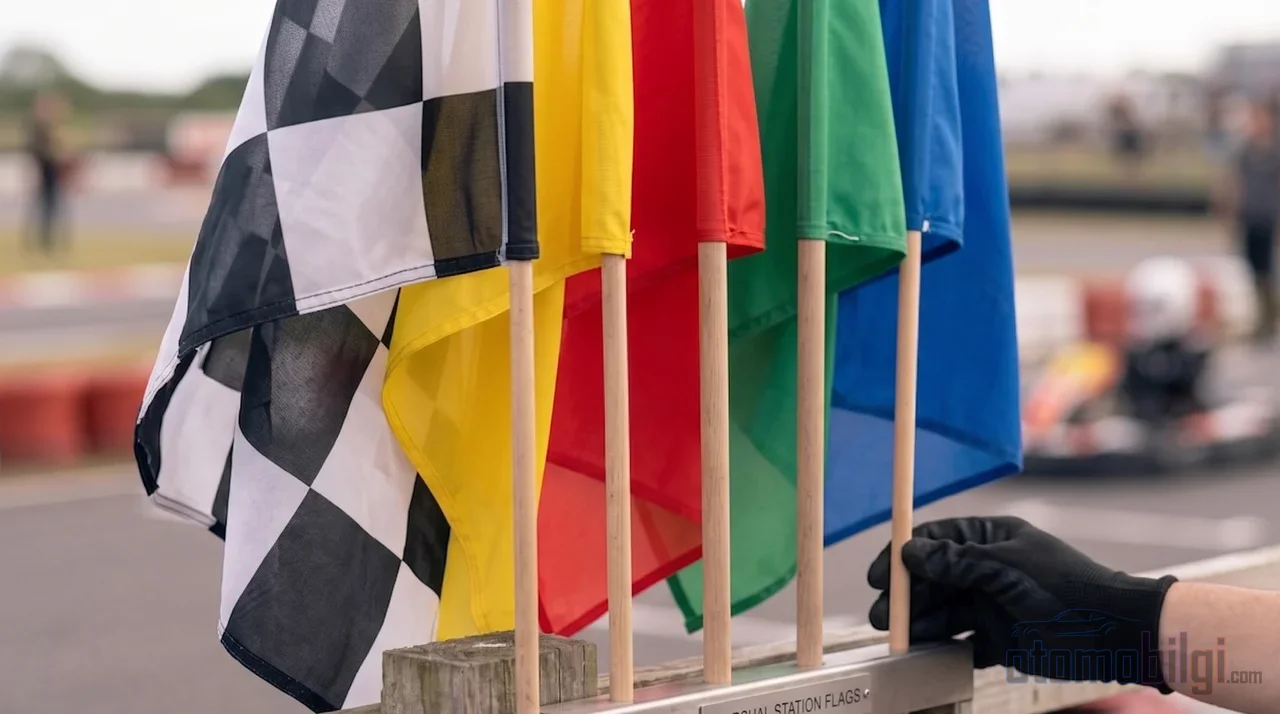
The flags at the karting track are a common language spoken between drivers and race marshals: green means start, yellow means danger, red means stop. Since, at the wheel of the kart you have your eyes glued to on the track, you can hear nothing but the engine noise and your earplugs, these visual signals are of vital importance; reading the flag correctly is the key to both your safety and avoiding penalties. Here we decode that language from start to finish, flag by flag.
Highlights
- In its 2026 regulations, the FIA defines 11 core racing flags .
- The yellow flag prohibits overtaking; at a stationary yellow, speed must be reduced to roughly 70% of normal pace.
- In a race, failing to see three blue flags triggers an automatic drive-through penalty.
- A driver who collects 12 penalty points in 12 months
- faces an automatic racing ban.
With its 2026 National Karting Rules, TOSFED officially applies the same flag language in Türkiye.
Think about it: you are wearing a helmet, the engine is making noise at around 90-100 decibels, and dozens of karts are circling around. In this environment, no one can explain the situation to you over the radio. Flags exist precisely for this reason; they are a silent safety system whose meaning you must know the moment you see them. Research also shows that optimized visual signal systems increase attention capture by 35.9% and hazard detection accuracy by 42.3%. In other words, that flag is not being waved for nothing.
One tip to keep in mind right from the start: a stationary flag means a general warning, while a waving flag means immediate danger. Interpreting a waving yellow as a stationary yellow is one of the most classic reasons novice drivers get penalties. The difference between the two flags is so great that one means slow down, while the other means be almost ready to stop.
What Do Karting Flags Mean? Meanings, Flag by Flag
| Flag | Meaning | What is required of you |
|---|---|---|
| Green | Track is clear, race is starting, or the yellow zone has ended | Return to normal racing pace |
| Yellow (single, stationary) | Danger at the edge of the track | Slow down noticeably, do not overtake |
| Yellow (double, waved) | Track fully or partially blocked | Slow down, be ready to stop |
| Red | Session immediately stopped | Slow down and return to the pits |
| Blue | A faster driver is lapping you | Let them pass as soon as possible |
| White | There is a very slow vehicle on the track | Caution, do not attempt to squeeze past it |
| Yellow-red striped | Slippery surface: oil, water, sand, debris | Do not rely on traction |
| Black | Disqualification / called to the pits | Return to the pit lane immediately |
| Black-white cross | Unsportsmanlike conduct warning | If you do not change your style, the black flag comes |
| Orange circle on black | Dangerous mechanical problem with your kart | Return to the pits immediately |
| Checkered | The race is over | Do a paced cooling-down lap |
Yellow flag: the track's red light bulb
A single waved yellow means danger at the edge of the track or in a section; you must slow down noticeably, not overtake, and be ready to react to something at any moment. A double waved yellow is the serious version: the track may be fully or partially blocked, slow down and be prepared to stop. According to the FIA standard, with a stationary yellow you are expected to reduce your speed to about 70% of the normal track pace. The overtaking ban lasts until the waved green flag after the danger has passed.
Red flag: the commander standing above everything
The moment you see the red, the session is considered stopped. Even if finishing a fast lap is one of your biggest dreams, the answer is clear: no, you cannot finish it. You must slow down and return to the pits or to the area indicated by the officials. The red flag is carried above all other signals; meaning there is no more debate about whether it was yellow or blue, once you see the red, everything ends.
Blue flag: the mirror of a track without mirrors
Since rental karts have no mirrors, the blue flag takes over its job: a faster driver is approaching to lap you and you are asked to give way. Without compromising the safety of the race, it is enough to hold a predictable line and make the pass easier; jumping onto the grass is both unnecessary and risky. If a driver is more than one lap behind, yielding to faster cars is mandatory. And let's add this on top: ignoring three blue flags during a race triggers an automatic drive-through penalty, that is, a pit lane pass. Giving way is free, not giving way is expensive.
The checkered flag and the classic rookie mistake
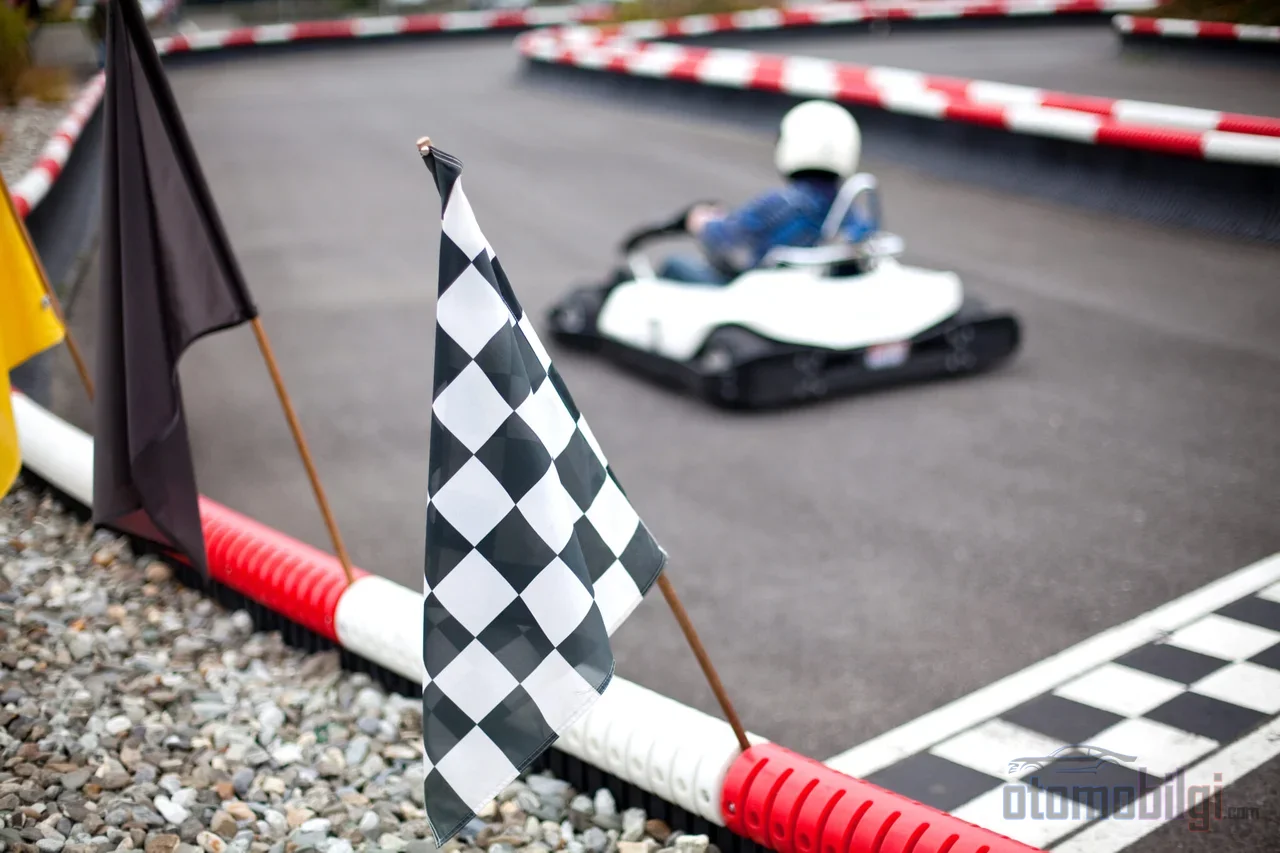
The checkered flag means the race or session has ended, followed by a controlled cooldown lap. Flooring the throttle the moment the checkered flag is waved is the classic rookie scene that makes everyone at the track laugh and shake their heads. The race is over, friend, take a breath.
The Penalty System: How Much Is a Flag Violation?
Misreading or ignoring a flag turns directly into a penalty in karting. According to the FIA's 2026 regulations, flag violations are recorded as penalty points, and a driver reaching 12 points within 12 months automatically faces a racing ban. So ignoring the flags may gain you a lap in the short term but can end your season.
The penalty spectrum is broad. The most common ones are:
- Time penalties: 5 or 10 second penalties added to race time, the most frequently applied sanction in motorsport.
- Drive-through: A penalty of passing through the pit lane without stopping; on a narrow track the loss is measured in positions, not seconds.
- Stop-go: A penalty of coming to a complete stop in the pits, the heavier older brother of the drive-through.
A jump start - that is, moving before the lights turn green to try to gain positions - is strictly forbidden in karting. An early start carries a 10-second penalty in the penalty catalogs, while shortening the track, i.e. shortcutting, carries a minimum of 5 seconds. Some regulations even define a false start very clearly: for example, in one national rule set, if the kart in the front row leaves its marked corridor with at least two tires before the start is released, it counts as a Type A false start. Even roughness on the approach to the starting grid can result in a false start penalty in some federations.
Going off track is not left in a void either. In F1, the rule is that the driver must use the track at all times and must not leave the track without a justified reason; violations are penalized with time penalties. In MotoGP, repeated violations can turn into a ride-through or a time penalty. These examples come from the world of Formula 1 and motorcycles, and are not an exact copy of karting; but the logic is the same. For karting specifically, off-track penalties are determined by the TOSFED National Karting Rules, and the penalties can be declared during the race as well as applied after the race upon review of reports and evidence. So when you enter the pits, don't forget to say "he passed us" - the stewards don't forget.
The Situation in Türkiye: Do TOSFED and FIA Speak the Same Language?
Yes, largely they do. Motorsport organizations in Türkiye are run according to FIA and CIK-FIA rules and regulations, and the National Karting Rules published by TOSFED in February 2026 bring this framework down to the local level. The rules cover incidents left to the discretion of the Board of Stewards, unsporting behavior, and actions that endanger race safety.
The blue flag is also clearly defined in TOSFED rules: the driver who sees the flag must, in a way that does not endanger the safety of the race, yield to the driver about to lap them as soon as possible. On the FIA Karting side, the 2026 Sporting Regulations, Technical Regulations, driving conduct rules, and flag signals used at observation posts are defined; the yellow flag there officially appears as a "danger signal." In short, a child stepping onto a rental track for the first time in Izmir and a driver competing in the European championship read the same visual language. That, to me, is the most beautiful thing about karting.
Does Every Track Apply the Same Rules? There Is No Universal System
Here's the part that will surprise you: flag meanings can vary between series. NASCAR does not use a plain black flag; there, the black-and-white cross flag means disqualification, and the yellow-and-red striped flag does not exist either, with the blue flag most often shown with a light. The white flag is the naughtiest one: on the FIA side it means "very slow vehicle on track," while in NASCAR and IndyCar it means "final lap." Same color, two different worlds, two different meanings. To avoid surprises at the track, knowing your series' own rules is a must.
Rented tracks, on the other hand, are not directly subject to FIA regulations; but they are not entirely rule-free either. Under the EU General Product Safety Regulation, if there is no national regulation, CIK-FIA standards and recognized flag guides are used as reference; in the event of an accident, the lack of a standard signaling system can be counted against the operator. In other words, even at the neighborhood track, flags have both a meaning and a sin.
How long is the yellow-red flag shown?
The slippery surface flag is shown for at least 4 laps after the hazard is identified, or until the hazard is removed. In other words, that flag may keep waving until the oil stain evaporates on its own; you too should learn to brake early compared to a straight, dry road in that area.
Practical Habits That Will Work at the Track
Even if flag knowledge is good in your head, you need to develop a few habits for it to work in practice. I think of these as a "to-do from day one" list:
- Scan the observation points on every lap; place the flag posts in your mind turn-by-turn.
- If your kart stops on track, first pull the kart off the racing line, and never cross the track on foot.
- Before changing your line in a slow section, always look behind you; there is no mirror, you are the mirror.
- Raise your hand when returning to the pits, and do not exceed walking speed on the pit lane.
There is also a psychological side: seeing a flag is not panic, it is information. A driver who, upon seeing yellow, can say "I am slowing down, I am not overtaking, I am ready" instead of "oh, what is happening," stays both safe and penalty-free. Race engineers read lap data; you should learn to read the track through flags.
A Driver Who Reads the Flags Is One Step Ahead
If karting is the school of motorsport, flags are the alphabet of that school. From green to checkered, every signal has a meaning and every violation has a price, and this alphabet is supported by a common set of rules from TOSFED in Türkiye and FIA and CIK-FIA worldwide. When you go to your next practice session, place the flag posts in your mind; after a few sessions, you will notice that you are reading the track with flags, steering, and reflexes all at once. That moment is the moment you truly start driving.
Sources
- Karting flags - meaning, rules, and track branding
- Racing Flags and Signals Explained: A Driver's Essential Guide
- Karting Flags: Meaning and Track Rules
- Racing flags
- National Karting Rules - TOSFED (2026)
- TOSFED Karting Endurance Cup Rules (2022)
- Sporting regulations - FIA Karting
- General Regulations - FIA Karting (2026)
- Flag signals in karting - ARKS (2025)
- Penalty Catalogue - IAME Motorsport (2025)
- Rule Changes - Motorsport UK (2019)
- MSA National ROK Karting Standing Supplementary Regulations (2024)
- The beginner's guide to F1 penalties - Formula1.com
- What Are MotoGP Track Limits?
- The Karting Classroom - Let's Discuss Penalties