Read the Listing Photos Carefully: Red Flags in a Used Car

Share This Page
In a used car listing, the photos tell more than the seller intends to convey. Omitted angles, scarves placed over the license plate, interior shots that are never shared, and a set of images giving no clue whatsoever about the underside of the chassis; they prompt you to ask concrete questions about the car's history before you go for an inspection. In this article, drawing on thirty years of observation, I explain the red flags that can be read from listing photos while you are still on the phone, which question each one should prompt, and in which situation the listing should be eliminated immediately.
Key Takeaways
- Front, rear, side and angled shots, along with interior, engine bay and trunk photos, are the standard of a good listing.
- Fender and bumper replacement can be detected from disassembly marks at the screw points and panel gap differences between parts.
- Sending an SMS to 5664 with the plate number for an damage history query costs 275.00 TL per query.
- The mileage check can be done free of charge through e-Devlet using the inspection records.
- In listings where no underbody image is provided, an underbody guard check at the inspection is indispensable.
What Does a Good Listing Look Like? The Benchmark for Recognizing Red Flags
To notice that something is missing, you first need to know what it looks like in its natural state. A listing that inspires confidence includes the front, rear, right and left sides of the exterior, the angled shots; as well as photos of the hood, roof, trunk, interior and engine bay. The industry's own sales guides recommend exactly this set to sellers; because the buyer examines the photos before even looking at the listing title. While years ago a car could be sold with a single poorly lit shot, today both platforms and buyers are far more meticulous.
Once you have this benchmark, the elimination process becomes easier: Every angle deliberately left out of the standard set means there is something the seller does not want to show. Blurry photos, overly processed studio-looking images, and listings that never show the interior are judged in the same category. In buyer forums, too, it is said that these are precisely the elements that undermine trust the most.
Avoided Shooting Angles: What Does Each Omission Mean?
Missing angles are no coincidence. Each one may be a choice concealing a problem in a specific area, and each one prompts a different question from the buyer.
- If there is no side angle: Paint differences, dents, or poor panel gaps on the door and fender surface may be hidden. The question to ask: Have the side panels been repaired?
- If there is no rear view: The trunk lid, rear bumper and rear panel are among the most frequently replaced areas on damaged vehicles. The question: Has the rear damage been recorded in the TRAMER registry?
- If there is no engine bay photo: There are experienced sellers who share the odometer reading, tire tread depth and an engine photo; not showing the engine raises a question mark about the maintenance history.
- If there is no interior at all: Upholstery wear gives a clue about the mileage. The absence of the steering wheel, gear knob, and pedals in the photos suggests there may be a discrepancy between the actual mileage and the listed mileage.
In such cases, the first step is not to immediately eliminate the listing, but to ask the seller for the missing photos. A vague, evasive, or nonexistent response means it is time to eliminate the listing. Regardless of the vehicle, the communication style is also a piece of data; I have seen it be this way for thirty years.
License Plate and Window Checks: The Transparency Test
A seller who covers the license plate with a scarf, paper, or digital editing in listing photos usually says they did it out of privacy concerns. There was a time when this practice was an absolute reason for elimination; the rationale was to prevent the accident history from being queried through insurance records. Today the picture has partly changed: Since a TRAMER query can also be done with the chassis number, a covered plate no longer completely blocks the inquiry. Even so, the principle of transparency still holds; the plate of a vehicle with nothing to hide can be shown.
The common sense here is this: A covered plate alone does not push a listing toward elimination, but when combined with other suspicious signs, it becomes a heavier concern. Compared with a listing that has an open plate, complete angles, and a visible interior, the bargaining power should be against the seller of the listing with the covered plate. The windows in the photos also offer clues: If the manufacturing year stamp on the glass does not match the vehicle's model year, it is clear that the glass has been replaced - and therefore there may have been repair in that area.
Signs of Replaced Parts on the Wheels, Bumpers, and Fenders
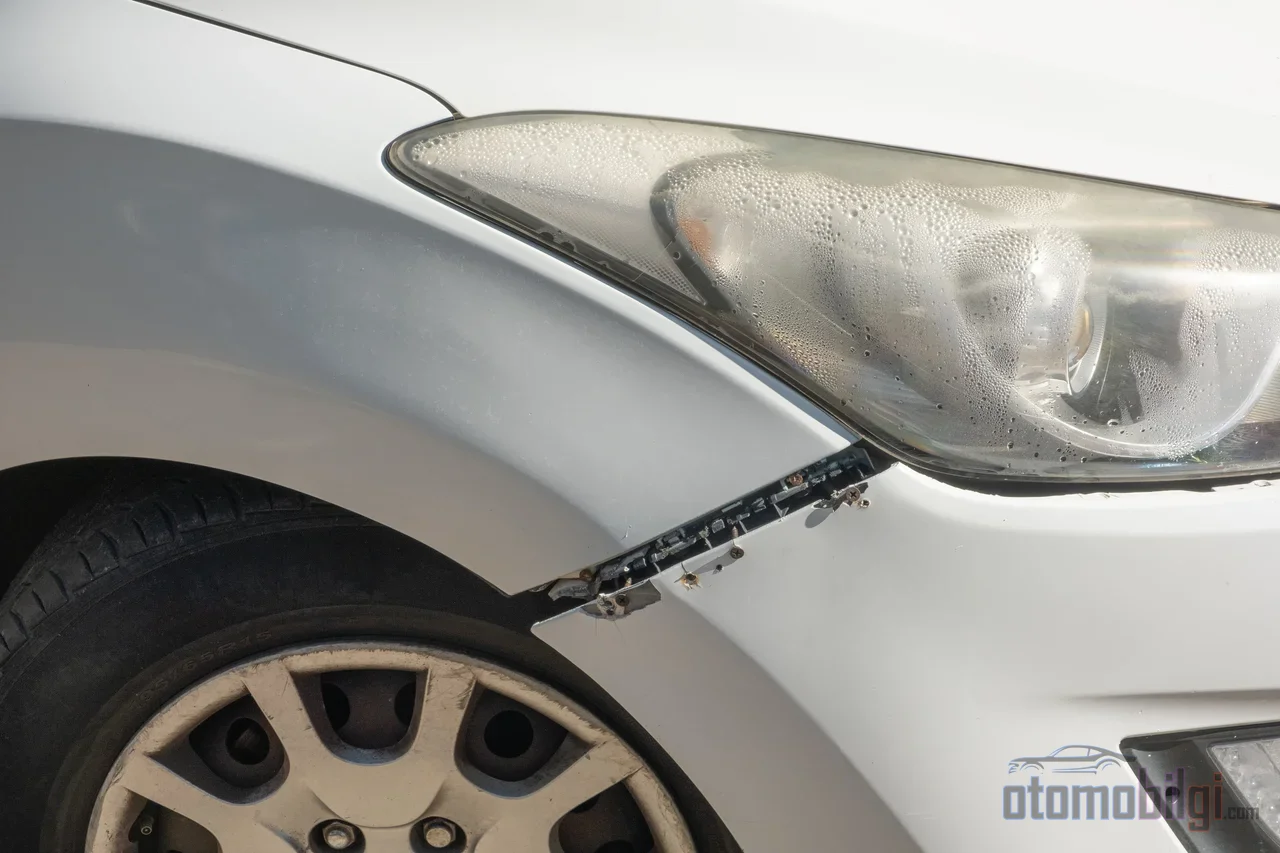
Detecting replaced parts used to be entirely the job of expert inspection; today, high-resolution listing photos carry part of this examination onto the phone. The points that experts have been checking for years are well known and can also be read from a photo.
Screws and connection points
If a fender or hood has been replaced, the removal and reinstallation process leaves marks on the screws and connection points. In a factory-original vehicle, these points are in original paint and appear untouched. If the photo shows paint loss, scratches, or file marks on a screw head, the part has been removed. The damage to the paint surface from removed screws is also the clearest indicator of cases where the part was not replaced but repaired.
Panel gaps and water marks
Panel gap is the joint space between body panels. These gaps, produced at the factory with millimetric consistency, become wider, narrower, or uneven on a reinstalled part. If the line between the hood and the fender appears broken in the photo, work may have been done in that area. Another clue is dirt and water marks: In an area where a part has been replaced, the dirt and water marks that form naturally on the vehicle's other areas are less visible. Even on a vehicle a few months old, marks are expected to form in some spots; a single panel that looks spotlessly clean raises suspicion. For this reason, pay extra attention in listing photos to overly shiny, overly clean areas that contrast with the vehicle's overall condition.
What does a replaced part mean in an inspection report?
Let's clarify this from the start: A replaced parts record in the inspection report means the relevant section was swapped with another part, not that it was repaired. Repaired and repainted sections are marked separately in the report. Knowing this distinction at the listing stage keeps you measured when comparing the seller's "no replaced parts" claim against the traces in the photos.
If There Is No Underbody Image: Why Is an Underbody Check Essential?
The natural limit of listing photos is the car's underside. The seller could technically take an underbody photo without a lift, but almost nobody does; this shortcoming alone should not be counted as a crime. The real issue is listings that provide no underbody images at all and whose photos portray the car's overall condition as exaggeratedly flawless. In this business, there is a category of trickery known as "inspection evasion": preventing the vehicle from entering the inspection by various means, or keeping the check incomplete. There have even been cases of a nearly unsellable car with tampered hood bolts being put on the market with an added chassis.
For this reason the rule is clear: Do not accept an inspection report without an underbody check. For every listing that provides no underbody images, make sure to state before the inspection appointment that this check will be performed. A seller who refuses the inspection or tries to restrict it verbally confirms the story the missing photos tell; at that point, the listing is eliminated immediately. There is also a basic safety check: comparing the engine and chassis numbers against the registration certificate is the most fundamental step against theft risk and can be done independently of an inspection.
Turning the Suspicions from the Photos into an Inquiry: 5664, e-Devlet and Inspections
Every red flag you read from the listing photos is a reason to take action; but on its own, it is not a verdict. Cross-checking suspicions with cheap methods before paying for an inspection is the most efficient step in this business. One must also be measured about trusting TRAMER records: Repairs not covered by comprehensive insurance may not appear in TRAMER; damages repaired at private shops do not get recorded. This gap is exactly what keeps listing photos important.
| Suspicion | Inquiry Method |
|---|---|
| Damage and TRAMER history | SMS with the plate to 5664; 275.00 TL per query |
| Mileage consistency | Inspection record query via e-Devlet, free of charge |
| Damage record from the plate | Damage inquiry services of listing platforms |
| Paint and replaced parts | Body paint inspection and paint measurement |
| Chassis and underbody | An inspection that includes an underbody check |
The SMS query format is simple: The vehicle's plate is written and sent to 5664 for detailed damage information. For mileage, the inspection station records on e-Devlet show the vehicle's mileage progression by year, free of charge. A car whose interior wear looks high in the photo but whose mileage is claimed to be low gives itself away in this query.
One final warning: Claims in the listing text such as "no paint, no replaced parts" should be cross-checked against the photographs. Examples of this trade include a car the seller called clean turning up at inspection with a scratched hood and a ten-centimeter paint reading, or service records showing a four-year-old car had never been to an authorized service center. A listing is merely an invitation that earns you the right to a conversation; the verdict is delivered at the inspection.
When Should You Eliminate? Practical Elimination Criteria
You need to be pragmatic during the pre-screening process; going to a full inspection for every suspicious listing is a waste of both time and money. I have kept the same criteria for years:
- If several items from the standard tool kit are missing and the seller will not complete them: eliminate.
- If there are no interior photos at all and the claimed mileage is low: do not proceed without questioning.
- If you see screw marks, damaged trim gaps, or a panel suspiciously cleaner than the rest in the photos: go to the inspection with these questions, or eliminate.
- If there is no data at all about the underbody: inspection conditional on an underbody guard check, otherwise eliminate.
- Overly edited, studio-looking images that give no detail: lower the trust score; eliminating the listing is a valid choice.
It is worth noting: from time to time there is an air of this meticulousness in the used car market not being for everyone; inexperienced buyers are sometimes advised to wait and buy a brand-new car if necessary. I do not agree. A buyer who knows the rules can get a far better car on the used market than new; as long as they start the elimination process not at the inspection door, but in front of the listing photos. Regulatory discussions that bring mandatory inspections onto the agenda will likely make this process partially easier soon; but until that day, the two minutes you spend reviewing photos on your screen is your cheapest insurance.
Sources
- What to Consider When Selling a Used Car? - Sixt Türkiye
- What to Consider When Buying a Used Car? - Toyota Blog
- How to Tell If a Car's Parts Have Been Replaced? - Lexus Türkiye
- Bodywork Paint Inspection - Bosch Car Service
- Inquiry via SMS - SBM (Insurance Information Center)
- Vehicle Damage Inquiry - sahibinden.com OTO360
- How to Check a Vehicle's Mileage - RS Oto Ekspertiz
- Tramer and Damage Record Inquiry by License Plate (2026 Guide) - Tenax Auto
- Used Car Buying Checklist 2026 - Otomerkezi.net
- How to Tell If a Part on a Car Has Been Replaced? - Arabam.com
- 20 Points to Consider in a Car Listing - mobile.tr
- How to Tell If a Car Has Replaced Parts? - Tan Oto
- How to Detect Paint and Replaced Parts on Cars? - İkinciyeni
- What to Consider When Buying a Used Car? - Araclo
- Things to consider when buying a used car - Ekşi Sözlük
- The 3 most common tricks used by sellers - DonanımHaber Forum
- Turn-offs when browsing car listings online - Reddit r/cars