What Happens to the Car While It's Airborne in Rallycross?
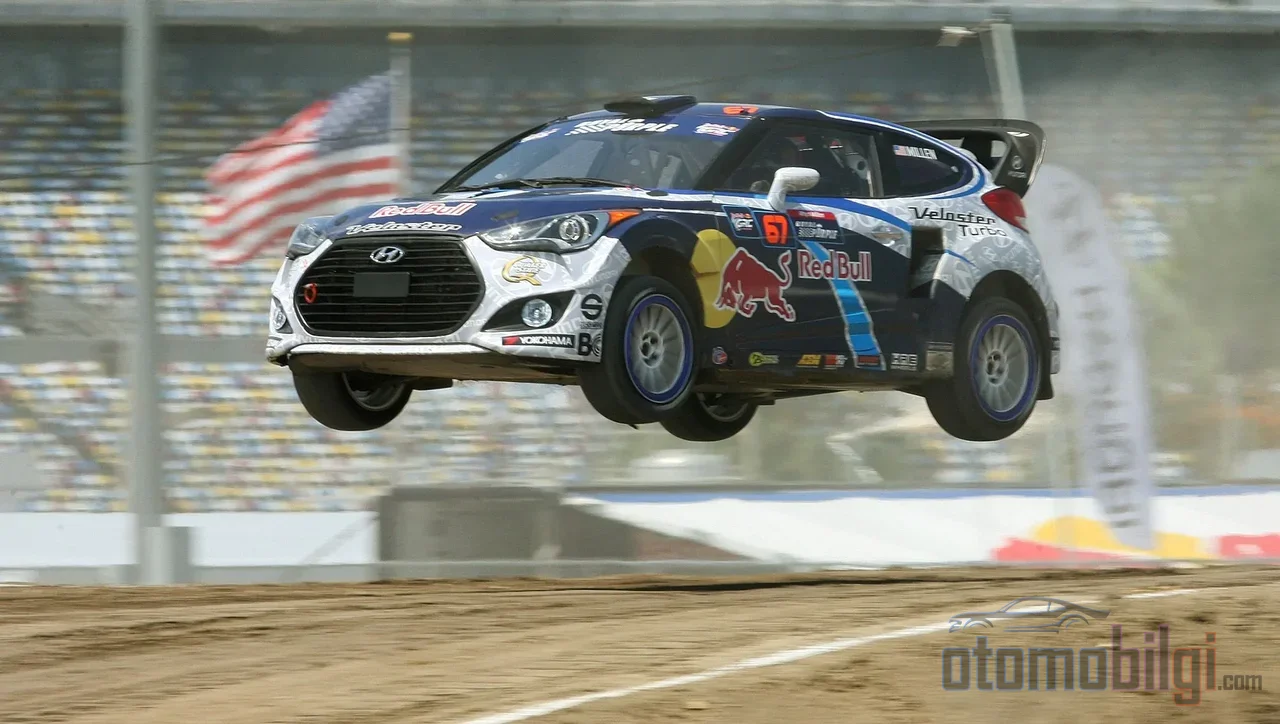
Everyone loves that marker exit on a rallycross track: throttle, a ramp, a slight load-up, and then the car, for a second... airborne. But have you ever thought about what's actually happening in those few seconds? Because the moment the car leaves the ground, a whole set of engineering calculations comes into play, and at landing they all face a one-time exam. One wrong landing can end an entire race in a second. Let's take a look behind the curtain of this flight.
Highlights
- When rally cars are airborne, throttle raises the nose, braking lowers it.
- Rally springs work with more force than those of street cars - over 100 pounds.
- For the legendary jump on the Holjes track in Sweden, getting the corner right first is essential.
- In the air, the steering's power is limited by the wheels' angular momentum.
- One study found that active suspension preload can change the takeoff pitch angle by up to +4 degrees.
Have You Ever Wondered Who's Really in Control of a Car Gliding Through the Air?
On the road, the connection between a car's tires and the ground is everything: steering, braking, throttle all work through that contact. But when a rallycross car takes off from a jump, that connection is broken and the car physically becomes a stage show. In the air there is no traction, no braking distance, no steering in the classic sense. So what's left? The car's own angular motions and the driver's art of directing those motions with just three inputs: throttle, brake, and steering.
Here's the interesting part: when the car is airborne, turning the steering wheel has its real effect not from the wheels themselves, but from the angular momentum those wheels carry while spinning. So when you turn the wheel, the front wheels rotate, and the momentum of that rotation can push the car's body slightly in the opposite direction. What we call "turning" in the air is actually a momentum balancing act. If you want an everyday-life comparison: think of lying down and swinging one leg in the air - your body drifts slightly the other way. The car version happens with tons of weight and at 100 km/h.
Throttle or Brake? Who Controls the Car's Nose in the Air?
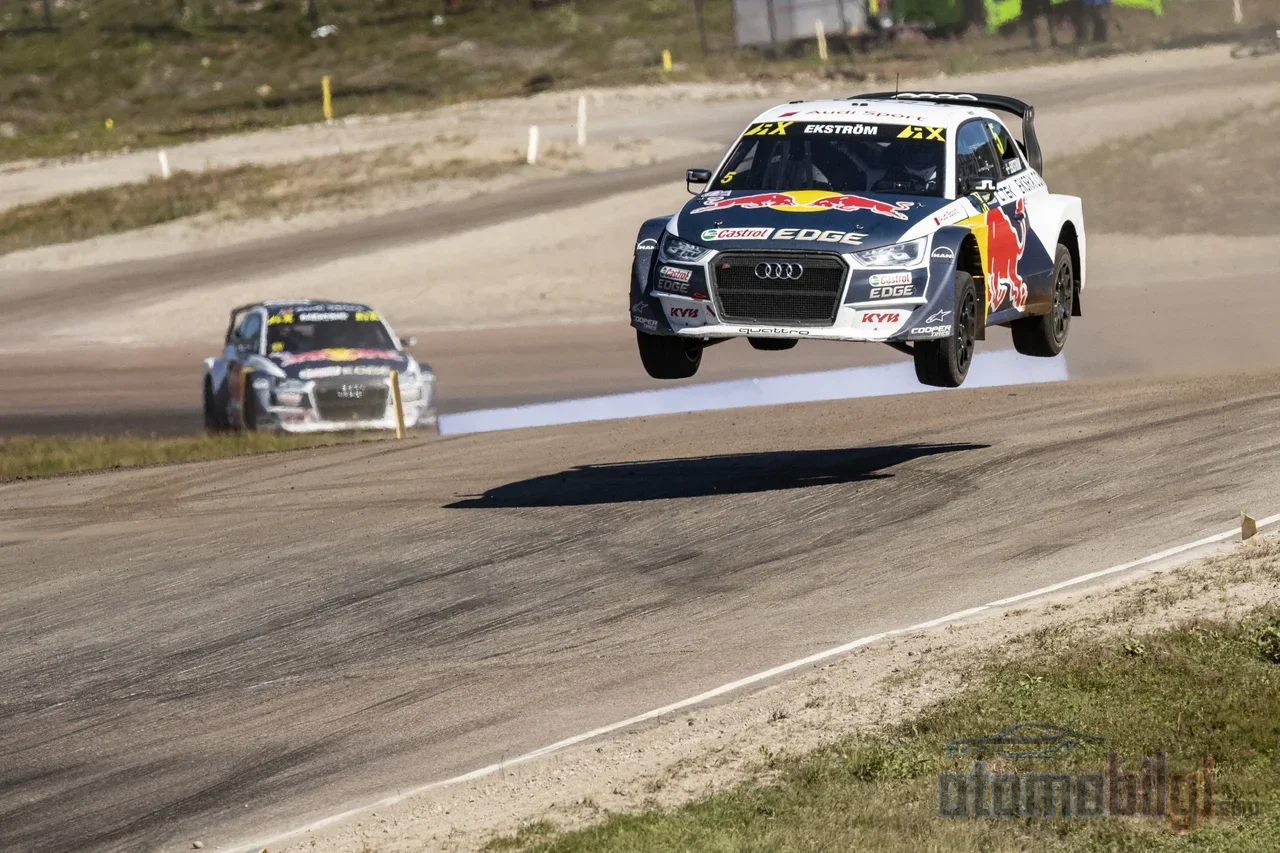
The golden rule of rally drivers is never to lift off the throttle entering a jump. Because if you release the throttle at takeoff, the car's weight shifts forward and the nose drops forward instead of rising; if you keep the throttle on, the weight stays at the rear and the nose lifts in a controlled angle. But what about once the car has taken to the air?
That's where the driver's secret remote control comes into play. Applying throttle speeds up the wheels and lifts the car's nose; when you press the brake, the wheels slow down, and this time the car's nose rotates downward. Just before landing, the driver uses the brake to set the nose at the angle they want - ideally that sweet position where the tires land nearly parallel. In the air, the steering also changes the attitude to some degree, but the real heroes are throttle and brake. That's why professional drivers map out the ramp and the section right after it in their minds before the jump; entering the landing prepared is half the flight.
There is no difficulty at all in learning this from motocross riders: they have been changing the takeoff trajectory by pre-compressing the suspension on the ramp surface for centuries (let's exaggerate a little, for decades). If you get the compression and release timing right, you can set the vehicle's nose angle at takeoff exactly as you wish. The research world is now formalizing this technique for full-scale cars: active suspension systems can pre-shape the takeoff pitch angle, pitch rate, and even wheel rotation by pre-loading the suspension on the ramp surface.
Why Does Suspension at the Moment of Takeoff Determine the Fate of the Jump Tomorrow?
The first act of the jump actually begins on the ramp. The position the suspension is in during the final millimeters before the vehicle leaves the ground determines the angle at which it will launch. There is an interesting detail in active suspension research: increasing spring travel consistently expands the takeoff pitch authority; for example, an increase in stroke from 33 mm to 67 mm can vary the takeoff angle progressively between +2.5 and +4 degrees. A suspension prepared with the front up and the rear down, on the other hand, can shift the vehicle's static nose angle by about 3.5 degrees.
But there is a crucial nuance here: it turned out that this front preload does not always pay off on landing. The same simulation study shows that the same front preload produces completely different results on a 35-degree ramp depending on speed - at some speeds it corrects the landing, at others it spoils it. So engineering has no magic "works in every situation" button; every track, every jump, and every speed demands its own calculation.
But what happens the moment the vehicle touches the ground on landing? That is when the suspension faces the toughest exam of its life.
How Does the Suspension Absorb the Loads at Landing?
When a vehicle hits a bump, its spring compresses; it releases the energy stored in the spring back out, but the thing that controls this oscillation is the real hero: the damper, in other words the shock absorber. Without shock absorbers, every rally car would turn into a trampoline traveling at 200 km/h - it would hit, bounce, and bounce again. That is why the rally world uses dampers and springs that are reinforced to a degree incomparable with those in everyday cars, with long travel. Rally springs often work with more than 100 pounds of force compared to those of street cars, and with a much longer travel distance; moreover, engineers have to factor in the lateral loads the springs are subjected to.
Damper tuning is not a single-button job either. There are two separate adjustment groups: low-speed compression and high-speed compression. For sudden, harsh impacts like jumps, the high-speed compression setting comes into play and regulates the rapid compression of the suspension; a softer setting pulls the vehicle's behavior in a completely different direction. On stages famous for their huge jumps, like the Finland and Sweden rallies, teams set up the car entirely for jumping. In rallycross, things are a bit more complicated: in the short, intense race format, while the driver chases big air, they also have to bear the risk of a part of the car breaking. A classic question circulates in this sport: which exceeds the limit first, the car or the driver? If the broken part wins, the race is over; if your car breaks, you cannot win by dropping out of the race.
The Most Dangerous Moment of the Landing: Touching Down Not at an Angle, But at the Wrong Angle
From the driver's perspective, the real nightmare is the car landing in a way that puts all the impact on a single wheel or the nose. Cars frequently touch down at a noticeable nose-down angle, and this either damages suspension components or costs the driver valuable seconds while waiting for the car to stabilize. In short rallycross races, every tenth of a second you lose is billed to you on the points table. The effect of landing slope on load dynamics has also been scientifically studied: a flatter landing surface directly changes the time the car spends in the air and the load it has to absorb on landing. In other words, every degree in the track design speaks to every damper setting on the car.
What Happens If You Apply Throttle While the Wheels Are in the Air? The Differential's Hidden Work
At the moment of landing, an interesting scene unfolds beneath the car: one or more of the wheels may not yet have touched the ground, but the driver's foot is on the throttle. In a driven race car, in this situation, distributing the power is entirely the job of the differentials. In four-wheel-drive World Rally Cars, the center differential distributes the power appropriately between the front and rear axles according to mechanical and electronic signals. Limited-slip differentials, meanwhile, allow each wheel to turn at its own speed while trying to prevent excessive free-spinning of a wheel carrying no load.
This is why race cars must be designed to handle situations where an inner wheel has almost zero grip - or even where the wheels are floating entirely in the air. When one wheel touches down first at the moment of landing, the differential kicks in to avoid wasting power on the wheel that, until that moment, had been spinning for free. From the driver's perspective, the difference can be summarized as follows: if you land with a good differential setup, the car keeps pushing you forward; if you land with a bad or wrong setup, the car momentarily feels like it is "spinning its wheels." In rallycross's short races, even that one momentary loss can shake up the running order.
Part of Jump Track Design, or an Engineering Test?
On rallycross tracks, the jump is no longer an ornament but one of the backbones of the design. In top-level series, every track features at least one jump, and these jumps define the rhythm of the track. At the FIA Rallycross World Cup's round in Indonesia, the 1376-meter lap includes a jump after the third corner; the legendary jump at Holjes, meanwhile, only gives serious air if you get the previous section and corner exactly right - in other words, the size of the jump is calculated together with the track's geometry and your racing line.
Track standards have not been left empty either: Track width is being discussed as a minimum of 10 and a maximum of 12 meters, along with rules such as jump entries and exits not being on the racing line and mandatory safety protection between the two courses. Elevation is also a design tool: At circuits like the Kymi Ring, an 18-meter elevation difference between the highest and lowest points provides a natural stage for jumps. Travis Pastrana's track project in Utah is described as a groundbreaking example in this sport, with a 100-foot gap jump, banked corners, and multiple routes.
How Quickly Can a Bad Landing End a Race?
All of this engineering is elegant but fragile. The archives of the racing world are full of painful examples of what a car that lands badly can do: there have been incidents where, in a rally crash, the suspension broke on corner exit and the driver effectively became a "passenger" as the car went out of control. In another dramatic incident, at a WRC stage, a wheel completely detached from the car due to the effect of landing and post-impact loading. In a Ford Puma Rally1, a brake caliper breaking off led to a mechanical failure. In the top level of rallycross history, crashes and rolls that ended with a red flag have not been erased from the archives either.
These examples show that a bad landing can end a race in four different ways: a suspension component breaking, a wheel or brake component detaching, the car going out of control, or the time the driver loses until the car stabilizes. In rallycross's format, where a race lasts only a few minutes, a mechanical failure in the third second means an unrecoverable outcome.
So What Was the Secret of the Car's Airtime in a Jump?
Returning to the initial question: the car takes off, and in those few seconds the suspension has set the takeoff angle, aerodynamic balance and damper settings manage the flight, the driver uses throttle and brake to prepare the nose for landing, and the differentials stand guard to send power to the right place along with the first wheel to touch the ground. A single jump is, in fact, the simultaneous exam of four engineering disciplines. In the next rallycross race, when the cars launch off that exit sign, you'll know what's going on - and I'm sure you'll never watch it the same way again. Would you, if it were you, still go full throttle onto that ramp?
Sources
- Vehicle Dynamics of a Jumping Rallycross Car
- DART-S: Reachability-Audited Active-Suspension Preconditioning for Off-Road Vehicle Jumps
- How dampers turn WRC cars into high fliers
- How to jump a rally car by Kalle Rovanperä
- How to jump a rally car
- Pastrana unveils new rallycross track plans
- The Science of the Red Bull Global Rallycross Jump
- Here's how a World Rally Car's center differential works
- Differential: Why Your Car Can Turn?
- What makes it a rally car? The suspension