Why Are 12-Volt Batteries in EVs Switching to LFP?

You've left your electric car at the charging station, the high-voltage battery pack ninety percent full. You return and the vehicle is completely unresponsive: the fob doesn't work, ignition doesn't respond, the car can't be driven and charging can't be started. The first thing most drivers blame is that huge main battery pack. Yet in reality, the part that strands the car is often the 12-volt auxiliary battery sitting in a corner of the trunk or engine bay, no different from a motorcycle battery. This small component has now found itself at the center of a quiet but critical architectural debate in the electric vehicle industry: lead-acid or lithium-iron-phosphate (LFP)?
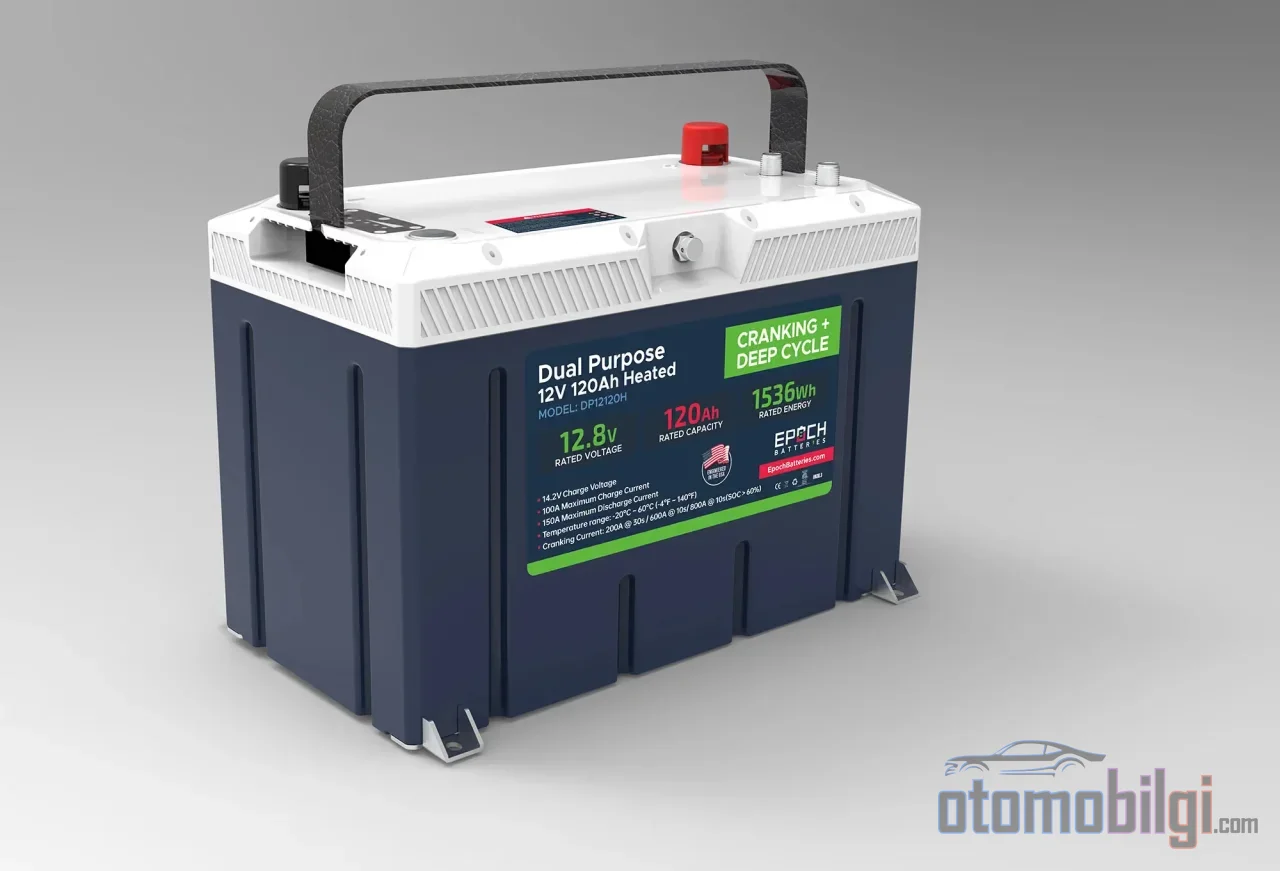
In this article, we will examine the transition of the 12-volt auxiliary battery in electric vehicles from lead-acid to LFP chemistry, why the 12.8 V voltage profile fits so well, the cold-weather limitations, and the risks trickle charging poses to LFP.
Why Is There a 12-Volt Battery When the Electric Vehicle Already Has a Big Battery?
All current electric vehicles run on two separate electrical systems. The first is the high-voltage system that provides propulsion: typically 400 V, increasingly at the 800 V level in next-generation platforms. The second is the familiar 12-volt system, identical to the one used in internal combustion vehicles for the past seven decades. All low-voltage loads, including infotainment, locks, windows, the HVAC fan, airbags and advanced driver assistance systems (ADAS), are powered by this second system. Powering the accessories directly from the 400 or 800 V pack would pose a serious safety problem; high voltage must be kept isolated from critical electronics.
The role of the 12-volt battery is not limited to this either. The power source for the contactor that disconnects the high-voltage pack in a collision is the 12-volt battery; meaning this small battery is an active safety component. For this reason, it cannot be eliminated even in a fully electric vehicle. Since there is no alternator in an electric vehicle, the 12-volt battery is charged by a DC-DC converter that steps down voltage from the high-voltage pack; the auxiliary battery is usually also charged while the vehicle is at a charging station.
Why Is the Lead-Acid Battery the Weak Link in an Electric Vehicle?
Lead-acid chemistry has a history of more than 100 years; it was used even in the first electric vehicles of the 1890s. Its ability to deliver peak currents of up to 500 A for 5 seconds in the cold is an ideal feature for the starter motor in internal combustion vehicles. In an electric vehicle, there is no starter motor and there is no need for this peak current capability. In other words, lead-acid's most valuable card is not on the table in an electric vehicle.
Highlights
- The nominal voltage of a 12-volt LFP battery is 12.8 V; about 3.55 V per cell at full charge, or ~14.6 V in a 4-cell pack.
- A single deep discharge (below 10.5 V) can permanently reduce lead-acid capacity by 20-50%.
- Lead-acid batteries typically offer a lifespan of 200-500 full cycles; LFP lasts several years longer.
- Below 0°C, the LFP charge current should be reduced to 0.1C, and below -10°C to 0.05C.
- Lithium batteries should not be trickle charged; an incompatible charging profile leads to overcharging.
The Problem of Deep Discharge and Cycle Life
Lead-acid's real weakness is its fragility against depth of discharge. A single deep discharge dropping below 10.5 Volts can cause permanent sulfation, reducing the battery's capacity by 20 to 50 percent. Repeated discharges below the 50% state of charge also systematically shorten its life; the deeper the discharge, the greater the damage. Most lead-acid batteries offer 200-500 full charge-discharge cycles. Also on the list are its limited usable capacity, its slow and inefficient charging, and the drop in effective capacity at high discharge currents known as Peukert losses.
In electric vehicles, the job becomes even harder. The 12 Volt batteries of EVs can see deeper cycling than their internal combustion counterparts, because they carry more accessory load and receive less opportunistic charging while driving. In addition, a very deep discharge can cause a risk of polarity reversal and cell failure in the weakest cell. The reason lead-acid has survived this long in electric vehicles is not technical superiority; it is the low cost, the fact that automotive approval processes take years, and the safe isolation of high voltage from critical systems.
The Penalty of Weight and Size
Lithium-based 12 Volt batteries offer a clear weight advantage over lead-acid, higher capacity in the same physical size, and a lifespan several years longer. This trio is a gain that cannot be ignored in efficiency-focused electric vehicle architecture. For this reason, some new EV designs have preferred to replace lead-acid with a much smaller and lighter, lower output current lithium-based battery.
Why Does LFP's 12.8 Volt Voltage Profile Fit Architecturally?
The technical key to the transition is voltage compatibility. The nominal voltage of the LiFePO4 battery sold as "12V" is actually about 12.8 V: each LFP cell is approximately 3.2 V nominal, and 4 cells connected in series give 12.8 V. Since the full charge voltage is about 3.55 V per cell, the full charge point of a 4-cell pack is about 14.6 V. These values practically overlap with the lead-acid battery's 12 V nominal / 14.4-14.7 V charging window. In other words, since LFP offers behavior comparable to the voltage profile of the lead-acid it replaces, it does not require the redesign of vehicle electronics. The system architecture stays the same, the chemistry inside changes.
Beyond voltage compatibility, LFP provides a notably stable voltage throughout discharge, offers more usable capacity, and charges faster. The chemistry itself is also safe: LFP cells remain stable up to 270°C, while in NMC chemistry the risk of thermal runaway begins above 210°C. Thermal resilience, combined with the safety-critical role of the low-voltage system, makes LFP a logical choice.
| Feature | Lead-Acid (AGM/EFB) | LFP (4 cells) |
|---|---|---|
| Nominal voltage | 12 V | ~12.8 V |
| Full charge voltage | ~14.4-14.7 V | ~14.6 V (3.55 V per cell) |
| Cycle life | 200-500 full cycles | Several years longer |
| Deep discharge tolerance | Low; risk of permanent damage | High |
| Weight | High | Significantly lower |
| Charging in cold | No problem | Restricted below 0°C |
The Limits of LFP Charging in Cold Weather
The only serious drawback of LFP is its charging behavior in cold weather. Below 0°C, the charging current must be reduced to 0.1C, and below -10°C to 0.05C. Below approximately -4°C, the battery should not be charged unless it has internal heating. The reason is mechanical: charging below 0°C leads to the accumulation of metallic lithium on the anode surface, known as lithium plating; this accumulation results in both permanent capacity loss and a safety risk. The solution is either to heat the battery before charging or to use a special cold-weather charging solution.
On the other hand, the generalization that "LFP is bad in cold weather" varies depending on the formulation. LFP batteries formulated for cold weather can reach a charging rate of approximately 1C even at -30°C, which is twice that of lead-acid. The problem is not the chemistry itself, but that standard cells are not optimized for these conditions. There is also an important practical warning: most cheap LFP batteries on the market may lack cold-weather charging protection in their BMS. Peer-reviewed research also shows that fast charging causes noticeable degradation in LFP, especially in cold climates, and that most of this wear occurs in the initial phase of fast charging.
Trickle Charging: Why Is It Risky for LFP?
In the lead-acid world, trickle charging, meaning continuously supplying a small current to the battery regardless of its state of charge, is a standard maintenance practice. In the lithium world, however, quite the opposite rule applies: lithium batteries should never be trickle charged. The reason is the fundamental difference in charging profiles. Lead-acid tolerates being held at low voltage for long periods; LFP, on the other hand, produces permanent deviations in cell voltage balance.
Charging with a trickle charger not designed for LFP can lead to overcharging or direct damage due to the different charging profiles. For this reason, quality LFP batteries are protected with an internal BMS, and unless both the charger and the BMS are specifically designed for continuous charging, float or trickle charging should be avoided. In the context of electric vehicles, the matter is practical: parasitic currents can drop a 40 Ah AGM battery to a voltage level that will trigger the vehicle's failure-to-start condition within as short a period as a week. Among EV owners with lead-acid auxiliary batteries, a recommendation circulates for 48 hours of trickle charging when the battery drops to 12.0 V; this is not a manufacturer instruction but a practice based on community experience, and it applies only to lead-acid. In a vehicle with LFP, it is essential that the DC-DC converter and the BMS operate with the correct profile; an external trickle charger can only be considered if the device and the battery are compatible.
What Happens to the Vehicle If the 12 Volt Battery Dies?
When the auxiliary battery dies, the situation is harsh: the high-voltage contactors cannot close, the ignition button does not respond, the drive system cannot be started, and the vehicle may not be able to charge. Even if the main battery is full, the vehicle may appear completely unresponsive. The good news is that, since it is a standard 12 V system, it can be jump-started with jumper cables or a booster pack. User experiences make the picture concrete: cases such as the auxiliary battery being drained after a two-hour park have been reported; if the system does not manage the battery well, replacement remains only a short-term fix, as the new one gets drained the same way. In some vehicles a faulty auxiliary battery does not completely stop driving, but it reveals itself with symptoms such as an auxiliary battery fault warning.
Conclusion: Is the Transition Logical, and Who Is Moving Further Ahead?
The clear answer to the question is this: LFP, with its 12.8 V nominal voltage and full-charge window of around 14.6 V, fits almost perfectly into the existing 12-volt architecture; in return, it eliminates lead-acid's deep-discharge fragility, its 200-500 cycle lifespan, and its weight penalty. The price is paid under two conditions: charging below 0°C requires current limitation and internal heating, and a charging regime without trickle charging, controlled by the BMS, must be followed.
Two trends are progressing in parallel in the industry. On the one hand, manufacturers are replacing lead-acid with smaller and lighter lithium-based batteries; it is known that a transition to 12/16-volt lithium has been made in some new EV designs, and that the manufacturers turning to lithium on the low-voltage side are not few. On the other hand, power supply solutions that completely eliminate the 12-volt battery by feeding directly from high voltage through DC-DC conversion are also being proposed; but a separate 12 V battery continues to be the dominant solution in terms of simplicity, safety, and compatibility with existing electronics. While sodium-ion and solid-state technologies are moving from the lab to the market on the main pack side, the transition from lead-acid to LFP in the secondary battery world is also a quiet but determined step in the maturing of electric vehicle architecture.
Sources
- Why Do Fully Electric Vehicles Still Have a 12V Battery in Them?
- Why Do EVs Still Need 12 V Lead-Acid Batteries?
- Switching from Lead Acid to Lithium in an RV
- Understanding Temperature Limits of LiFePO4 Batteries
- How do LiFePO4 batteries perform in cold temperatures?
- The Comprehensive Guide to LiFePO4 Voltage Chart
- Is a Deep Discharge Really That Damaging?
- Can You Charge a Lithium Battery with a Trickle Charger