Why Can't Robotized Transmissions Be Fully Automatic in Any Class?
Share This Page
A robotized (AMT) transmission is a design that takes over the clutch and gear operations of a classic manual gearbox with electrohydraulic or electromechanical actuators; since it remains fully manual in terms of hardware, it interrupts drive during gear changes and therefore cannot offer true full-automatic comfort in any vehicle class. The problem is not software or durability, but the physical limit of the single-clutch architecture: it cannot shift gears without interrupting the power flow.
Highlights
- AMT is the automated version of a manual transmission with actuators; its gear layout is exactly the same as a manual.
- Because of the single clutch, the power flow is briefly interrupted at every gear change; this is the main source of the jolt.
- The DCT was developed precisely to eliminate this delay; torque converter automatics, on the other hand, use a smooth fluid coupling instead of a clutch.
- The reason AMT survives is cost: it can be produced noticeably more cheaply than automatics and CVTs.
- In the heavy truck segment, AMTs such as the Volvo I-Shift and ZF AS Tronic have become the standard.
How Exactly Does AMT Work?
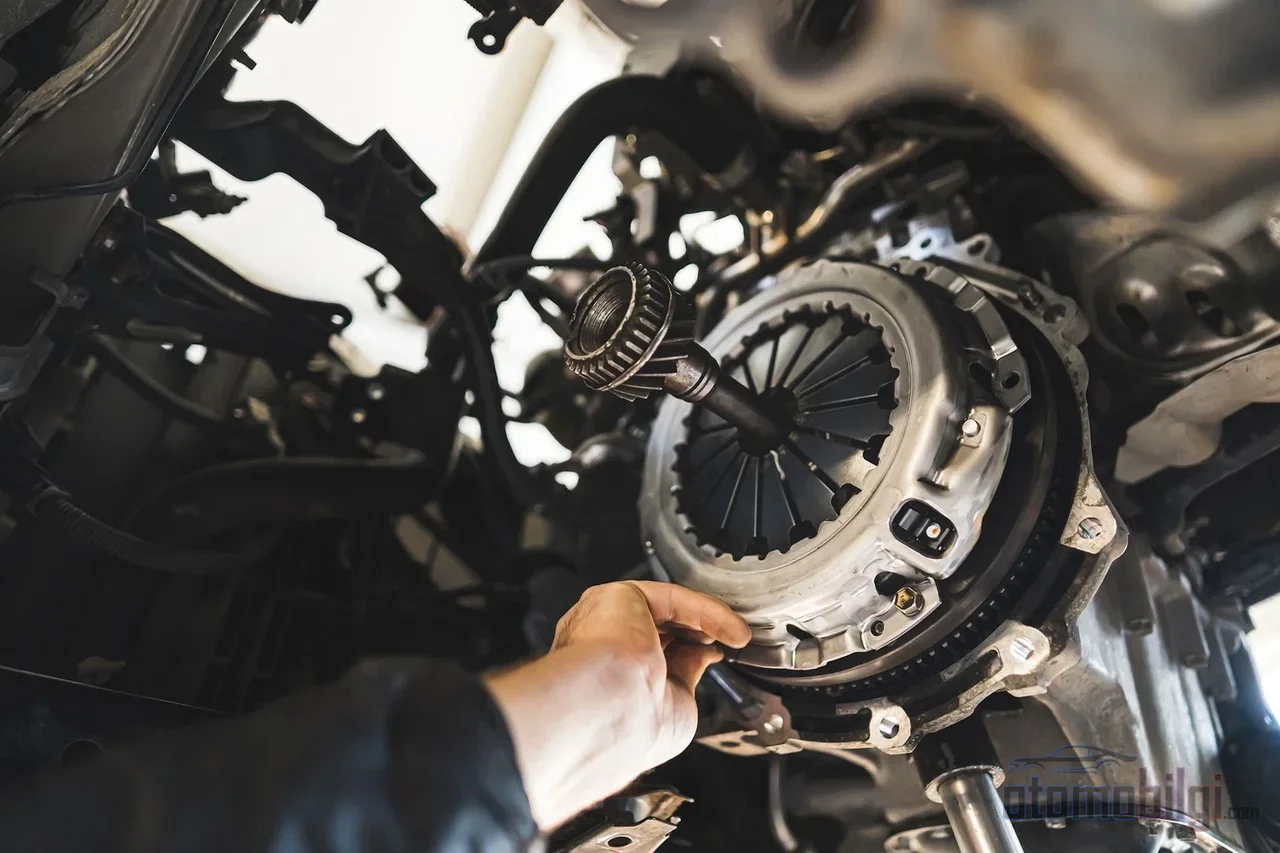
Inside an AMT, there are fixed gears and a single clutch, just like in any manual car you have driven. The difference lies in who controls these parts. There is no clutch pedal; solenoids and actuators squeeze and release the clutch. The decision to change gears is made by a transmission control unit that gathers data from sensors; after disengaging the clutch and shifting into gear, the system automatically matches the throttle to re-engage drive.
There is more than one way to automate the clutch: electrohydraulic, electromechanical, pneumatic, electromagnetic, or fully electric-motor actuation. Of these, electromechanical actuators are cheaper but generally limited to 250 N·m of input torque; electrohydraulic systems are more expensive, faster, and suitable for high torque. Modern examples work together with electronic throttle control and trigger gear changes based on specific engine speed and throttle position values.
The hardware difference is not cosmetic
A classic automatic transmission uses planetary gear sets; AMT, on the other hand, carries fixed gears like a manual. So the difference between the two is not just "the same box with different software." AMT is an automated manual gearbox, while a classic automatic is a completely different mechanical architecture from start to finish. This distinction is exactly the source of the driving roughness I will describe later on.
Where Did the Idea Come From? A Brief History
The idea of a clutchless manual dates back to the 1940s: the 1942 Drive-Master system of the Hudson Commodore offered a vacuum-operated clutch. In 1955 the Citroën DS arrived with the BVH hydraulic automatic clutch, and in 1956 the Renault Dauphine tried the Ferlec with an electromagnetic clutch. The 1967 Porsche 911 Sportomatic and the 1968 VW Autostick were also extensions of the same idea.
You have to wait until 1984 for a truly modern AMT, and for the NAVi5 with hydraulic actuators adapted from trucks in the Isuzu Aska. Then came the performance world's turn: The paddle-shift gearbox of the Ferrari 640 F1 in 1989, the SMG of the Ferrari F355 F1 and BMW E36 M3 in 1997, and the Alfa Romeo 156 Selespeed in 1999. The SMG-III of the E60 M5 between 2004 and 2010 could achieve shift times as fast as 65 milliseconds in its most aggressive mode. The E-gear of the Lamborghini Gallardo and the R-tronic of the Audi R8 were also members of the same family. The bottom line: AMTs were once used even in supercars, but today their main homeland is budget cars and heavy commercial vehicles.
The Engineering Explanation of Jerkiness and Delay
A gear change consists of three steps: disengage the clutch, change the gear, and smoothly re-engage the clutch. In a single-clutch setup, the moment the first step begins, the engine's power cannot reach the wheels; the power flow is physically cut off. The system's software tries to shorten this interruption and soften the clutch's engagement moment, but the timing is limited by what software can predict. If the clutch misses perfect synchronization by a few milliseconds while engaging, the driver and passengers feel it as a jerk. The fact that small AMT-equipped cars like the Smart fortwo leave users with a "slow and jerky" impression is no coincidence.
In practice, there is also a way to reduce this flaw: letting off the gas patiently or switching the transmission to manual mode when necessary. This method works especially well in diesel AMTs; when you make the gear decision yourself, the system's hesitation time disappears. But this doesn't eliminate the problem - it merely papers over it.
How Did the DCT and Torque Converter Solve the Problem?
The dual-clutch transmission (DCT) was born to overcome the weak point of the single-clutch automatic: it is essentially two separate transmissions connected to each other. One carries the odd and even gears, while the other carries the intermediate gears; while driving in one gear, the next gear is already ready on the second clutch. A gear change is simply the clutches transferring the load to each other within milliseconds, which is why the hesitation and jerkiness largely disappear. Let's add that the DCT is not perfect either: in some users it can create a feeling of delay in first gear, and its traction character can be reminiscent of an AMT.
The torque converter automatic, on the other hand, solves the problem from a different corner: instead of a clutch, it uses a fluid-filled, slippery connection between the engine and the transmission. This structure naturally softens the harsh engagement seen in AMTs; no harsh jolt is felt during gear changes. The comparative summary is as follows: AMT is the cheapest, CVT is the smoothest in city use, the torque converter automatic is the reliable all-purpose solution, and the DCT is the performance-oriented, versatile choice. The single-clutch automatic, meanwhile, offers an experience below the manual's driving pleasure, the torque converter's smoothness, and the DCT's speed.
| Transmission | Clutch / connection | Gear change | Standout feature |
|---|---|---|---|
| AMT | Single clutch, actuator-controlled | Traction is cut | Lowest cost |
| DCT | Dual-clutch pack | Nearly seamless | Performance-oriented |
| Torque converter | Fluid coupling | Smooth | General-purpose, reliable |
| CVT | Belt/variator | No gears | Smoothest in the city |
Why Are They Still Being Produced? The Economy Answer
The answer is simple: cost. AMTs are significantly cheaper to produce compared to classic automatics and CVTs; that is why they have kept their place in Europe's small cars and in developing markets like India. They are mechanically simple and reliable, maintenance costs are low, and they try to combine the efficiency of a manual with automatic comfort. Low production cost makes them the favorite of budget cars; on the other hand, in city traffic the single clutch disk constantly working in half-engagement has a short life - a trade-off you need to know.
The truck side is a whole different story
In heavy commercial vehicles, AMTs are now the standard: Volvo I-Shift since 2001, ZF AS Tronic since 2003, plus Eaton AutoShift, Mack mDRIVE since 2010 and Daimler DT12 since 2012 on the roads. Here, the value of an AMT is not comfort but shifting gears knowing exactly when to do so: the system improves fuel economy because it shifts faster and at a more accurate moment than most human drivers. There is also an interesting nuance: Eaton Cummins notes that in the heavy truck segment, AMTs can be more expensive than manuals for performance purposes; that is, the perception of a "cheap transmission" changes from class to class.
Maintenance and Failure Perspective
The mechanical simplicity of an AMT provides a reliability advantage, but the weak link of the system is the actuators and sensors that control the clutch. Symptoms of a clutch actuator failure are irregular clutch behavior, difficulty in gear changes, and unusual noises during clutch operation. In commercial fleet maintenance literature, AMT clutch failures appear as intermittent errors, random gear problems, communication breakdowns, or actuator/sensor failures; systematic diagnosis is essential. In older examples, Toyota Corolla MMT boxes slipping into neutral while driving and smart fortwo actuator problems are among the known faults of this family. The advantage compared to a conventional automatic is this: the fault is usually sought not in the gear set but in the actuator and electronics, which narrows the diagnosis.
When Does an AMT Make a Sensible Choice?
If I list your decision criteria: If budget is your first priority and your usage is not stop-and-go traffic, an AMT is a cheap and efficient automation solution. If the judder is unacceptable to you, look at a torque-converter automatic; if performance and speed are your priority, look at a DCT; if you want fluidity in the city, the CVT finds its place on the list. On the truck side, the debate is closed: in the balance of fuel economy and driver fatigue, the AMT is the clear winner.
One final context note: As of 2026, only 24 models in the US new car market still offer a manual transmission option. AMTs were crushed in this process; By the 2010s they were largely eroded by DCTs, and today they survive mainly in small city cars and emerging markets. The sentence "not fully automatic in any class" is not a legitimate death certificate for single-clutch architecture, but a summary of correct positioning: AMT is a cost solution that makes no comfort claims - and in that role, it still does its job.
Sources
- Automated manual transmission - Wikipedia
- Automated Manual Transmission (AMT) - x-engineer.org
- What is an automated manual transmission in a semi-truck? - Schneider
- What is an Automated Manual Transmission? - Detroit Diesel
- Automated vs. Manual Transmissions - Eaton Cummins
- AMT vs CVT vs Torque Converter vs DCT - Autofy Store
- Why Choose a Dual Clutch Instead of a Single Clutch? - Clutch Masters
- How DSG Works - LiveAbout
- Common AMT clutch problems - Fleet Maintenance
- Understanding Clutch Actuator Technology - Kaige Auto
- Should we approach AMTs as manuals instead of automatics? - Team-BHP
- Every New Car You Can Still Buy with a Manual Transmission - Car and Driver