Why Did the First Series-Production Plug-in Hybrid Find Only 48 Buyers a Year?
Share This Page
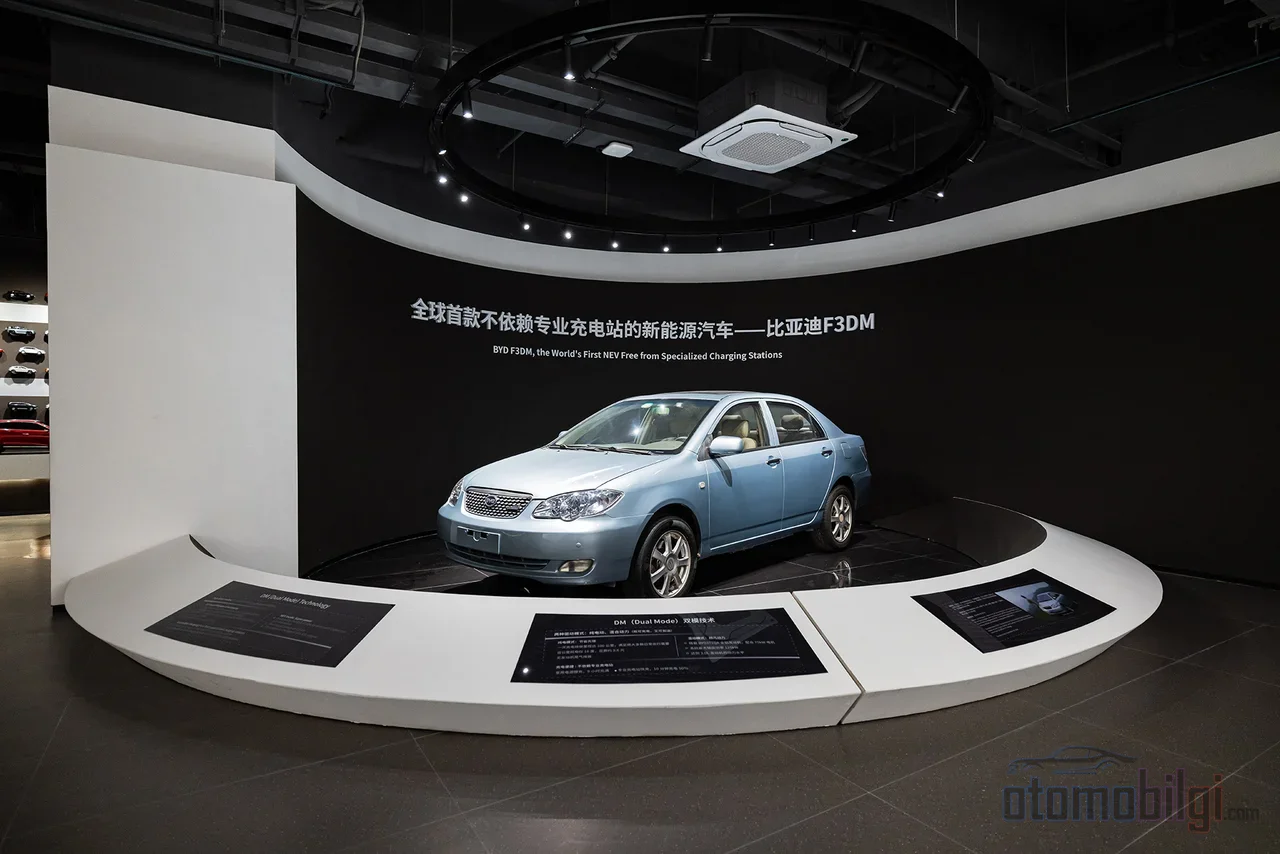
The world's first mass-produced plug-in hybrid car is the BYD F3DM, which went on sale in China on December 15, 2008; yet this technical pioneer sold only 48 units in its first year, going down in history as a textbook example of commercial failure. A high price, a nearly nonexistent charging infrastructure, and an unprepared market turned the engineering breakthrough into a fiasco. This article explains why that first step made such a weak impact, and how the same technology grew to 7.2 million units per year by 2025.
Key Highlights
- First mass-produced plug-in hybrid: BYD F3DM, December 15, 2008
- First-year (2009) sales: 48 units, all corporate and public-sector customers
- Launch price: 149,800 yuan (~21,900 USD) - nearly three times the price of the gasoline F3
- Battery: 16 kWh LiFePO4 pack, 60 km electric range
- PHEV sales: from 450 units in 2010 to 7.2 million units in 2025
BYD F3DM: The First Mass-Produced Car You Could Charge from a Wall Outlet
The letters "DM" in the F3DM name stand for Dual Mode: the vehicle could run in fully electric mode as well as switch to a gasoline range-extender mode. In its first year, BYD offered the car only to government agencies and companies; sales to the general public only began in March 2010 in Shenzhen. This phased rollout reflected a manufacturer's cautious approach - scaling up battery production on one hand while managing safety and legal issues on the other.
The numbers are striking when viewed from today: The F3DM ended production in China with 3,284 units built between 2008 and 2013. Sales progressed by year as follows:
| Period | Sales | Notes |
|---|---|---|
| 2009 (first year) | 48 units | Corporate and public-sector customers only |
| 2010 | 417 units | Opened to the public in Shenzhen in March; 28 units in the first three months |
| 2011 | 613 units | US retail launch postponed in October |
| 2012 | 1,201 units | Total sales in Europe only 11 units (through October 2012) |
| 2013 | 1,005 units (first 10 months) | Production and sales ended in October 2013 |
This Idea Wasn't New: The Century-Long Journey of the PHEV
To read the story of the F3DM correctly, one must see that the plug-in hybrid was actually not a new idea. In the early 1900s, Ferdinand Porsche, developing the Lohner-Porsche at Lohner-Werke, signed his name to both the first hybrid electric vehicle and the first commercial vehicle with hub motors. The Semper Vivus of 1901 is considered the world's first hybrid car; Porsche proved the concept's performance as well by winning the 1902 Exelberg Rally with the hybrid Mixte.
In the modern era, the idea was pulled from dusty shelves time and again. In July 1969, General Motors unveiled its XP-883 plug-in hybrid concept; this suburban commuter car carrying six 12-volt batteries was a remarkably complete sketch of today's PHEV architecture. At UC Davis in California, Prof. Andy Frank developed what was probably the first plug-in hybrid vehicle in 1972, setting a target of 100 miles per gallon; the prototypes it built with student teams earned it the title of father of the modern plug-in hybrid.
The door to hybrid mass production was opened in 1997 in Japan by the Toyota Prius - but the Prius was a hybrid electric vehicle, one that did not plug in. It would take 11 more years to wait for the first mass-produced model that plugged in. By that count, the F3DM was a full two years ahead of the 2011 Chevrolet Volt.
The Chemistry That Made the Early Launch Possible: LiFePO4 Battery
It was no coincidence that BYD's breakthrough came from a battery company as much as a car company. Wang Chuanfu took the company he founded in Shenzhen in 1995 from battery manufacturing into automobiles and made the critical decision early: lithium iron phosphate (LFP) chemistry. BYD positioned these batteries as more chemically stable, in other words "inherently safe"; the price was energy density. While LFP cells stayed around 100 Wh/kg, conventional LiCoO2 cells offered 150-200 Wh/kg.
Looking back from today, that choice became the company's backbone: the early investment in EV batteries from the mid-2000s onward is regarded as the foundation of BYD's and CATL's current advantage. The same chemistry is the starting point of a line that extends to the Blade Battery, which passes the nail penetration test and promises more than 5,000 cycles.
F3DM Technical Specifications
The F3DM's hardware was drawing the blueprint of today's PHEVs for the first time. Under the cabin sat a 16 kWh LiFePO4 pack made up of 100 cells of 3.3 volts each. Two AC electric motors divided the work: a 50 kW (67 hp) drive motor and a 25 kW (34 hp) auxiliary motor handling generation and regenerative braking. Total system output was 168 hp (125 kW); estimated fuel economy was at the level of 7.8 L/100 km (30 mpg).
| Specification | Value |
|---|---|
| Battery | 16 kWh LiFePO4, 100 x 3.3 V cells |
| Electric range | 60 km (NEDC, assuming a constant 50 km/h) |
| Hybrid mode extra range | 480 km |
| Electric motors | 50 kW drive + 25 kW auxiliary/generator |
| Total power | 168 hp (125 kW) |
| Gasoline engine | 1.0-liter, 3-cylinder (kicks in when charge drops to 20%) |
| Launch price | 149,800 yuan (~21,900 USD) |
| Charging time | More than 7 hours (production version) |
The solar panel on the roof powered accessories like the radio and air conditioning - a nice detail, but not enough to change the sales figures. The range claim was also a delicate matter: the 60 km electric range was based on the assumption of a constant 50 km/h; in real traffic this figure could easily fail to hold. In practice, when the charge dropped to 20%, the vehicle switched to hybrid mode, and the 1.0-liter three-cylinder engine kicked in to bring the charge up to around 30%.
Why Only 48 Buyers? Four Reasons for the Failure
The 48 buyers of the first year consisted entirely of corporate and public customers - not a single car was sold to the general consumer. Measurable reasons lay behind this.
1. Price: Almost Twice That of the Gasoline Equivalent
The F3DM went on sale from 149,800 yuan (~21,900 USD); while the gasoline F3 started from 59,800 yuan (~8,750 USD). The difference amounted to less than a third of the F3DM's price - the figure is clear: Economic analyses of the period cited the lack of charging station infrastructure, high battery costs, and the impact of news about battery safety concerns among the reasons for slow sales. Moreover, there was no competitor; China's best-selling model was once again the gasoline F3, which sold 290,963 units in 2009. The 2010 model raised the price to 169,800 yuan (25,792 USD) with the solar panel included. Even after the 50,000 yuan (~7,320 USD) subsidy introduced in June 2010, the F3DM was still about 5,900 USD more expensive than the gasoline F3.
2. Lack of Subsidies and Charging Infrastructure
BYD explained that the main reason for slow sales was the high price and the absence of government subsidies. The charging side was as critical as the price: a home charge taking more than 7 hours, without a network of public charging stations, effectively made daily use impossible. Economic analyses of the period cited the lack of charging station infrastructure, high battery costs, and the impact of news reports questioning battery safety among the reasons for slow sales. BYD also postponed its US retail sales in October 2011, citing the lack of charging infrastructure - the same equation applied outside China as well. In addition, the difficulty of complying with US and European safety standards played a part in the F3DM's delay in markets outside China.
3. Consumer Awareness and Product Maturity
The public sale that began in Shenzhen in March 2010 was the real test of demand, and the result was brutal: in the first three months, 28 units were sold, all of which went to the Shenzhen local government. During the Bloomberg era, it was observed that Chinese drivers were staying away from hybrid and electric vehicles due to the lack of subsidies. The technical side was not flawless either: independent driving assessments noted that the battery needed further development and even testing, and that the styling was also criticized; the roughness of transitions between electric and gasoline mode was also on the list of criticisms. The claim that BYD's battery production in 2010 was insufficient to meet demand loses credibility when placed alongside the 417 units sold in the same period.
Competitors' Delay and the 7.2 Million Market
On launch day, it was clearly recorded that BYD had beaten Toyota and General Motors in the plug-in field: the two giants planned to bring their wall-chargeable hybrids to market only in later years. In the short term, this brought applause for the F3DM but not sales. In the long term, the delayed competitors entered more mature markets with more mature products.
The curve is striking: PHEV sales rose from 450 units in 2010 to 7.2 million units in 2025. Total electric vehicle sales reached 20.7 million units in 2025 with a 20% increase, and electric vehicles accounted for 25% of global sales. As of 2026, global demand for hybrids is strong again; Toyota and Chinese manufacturers are seeing strong demand.
And surprisingly, at the center of this market stands the maker of a 48-buyer vehicle: With production exceeding 7.7 million units, BYD is the world's largest PHEV manufacturer, accounting for 25% of global plug-in hybrid sales on its own. The company employs more than 110,000 engineers; it produced its first 1 million new energy vehicles 13 years after the F3DM's launch and became the first manufacturer to pass the 15 million electric/plug-in vehicle threshold. Although unverified, there are also reports that Toyota will use BYD's DM-i platform to expand its PHEV lineup - the technology of the company that surpassed Toyota in 2008 is on Toyota's agenda seventeen years later.
Conclusion: Right Technology, Wrong Time
The story of the F3DM is a good case study in measuring the distance between engineering success and commercial success. The 16 kWh LFP pack, 60 km of electric range, and dual-motor architecture were the scheme that works in every PHEV today; but the 149,800 yuan price tag, a charging network that was non-existent, and a market without subsidies limited the product to a total of 3,284 buyers over three years. While BYD's own subsequent communications draw a "the market wasn't ready for years" narrative, analytical studies reach the same conclusion through high price and lack of infrastructure. The technology matured on the first attempt; the market caught up with a delay of nearly a decade. The number 48 is the measure of a timing mistake, not a design mistake.
Sources
- BYD F3DM - Wikipedia
- From the F3DM to the ATTO 2 DM-i: BYD presents 18 years of evolution (BYD official)
- BYD Blade Battery | BYD Europe
- BYD Markets World's First Mass-Produced Plug-In Hybrids - NYT archive
- World's First Plug-In Hybrid Sales? So Far, Not So Good - Green Car Reports
- Drive Report: BYD F3DM - Green Car Reports
- Chinese carmaker takes up hybrid challenge - France 24
- BYD plug-in hybrids delayed in non-Chinese markets until 2011 - Motor Authority
- In the 'Electrifying 100': Professor Andy Frank Recognized - UC Davis
- History of plug-in hybrids - Wikipedia
- Lohner–Porsche - Wikipedia
- 1901 Lohner-Porsche Semper Vivus and Mixte - Hemmings
- The history of Porsche begins electrically - Porsche Newsroom
- A firm-level study of BYD and CATL - ScienceDirect
- BYD Now Controls 25% of the Global PHEV Market - zecar
- BYD Becomes First Automaker to Build 15 Million Electric & Plug-in Vehicles - zecar
- Global EV Sales by Type - RoadGenius
- EV Sales Grew 20% Globally in 2025 - IER
- Hybrid cars are hot again globally - Los Angeles Times