Why Was the Minimum Age Rule in MotoGP Raised to 18?
Imagine you are 15 years old, racing motorcycles, and you finish on the podium in only your sixth race in the 125cc World Championship. It sounds like a holy script, doesn't it? Not for Marc Marquez; that is exactly what he did, and back in 2008, too. But today, a youngster with the same talent has almost zero chance of living this story. Because, starting from the 2023 season, the MotoGP world raised the minimum racing age to 18 in all classes. So why did this rule come in, who does it affect, and how is it holding back the rise of young talents? If you are ready, let's decode the Grid's most critical non-rider rule together.
What Exactly Did the Minimum Age Rule Bring?
In October 2021, FIM and Dorna officially announced a fundamental change in Grand Prix motorcycle racing: Starting from the 2023 season, the minimum age to compete would rise to 18 in all world championship classes, namely MotoGP, Moto2 and Moto3. Previously, the limit was 16 in Moto2 and Moto3, and already 18 in MotoGP. So the rule actually hit the lower classes the hardest; because talents who used to move up there at 16 now have to wait two more years.
The transition did not happen all at once; it was introduced gradually. In 2022, the minimum age in Moto3 was raised to 17, and in 2023 it reached 18, the fully enforced level. In the same package, the minimum age in junior series was raised from 15 to 16, and to 14 for all races held on Grand Prix-style circuits. The lower limit in national-level Moto3 races was also raised from 13 to 14. In short, FIM drew an age line at every rung of the racing ladder.
Highlights
- FIM announced in October 2021 that the minimum age would rise to 18 starting from 2023
- The rule covers all world championship classes, including MotoGP, Moto2 and Moto3
- 2022 was the transition year for Moto3: the minimum age was first raised to 17
- In Moto3, the upper age limit is 28; the rule effectively locked the rookie-era records
- In 2024, exceptions were expanded to reduce the bottleneck at the lower rungs
Why the Rule Became Necessary: The Painful Period of 2021

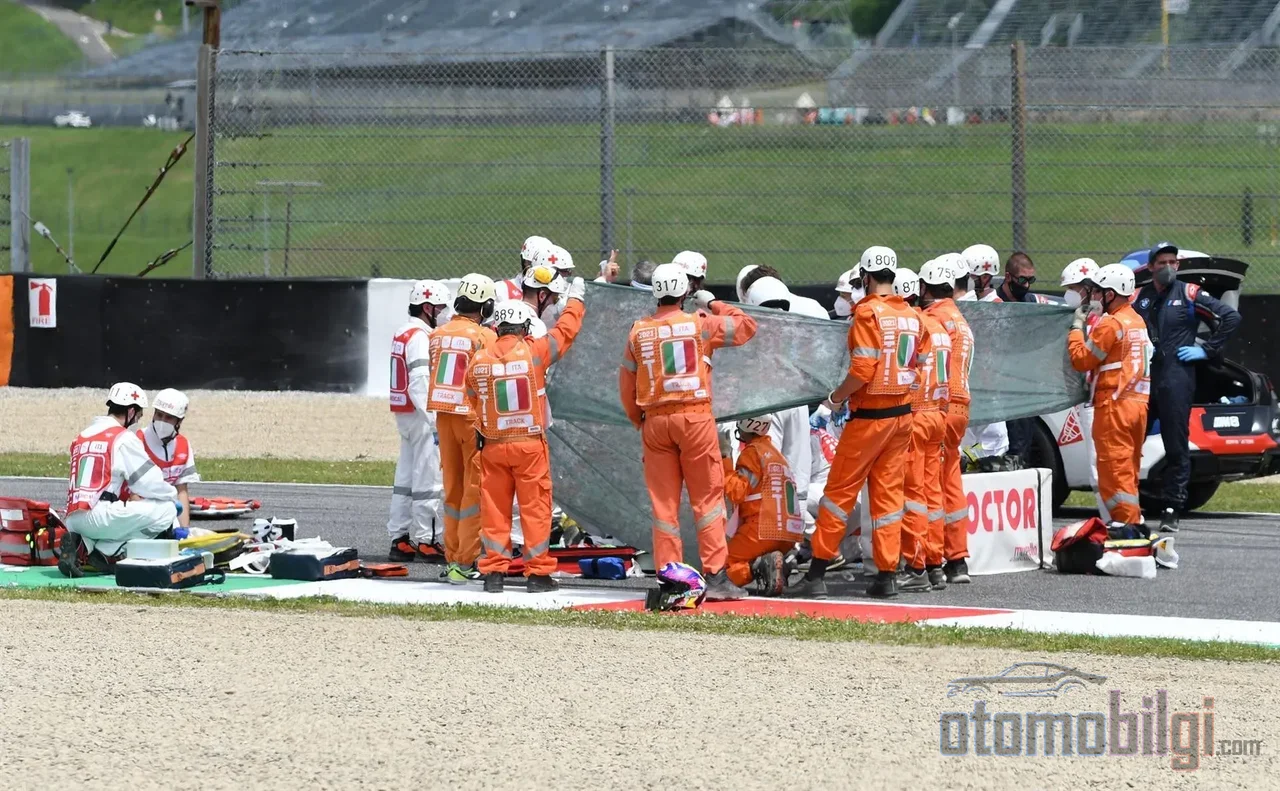
Every major rule change has a trigger, and unfortunately the picture here is very clear. The 2021 season went down in history as a year in which young riders lost their lives in the lower classes. That year, at the Italian GP at Mugello, Moto3 rider Jason Dupasquier lost his life after a crash in the second practice session. Following this and similar tragedies, FIM rolled out a comprehensive safety package reviewing age limits.
What stands out is this: The package was not limited to the age limit alone. The same regulation brought automatic warning systems to the circuits and limited the number of riders on the grid to 32. So what FIM did was not take a single measure, but reduce the risk young riders are exposed to from multiple fronts. A 16- or 17-year-old racing a 250cc prototype among the fastest riders in the world was no longer seen as an acceptable risk.
The Long History of Rules Changed for Safety
This is actually a familiar cycle in motorcycle racing. Gilberto Parlotti's death at the 1972 Isle of Man TT led to a boycott by the riders. The 1979 riders' rebellion led by Kenny Roberts paved the way for improved safety standards and the sport's professional era. In more recent history, the losses of Shoya Tomizawa in 2010, Marco Simoncelli in 2011, and Luis Salom in 2016 shook the sport each time. The 2023 age rule is also the newest link in this long chain; every tragedy laid another brick into the safety wall.
How Do Age Quotas Work in Moto3 and Moto2?
Now let's take a closer look at the ladder, because that is where the rule's real weight is felt. The Grand Prix structure consists of three classes: MotoGP, the premier class where 1000cc prototype motorcycles compete; Moto2, the intermediate step that has used a 765cc Triumph production engine since 2019; and Moto3, the entry class raced since 2012 with 250cc four-stroke single-cylinder engines and a weight limit of 65 kilograms including fuel. None of these motorcycles are sold to the public; they are all purpose-built prototypes.
There is an interesting asymmetry in the lower classes: In Moto3, the upper age limit is 28. In other words, the class is, by design, a school for young riders. In Moto2, on the other hand, there is no upper limit that effectively eliminates riders; under the European Championship regulations, the maximum age expires at the end of the year in which the rider turns 50. This asymmetry also summarizes the system's philosophy: Moto3 is for discovery and development, while Moto2 is the stepping stone to maturity.
As for the Junior side, the picture is as follows: At the FIM's JuniorGP and MotoJunior level, according to the 2026 regulations, riders in the lowest category are between 10 and 14 years old and race with identical equipment. At the Moto3 Junior level, the minimum entry age is 13, and the rider must be under 18 as of January 1. Road to MotoGP, meanwhile, is a series open to riders aged 14 to 17, running on race weekends alongside MotoGP. So the ladder itself still starts at an early age; what has changed is the age at which the door to the world championship opens.
The Gridlock Created by the Rule and the 2024 Exceptions
So how did team managers react to this system? Quite mixed. The 18-year age limit created a serious bottleneck at the lower levels; the queue of riders waiting for a spot in Moto3 grew longer. To ease this gridlock, some exceptions were expanded in Moto3 and Moto2 in 2024. Riders already racing in Moto3 in 2022 could continue, and transition rights were granted to those coming from JuniorGP; conditions such as the riders benefiting from the exception being at least 17 years old were applied. The rule is strict, but the valves were opened slightly to keep the system from locking up completely. Reactions from the grid were not always positive either; quite a few riders considered the rule controversial and demanding.
Why Is the Marc Márquez Era Closing?
And here is, in my opinion, the most striking part of the story. Marc Márquez entered the 125cc World Championship in 2008 at just 15 years old and saw his first podium in his sixth race, at the British GP at Donington. The first rookie to win the championship in the MotoGP era in 2013 and the youngest premier class world champion of all time. In 2019, at 26, he became the youngest rider to claim a sixth MotoGP championship; today he holds a total of seven MotoGP championships and is the name carrying the crown in 2025 as well.
Now stop and think: This profile - the type of rider who enters the world championship at 15-16 and climbs to the top at an early age - can no longer be repeated with the 18-year age limit. Marquez's debut at 15 would not be possible under today's rules. The natural consequence is this: records set at 15-16, such as youngest champion, youngest podium, youngest winner, are effectively locked. Since no one can touch those records at those ages anymore, they have all but moved into unbreakable status. Think of it as if the graduation age were raised to 18 so that no one could break all the school records; the record book is closing, but what is written in the history book remains.
How Is the Age Rule Shaping the Future of the Grid?
The rule's impact is not limited to records; it is also transforming the transfer market. The upcoming 2027 regulations bring a major transformation in which engine capacity in MotoGP will drop to the 850cc level. As teams prepare for this new era, they are turning to young riders, with the idea that they will adapt to the new motorcycles faster. So while the 18-year age limit has slowed young talent, the steel-legged vision of 2027 instantly moved them to the center of the transfer market. Two forces are working together: the rule keeps the young waiting outside the grid, while the new regulations make them more valuable on it.
Here is how the system works today: a rider starts in the junior series at 13-14, cannot enter through the Moto3 door before turning 18, tries to find his way in Moto3 until 28, and extends toward MotoGP via Moto2. Maximo Quiles, who completed the 2026 Moto3 season as champion, stood out in a season in which CFMoto Aspar took the teams' championship and KTM the manufacturers' championship, as a product of this new system. Young talent is still coming; it just comes according to a later and more mature schedule.
Why Was the Minimum Age Raised to 18? The Clear Answer
Let's wrap it up, because you deserve a clear answer to the question at the start. Following the deaths of young riders in the lower classes in 2021, particularly Jason Dupasquier's death after the crash at Mugello, the FIM reviewed safety and raised the minimum racing age to 18 across all world championship classes, including MotoGP, Moto2 and Moto3, starting from 2023. The goal was to eliminate the risk of 16-17-year-olds riding world championship-level prototypes without being ready, both physically and in terms of experience. The rule did not come alone; it arrived as part of the same safety package together with automatic warning systems, a 32-rider grid limit and age increases in the junior series.
The price of this change was the closing of an era that brought excitement to the sport. Stories like Márquez's podium at 15 and a championship in his rookie season are now among records that can no longer be repeated. In return, the hope of fewer paid-for accidents cannot be compared with any record. Like every major rule change in MotoGP, this one prioritized safety over speed; and the next talent waiting on the ladder will now pass through that door along with an 18th birthday cake.
Sources
- Important Safety Regulation updates from the Permanent Bureau
- MotoGP: Minimum Grand Prix age limit to be raised to 18 from 2023
- FIM raises age limits for junior series following teenager deaths
- Minimal age raised in MotoGP, lower classes after '21 tragedies
- How MotoGP grid reacted to 'controversial and difficult' age rule
- MotoGP renews its rules and raises its age limits
- Safety changes: Grand Prix age limit raised, automatic warning systems
- Minimum age exemptions 'widened' for Moto3, Moto2
- What is the Difference Between MotoGP, Moto2 and Moto3?
- Grand Prix motorcycle racing