Bubble on the Tire Sidewall: The Danger and the Solution

Share This Page
That bulge appearing on the tire's sidewall two days after hitting a curb is something most drivers overlook at first. What looks like a harmless swelling is in fact a failure report from the tire's internal structure. In this article, I explain what a ballooning sidewall means, what risks it poses while driving, and why the repair-or-replace decision becomes clear with just a brief inspection. Because the most expensive mistake in this matter is waiting to see the bulge.
How Does a Bulge Form in a Tire? What Gets Damaged in the Internal Structure?
Thinking of a tire as a single piece of rubber when you look at it from the outside is the most common misconception in this business. A tire is actually made up of layers of rubber-coated plies, called cords, stacked on top of one another that maintain their shape under load; an airtight inner liner separates this carcass structure from the inside. Everything depends on this arrangement remaining intact.
A bulge is visible proof that this arrangement has been compromised. In a hard impact with a pothole or curbstone, the tire gets pinched between the rim; the force of the impact damages the inner liner and air is forced between the layers. The air pressure, instead of staying in a single volume, pushes outward by separating the layers and eventually a visible bulge appears on the sidewall. This is a sign that the cords have broken or that internal separation has begun: that zone has lost the strength to carry normal driving pressure.
The main causes of a bulge
- High-impact damage such as hitting a pothole or road debris
- Hitting curbs, and driving fast over speed bumps and railroad crossings
- Overloading the tire by carrying loads above the manufacturer's limit
- Driving with low air pressure: the excessively flexing sidewall heats up and its structure degrades
- Overinflation: the stretched rubber constantly stresses the internal structure
- Damage to the inner cords from an impact, or driving on a flat tire even for a short time
Rarely, a manufacturing defect can also cause a bulge, but in practice the first two items on the list explain the vast majority of cases. And you need to know this detail: a bulge is not always immediately visible. Most drivers notice it days after the pothole; in the meantime, the tire fatigues the weak zone a little more with every rotation.
Key Takeaways
- A bulge is a sign that the inner cords have broken and layer separation has begun
- A tire with a bulge can never be safely repaired under any circumstances; the only solution is replacement
- While sidewall damage cannot be repaired, some punctures in the center of the tread can be fixed
- Every bulge, including ones that look small, should be treated as a serious tire problem
Is Driving on a Tire with a Bulge Dangerous? How Real Is the Risk of a Blowout?
The most honest answer to this question is that a tire with a bulge behaves like a loaded stick of dynamite: it can hold air and rotate for a while, but when it will give up is unpredictable. The weakened zone cannot carry the expected pressure and impacts; the result can be sudden air loss or a complete blowout at an unexpected moment. Moreover, blowouts most commonly occur not during slow city driving but at highway speeds.
The risk should not be seen as an abstract possibility. Tire-related failures are estimated to cause around 11,000 accidents per year in the US alone; a figure equivalent to an average of 30 accidents a day. When a front tire blows out on the highway, it is not just the tire that gets damaged; the rim, underbody and bodywork all take a hit too. The real price, however, is the momentary loss of steering control.
The trio of heat, speed and load makes this picture worse. A bulging tire hitting the highway in summer heat with a full trunk is the riskiest combination. That is why the stance of tire manufacturers is beyond dispute: continuing to drive on a tire with a confirmed bulge is not an option, it is negligence. The thought of "I only drive short distances in the city" offers no protection either; a bulge can turn into slow or rapid air loss even over a short distance.
Now let's come to the question I hear most often: "Can't I drive a bit further?" There is no safe distance to give in answer to this question, because no one can see from the outside how far the structural damage inside the bulge has progressed. When the cords are cut, the tire blowing out is not a possibility but a matter of time.
Is the Bulge in the Tread or the Sidewall? Why Does Location Matter?
Two bulges that look the same tell different stories depending on where they are on the tire. The tread, the tire's middle region that contacts the road, is the thickest and best-supported part; a bulge forming here is likewise usually a harbinger of internal structural separation and must be treated with the same seriousness. But this is where the difference in repairability begins: while punctures in the central region of the tread fall within the scope of repair, the shoulder and sidewall areas are excluded from repair.
| Feature | Tread (contact area) | Sidewall and shoulder |
|---|---|---|
| Function | Road contact, grip and propulsion | The load-bearing region that absorbs shock by flexing |
| Puncture in the center | Repairable under certain conditions | Not repairable |
| Bulging | Sign of internal structural damage | Sign of internal structural damage |
| Decision | Repair or replacement depending on the damage | Replacement in all cases |
A small distinction is also worth knowing: the small dimples and undulations you see on the inner face of the sidewall are not always bulges. These inward-facing depressions resulting from the manufacturing process are normal; an outward-swelling, soft and growing bulge, on the other hand, has nothing to do with either manufacturing or patience.
Why Can't Sidewall Damage Be Repaired While Tread Damage Can?
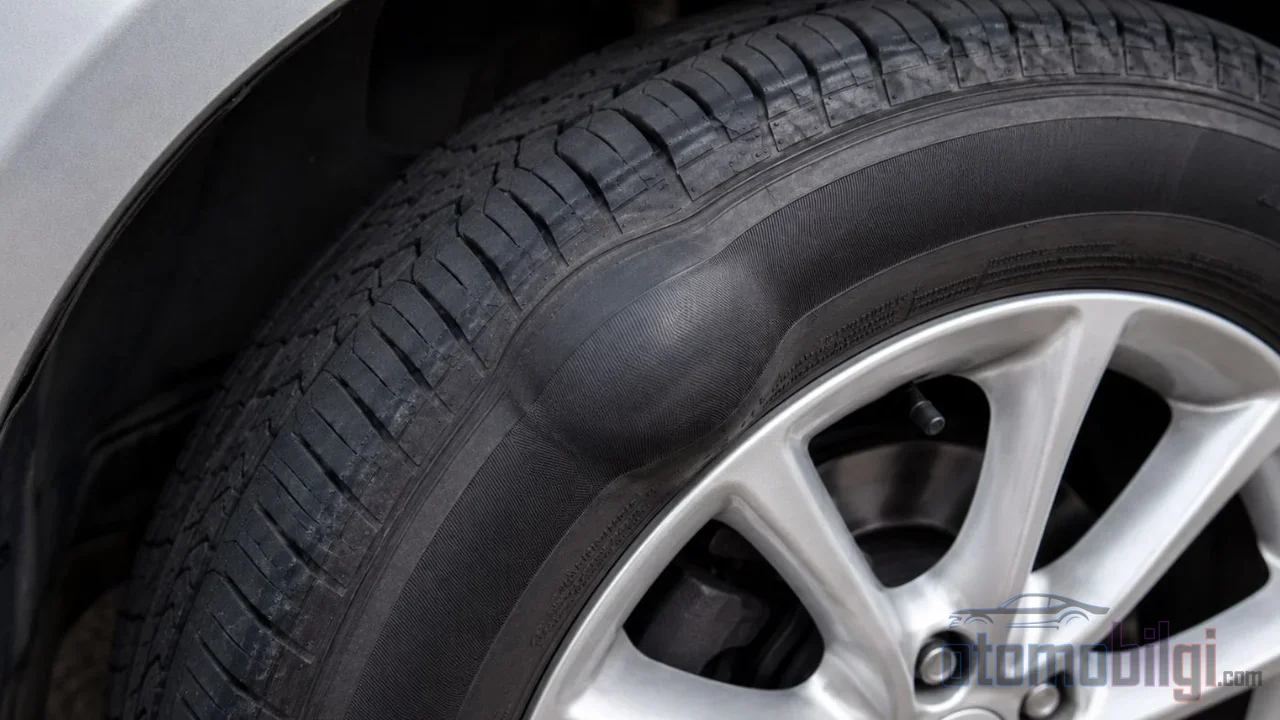
The repairable-versus-not-repairable distinction should be sought not at the rim shop, but in the tire's operating principle. Patches, plugs and sealing materials can prevent air loss; but they cannot restore the structural damage that causes the bulge, namely broken cords and separated layers. Filling it, inflating it, or patching it from inside only hides the bulge temporarily; the weak zone remains in place.
The sidewall is protected for a further reason of its own. It is a dynamic region that strikes the road, bears load and flexes constantly with every turn; any repair applied here cannot withstand thousands of flex cycles. This is the industry's established rule: repair is limited only to the repair band in the center of the tread; damage extending to the sidewall or shoulder requires tire replacement. Bulges of 6 mm and above are not repaired anywhere, regardless of location.
There is a scene I have seen for years: shops putting up "we do sidewall repairs" signs. Behind such a repair stands a practice that contradicts the guidelines of tire manufacturers and industry organizations, and is unsupported on safety grounds. Even if it saves you a few thousand liras in the short term, there is no technical reality showing that it restores the tire to its original load-carrying capacity.
Warranty and Road Hazard Damage on a Bulged Tire: How Is the Replacement Decision Made?
The question of who will bear the cost of tire replacement is as confusing as the technical question. The standard tire warranty does not cover a bulge, because potholes and curb strikes, the typical causes of bulges, along with low pressure and improper use, are not considered manufacturing defects. The warranty assessment essentially comes down to a single question: does the damage stem from a manufacturing defect or from road damage? This distinction can only be confirmed by removing the tire from the wheel and examining its inner surface; the traces of the impact usually show on the inside.
If there is no obvious impact mark, the cards may fall differently: the damage may be found to be manufacturing-related and assessed under warranty. If road hazard protection has been purchased, potholes, nails, and similar risks can be claimed under that coverage; since these are not included in the standard warranty, it is a separate safeguard. Even with a half-worn tire replaced under warranty, the user's share comes into play: you may be asked to pay a contribution proportional to the wear rate. In other words, on a tire that is one quarter worn, you pay close to a quarter of the price of the new tire.
The practical decision chain is as follows:
- Did you notice a bulge protruding outward on the sidewall? Do not drive; fit the spare or have the vehicle towed.
- Have the tire inspected by an authorized service; a bulge always results in replacement.
- Ask to have the tire removed and its inner surface examined; this is also the necessary evidence for a warranty or road hazard claim.
- If your tire is insured against impact or if you doubt the warranty, keep the tire instead of discarding it.
What Should Be Done to Prevent Bulging?
Avoiding a bulge is a much easier task than living with one. Regularly checking the air pressure recommended by the manufacturer comes first; low pressure is a silent culprit that stretches and heats the sidewall extra with every kilometer. Periodic inspection and rotation of the tires are also part of the same causal chain.
On the driving side, the effort is less demanding: not parking against curb edges, not crossing potholes and railroad crossings at unnecessary speed, and not constantly loading the vehicle beyond its capacity. And if you have hit a pothole hard, or if you have noticed a new vibration, wobble, crack, or surface deformation, do not wait; remember that a bulge can appear days later. If rapid air loss occurs, pulling over to a safe place before it's too late is the cheapest decision you can make on this matter.
Conclusion: The Decision on a Bulging Tire Is Already Made
The real decision about a tire with a bulge on its sidewall is made the moment you first notice it, not at the inspection bench: that tire will be replaced. A bulge is visible proof that the cords have broken and the layers have separated; no patch or filler can safely repair this structural damage, and no distance can be considered safe. Moreover, a bulge that looks small is just as serious as a large one, because both indicate the same internal breakdown. The only remaining area for decision-making concerns the costs: warranty, road hazard insurance, and an examination of the source of the damage. You solve that too by having the tire removed and looking at its inner surface, not by watching the sidewall swell.
Sources
- What Causes Tire Bubbles, & Can They Be Fixed?
- What to do About Bubble In Tire Sidewall
- What Do Tire Sidewall Bubbles or Bulges Mean?
- Sidewall Problems - Tire Damage
- Tire Repair
- Tire Repair - Consumer Safety Overview
- Tire Repairable Area
- Tire Bulges: What Causes Them and Why They're Dangerous
- Tire Bulge or Bubble: Why It Happens and What to Do
- Uniroyal Tire Warranty FAQs
- Tire Road Hazard Protection
- Tire Sidewall Bubble Warranty: How to Check Coverage