Is Buying Used Tires Risky?
Share This Page
Buying used tires is a reasonable way to save money if you find the right tire; but it also carries serious risks due to sidewall damage, hidden internal damage, unknown storage history and the story behind the tread depth. Before buying, the tread depth, manufacturing date, repair marks and sidewall condition must definitely be checked; with any suspicious tire, walking away is the safest decision.
Key Highlights
- Used tires are 30-50% cheaper than new tires, but they carry no warranty.
- The legal minimum tread depth is 1.6 mm; safety-wise, significantly more is required.
- The manufacturing date is read from the last four digits of the DOT code; a tire ages even if it is not used.
- A tire with a sidewall bubble or a shoulder repair is not repairable; the tire is rejected.
Is Buying Used Tires Risky?
I have been in this business for over thirty years; I can say that the industry is divided in two on the subject of used tires. One side holds that a used tire should never be bought, because you cannot know where it came from or how it was used. The other side argues that this tire can be a smart solution if its condition is genuinely good and the intended use is appropriate. The truth lies between the two views: an uninspected used tire is a gamble with safety; inspected properly, it can be a reasonable economic choice.
Its appeal is obvious. It is possible to find a used tire for half, or even a third, of the price of a new tire. Moreover, what you get in return for the cheap price is not a new product but a used one; and the manufacturer's warranty does not protect you. Warranties are not transferred on the used market, meaning any problem that appears after mounting is written entirely to your account. In the old days, the neighborhood tire dealer would judge the tire's condition by eye; now, in digital marketplaces, you are buying a tire from someone you have never seen, among hundreds of listings. If your chance to inspect it in person has decreased, your inspection discipline has to increase.
The essence of the risk is this: the tire's external appearance may not match its internal condition. A tire with plenty of tread may have strained internal belts and weakened sidewalls, or a tire with irregular wear marks may have a suspension-related illness. Overloading, low pressure or prolonged high-speed driving can damage the tire's internal structure in ways that are imperceptible from the outside. The seller does not know this - and even if he did, he would not say so.
Tread Depth: The Measurement That Determines Remaining Life
Tread depth is the most fundamental indicator on a used tire, but it is not enough on its own. A new passenger car tire is produced with approximately 10/32 to 12/32 of an inch of tread. The legal minimum in most regions is 2/32 of an inch, or 1.6 mm; a tire that has reached this limit must be replaced. The 3/32 of an inch level coincides with a critical threshold that directly affects wet braking; for safe use, values above 4/32 of an inch are taken as the basis. In practice, many experts recommend replacing around 3 mm to preserve the safety margin.
Let me also add this: A one-cent coin test gives a rough idea but is not enough for a purchase decision. Measure the tread depth with a gauge, separately at the tire's inner, center, and outer regions. Just glancing at the outer edge and moving on is the most common mistake in this business. The general rule is simple: The more tread, the better; for both wet performance and remaining life, not just depth but an even distribution of depth across the entire width matters.
DOT Code: Reading the Production Year from the Tire's Identity
A tire that looks new in the tread may be old; rubber ages even if the tire is not used. That is why tread depth alone does not tell the whole story. The last four digits of the DOT code on the sidewall indicate the production week and year: The code 2423 means the tire was produced in the 24th week of 2023. 24th week of 2023. The first two digits indicate the week (01-52, sometimes 53 in some years), and the last two digits indicate the year. The code format on tires produced before 2000 differs from today's; you are unlikely to practically encounter tires from that era today anyway.
Tires have a shelf life of about 5-6 years; this period can be shorter in dry and hot climates. There is no universal expiration date, but if you come across a tire past roughly six years of age, you should ask three questions: Why is this tire being sold, where was it stored, and are there any cracks on it? A tire that has waited in the sun for years and been poorly stored is like a fruit with a peeled skin, even if its tread is full; you cannot trust what is inside.
Pre-Purchase Checklist: Step-by-Step Inspection
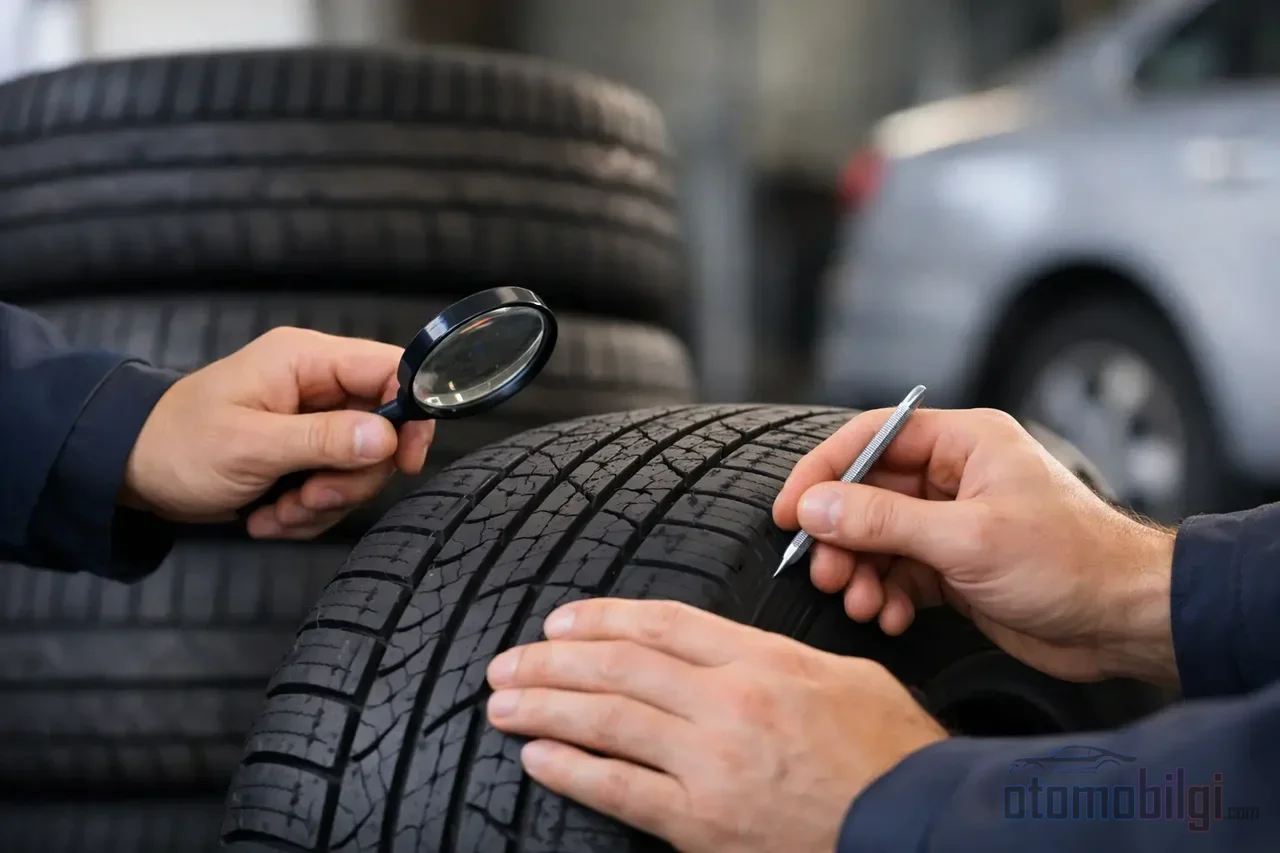
The difference between someone who knows what to look for and someone who does not, when holding a second-hand tire, becomes clear with a few minutes of inspection. Apply the following steps in order:
- Inspect the entire width of the tread. Irregular wear patterns tell the tire's history, and each pattern has a meaning.
- Look at both sidewalls. The inner sidewall hides traces of curb impact or mounting damage; a tire that looks fine from the outside may have a problem there.
- Check the sidewall and bead. Deep gouges, torn rubber, or corrosion marks on the edge that contacts the rim (the bead) lead to air leaks.
- Look for repair marks. Repairs near the shoulder or sidewall are a major risk; numerous repairs greatly narrow the margin of safety.
- If possible, look inside the tire. Dusty rubber debris, or a crumbled or wrinkled inner liner, indicates that the tire was driven flat or at very low pressure for a long time.
- Read the DOT code and note the production year.
- Compare the size, load, and speed rating. Simply fitting on the rim is not enough.
What does irregular wear mean?
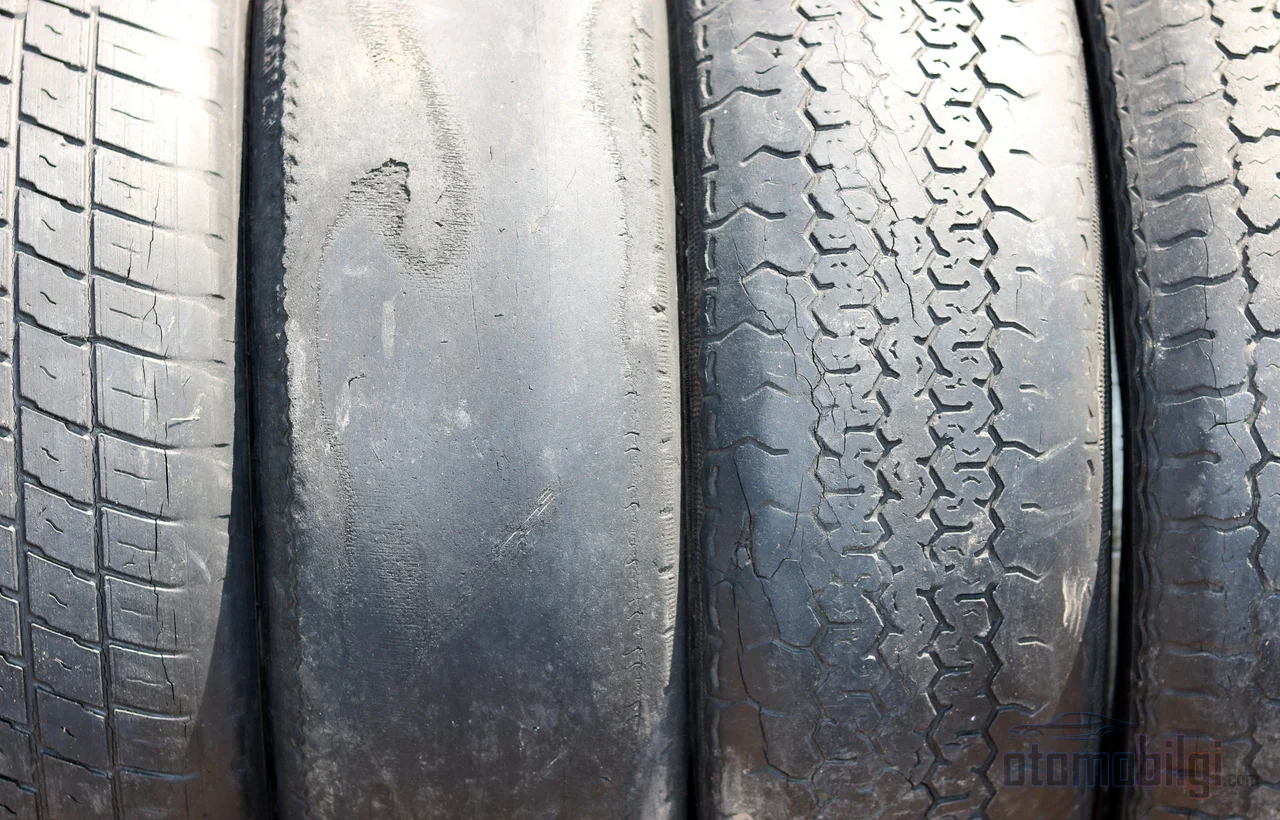
Wear marks are the logbook not of the tire but of the vehicle that used it. Wear on a single inner or outer edge points to an alignment problem. Heavy wear in the center shows the tire was repeatedly overinflated. Wear on both shoulders is the trace of use at low pressure or hard cornering. Fins and grooves worn on the tire surface point to a worn shock absorber, bushing or wheel bearing, or a balance problem. The most dangerous sign is a smooth strip left in place of the tread: This tire has either been used with dangerously low tread or has been damaged.
What to look for on the sidewall that disqualifies a tire?
Look for cracks, cuts, bubbles, bulges, exposed cords, or wavy areas. A sidewall bulge indicates internal cord damage, and such a tire is for rejecting, not considering. A bubble is the outward manifestation of a broken internal cord; it cannot be repaired and used. Also approach tires with sealant residue with caution: Sealant makes the inside messy and hides leaks. Do not hesitate to walk away from a seller who will not let you inspect the inside; they have something to hide.
When Is It Reasonable, and When Should You Walk Away?
Not every second-hand tire is the same. In some cases, the purchase is justifiable; in some cases, you must stay away no matter how attractive the price is.
| Decision | Situation | Reason |
|---|---|---|
| Reasonable | Emergency single-tire replacement; size, type, and tread depth closely match | Provides a safe transition, even if not a permanent solution |
| Reasonable | Removed from a lightly used vehicle, with deep and evenly distributed tread | The remaining life can justify the price difference |
| Walk Away | Sidewall crack or bubble | It is not repaired; it is a sign of a broken internal cord |
| Walk Away | Tire with shoulder or sidewall repair, or with numerous repairs | Industry rule: repairs are only valid in the central area of the tread |
| Walk Away | Tire with new-looking tread but old age (no DOT check done) | A tire ages before its tread wears out |
| Walk Away | Poorly stored tire that has been left in the sun | The rubber structure degrades in ways invisible from the outside |
Should you buy a single tire?
In an emergency, sometimes yes, but this choice has a price. A single tire with a tread depth significantly different from the other three tires can, due to the mismatch, damage the other three, increase fuel consumption, and cause pulling to one side. In all-wheel drive (AWD/4WD) vehicles, this sensitivity is multiplied; matching the circumference of the circle is critical, and the tread depth of all four tires must be checked together. Buying a winter tire second-hand is considered an especially risky choice; the safety margin on wet and snowy surfaces is already narrowed. Let me also add a note about retread, i.e., remolded tires, for passenger vehicles: This practice is intended for the commercial truck sector, and although its validity in that sector is not debatable when properly maintained, it is not recommended to buy it as a second-hand tire for a passenger car.
Final Word: Do Not Put Your Safety on the Table Before You Negotiate
A second-hand tire is a justifiable economic choice under certain conditions; but under no conditions is it an unchecked choice. A buyer who does not read the DOT code, does not look at the inner sidewalls, and does not measure the tread is, in fact, playing a gamble whose outcome they cannot know. The checklist above takes ten minutes of your time; between noticing a sidewall bubble and a tire blowing out on the road after installation, the value of those ten minutes is immeasurable. Trust your hands on every tire you have doubts about. A tire may be open to negotiation at the supplier; on the road, you get no room for negotiation with anyone.
Sources
- How To Inspect Used Tires Safely Before You Buy
- Used Tires: Tire Agent Guide
- Is Buying Used Tires Safe?
- Tire Date Code: Reading a Tire's Manufacture Date
- Tire Repair - Tire Industry Association
- How Much Tread Depth Is Enough?
- Tire Tread Depth: Legal Limits and What to Know
- Why You Should Never Buy Used Tires for Your Car