Do Tires Age While Sitting on the Shelf? The Date of a Tire in Its Packaging
Share This Page
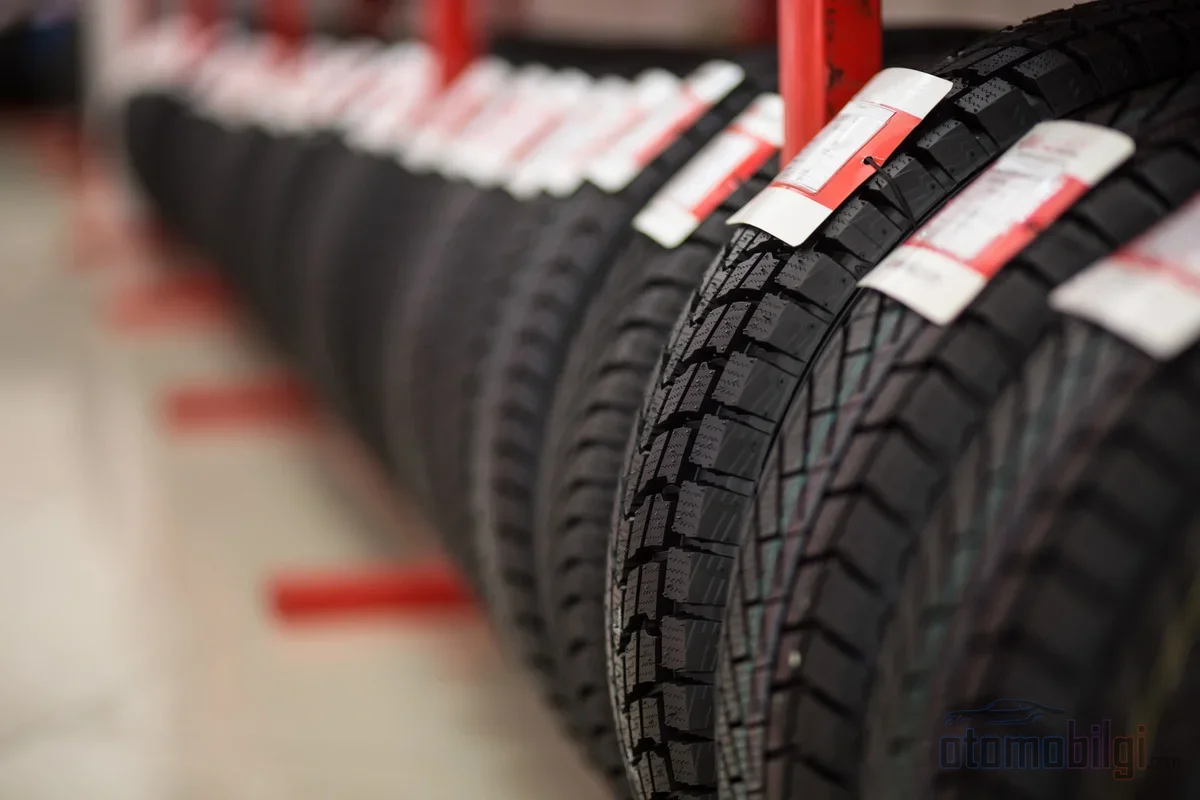
Yes, a tire that just sits on a shelf ages too. A tire's life is not measured by tread depth alone; whether rolling on a vehicle or waiting in storage, the rubber compound hardens and chemically degrades over time. The production date is written in the last four digits of the DOT code on the tire's sidewall: the first two digits give the week, the last two give the year. Knowing how to read this date is the key to the most reliable check when buying new stock or second-hand tires.
Highlights
- The last 4 digits of the DOT code show the production week and year: for example, 3419 means the 34th week of 2019.
- There is no official expiration date on a tire, but the rubber degrades due to oxygen, heat and UV rays even when unused.
- Tire manufacturers generally recommend 10 years as the upper limit; many vehicle manufacturers, however, recommend replacement at 6 years.
- A practical guide when buying: 0-2 years is acceptable, 3+ years should be questioned, 5+ years should be rejected.
- For a spare tire, the upper limit is 5 years; a tire waiting in storage never experiences the heat and flexing that come from the road.
What Is the DOT Date and How Do You Read It?
On the tire's sidewall you will see a series of letters and digits starting with the letters DOT. This series is an identification code mandated by the U.S. Department of Transportation; it includes the place of manufacture, the tire size and the manufacturer's code, and is typically between 8 and 13 characters. The part that really interests us is at the end of the series: on all tires produced after 2000, the last four digits are the production date. The first two digits show which week of the year the tire was produced in, and the last two show the year of production.
A few examples will make it clear. The code 3419 means the 34th week of 2019, while 2521 means a tire produced in the 25th week of 2021. A simple check: the first two digits of the code must be a number between 1 and 52; if you see a week code of 53 or higher, the code has been misread or there is something else going on with that tire.
Why is the code only on one side of the sidewall?
The first detail that surprises even experienced buyers is this: the full DOT code is usually present on only one sidewall. The other sidewall may have a shorter code without the date; this is not a manufacturing defect but a normal practice. When checking a tire's age, inspect both sidewalls. On tires with asymmetric tread patterns, the full code is always molded onto the outer sidewall, so on that type of tire the place to look is obvious.
It is also useful to know: this code is not unique to a single tire but a batch code that refers to products made in the same batch. Before 2000, the system used three digits: two digits for the week and a single digit for the year. In the 1990s, a small triangle mark appeared next to this old code; if the mark is absent, the tire dates from before 1990. This format was based on the assumption that tires would not be used for more than ten years - the accounting of those years was looser than today's approach.
Why Does a Never-Rolled Tire Age?
A tire that rolls on the road doesn't wear, but that doesn't mean it hasn't degraded. Rubber behaves like a living material; over time it loses its internal chemical balance. This process is not dependent on mileage or wear - a tire with full tread, visually spotless, may have long since lost its performance if the compound has hardened.
There are four main degradation mechanisms:
- Oxidation: The polymer chains in rubber react with oxygen in the air, the chains break down, the tire hardens and becomes brittle.
- UV degradation: Sunlight significantly accelerates the aging process.
- Heat cycles: Repeated heating and cooling prepares the ground for the birth of micro-cracks.
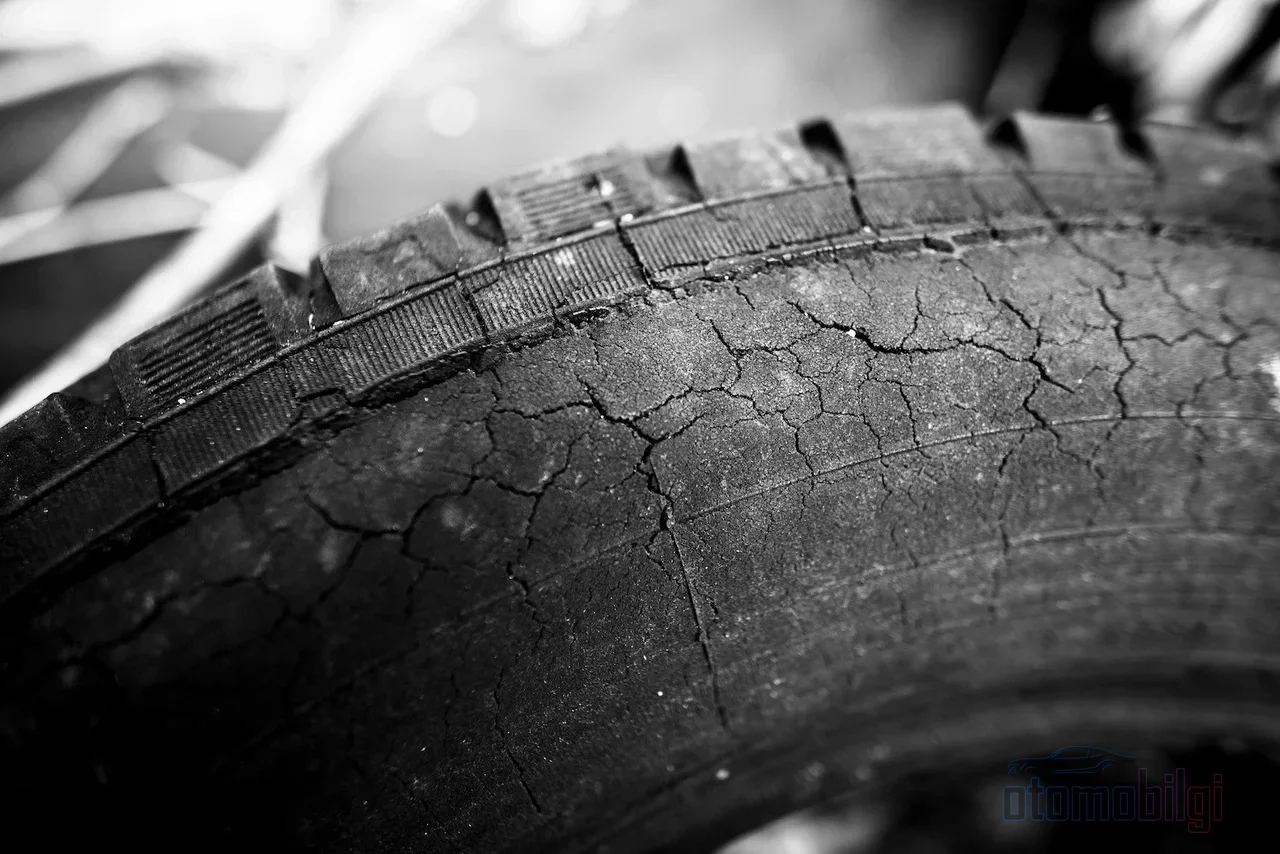
- Ozone effect: It creates fine, web-like surface cracks on the sidewalls.
The combined effect of these processes becomes visible on the road: hardened rubber can no longer grip the asphalt surface as it used to, braking distance increases, the sidewall weakens, and the risk of air leakage rises. A drop in sidewall strength at high speed opens the door to problems such as tread separation. The relationship between age and loss of friction and increased braking distance is a finding confirmed in peer-reviewed engineering studies; so this is not a garage myth, but a measurable physical reality.
Waiting until a crack appears is a mistake
The most misleading point is this: when visible cracking appears on the sidewall, the structural damage inside the tire is usually at an advanced stage. Visual inspection is prone to missing most of the dangerous degradation. That is why the decision should be made not by looking at the tire's age but by looking at the DOT date. Mechanics used to touch the tire and feel its flexibility; today the most honest indicator is still those four digits on the sidewall.
When Does the Age Limit for Tire Replacement Run Out?
There is no official expiration date, but the industry average shows a clear range: most tire manufacturers recommend replacing tires between 6 and 10 years regardless of how good their outward appearance is. The reason for the difference between the ends of this range is interesting: tire brands generally advocate 10 years as the upper limit, while vehicle manufacturers are more cautious. Brands such as Ford, Mercedes-Benz, Nissan and Toyota recommend replacement at 6 years in their owner's manuals. Safety authorities also stand on a line that supports the importance of the 6-year threshold with data.
The difference should be read as follows: 10 years is the technical upper limit a tire can still survive; 6 years is a prudent usage recommendation. Choosing between the two is left to how the vehicle is used, its climate, and the load it carries - but staying within this range is the common ground in both cases.
| Category | Recommended maximum age limit |
|---|---|
| Passenger car tire | 10 years |
| Cautious vehicle manufacturer recommendation | 6 years |
| Motorcycle tire | 5-7 years |
| Caravan / motorhome | 5-7 years |
| Truck tire | 7-10 years |
| Spare tire | At most 5 years |
I want to emphasize that the spare tire is subject to a separate regime. A spare waiting in the trunk or underneath never experiences the heat from the road, water spray, or regular flexing; this does not protect it - on the contrary, it disrupts the compound's aging balance. A space-saver spare that is over ten years old carries a serious risk of bursting under high pressure. The same question applies to the tires of a vehicle parked in a garage for five years: even if the tread looks full, the age of the compound is what determines the decision.
Age is evaluated together with other criteria
Age is not a factor above everything else; tire safety is not determined by the DOT date alone. Proper storage, regular inspection, tread depth, and physical damage checks are all evaluated at the same table. During periodic vehicle inspections, age alone is not a reason for rejection either; inspectors look for cracking, damage, and tread condition. But in practice, a clear answer is needed to this question: is a ten-year-old caravan tire with 6 mm of tread more dangerous, or a three-year-old tire with 3 mm of tread? The first choice, which appears to be a saving, comes back as a real risk - an old tire with full tread is more dangerous than a young tire with reduced tread.
Why Is Checking the DOT Date a Must When Buying Stock Tires?
A tire bought as new not always being freshly produced is one of the industry's oldest tricks. Months, sometimes years, can pass between production and import; long-shelf-life tires may appear attractively priced and of adequate quality. The waiting period between production and import is natural; what matters is the date the tire left the factory, and that date is written inside the DOT code. Looking at the sidewall and reading the four digits before buying is the simplest and most effective habit acquired in thirty years of this trade.
A practical age guide at the moment of purchase can be summarized as follows: 0-2 years old tire can be accepted without issue. 3 years and above you should ask the seller why, and discuss whether it is reflected in the price. 5 years and above old tire should be rejected, no matter how full the tread is. It is normal for most of a well-managed dealer's stock to have been produced within the last one or two years; older stock can be clearly labeled and sold at a discount - and that is an honest practice; it is the labeling that is the problem-free side.
The silent rule of the warranty period
You will also see the cost of shelf age on the warranty side. Most tire manufacturers' warranties are limited to 4 years from the date of purchase or 5 years from the week of production; when the receipt is lost, the warranty effectively ends at the end of five years from the week of production. So a tire that has waited three or four years on the shelf is close to the end of its warranty period the moment you buy it. Keeping the invoice and proof of purchase is therefore not merely a bureaucratic habit, but effectively an economic protection.
What Does Age Tell You in the Used Tire Bargain?
In the second-hand tire market, the bargaining chip is usually tread depth; yet the DOT date is just as decisive. The same method applies second-hand: find the four-digit code on the sidewall, calculate the week, determine its age. Failing to find the DOT code on a tire, or seeing only a short series on one sidewall, does not make the job easier - do not forget to check both sidewalls.
But finding the date is only half the job. Then comes the condition check: is there cracking on the sidewall and tread surface, are there impact or repair marks, is the tread depth sufficient? Using a depth gauge for tread depth is the most correct approach; in practice, inserting a penny or a coin into the tread channel and checking is also a common method. If the tread has worn down to the minimum depth or there is physical damage, the tire must not be used regardless of its age.
To put it in bargaining terms: with years of trained eyes, if a tire is past eight to ten years old, it is a product that should not be purchased no matter what the tread depth says, while a one-to-two-year-old tire that looks sound is a reasonable buy. All the years in between are a gray zone where price and risk must be weighed before deciding. Common forum opinions also circulate more cautious individual practices, like discarding tires past five to six years; this is an extreme below official recommendations, but never above the official advice.
A warning about the idea of reviving tires
Content circulates on the internet claiming that old, dried-out tires can be temporarily softened with certain chemicals; these are popular methods coming from low-speed applications like go-karts. They directly contradict manufacturer recommendations and must not be taken as a safety solution. Rejuvenating a hardened compound is barely possible even with a laboratory, not with the physics of the road - not in the service lane.
Conclusion: Read the Date as Well as the Tread Depth
Over the years, one habit still holds true: when buying tires, first look at the sidewall and read the four-digit date. The fact that an unused tire may have aged must be written down as a third criterion alongside pressure and tread depth. The real cost of age is not even visible in fuel consumption - low pressure is a far more influential player there; the price of age is paid in road holding and safety. Trust not your wallet but your DOT code: those four digits are the most honest story a tire can tell you.
Sources
- How Do I Determine The Age Of My Tires?
- DOT Code Calculator & Tyre Age Decoder
- How to Read Tire Size and Specs
- When to Replace Tires
- Tire Lifespan & Aging
- How Long Do Tires Last?
- Tire Aging and Service Life
- How Old - and Dangerous - Are Your Tires?
- TireWise
- Do Tires Expire?
- Do Tires Expire? What To Know About Tire Shelf Life
- Storing tires-is it safe, and how long will they last?
- 7 Signs Your Tires Are Too Old
- Check the Date: Are your tires too old?
- 5 Tips to Read the DOT Date Code
- Tire Age & DOT Codes
- How to Check Tire Tread Depth: The Penny Test