Does Filling Tires with Nitrogen Really Make a Difference?
Share This Page
No, for an ordinary driver, nitrogen-filled tires do not make a noticeable difference compared to regular air-filled tires kept at the correct pressure. Nitrogen slows pressure loss slightly, but the annual difference remains small, at around 1.3 psi ; a driver who checks their tires once a month can easily offset this advantage with a single pumping session. Nitrogen genuinely makes sense for heavy-duty vehicles, fleets, and track use.
Highlights
- Atmospheric air already contains about 78% nitrogen .
- The pressure advantage of nitrogen inflation is only about 1.3 psi per year.
- Temperature sensitivity is the same as air: a change of 1 psi for roughly every 5.5°C.
- It has little or no direct effect on rolling resistance and fuel consumption.
- The cost per tire can reach up to $20 ; air, on the other hand, is free in most places.
Where Marketing Meets Physics
The idea of inflating tires with nitrogen appeared in aircraft and race cars long before automobiles. Being the preferred gas in aircraft tires, heavy machinery, and almost exclusively race vehicles paved the way for this practice to be carried over to street cars as well. The marketing side makes good use of this history: slower pressure loss, less wear, fuel savings, reduced corrosion. There is a bit of physics behind each claim; the question is how much weight that physics carries under everyday driving conditions.
Let's put two basic facts on the table from the start. First, the air we breathe already contains about 78% nitrogen ; in other words, nearly three-quarters of regular air and nitrogen are the same gas. Second, nitrogen molecules are larger than oxygen molecules and permeate through the tire's inner liner more slowly. This second fact is the basis of nitrogen inflation's most-touted advantage, and it is a correct observation. But does a correct physical fact mean a meaningful practical difference? That is exactly where the debate lies.
The Pressure Loss Claim: What Do the Numbers Say?
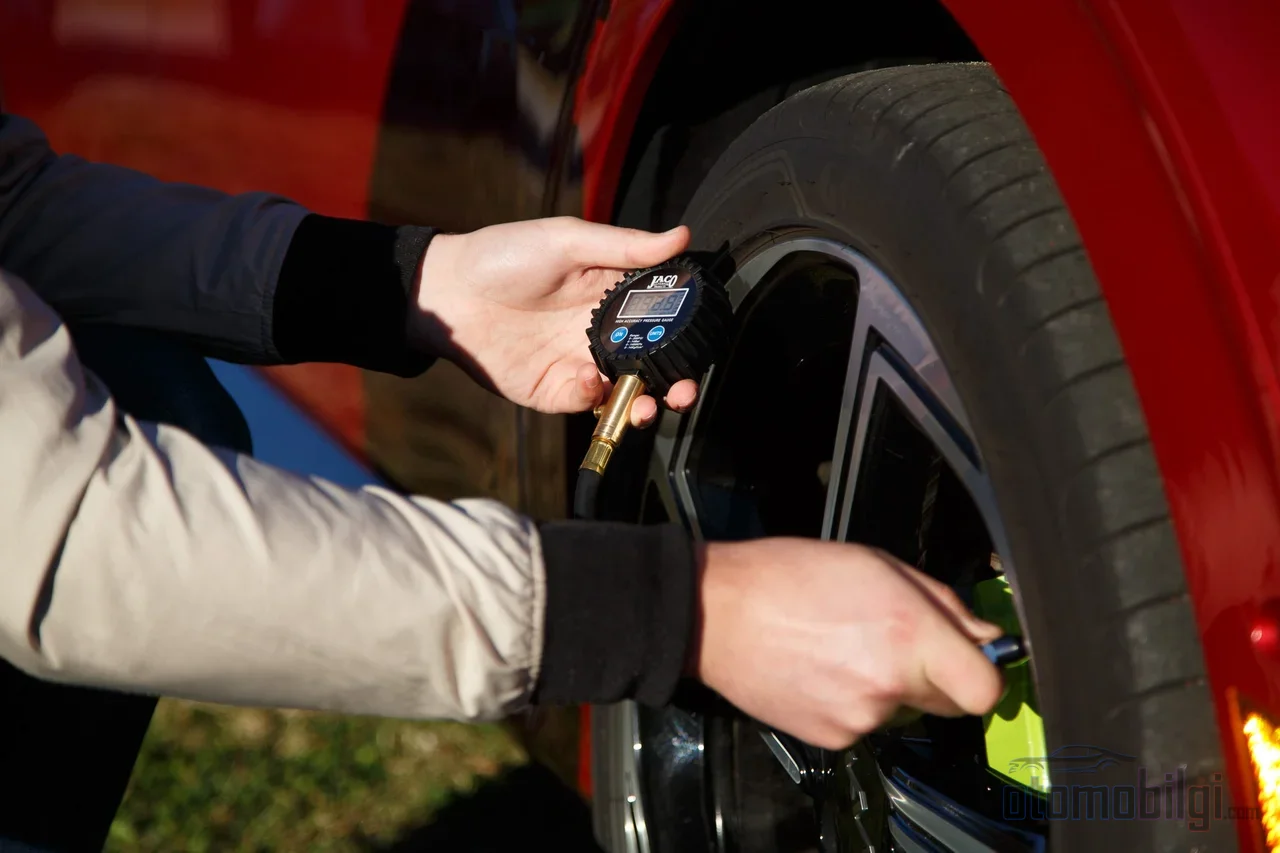
Nitrogen really does escape more slowly; there is no debate there. The question is: how much slower, and does this difference change your life? Independent tests give a clear answer to this question. Over a one-year observation period, tires inflated with nitrogen lost only 1.3 psi less pressure than those inflated with air. This difference is technically measurable, but in practice it disappears immediately: any driver who checks tire pressure once a month makes up all of nitrogen's advantage with a single stop.
More detailed laboratory data is also available. An NHTSA study showed that under variable temperature conditions, the pressure loss rate of nitrogen-inflated tires remained at about two-thirds that of air-filled tires. A Clemson University thesis, meanwhile, found that in leak tests, pressure was 35–55% lower compared to air, and 29–35% measured that it is better preserved. These figures may look impressive, but the small size of the absolute difference should not be overlooked: reducing the loss of a gas that already loses only a small amount is not a major gain.
There is also a critical detail. If your tire is punctured, the valve leaks, or there is a leak at the wheel rim connection, oxygen and nitrogen escape at the same rate. In the face of a large leak, the type of gas is of no importance. Nitrogen mitigates slow diffusion losses; it does not prevent mechanical failure.
Is the Claim That "Nitrogen Is Unaffected by Temperature" True?
No, it is affected. This claim is the most common misconception surrounding nitrogen. Nitrogen is a gas, and like all gases it expands and contracts with temperature. The rule established in the industry is that for every 10°F (approximately 5.5°C) change in temperature, pressure changes by about 1 psi and this rule also applies to nitrogen. You cannot eliminate the pressure warning that lights up on your dashboard on winter mornings by switching to nitrogen.
The only real advantage nitrogen has regarding temperature is that it maintains pressure slightly longer than air under varying temperatures. This is a natural consequence of the slower diffusion described above; it does not mean the gas is insensitive to temperature. For a driver who regularly checks their tires, this extra consistency changes very little in practice. The benefit gained by a driver who performs proper maintenance is negligible when examined closely.
Wear and Fuel Consumption: Does Nitrogen Really Save Money?
The answer to this heading is short and clear: the type of gas itself has little or no direct effect on rolling resistance. What determines fuel economy is whether the tire is at the correct pressure; what gas it is inflated with does not make a measurable difference for the average driver. To give a reference point, a total 1 psi drop across four tires reduces fuel economy by about 0.3% . This figure shows the importance of pressure maintenance, not nitrogen.
The claims circulating on internet forums also deserve mention here. Figures such as "3.3% better fuel consumption" or "25% longer tire life" circulate at the forum level; no reliable institutional test has verified a difference of this magnitude. Think of it like an experienced accountant's warning: a figure that looks suspiciously good is usually an unverified figure.
The only technical advantage nitrogen rightfully has is that it is a dry gas. Since it contains no moisture, it can reduce inner liner and rim corrosion. This is an advantage that carries value especially in steel wheels and long-life commercial use; in a daily passenger car, however, it is not a decisive factor.
The "Fill It and Forget About It" Trap
Some drivers who buy nitrogen assume they have also purchased exemption from maintenance requirements. Wrong. Tires inflated with nitrogen are not maintenance-free; regular pressure checks, inspection for cuts and bulges, and tread depth monitoring continue exactly as before. The type of gas does not eliminate any step of tire maintenance.
Two more practical points. First, nitrogen and air can safely be mixed; there is no chemical reaction involved. If the pressure drops on the road, do not hesitate to add air from the first pump you see. The only cost of this is that the nitrogen ratio, and therefore its benefit, becomes diluted. Second, nitrogen does not affect pressure sensors, meaning the TPMS system; the system works the same way with both gases.
When Nitrogen Makes Sense
Throughout this article we have looked at nitrogen with some distance, but rejecting everything would also be unfair. In three areas of use, nitrogen delivers real value:
- Trucks and fleet operations: When dozens of tires need to be kept at ideal pressure, slower diffusion means less manual checking and more predictable costs. At fleet scale, small differences accumulate and become meaningful; some operators also point out that the risk of combustion decreases and tire costs fall.
- Track and racing use: Nitrogen can provide more stable tire temperatures; however, this advantage is only obtained if the tires are purged to nearly one hundred percent. Since daily vehicles have no purge point, this benefit is technically impossible on the street.
- Demanding commercial conditions: Reduced corrosion and longer-lasting pressure continuity can be useful in heavy-duty machinery.
Whereas we used to see this practice only on race tracks and in hangars, it has now become one of the standard extra packages at dealerships. The reason for the rapid transition is not performance, but margin; your perspective on this depends on which side of the sales desk you are sitting on. In an environment where independent tests show small differences, the mismatch between the optimism of service blogs selling nitrogen and corporate test data is not surprising.
The Cost Side: 20 Dollars Versus a Pump
The last leg of the practical equation is money. Air is cheap and available everywhere; in many areas the air pump at stations is completely free. Nitrogen, on the other hand, can cost up to 20 dollars per tire, do the math for four tires. The initial fill can also be a long and expensive process; and afterward, finding nitrogen on the road is not easy, whereas there is an air pump at every corner.
In this picture, for the average user the trade clearly works against nitrogen: what you pay for is pressure continuity that you would already have with a monthly checking habit.
Frequently Asked Questions
Can I add air to a nitrogen-filled tire?
Yes, it is completely safe; the gases mix with each other, there is no reaction. The only result is that the nitrogen ratio drops and the advantage decreases.
Does nitrogen reduce fuel consumption?
The correct pressure does; the difference of the gas type itself in this regard is minimal. Nitrogen can be a way to maintain the correct pressure, but it is not a direct fuel-saving tool.
Does nitrogen turn off the TPMS light?
No. Pressure sensors are not affected by nitrogen, but temperature-related pressure changes can also trigger a warning in a nitrogen-filled tire.
Is it worth it for the everyday user?
According to the conclusion reached by reliable independent tests, no. Checking tire pressure once a month more than covers everything nitrogen has to offer.
Conclusion: Pressure Checks Are No Substitute for Nitrogen, and Nitrogen Is No Substitute for Pressure
Throughout this article, a single sentence carries the essence of the nitrogen debate: correct pressure comes before everything else, and no gas can take its place. Nitrogen is not an alternative to checking your pressure, at most a weak complement to it. To sum up thirty years of experience: seeing a driver who expects something from their tires take a measurement while passing the pump is worth far more than their purchasing a nitrogen fill.
Sources
- Should You Use Nitrogen in Your Car Tires?
- Top 4 Myths Vs Facts About Using Nitrogen To Inflate Car Tires
- Should I Use Nitrogen In My Tires?
- The Effects of Varying the Levels of Nitrogen in the Inflation - NHTSA 2009 Study
- Effect of nitrogen filling on tire rolling resistance - Clemson University Thesis, 2007
- Nitrogen vs Air in Tires: Which Is Better?
- Nitrogen vs Air in Tires: Which Is Better for Your Vehicle?
- Are Nitrogen-Filled Tires Worth the Cost?
- Do Nitrogen-Filled Tires Enhance Fuel-Efficiency?
- Nitrogen benefits truck tires
- Benefits of Nitrogen