Why Does a Tire Go Flat? Possible Causes of Slow Air Leaks
Share This Page
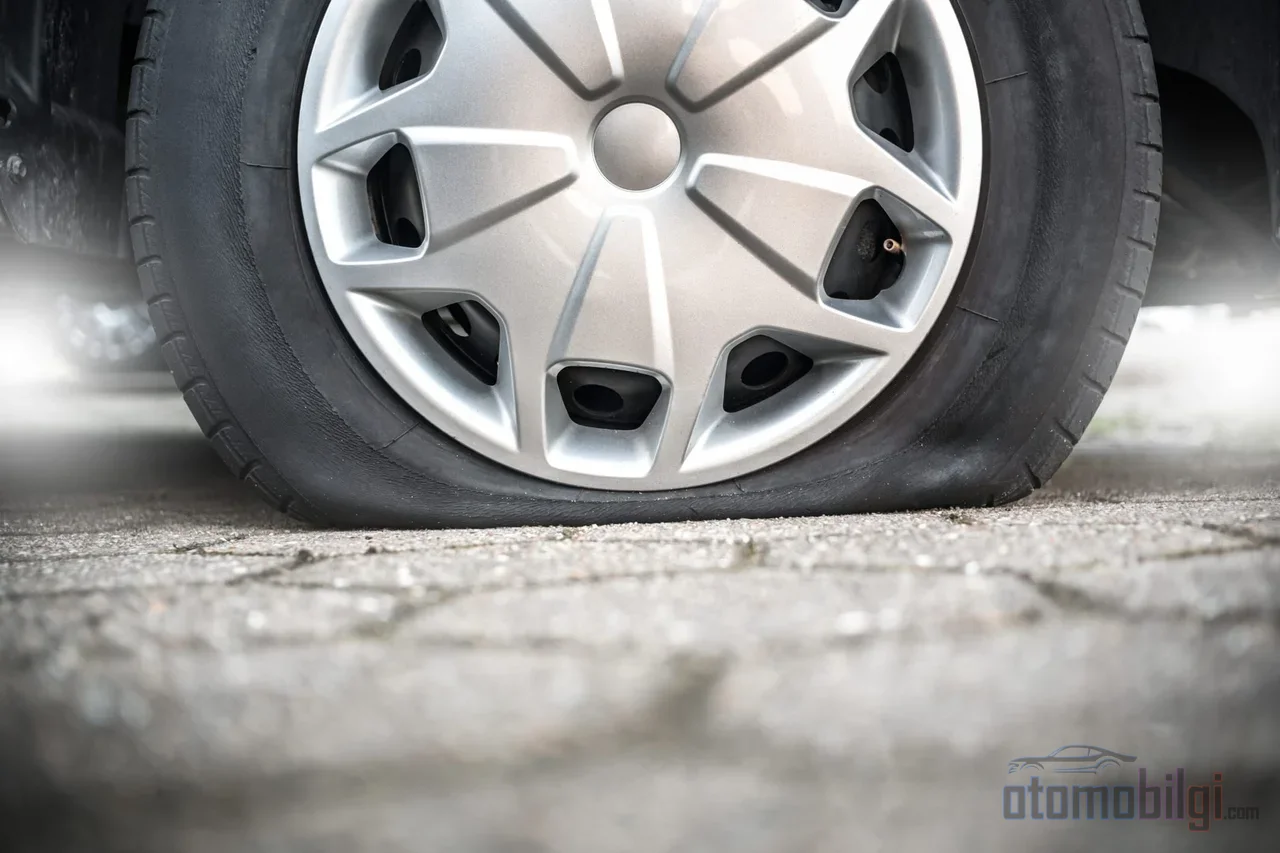
If a tire is going flat, there is usually no visible puncture; the source of the problem is typically the valve, the point where the tire seats on the rim, corrosion or a crack in the rim, a tiny foreign object embedded in the tread area, or the natural air loss inherent in the tire's construction. A loss of up to 1-2 PSI per month is considered normal; a faster drop indicates that the leak needs to be located and repaired. In this article, we explain why and where the air escapes, which situations can be handled with simple inflation, which ones require professional intervention, and what driving on low pressure does to the tire.
Key Takeaways
- Due to natural diffusion, a tire loses about 1-2 PSI of air per month; this range is normal.
- For every 10°F (about 5.5°C) drop in temperature, pressure decreases by about 1 PSI.
- The valve base, the rim-tire seating point, and rim corrosion are the three most common addresses of invisible leaks.
- A plug is a temporary fix; a permanent repair requires a patch or a patch-plug combination.
- Driving on low pressure can permanently damage the sidewall, belts, and tread.
Why and Where Does the Air Escape? Five Possible Sources of the Leak
I have been in this business for more than thirty years; the most common mistake customers make is assuming that a tire losing a few pounds a week must mean a puncture. In fact, there are five distinct families of air escape, and each has a different solution. Not knowing one of them results in removing the right tire and searching for the wrong problem.
Valve and valve stem: the most frequently overlooked suspect
The valve is a small part seated on a rubber base, and over time it cracks, dries out, and wears. In rubber valves, the first crack almost always appears where the stem meets the base; that is also where the leak occurs. This failure is especially common in older tires and goes unnoticed because the tire itself is inspected instead. In metal valve stems, leakage can occur around the gasket, the retaining nut, or the TPMS components; in addition, the valve core inside the valve can also leak. Testing the valve core is not a troublesome task: drip water over the core and watch whether bubbles form and pop. If the core is leaking, the solution is not a patch but a new valve.
Rim-tire seating point: bead leak
The point where the tire seats on the rim is called the bead. This rubber-to-metal contact surface loses its seal when dust, corrosion, or a tiny foreign object gets trapped. A small piece breaking off the edge of the bead (bead chunking) also leads to the same result. In the soapy water test, the typical signature of a bead leak is this: bubbles appear not all around, but as a small cluster on the rim flange or as a thin chain stretching along a single spring. Years ago rims were simple steel constructions; today, in alloy wheels, corrosion has become the leading cause of this problem.
Rim cracks and corrosion
In alloy wheels, the bead area where the tire seats corrodes over time; an oxidized surface prevents the tire from seating properly and air escapes from there. Behind this corrosion are factors such as road salt, the quality of the wheel coating, and the tire's friction on the wheel. Hitting a pothole or curb can also slightly bend the wheel and produce the same result: the tire cannot seal completely with the wheel. The permanent fix is plain and old-fashioned; removing the tire, cleaning the bead seating surface down to bare aluminum with a wire brush, and reassembling.
Micro-leaks spreading across the tread and sidewall
A nail or screw that will not flatten the tire overnight but will drop the pressure over weeks is the most misleading type of leak. As long as the foreign object remains inside the tire, the escape channel stays very narrow; it may go unnoticed unless the tire is dismounted or regularly inspected. Cracks spreading on the sidewall are a separate category and cannot be repaired; at that point a tire replacement is unavoidable.
Natural diffusion: the inevitable loss
No matter how sound the rubber is, it is not a solid barrier. Over time, air molecules seep out through the rubber in the sidewall; this is called permeation or diffusion. This is a completely normal process with a known measure: a loss of about 1-2 PSI per month is the work of physiology, something no mechanic can fix. Temperature is added to this: as air contracts, pressure drops by about 1 PSI for every 10°F decrease in temperature. When the TPMS light comes on in autumn, it is usually not a malfunction but physics.
How to Recognize the Signs of a Slow Leak?
A slow leak rarely presents itself dramatically; its signals are subtle and get lost in the routine. If the following signs come together, there should be no doubt that a problem exists:
- Having to inflate the same tire over and over again.
- The TPMS warning light coming on frequently.
- One tire always measuring lower than the others.
- Slightly reduced road grip or fuel efficiency.
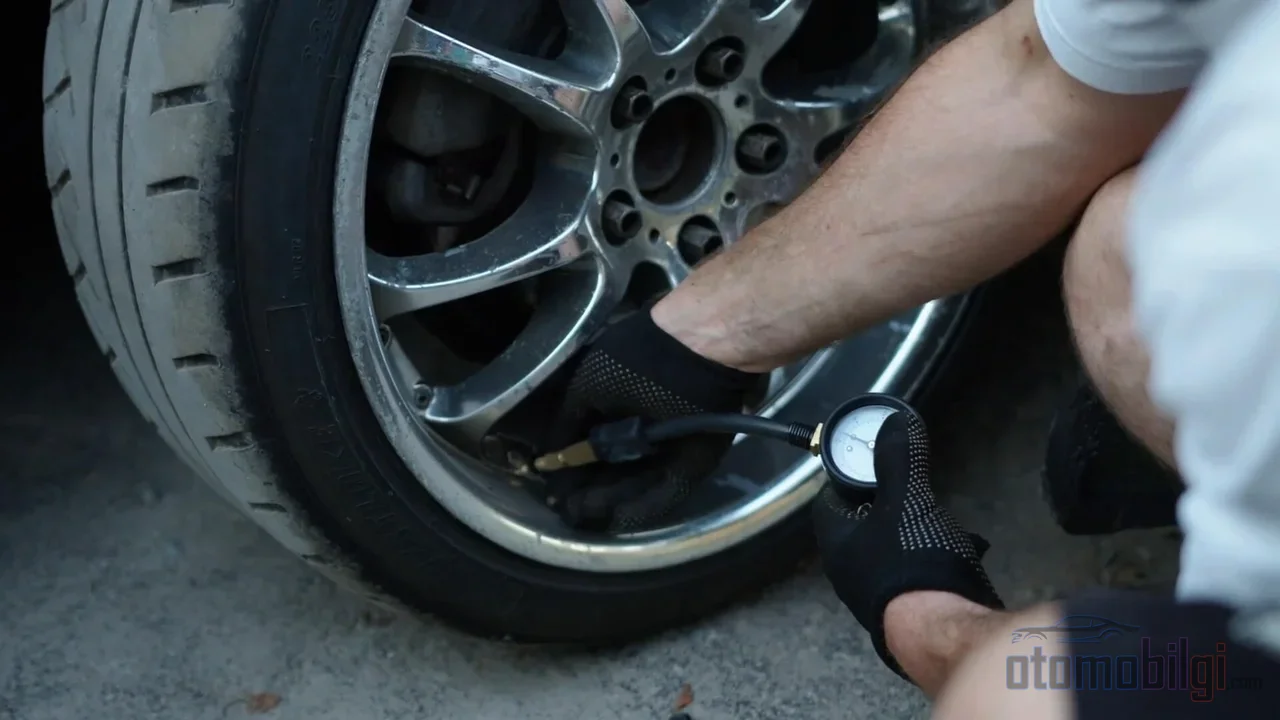
In the past, drivers used to do this job with their own eyes; now nobody bothers with a gauge because TPMS exists. Yet TPMS warns at the threshold and does not tell you where the leak is. Checking the pressure at least once a month and before a long trip is still a valid habit; it is also worth doing a round during periods of sudden temperature changes.
Finding the Leak at Home: The Soapy Water Test
If you think the pressure drop is faster than normal diffusion, it is possible to start the diagnosis at home. The method is simple and has not changed in thirty years: inflate the tire to the recommended pressure, and spray soapy water on the valve core, the valve base, and the wheel-tire seating area. Bubbles emerge from the leaking spot; the location of the leak is clear. To distinguish a bead leak from the others, remember the signature from the previous section: a chain of fine bubbles clustered along a single span.
That said, to be honest: sometimes despite wetting the tire, wheel, bead, and valve, no bubbles appear at all. In that case, the job is no longer something to be done at home; professional methods and usually dismounting the tire from the wheel are required. Indeed, many slow leak repairs require the tire to be dismounted, so going to an experienced tire specialist is usually the right step. Experts follow a similar sequence: first the tire's age is checked, then the valve body is inspected for damage, small punctures are examined, then the rim is checked for damage; if doubt remains, the tire-wheel assembly is dismounted, internal components are inspected, and escaping air is listened for.
Is Simple Inflation Enough, or Is a Professional Needed?
Not every loss of air is a repair job. Making a trip to the tire shop to check the natural 1-2 PSI monthly loss is a waste of both time and money; regular inflation is the only remedy for loss in this range, and it is sufficient. To clarify the distinction, I have grouped the situations into two categories:
| Situation | What to do |
|---|---|
| 1-2 PSI monthly loss (natural diffusion) | Regular inflation is sufficient |
| Pressure drop due to falling temperature | Check after pressure has been corrected |
| Small puncture in the tread area | Repairable; professional repair |
| Cracked, old, or dry-looking valve rubber | Immediate valve replacement |
| Bead leak, rim corrosion, bent rim | Dismount the tire for cleaning / resealing |
| Sidewall damage, large puncture, structural damage | Not repairable; tire replacement |
The logic behind this table is simple: if the source of the loss is in the tire's body and the puncture is small, repair is possible; if the source is in the structural integrity or the sidewall, it is not. A proper repair always follows the same procedure: the tire is dismounted, inspected inside, confirmed to be repairable, and an approved method is applied.
Temporary Fix or Permanent Repair? The Truth About Plugs, Patches, and Sealant Sprays
Having a plug installed at the roadside can be a lifesaver, but you need to know what a plug really is: it is a temporary, emergency solution, and its correct use is to hold air just long enough to get the vehicle to a repair shop. If the plug leaks, the tire will still slowly deflate; a patch, on the other hand, is applied from the inside, making it more permanent and superior in terms of holding air. The industry's official position is also clear: a plug alone is not considered an acceptable repair; the hole must be filled with a rubber-stemmed plug, and repairs must not overlap each other. For this reason, professional repair shops often prefer the patch-plus-plug combination.
The same honesty applies to Fix-a-Flat type sealant sprays: these are not a permanent solution; they only carry you to a repair shop in an emergency, and afterwards the tire must absolutely undergo a professional inspection. The rule is the same for the repair screws popular among motorcyclists; a real repair is done by dismounting the tire and checking it from the inside. These used to be undisputed facts; today they are not disputed either - they just wait to be remembered at the moment of urgency.
What Does Driving on Low Pressure Do to a Tire? Risk of Permanent Damage
Managing a slow leak by saying "it's deflating, I'll just inflate it" is the most expensive mistake. The sidewall of an underinflated tire flexes far more than normal; a tire is a multi-layered structure, and excessive stretching damages the layers. Damage to the internal components, including the sidewall, belts, and shoulder, is often permanent, and worst of all, this damage is not immediately visible. Since even a small natural loss can cause excessive wear on both edges, the condition of a tire that has been rolling at low pressure for weeks is predictable.
Practitioners' observations point in the same direction: even a short distance at severely low pressure can compromise the sidewall, and a compromised sidewall carries the risk of a blowout. In other words, while the visible loss seems as harmless as a few PSI, the real bill is layer damage and a possible sudden blowout. There is also an example of just the opposite: in contrast, the damage low pressure inflicts on the layers costs the price of a new tire. In short, catching the leak early not only saves the tire; it also saves safety.
Conclusion: Do Not Keep Inflating Before Finding the Source
1-2 PSI per month is physics; anything more is a message. When you have to inflate the same tire a second time, check the valve and the bead area with soapy water; if there are no bubbles or you cannot find the leak yourself, leave the job to a tire shop. A valve crack costs the price of a star wrench, and a bead cleaning is a half-hour job; on the other hand, the damage low pressure inflicts on the layers is worth the price of a new tire. I have been doing this math for many years; continuing to inflate without finding the source has always been the most expensive option.
Sources
- Why Your Tire Keeps Losing Air (Even Without a Visible Leak) – Hamm's Tires
- Recommended Tire Pressure – Discount Tire
- Tire Plug vs. Patch: Get the Right Tire Repair – AAA
- Tire Repair Basics – USTMA
- How Do I Find and Stop a Slow Tire Leak? – Cars.com
- Slow Tire Leaks: Causes, Fixes, and Prevention – Les Schwab
- How to Diagnose and Fix a Slow Tire Leak – Tires Plus
- Why Corroded Rims Cause Air Leaks – WheelWorx
- How to Find a Tire Bead Leak – ChaosMoto
- Slow Leak in a Tire? Common Causes and How to Fix It – Tech Tire Repairs
- Can Low Tire Pressure Affect Your Car's Safety? – Rice Tire
- What Happens When You Drive on a Flat Tire? – Jacobs Superior Products