DeltaWing: The Revolutionary Challenger to Le Mans at 475 kg
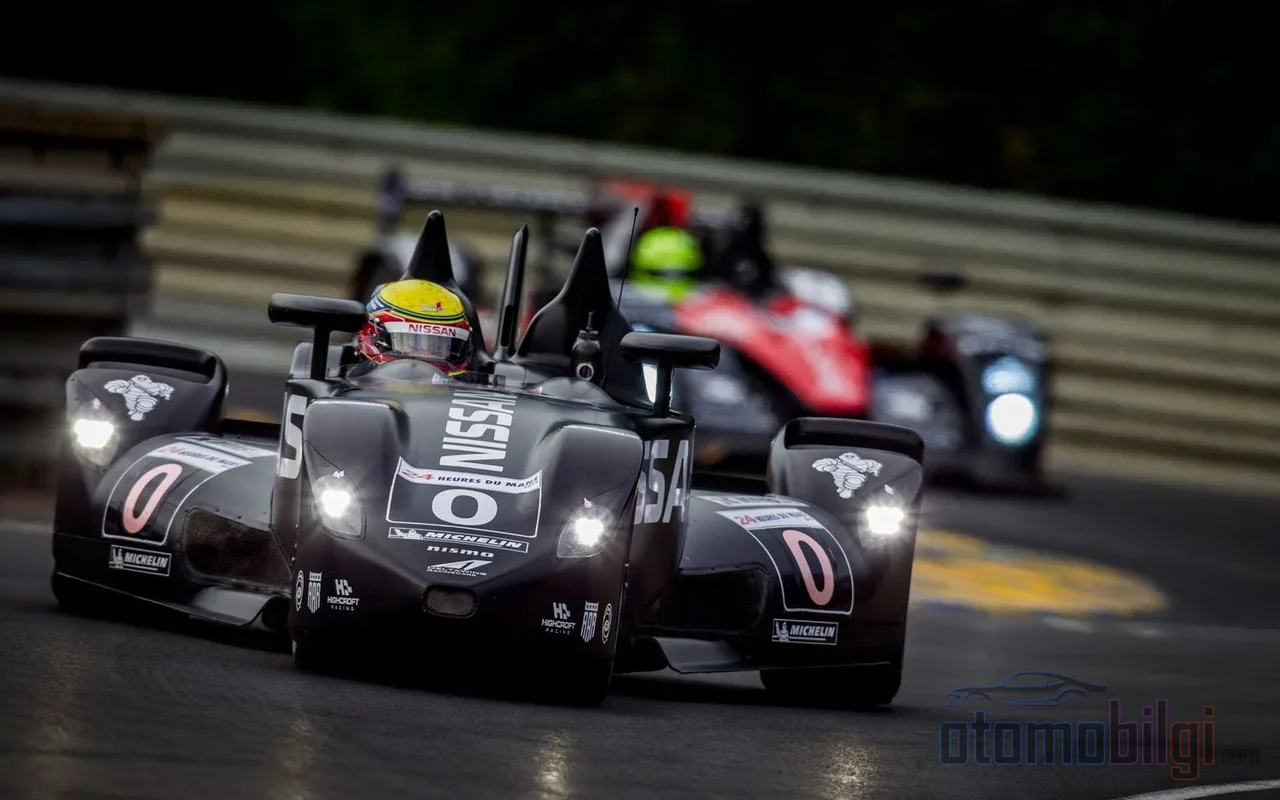
On a June night in 2012, something strange was on the track at Le Mans: among the huge LMP1 monsters everyone was used to, there stood a machine that looked as narrow as a motorcycle tire from the front. Black, silent, almost frail-looking. Its name was DeltaWing, and its claim sounded arrogant to the ears: to last 24 hours on half the fuel, half the tires, and half the weight. Did it sound like a fantasy? A little, yes. But the story of this dream is one of the strangest and boldest chapters of endurance racing.
So did this car actually work, or was it just a beautiful idea? The answer is more complicated than you think. Because the DeltaWing failed to finish Le Mans, yet at the same time it left proof on the track by lapping on half the fuel of its rivals. And without straining, without insisting.
Where Did the DeltaWing Idea Come From?
The story began taking shape in 2008 in the mind of a British designer named Ben Bowlby. Bowlby's question was simple: why does a race car have to be this heavy, this wide, and this much of a fuel guzzler? In his view, the answer lay in a formula that hadn't changed for decades: wide body, big engine, big tires. Bowlby wanted to reverse that formula.
The concept faced its first serious test in the IndyCar world. With Chip Ganassi's financial backing, the prototype was introduced at the Chicago Auto Show in February 2010; but in July 2010, IndyCar chose the Dallara design for its 2012 chassis. When the door slammed shut, Bowlby didn't give up. Working with Don Panoz, he took the idea straight to the Automobile Club de l'Ouest, the ACO. And the ACO invited it to the 2012 Le Mans through its Garage 56 experimental category, created precisely for such attempts. The project came to life under the name Project 56: the design was Bowlby's, the build was at Dan Gurney's All American Racers workshop, the race team was Duncan Dayton's Highcroft Racing, and the management was Don Panoz's. Nissan's NISMO division supplied the engine in exchange for naming rights. So even on paper, the team was an endurance festival made up entirely of stars.
Highlights
- With a weight of 475 kg and about 300 hp, the DeltaWing entered the 2012 Le Mans as the Garage 56 invitee.
- The goal was a race car with half the weight, half the power, and half the fuel consumption.
- With its 40-liter tank, it covered 150 km per tank, showing roughly twice the fuel economy of its rivals.
- In 2012 it collided with a Toyota and was eliminated; in the 2013 ALMS it reached the overall podium.
- After 29 races in total without a win, pole position, or fastest lap, the project was withdrawn.
The Physics of the Narrow Body: Why So Thin?
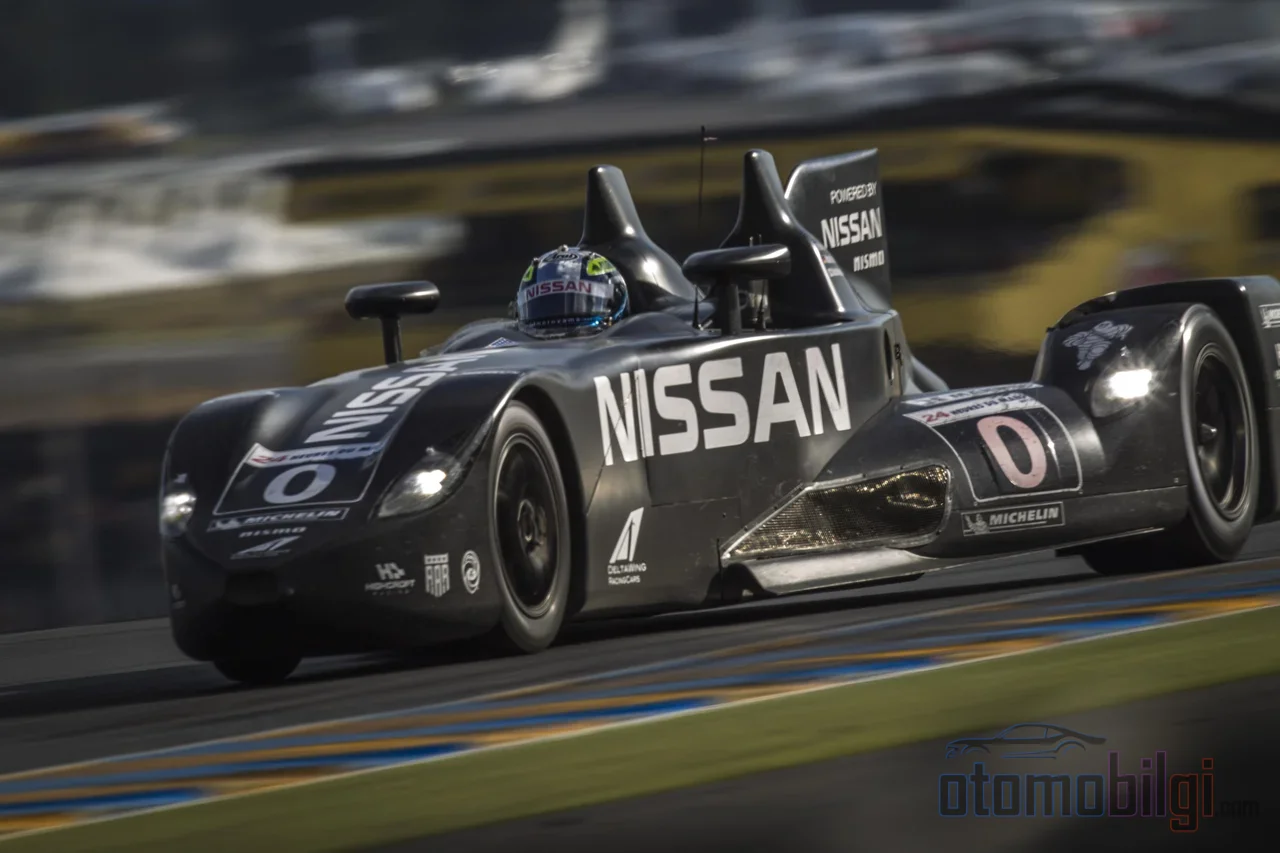
The DeltaWing's craziest feature is its dimensions. The distance between the front wheels is only 61 cm, while the rear track is 1.7 meters. For a race car, this difference seems absurd, and it truly does: from the front it's almost a formula car, from the rear an LMP. The body tapers toward this narrow front end; as the surface area shrinks, friction, that is, aerodynamic drag, also drops. The car's drag coefficient is 0.35; an almost unimaginable figure for such massive prototypes.
But how does this thing stay so planted in the corners? That is where the clever part comes in. 72.5% of the car's mass and 76% of its downforce are concentrated at the rear. In other words, the car behaves like a dart: its heavy, pressed-down rear comes from behind, and its narrow nose clears the way. There is no front or rear spoiler; all the downforce comes from underneath, that is, from underbody airflow. The moving Gurney flap, normally banned on regular cars, was allowed on this car thanks to its experimental status. Even the braking system was part of this philosophy: just 13.2 kg, roughly half of what is customary for a race car.
The Logic of the Half-Fuel Claim
When Nissan introduced the car, the formula was clear: half the weight, half the aerodynamic drag. When weight drops by half, the power the engine needs drops too; less power means lower fuel consumption; less fuel means a smaller tank, and the car gets a bit lighter still. Like a chain of dominoes. With this equation, Bowlby's goal was for the DeltaWing to be marginally faster than the 2009-2011 Dallara IndyCar in straight-line and cornering speeds. In other words, the same performance with fewer resources. The logic was sound; but did it work on track? We will get to that.
2012 Le Mans: The Crash, the Honor, and the 150-Kilometer Fuel Tanks
After its first track sighting at the shakedown at Buttonwillow Raceway Park on March 1, 2012, the car qualified 29th at Le Mans with a time of 3:42.612. Not dazzling, but remember: this car was there to prove a point, not to win. During the race, however, things unfolded in a way no one expected. However, in the race, things developed in a way no one expected. Its best lap of 3:45.737 was competitive with some LMP2 teams. With a 40-liter tank, it could cover 11 laps, roughly 150 km of distance. So the half-fuel promise had not remained on paper. Then came lap 77.
Then 75. laps. Kazuki Nakajima's Toyota TS030 Hybrid, failing to see the DeltaWing after the restart, hit it, and the black machine was rammed into the concrete barrier at the Porsche Curves. A race dream that had vanished mid-season was suddenly shattered to pieces. almost the distance of a regular WEC race. According to Nissan's official figures, the car had completed 1005 km of the race; At the end of 2012, it was granted unscored entry to Petit Le Mans at Road Atlanta. In practice, after a GTC Porsche rammed it from behind, the car overturned under the bridge;
At the end of 2012, it earned an invitation-free entry to Petit Le Mans at Road Atlanta. In practice, a GTC Porsche rear-ended the car, causing it to flip under the bridge; the team rebuilt the car, and the DeltaWing finished 5th in the overall classification. 388 laps compared to the winner's 398 laps. The Road to the Cup
2013 and Beyond: Nissan, All American Racers, Don Panoz, and Michelin were gone;
In 2013 the project changed hands: Nissan, All American Racers, Don Panoz and Michelin were gone; the car entered ALMS with P1 specification. The closed-cockpit DWC13 version used an Élan chassis and delivered 350 hp from a Mazda-based 1.9-liter turbo engine. The season's best results were an overall 5th place at Road America and a podium finish in the series' final race. Automobile Magazine even awarded the car its 2013 Racing Car of the Year prize. Competing in the United SportsCar Championship between 2014 and 2016, the car led 15 laps at the 2014 Petit Le Mans and took a 4th-place finish, its best result of the season. But in the end rule changes left it with no opportunity to compete, and in November 2016 it was confirmed that it would not enter the 2017 Rolex 24.
The career total looks harsh: 29 races, 0 wins, 0 pole positions, 0 fastest laps. So was this a failure? The numbers say yes, but the story says no.
Why Did It Fail Commercially?
There are two major reasons. The first is sporting: DeltaWing never found a class of its own. Garage 56 was an experimental invitational, with no championship points; and winning a classed entry into ALMS never came to pass. A car that does not fit the rules cannot, in the end, survive in an arena where rules exist. The second is legal: On November 22, 2013, the DeltaWing consortium filed a lawsuit against Ben Bowlby and Nissan over the Nissan ZEOD RC and BladeGlider concepts, whose designs resembled its own, with allegations such as theft of confidential information and misuse of trade secrets. The case was settled out of court in March 2016 under confidential terms. In other words, it was not on-track speed that ended the project, but off-track matters.
The economic side was also challenging: even though its shape could reduce drag and improve fuel efficiency, no tangible product output extending this physics to road cars ever materialized. Its gains passed not to road cars, but only into engineering culture and memory.
DeltaWing's Answer: Did It Race on Half the Fuel?
Yes, it did; but not exactly for 24 hours. At Le Mans in 2012, DeltaWing truly delivered on its claim of half the fuel and half the tires: it was on track with a range of 150 km per tank, a power/weight ratio of 631 hp per ton, and twice the fuel economy of its rivals. The reason for its elimination was not a mechanical failure, but another driver failing to see this small black machine and crashing into it. The car proved its idea; fate ended it. The project never won in 29 races and was withdrawn from the scene at the end of 2016 due to rule changes.
Yet DeltaWing is still remembered as one of the bravest race car designs of the 21st century. Because what it showed was not just an accident, but a proof: it was possible to achieve the same performance with half the resources. Today, the more central efficiency is in endurance racing, the deeper the mark DeltaWing left at La Sarthe that night.
Technical Specifications: 2012 Le Mans Version
| Specification | Value |
|---|---|
| Engine | 1.6 L four-cylinder turbo, direct injection (built by RML, Chevrolet-based components) |
| Power | Approximately 300 hp @ 7,400 rpm |
| Torque | 310 Nm (held from 4,000-6,750 rpm) |
| Weight (without fuel, without driver) | 475 kg |
| Length / Width / Height | 4,650 mm / 2,000 mm / 1,030 mm |
| Front / Rear track | 600 mm / 1,700 mm |
| Fuel tank | 40 liters |
| Drag coefficient (Cd) | 0.35 |
| Brake system weight | 13.2 kg |
| 0-100 km/h | Not disclosed by the manufacturer |
And one more detail: The range per tank at Le Mans 2012 may look like an average of 26.67 L/100 km, but for a race car running flat out for 24 hours straight, this is an extraordinary level of efficiency. Details like the throttle body taken from the Nissan Juke also show just how creatively resources were managed in building this project.
Sources
- DeltaWing
- Nissan DeltaWing Specifications
- Nissan backs ground-breaking DeltaWing project for Le Mans
- Heroic Nissan DeltaWing Team Ends Le Mans Journey
- Developing the DeltaWing
- DeltaWing: The Story of the 21st Century's Most Daring Race Car
- Death of the DeltaWing: What went wrong?
- 30 cars and 90 years of the 24 Hours of Le Mans 30/30: The Nissan DeltaWing (2012)
- The DeltaWing team finishes on the podium at the final ALMS race
- Fired up about the DeltaWing at Le Mans