Nissan GT-R LM Nismo: How Did the 1,250 hp Promise Collapse?
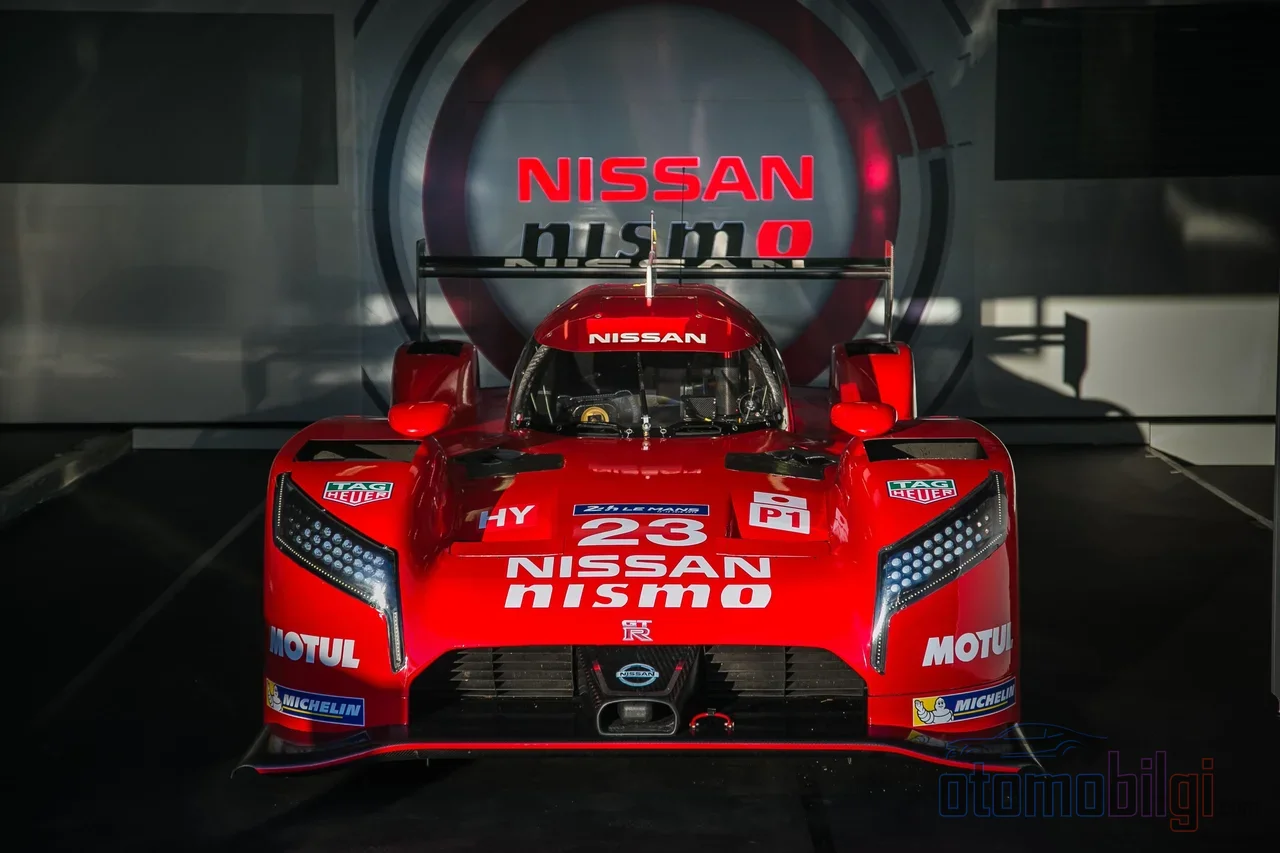
June 2015, Le Mans. The start time is approaching, and in the garage stand three of the world's strangest race cars: engine at the front, drive at the front, asymmetric tires. Nissan has arrived in the LMP1 class with a concept no one else dared, with the GT-R LM Nismo. On paper, it had a total system output of about 1,250 hp. So what was the result? By the end of 24 hours, not a single Nissan could even be classified. How does such an ambitious project collapse in a single season? The answer doesn't come from a single mistake; it comes from a series of decisions, and each one is a lesson in itself.
A Race Car Built Backwards: The Logic of the Concept
Let's first ask this question, because everything starts here: Why do almost all LMP1 prototypes carry their engine at the rear, with rear-wheel drive? Because it is a proven formula. Nissan, however, tried exactly the opposite. Chief designer Ben Bowlby, a name known for radical ideas since he was also the architect of the DeltaWing project, was instructed by the company not to produce an Audi copy. The result was the only car among all the Le Mans Prototypes of its era with a front-mounted engine and front-wheel drive.
The logic wasn't actually all that absurd, let's be honest. Bowlby's aerodynamic argument was this: if you pile weight and downforce at the front, you can slim down the rear wing and reduce drag. Moreover, packaging the engine and energy recovery system at the front gave the body a true air tunnel. Since the weight was at the front, 14-inch-wide Michelin tires were fitted at the front and only 9-inch-wide ones at the rear. Yes, you read that right: the front tires are noticeably wider than the rear ones. You wouldn't even see such a thing in your uncle's Passat.
Highlights
- The Nissan GT-R LM Nismo was the only front-engined, front-wheel-drive car in LMP1
- It targeted a total system output of about 1,250 hp, but the hybrid system never worked at Le Mans
- Three cars entered the 2015 Le Mans, and zero cars were classified
- The project was officially cancelled on December 22, 2015, its life lasting just one season
The Numbers on the Table: Technical Specifications
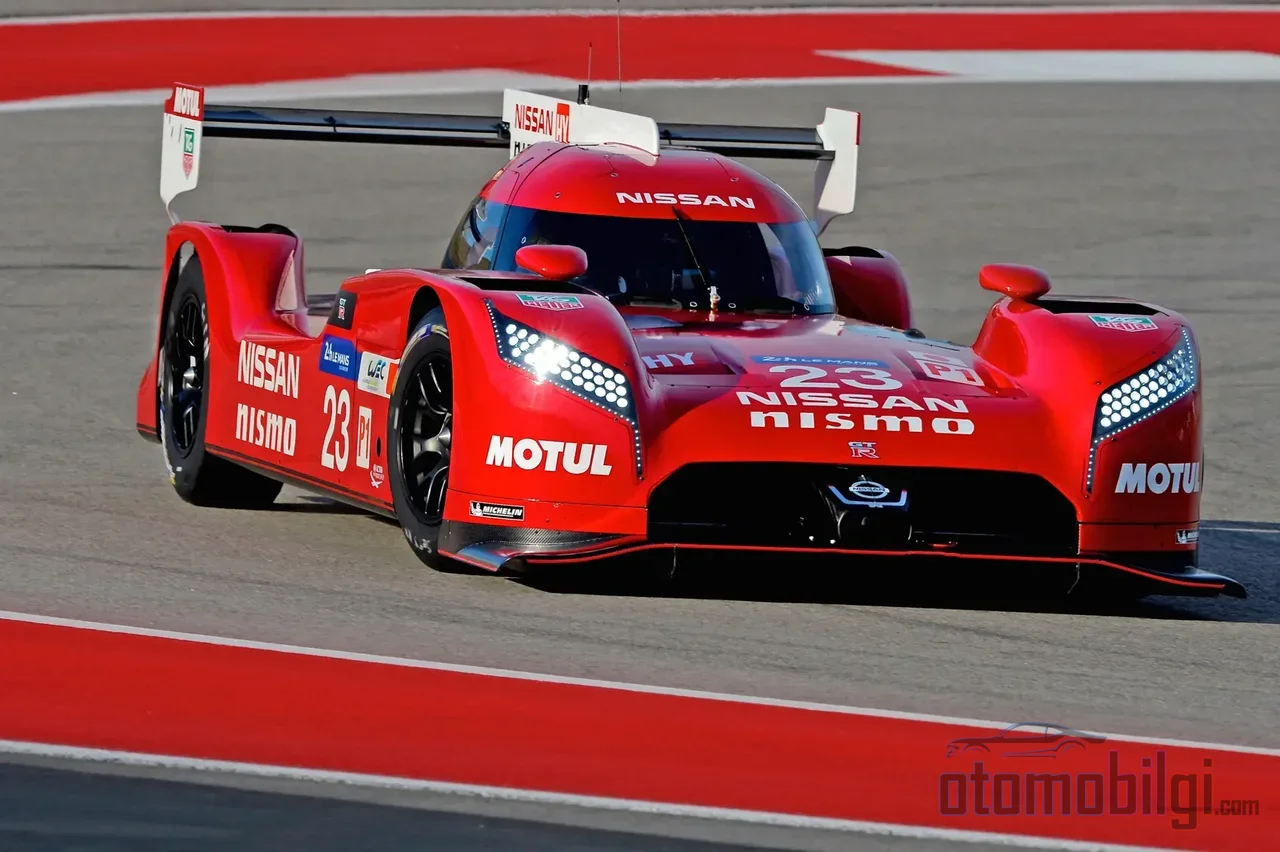
At the heart of the car lies the engine coded VRX30A, developed jointly by Nissan and Cosworth: a 3.0-liter, 60-degree, twin-turbocharged, direct-injection V6. Nissan saw this engine as its most fuel-efficient design. While the combustion engine produced about 500 hp, the twin flywheel KERS system harvesting energy from the front brakes added another 750 hp; yielding a total system output target of about 1,250 hp. Power was sent to the front wheels through an Xtrac five-speed sequential gearbox, and if needed, to the rear wheels as well via passing shafts and the epicyclic gearboxes at the rear. So in theory, all-wheel drive was even possible.
| Feature | Value |
|---|---|
| Engine | Nissan VRX30A, 3.0 L twin-turbo V6 |
| Combustion engine output | About 500 hp |
| Hybrid contribution (flywheel KERS) | About 750 hp |
| Total system output | About 1,250 hp |
| Gearbox | Xtrac 5-speed sequential |
| Weight | About 880 kg |
| Length / width / height | 4,645 / 1,900 / 1,030 mm |
| Front / rear tire width | 14 inches / 9 inches |
| Maximum torque | Not disclosed by the manufacturer |
I know you're stuck on that torque row. The maximum torque value was never announced, either in official technical bulletins or in reliable industry publications; in other words, it was not disclosed by the manufacturer. The same goes for the 0-100 km/h figure. But don't worry, horsepower was never the real issue in this car's story anyway.
The Hours Were Not Enough: The Price of the Testing Schedule
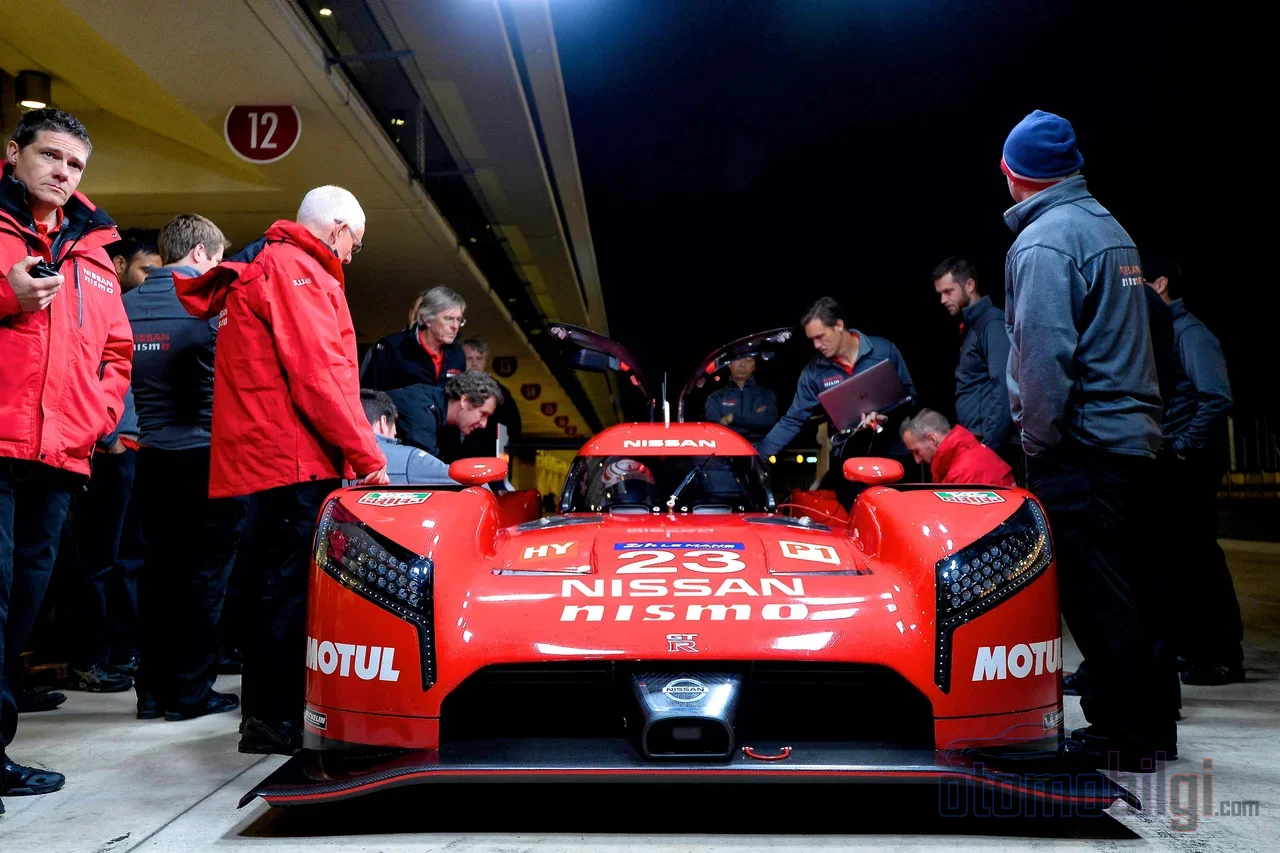
The project was announced on May 23, 2014, and the car was introduced to the world in a Super Bowl ad on February 1, 2015. Doesn't that sound great? But behind the curtain, the picture was dark: the car hadn't even turned a wheel until November 2014, and Le Mans 2015 was to be its first competitive event. The time between announcement and race was only 14 months. Developing an LMP1 car from scratch in that time is like a student starting to study on the night of the final exam.
Prototype failed the crash test
The schedule got even worse. The car failed the FIA crash test twice: in the first attempt the front roll hoop was damaged, and when the door structure failed the anti-burst load test, it had to be completely redesigned. For this reason, the team missed the Silverstone season opener of the WEC season and the Paul Ricard pre-season test. The brief rollout in Arizona, programs at Circuit of the Americas and Palm Beach International Raceway, and a test at Sebring cut short after two days in March due to a knocking-related engine problem... By Silverstone, the car's total test distance was only 3,800 km. A 2,000 km endurance run was carried out in Kentucky in April, but these were nothing compared to the distances covered by the rivals. What's more, there was no ready-made data set for this unusual concept: everything had to be learned from scratch.
2015 Le Mans: A 24-Hour Vigil
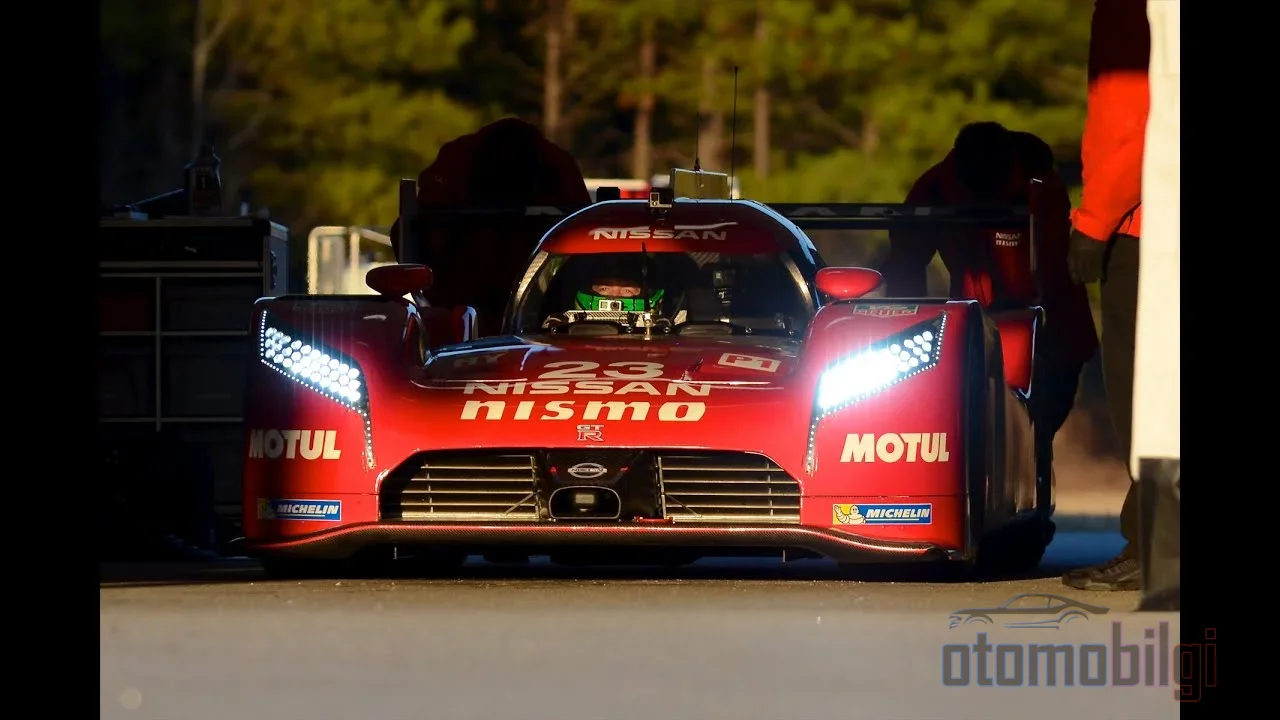
And the big week arrived. The three cars (numbers 21, 22 and 23) were pushed to the very back of the grid; since they could not come within 110 percent of the pole position time, they were placed at the rear of the prototypes, and their laps were more than 20 seconds slower than the fastest LMP1. Car number 21 was even behind the fastest LMP2. Why? Because the biggest bomb went off just before the race.
The hybrid that never worked
We were talking about a system of about 1,250 hp, right... well, that system's hybrid half, the flywheel-based KERS, never worked at Le Mans. Following a decision made after a test two weeks before the race, all three cars carried the full weight of the hybrid system and raced using none of its energy, solely on the roughly 500 hp gasoline engine. Deprived of a system designed to deliver over 1,000 hp, the cars left the grid missing several hundred horsepower. Without electric rear-wheel drive, the massive front-wheel-drive torque suffered from torque steer, and on corner exits they were slower than LMP2s and even some GT cars. An ironic detail: if it had been hybrid, it would have contributed up to 2g during braking; since it wasn't, large brake packages were fitted later, the brakes caught on, and the first disc change was made within the first six hours. Disc changes became almost routine; the changed discs were carving holes in the tarmac.
So did the car never manage any speed at all? It did; on the Mulsanne straight it reached a speed of around 210 mph, that is, about 340 km/h. So the straight was its friend, but the corners and climbs were its enemy. Friday night's 48-hour engine change, gearboxes stuck in fourth gear, and Harry Tincknell's crash at over 200 mph made the night even harder. The results table was brutal: Number 21 retired with a suspension failure after 115 laps, number 23 after 234. 234 laps with a gearbox problem; number 22 stayed on track but was not classified because it failed to complete even 70 percent of the winning Porsche's distance. The victory went to the Porsche 919 Hybrid with 391 laps. The Toyotas were left behind with 387 laps.
Why Did It End After One Season?
Now all the pieces are in hand; I can give a clear answer to the question. The Nissan GT-R LM Nismo died not from a single big mistake, but from five problems stacking on top of each other: the FIA crash test failed twice, the missed WEC season opener, a hybrid system that never worked, zero cars classified at Le Mans, and laps more than 20 seconds slower than the rivals. The brand name was on these cars, and corporate responsibility was clearly assumed.
After the race, the campaign was abandoned; there was no 2016 WEC entry. Although additional tests were conducted at NOLA Motorsports Park in December, the program was officially cancelled on December 22, 2015, three days before Christmas. The Indianapolis-based team was shut down, informing employees of the situation by email. A second-generation design adapted to the electric hybrid was ready on paper for 2016, but was never completed.
The Lesson of Losing Projects
So why does this story matter? Because the Le Mans narrative always focuses on the winners: Audi's dominance, Porsche's victories, Toyota's supremacy in the hypercar era... Yet what makes these victories possible is the lessons accumulated by failed projects. Nissan was not alone: Cadillac's earlier Le Mans effort collapsed in three years, and Aston Martin's AMR-One and DP212 projects remained on the same thin line. Each one showed how narrow the margin of endurance racing is.
There is also this opposing view, and there are places where it is right: was that Le Mans a complete fiasco? Continuing to race despite the hybrid not working was a bold decision to keep collecting race-condition data. Reliability issues aside, the team collected valuable data for 24 hours; before the race, Bowlby openly explained that the preparation was built on learning and recording data. Darren Cox, who took part in the project, also argues years later that the effort appeared to fail but that its cultural impact endured. And my verdict? A failure as an engineering textbook, invaluable as a case review. Few failures in Le Mans history have been talked about this much.
The next time you watch a hypercar victory, think about this: behind that podium lie not only the winners' achievements, but also the lessons accumulated by bold yet short-lived projects like the GT-R LM Nismo.
Sources
- Nissan reveals technical specs for GT-R LM NISMO ahead of Le Mans
- Q&A with Ben Bowlby on the 2015 Nissan GT-R LM NISMO
- Nissan GT-R LM Nismo - Wikipedia
- Full Specs Revealed for Crazysauce Nissan GT-R LM NISMO Le Mans Racer - Car and Driver
- Nissan reveals front-engined GT-R LM LMP1 for 2015 Le Mans and WEC - Autosport