How Did Porsche Win Le Mans 19 Times?
Share This Page
Porsche is the most successful manufacturer to have won the 24 Hours of Le Mans, with 19 overall victories. This story, which began with its first win in 1970 with the 917; continued through the 956/962 era of the 80s, the 90s, and the hybrid era of the 919 Hybrid, forming the most enduring brand dominance in endurance racing.
Highlights
- Porsche at Le Mans with 19 overall victories holds the record; it is followed by Audi with 13 wins and Ferrari with 12
- The brand has more than 100 class wins ; its first overall victory came in's with the Porsche 917 in 1970
- From 1982 onwards, with the 956/962, seven consecutive Le Mans victories were achieved
- The 919 Hybrid, won three times in a row between 2015 and 2017, bringing the brand its 19th victory in 2017
Why Is Le Mans Porsche's Playground?
In the 24 Hours of Le Mans, the winner is not the car that sets the fastest lap or finishes earliest, but the one that covers the most distance within 24 hours. This single rule defines the entire character of the race: speed matters, but alongside speed, reliability, efficiency, and patience are essential. At the Circuit de la Sarthe, up to 85% of a lap is spent at full throttle ; meaning the engine and drivetrain work almost around the clock without a single break. This effectively turns the race into an engineering endurance test.
And it is precisely at this point that Porsche's philosophy perfectly matches the nature of the track. The company has been competing since 1951 ; meaning it was already collecting class wins and accumulating data at Le Mans nearly two decades before its first overall victory. The winning strategy is actually simple: keeping fuel, tire, and driver changes under one minute during pit stops, maintaining rhythm with three-driver teams, and calculating from the start the engineering margin needed to get the car to the finish line. Pit strategy is a huge factor in this race - and Porsche applied it with a subtlety it shared with no one for years.
So much so that the track itself holds a Porsche detail: at the Circuit de la Sarthe there is a section called the "Porsche Curves". Let us begin this story in 1970, about a brand so dominant on this track 209 km west of Paris that it deserves to have corners named after it.
Porsche 917: The Road from Nightmare to Icon
It all began in 1968 when the FIA raised the maximum engine displacement from 3 liters to 5 liters in the World Sportscar Championship. The three-liter 908 had become a car that could no longer stay competitive. Moreover, the minimum production requirement had been lowered from 50 to 25 - and Porsche decided to seize this opportunity. The goal was clear: the first overall victory at Le Mans on June 14, 1970
A monster designed in nine months
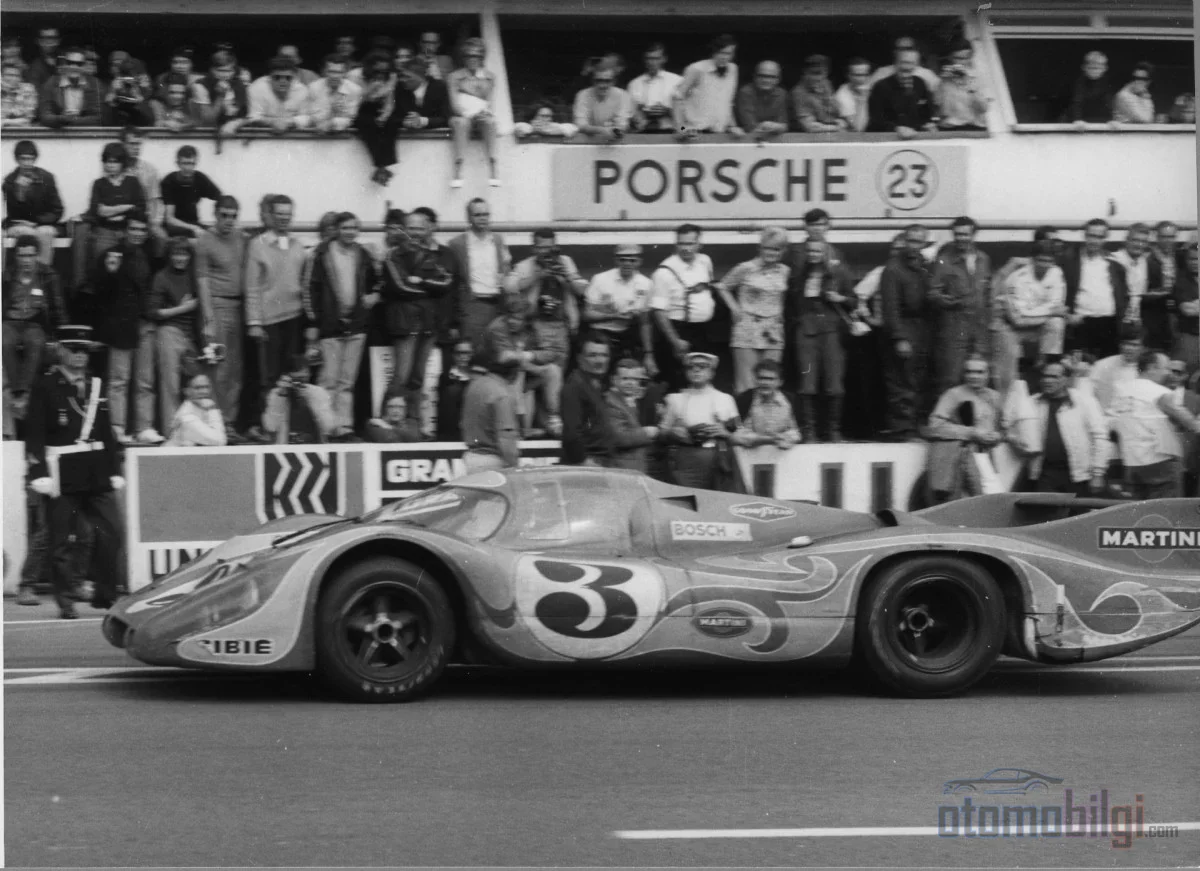
The project was stamped with the approval of development chief 31-year-old Ferdinand Piëch: "a car that would win against all odds." Chassis design belonged to Helmuth Bott, engine design to Hans Mezger. And time was extremely tight: from the first drafts to the presentation at the Geneva Motor Show on March 13, 1969 there were only nine months and there was almost no time left for testing. The aerodynamics were optimized for drag; the price in downforce was never paid. The result? Early on, the car gained a reputation for being "undrivable". According to driver Brian Redman, the 917 "used up the whole road" at high speed - which is the last thing you want in an endurance race.
The technical side, meanwhile, was full of madness: a 42 kg gas-pressurized spaceframe chassis (they pumped air into it to detect cracks, imagine that), a spaceframe chassis with 180° flat-12 "Type 912" engine signed by Hans Mezger, titanium and magnesium parts, fiberglass body. The engine was enlarged from 4.5 liters to 5.0 liters ; power climbed from ~520 hp in 1969 to 630 hp. But even homologation was an adventure: in March 1969, inspectors saw 3 completed, 18 in assembly cars and 7 part kits and rejected it. Piëch's response went down in history - on April 20, 25 units of the 917 25 units of the 917 were lined up in front of the factory, and approval was granted when the inspectors' offer of a test drive was also refused. The price? DM 140,000, roughly equivalent to about 10 units of the 911 - far from covering the development costs.
Salvation for the 917K, born at the trackside,
came in October 1969, at a joint test at the Österreichring. It was noticed that the short, raised tail of the open-cockpit 917PA spyder provided stability, and trackside, with duct tape and an aluminum sheet, the 917K (Kurzheck, meaning short tail) was developed. The entire rear section was re-engineered; the glass, radiator, door and roof remained unchanged. This was the car that brought the 1970 Le Mans victory: Hans Herrmann and Richard Attwood finished first with the red-and-white Porsche Salzburg 917K; Larrousse/Kauhsen's long-tail 917L finished second. Elford's pole-sitting 917L, however, was eliminated in the 18th hour with an engine failure.
In 1971, Helmut Marko and Gijs van Lennep set a race distance record of 5,335.16 km that stood unbroken for about 40 years. The 917 won 7 out of 8 races in both seasons. The rule change in 1972 left the car out of the championship, so it moved to Can-Am and Interserie, where it won a total of 37 times until 1975 - the 917/30 version in Can-Am produced 1,100-1,580 hp
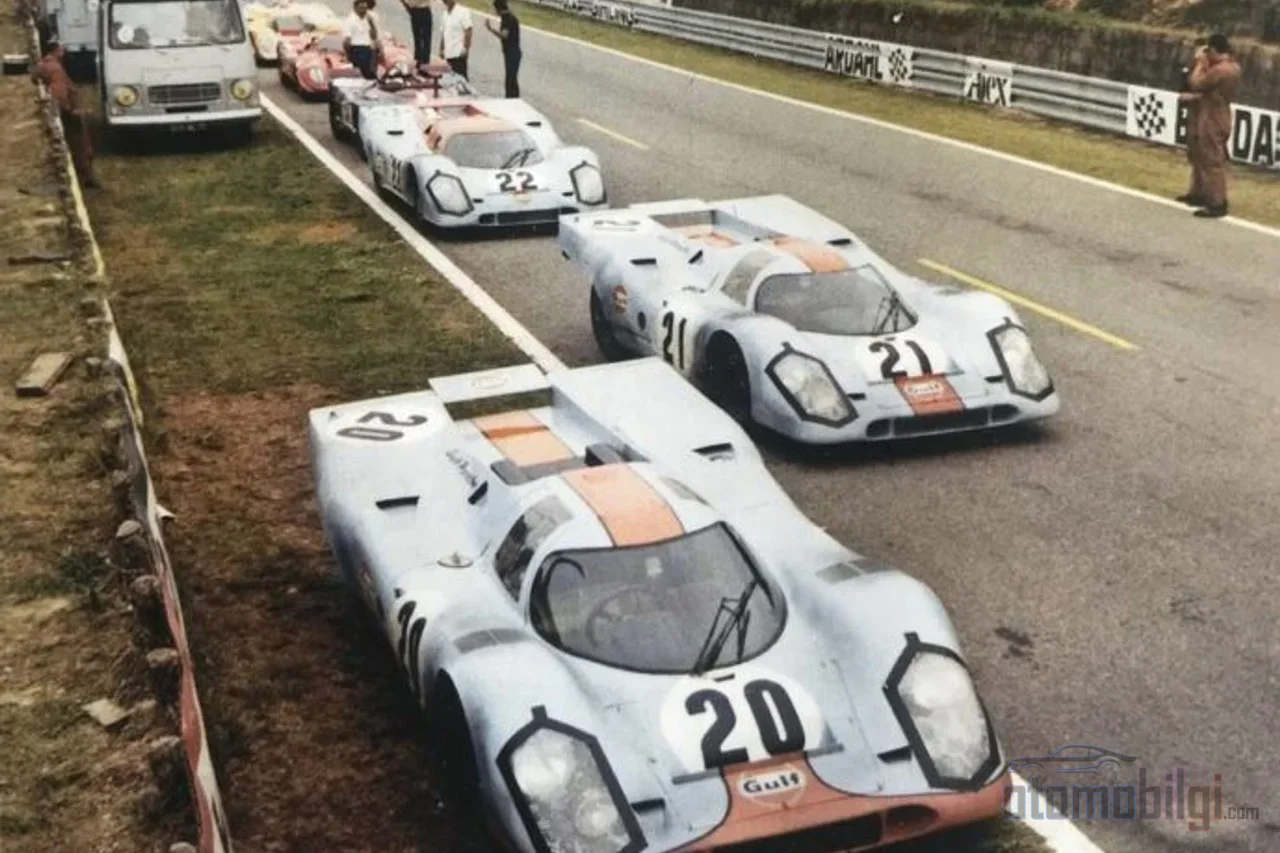
with twin turbos. And one unforgettable detail: thanks to Steve McQueen's 1971 film "Le Mans", the winning car in Gulf colors, the 917K was also written into cinema history in golden letters. Isn't it more than just a car?
If the 917 is a story that turned from a nightmare into a signature, the 956 was a car born directly with the signature. It was designed for the new Group C rules and brought together three big ideas: full ground-effect aerodynamics (using the airflow under the car like a vacuum from both sides to stick it to the road, in an everyday analogy, turning the car into a suction cup), big downforce and a lightweight aluminum monocoque chassis. The result speaks for itself: a 1-2-3 finish at the 1982 Le Mans, 23 overall victories in the 1983 season.
Let's add a note: in sources, the start of the 956/962 series is sometimes 1982 and sometimes 1981 ; this difference depends on whether the victory streak is anchored to the 956's Le Mans debut or the previous year's wins. But the series itself is undisputed: the 956 and its successor the 962 took seven consecutive victories at Le Mans and dominated every Le Mans between 1982 and 1986 . The 962 C was based on the 956 but built with 120 mm of extra wheelbase around an extra lightweight aluminum structure. This duo, combining raw power, aerodynamic efficiency, and unmatched durability in a single package, rewrote the standards from Le Mans to Daytona.
The 90s and the Long Wait: From 1998 to 2014
The victories Porsche won throughout the 90s showed how deep the brand's knowledge reserves were, even in years when motorsport budgets were being swallowed up. However, after the overall victory in 1998, Porsche announced its retirement and the Le Mans overall classification remained without Porsche for over a decade. What nobody knew at the time was that the wait would last 17 years .
919 Hybrid: Three Consecutive Wins in the Hybrid Era
919 Hybrid spent its first championship year at Le Mans in 2014, closing that 17-year gap since 1998 and carrying Porsche back to the top. Its technology, meanwhile, is a true laboratory: a 2.0-liter turbo V4 gasoline engine, a motor-generator on the front axle converting kinetic energy into electricity during braking, and energy recovery via the exhaust. In other words, the car collects the energy that would otherwise be wasted every time it enters a corner and uses it again - like gaining fuel even while braking.
The numbers tell the story: between 2014 and 2017, 17 wins in 34 races, 43 podiums, 20 poles , and 4 fastest laps; across four seasons, 6 championships and 3 overall Le Mans victories. Winning three times in a row between 2015 and 2017 proved that hybrid technology could dominate endurance racing. The 19th victory in 2017 came at the wheel of the factory 919 with Timo Bernhard and Brendon Hartley; while the No. 2 car won Le Mans, the No. 1 car came to the forefront in qualifying at Spa three weeks later. And even after retirement, the work wasn't finished: the 919 Evo, with Timo Bernhard, set a record of 5:19.55
at the Nürburgring Nordschleife. Meanwhile, let's not forget - the 917, 908, 911, and 914 sweeping all classes at Le Mans in 1970 was proof of the brand's depth; the 919 repeated the same in the hybrid era.
From Track to Road: How Does Le Mans Technology Transfer to Everyday Cars? For Porsche, technology transfer is not a marketing slogan but a corporate concept. The 911 GT3 R Hybrid from 2010 ran on additional power recovered from braking, and this technology was later transferred to the 918 RSR. The 919 Hybrid's technology also made its way to road cars: today's 54 hp electric motor. So the energy recovery learned at Le Mans is now under the cars in the showroom.
As for the future arena of transfer, it is no longer pistons and aerodynamics, software. Porsche, starting from 2023 had also announced its goal of competing for overall victory in classics like Le Mans with the hybrid prototype 963 in the LMDh category. 963, a joint effort between Porsche and Multimatic: 4.6-liter twin-turbo V8, approximately 670 hp, 1,030 kg in weight and a 7-speed sequential gearbox.
Why Is Porsche Not in the Overall Classification at Le Mans in 2026?
The current picture contains a somewhat glaring gap: the 963 will not take part in the overall classification in the 2026 WEC and at Le Mans. The reason is simple but frustrating - for the 963 to enter Le Mans, two more 963s running a full WEC season were needed, and with the confirmation that Proton Competition will not use the 963 in Hypercar from 2026 onward, this threshold could not be met. The 963 continues racing in America this year; Porsche, meanwhile, is celebrating its 75-year motorsport history at Le Mans with customer programs, and the 911 GT3 R carries that 75-year legacy on the Mulsanne.
The Shared Secret Behind the 19 Victories
In a ninety-year race, 19 overall victories cannot be a coincidence. From the 917's tail repaired with duct tape at the trackside, to the 956's ground effect revolution, and on to the 919's hybrid heart that recovers energy with every braking, there is a common thread: Porsche managed to answer Le Mans' real question - "Can you endure for 24 hours?" anew in every era. The victories came with different cars, different rules, and different decades, but all were products of the same philosophy: efficiency as much as speed, patience as much as courage. We don't know what comes next; but when this brand once again takes the stage, it will surprise no one.
Sources
- In praise of the fast car
- Porsche 917
- How the Porsche 956 became an endurance racing legend
- Porsche 962
- Champions - Porsche Museum, Success Story Le Mans
- Le Mans Winners - Porsche Motorsport
- How the technology of the 919 Hybrid works
- Porsche 919 Hybrid
- Technology transfer as a concept
- The Future Of Porsche's Racing Tech Transfer
- 24 Hours of Le Mans
- Circuit de la Sarthe
- Pit stop tactics
- The 963
- Porsche's 963 Hypercar will not enter Le Mans in 2026
- No 963, No Problem? Inside Porsche's 2026 Le Mans Strategy