Why Is Night Driving at Le Mans a Completely Different Race?
Share This Page
Night driving at Le Mans is a completely different experience from racing on the same track in daylight: there is not a single street lamp on the circuit, the distance illuminated by the headlights is at the limit of their reach, and around 3 a.m. both car and driver are going through their hardest moments. Since roughly a third of the race is run in darkness, it is no exaggeration to think of this portion of the 24 hours as a race of its own.
Highlights
- Roughly a third of the race is run in darkness; Circuit de la Sarthe has no street lamps at all.
- The track 13.6 km is long and features 38 corners
- A driver may spend at most 240 minutes in a single stint, at most 4 hours within the 6-hour window, and at most 14 hours behind the wheel in total.
- On the Mulsanne Straight, Hypercars reach ~340 km/h in the dark.
- At least one headlight must be working; otherwise the team risks being called to the pits.
Why Is Darkness Considered a Separate Race?
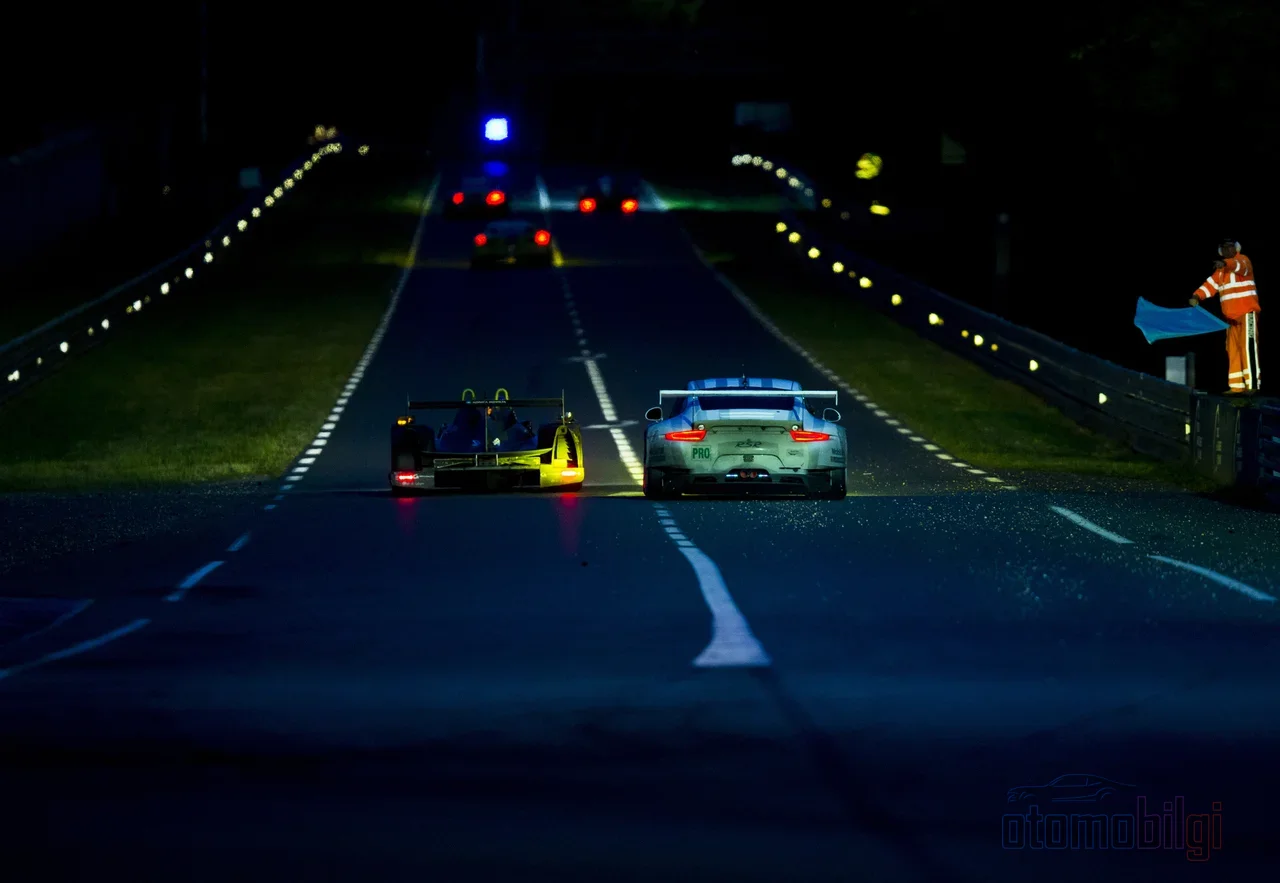
Think of it this way: in daylight, on the 13.6-kilometre Circuit de la Sarthe, you can see what lies ahead from hundreds of metres away. At night, the world shrinks to a tunnel drawn by two headlight beams. The rest of the road is pitch black. There is no lighting on the Le Mans circuit; and the darkness is truly pitch black. That is why drivers at night are not simply driving slower - they switch to a completely different driving mode: braking points are pushed back, racing lines change, and it feels as if everything must be learned all over again.
Let's look at the numbers: the track is about 13.6 km long and features 38 corners. So a significant portion of a lap consists of straights, beyond 300 km/h, covered within the reach of the headlights. In daylight, the crests, barriers and rival cars on that asphalt are easy to read; at night they simply vanish. As visual references diminish, the sensation of speed changes too; drivers say that at night they become one with the track, almost forming a single whole.
Visibility in the Dark: How Far Do the Headlights Get You?
The heart of night driving is this question: what lies beyond where your light ends? The Mulsanne Straight, the Les Hunaudieres section, is about 6 kilometres long and is the most brutal testing ground for this question. Hypercars here reach speeds of around 340 km/h on the 6-7 metre strip between the two barriers. History was written here too: in 1988, the Peugeot V6 Turbo driven by Roger Dorchy reached 405 km/h on the chicane-less straight. Today two chicanes stand in the way of that speed, but 340 km/h in the dark is still one of the craziest things that can be done in darkness.
And here is the most frustrating part: in daylight you recognize an approaching car by its sun glare; at night your only clue is two points of light flickering in the distance. The top speed gap between prototypes and GT cars can reach up to 40 km/h, which makes it nearly impossible to judge how close the approaching prototype's headlights are when you are overtaking the slower car. The headlights are so bright that misjudging distance is very easy. That is why GT drivers lock onto their mirrors at night, while prototype drivers turn overtaking into an art form.
Since there is no permanent facility on the circuit, the asphalt keeps changing throughout race week at night; picking out oil patches and rubber marks on it is much harder than during the day. It's as if the drivers are re-reading the track on every lap. So how is concentration maintained in these conditions? The answer, for the most part, lies in the human factor.
We move our braking points back and change our racing lines. When everything around you is pitch black, the track is like a tunnel.
The 3 A.M. Slump: Why Does the Human Body Start to Rebel?
The toughest opponent of night racing is sometimes not the other teams, but our biological clock. Around three in the morning, the effects of fatigue become most pronounced; drivers and crews openly describe this time window as the most miserable stretch. Think about it: normally you would be in your deepest sleep at these hours, while they are devouring the straights at 300 km/h.
So how do drivers stay awake at night? The answer lies in a series of methods based on tricking the body:
- To stay awake, light therapy lamps, exercise bikes, and warm-up routines.
- More effective than long, deep sleep, short naps; planned micro-sleeps between stints.
- Managing cabin comfort as much as possible with cooling, whether in cold weather or hot.
- There are even traditional tactics: Some drivers prefer eating blackberries to sharpen night vision and wearing yellow visors that enhance contrast.
On top of fatigue comes heat: Inside the cabin, both heat and intense concentration combine, meaning a double load. That's why night racing is an endurance test not just for the car, but for the human being.
Night Strategy: How Do the Pit Wall and Driver Rotation Change?
Winning Le Mans is not just about speed; it's a chess game that lasts for hours. For the winning teams, total pit time must be under 1 hour; refueling takes at least 5 minutes, and the driver can buckle in at the 4th minute. The engineers on the pit wall recalculate this equation every night: Since the margin for error shrinks in the dark, risky moves are less favored than during the day.
Driver rotation is also shaped according to the night. Three drivers work in shifts in each car; a driver can stay behind the wheel for at most 240 minutes in a single stint. In a 6-hour window, a driver cannot exceed 4 hours, and the overall cap is 14 hours. Stint lengths vary by class: they are kept short in LMP2 and longer in GT; Hypercars seek a balance right in the middle. Teams generally assign night stints to their strongest night drivers; because in the dark, every lap demands more experience than in daylight.
One of the unforgettable examples of this is Fernando Alonso's 2019 night stint, which is etched in memory: Alonso, closing a 1-minute gap to the leader, drove laps roughly 2 seconds faster per lap, showing just how strategic a weapon the night portion of the race can be. Also, as dawn breaks and visibility improves while traffic thins out, that golden window pilots call "happy hour" begins: The fastest lap times can still be set during these hours.
Inside the Cockpit: Dashboard Lights and Night Lighting
The fact that night racing is a separate engineering battle is evident even when you look at the car itself. Race cars use luminous number panels and "leader lights" - that is, bright panels placed on the body so that a car's number and class can be read in the dark. Electroluminescent panels were initially mounted on the side of the car to illuminate team numbers; today they have become far more refined.
Inside the cockpit, the situation is different too: Dashboard displays have transformed into digital dashes providing real-time performance data; the driver can read lap times, fuel status and telemetry at a single glance. Teams like Manthey Racing have developed special interior lighting systems that illuminate the cockpit at an optimum level for night driving. Every light source is a deliberate choice in order not to disturb the eye's adaptation to darkness; too much light impairs vision, too little makes the gauges unreadable. This balance is one of the unsung heroes of night racing.
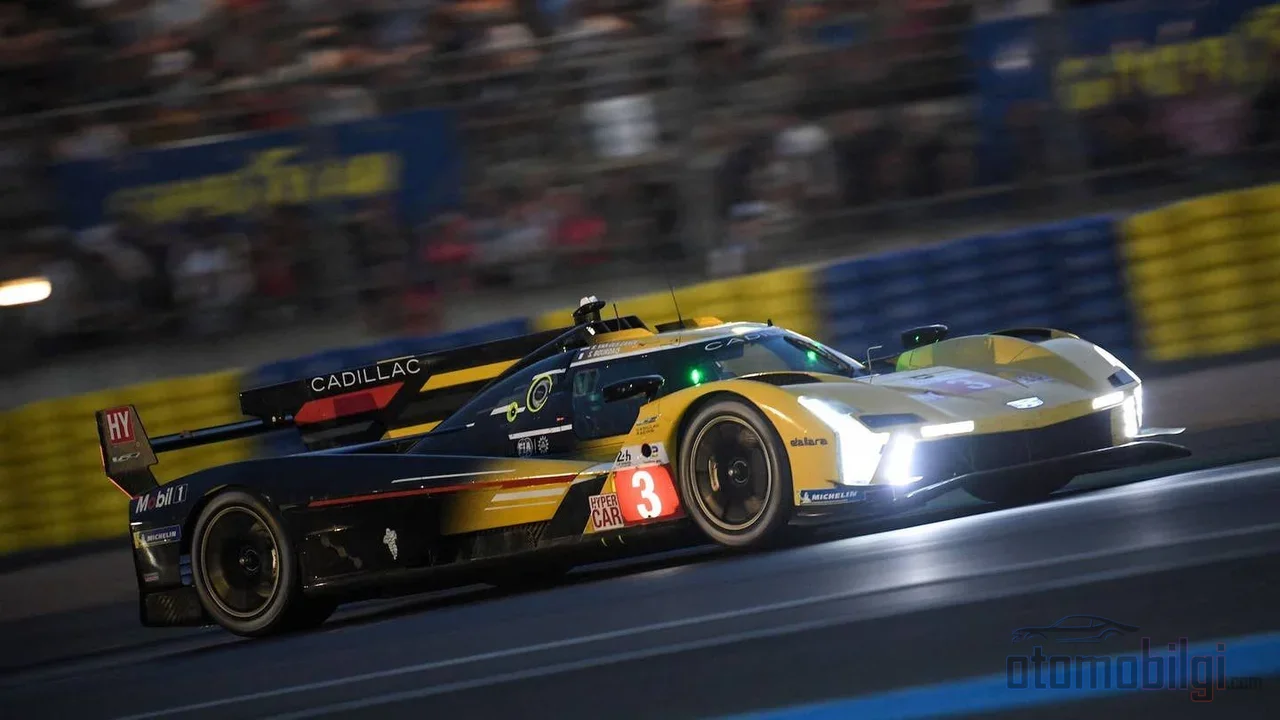
What happens if a headlight goes out? The rule is clear: At least one headlight must be working. Otherwise, the team risks being called to the pit. The 2024 Petit Le Mans showed just how dramatic this can be: A Cadillac V-Series.R in the lead position lost both of its headlights in the final laps. Had the lights gone completely out moments later, the car would have been out of the race, but the lights came back in time and the team won the 10-hour race by a margin of 2.948 seconds. Light is worth its weight in gold in night racing.
How Has Night Racing Evolved From 1923 to Today?
The first Le Mans was run on May 26-27, 1923, and at that time night racing was an unusual practice; similar endurance races preferred to run by splitting up the darkness. The first race started at 4:00 p.m., with 33 two-driver teams from 17 countries competing. In the early years, cars were lined up in descending order by engine displacement, not by practice results - meaning the race itself was a very new experience by today's standards. Beneath its status as the world's oldest endurance race still being held lies the courage to keep racing through the night without ever breaking with that tradition.
Over more than a century, the components of night racing have changed: Headlights grew stronger, telemetry and digital displays arrived, luminescent number panels allowed tracking at night, and the calculators on the pit wall began generating scenarios hours in advance. The numerous leadership changes among BMW, Cadillac and Toyota in the 2026 race, and seven cars finishing on the lead lap, showed that the strategic importance of the night segment has not diminished at all. Along the line stretching from the two-driver teams of the first race to today's three-driver rotation system, only one thing has remained unchanged: Night turns Le Mans from a race into an epic.
Final Word: You Should Watch the Night as a Race of Its Own
Next time you watch Le Mans, try not to take your eyes off the screen when the clock passes midnight. The headlights as two dots of light searching for their way, the engineers quietly recalculating on the pit wall, the drivers in the cockpit trying to keep their concentration at its peak... A completely different race is run in that segment. If it were you, would you watch the day or the night segment? In my opinion, the answer is night; because that is where the true soul of the 24 hours is hidden.
Sources
- Out of the darkness and into the light... night driving at the 24 Hours of Le Mans
- 24 Hours of Le Mans – How do drivers cope with tiredness?
- The iconic Mulsanne Straight pushes drivers to their limit
- Pit stop tactics: a major factor at the 24 Hours of Le Mans
- Le Mans Car Classes – Hypercar, LMP2, LMGT3
- 24 Hours of Le Mans – Wikipedia
- 2026 24 Hours of Le Mans – Wikipedia
- Mulsanne Straight – Wikipedia
- How does the 24 Hours of Le Mans work? A beginner's guide – Porsche
- Le Mans Racing Legends on Mastering the 200-MPH Mulsanne Straight – Road & Track
- The importance of sleep at Le Mans: Dr. Elina Haukipuro – Dive-bomb
- 24 Hours of Le Mans: Five moments that deliver – DHL In Motion
- Legendary Le Mans – Revs Institute
- 1923 – The first edition – Radio Le Mans
- 24 Hours of Le Mans – Race Car Panels – Surelight
- 24h interior lighting black light 911 – Manthey Racing
- Car Racing Displays – AIM Technologies
- 2024 Petit Le Mans Cadillac headlight drama