How Is a Pit Stop Managed at Le Mans?
Share This Page
A pit stop at the 24 Hours of Le Mans is something very different from that 2.5-second show in F1: tires are changed while fuel flows, the driver swaps everything from the harness to the seat insert, stops of 30 seconds sometimes stretch into minutes - yet it is still an operation that decides the outcome of the race. The winning team spends less than one hour in total in the pit lane over 24 hours; every remaining second is earned out on track.
Highlights
- Speed limit in the pit lane 60 km/h; the safety harness cannot be opened until the car comes to a complete stop.
- Hypercars refuel roughly 30 times over 24 hours.
- In 2025, the winning Hypercar team spent a total of 45 minutes 10 seconds across 32 stops.
- In 2023, NASCAR's Garage 56 pit crew beat 16 GTE teams to win the Pit Stop Challenge.
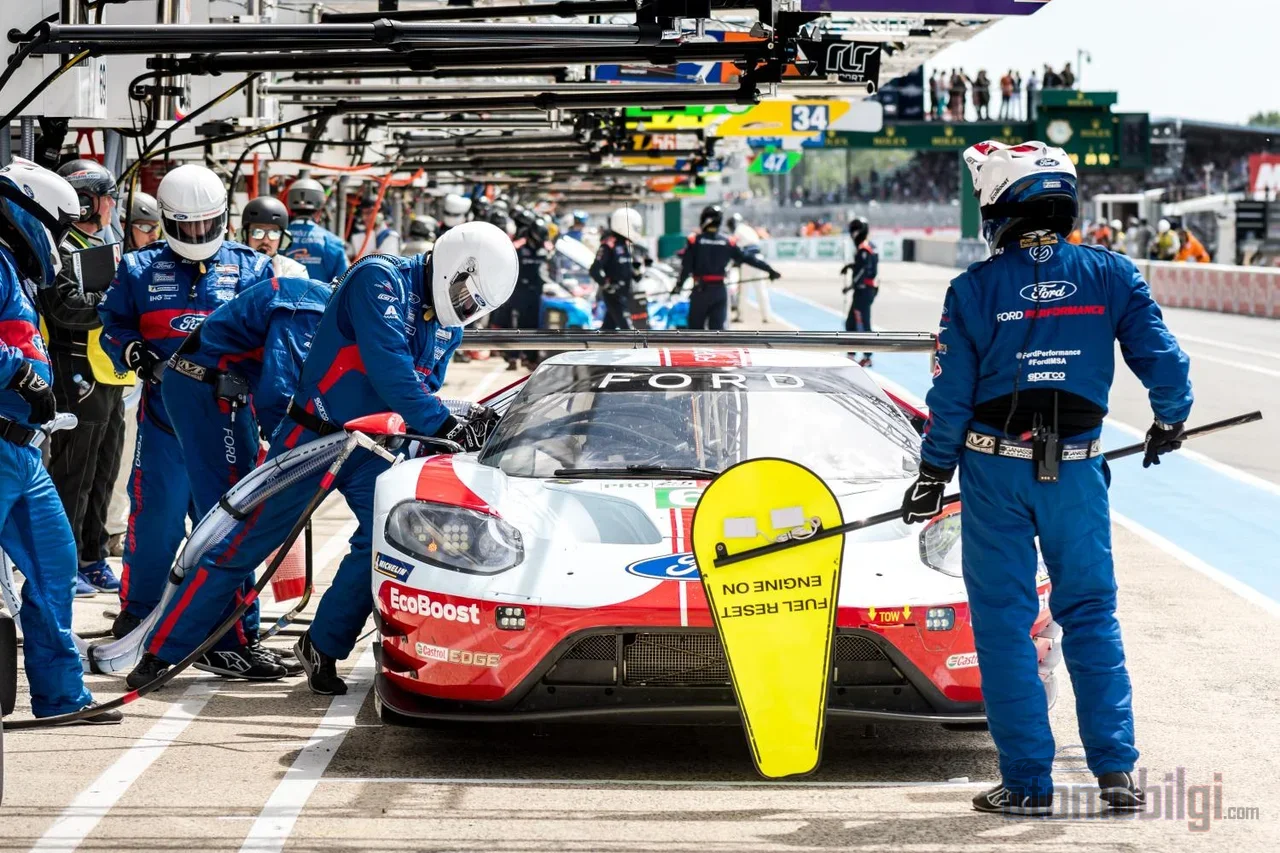
- With pit strategy and reliability, the Ford GT40 won the Le Mans title four years in a row between 1966-1969
The Red Lines of the Pit Lane: Why Are the Safety Rules So Strict?
Let's start with the most basic thing: at Le Mans, the pit lane is not a gas station, it's more like a working hospital operating theater. The speed limit is 60 km/h, and if you exceed it even slightly, a penalty is coming your way. The driver cannot unfasten the harness until the car has fully stopped, and the engine must be switched off too. It may sound fussy, but when you think of tired drivers and hot fuel over 24 hours, the logic quickly makes sense.
The number of people allowed to work on the car is also strictly limited. For tire changes, only two air guns may be used. So that twelve-person army you see in F1 doesn't exist at Le Mans; there is a smaller, more disciplined crew. The tools must also stay in the garage between refueling operations.
The nice part: the rules are becoming more pragmatic over time. Since 2018, mechanics can change tires during refueling. This sounds like a small detail, but overlapping the fuel flow with the tire change saves tens of seconds. Toyota setting up a strategy team that listed all possible scenarios and ran dedicated tests after this rule change shows just how seriously it is taken.
So where is the speed? Here is exactly where the official message has two sides: races are won or lost in the pits, yet at the same time the warning "if you rush, you slow down" always hangs in the air. Teams that break the rules and take penalties pay back the seconds they gained, twice over.
"Box This Lap": How Is a Driver Change Done?
Now let's get to the most cinematic part. The entry to the pit lane begins with a radio sentence: "box this lap". The driver replies "copy", and from that moment every second flows according to the choreography. In LMP2, the typical pit stop window is around lap 11; in safety car or slow zone situations, the stints stretch out and the whole plan is rewritten.
TDS Racing driver Mathias Beche describes the rhythm like this: on the straight, he pulls out the hydration tube, takes one last reminder before the Porsche Curves, then enters the slowdown lane at speed - there's a gravel trap there, and in 2025 Alessandro Pier Guidi learned firsthand what it means to meet that gravel trap in the #51 Ferrari 499P. He tries not to drop his speed too much before passing the 60 km/h sign, then stops centimeter-perfect at the marked point. The harnesses are unbuckled, the radio connection is cut, and the most interesting part: the seat insert, molded to the driver's body shape, comes out with the driver.
Meanwhile, the new driver immediately takes his place in the car; as Peugeot Sport explains, the change begins as driver 1 exits and driver 2 gets in. A short briefing is held in the garage and the plan for the next stint is handed over. Meanwhile, a driver cannot be behind the wheel without limit over 24 hours; stints usually vary between 1 and 4 hours. So driver rotation is not a luxury, but a necessity of the race.
Behind the Scenes of the Mechanics Team: What Happens If a Lug Nut Is Lost?
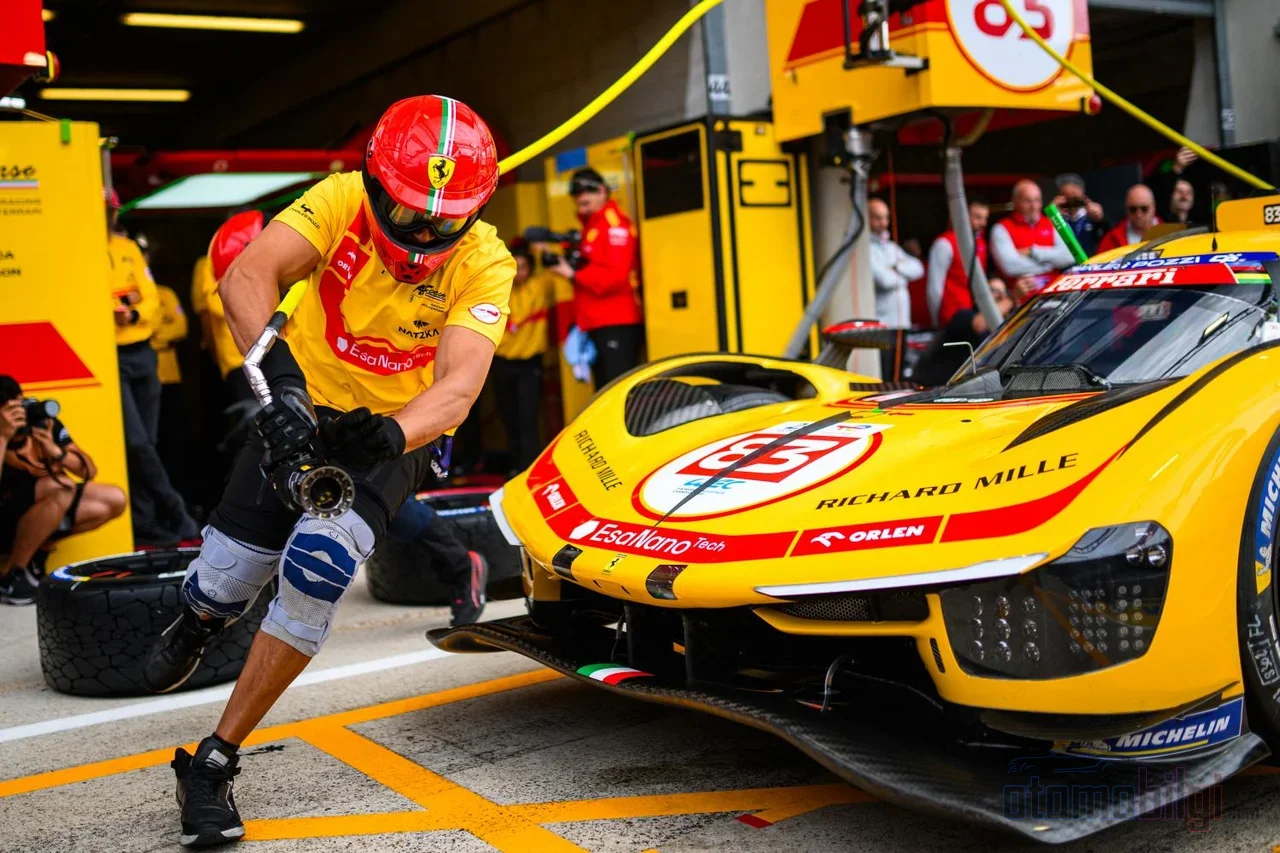
Cameras always focus on the driver, but the heart of the pit stop is in the mechanics' hands. The job description of Antoine Tico, a mechanic on RD Limited's LMP2 car, is simple but merciless: remove the front wheels, take off and hand over the left or right side to a colleague. And yes, if a lug nut is lost, a spare is carried - in a 24-hour race you need to be prepared for every scenario.
Before the stop, the sequence works like this: the engineer gives the signal, the mechanics check one last time that the pressurized air tanks are open, the tires are in place, and the wheel gun is in "remove" mode. The car stops within centimeters of the marks; if it drifts even a hand's width, the whole choreography falls apart.
Here's the critical rule: the front wheel mechanic cannot touch anything on the prototype until the tank is full. In other words, touching the wheel before refueling is finished is forbidden. That's why the track engineer - Arthur Trouttet at TDS Racing - decides the stop time using telemetry data, usually reminds the call "box this lap" at the exit of the Arnage corner, and tells the mechanics how much time remains until the tank is full. When the remaining time drops below 10 seconds, the mechanics grab the tires; when refueling ends, the tire change begins. In the ideal scenario, the tire and driver change are completed at the same time.
Speed or Endurance? The Math of Pit Strategy
What separates the Le Mans pit stop from F1? An F1 stop averages 2.5 seconds; at Le Mans, the time is primarily determined by the fuel transfer rate. While waiting for the tank to fill, other tasks are layered on top: tire changes, sometimes brake discs, driver changes. Everything is compressed into the same stop.
Then there is the tire math. Usage is limited by regulation: under the 2019 rule set, LMP1 gets 48 tires, LMP2 56, and LMGTE Pro/Am 60. That is why teams are in no hurry; Hypercar and LMP2 teams can do 2-3 stints on one set of tires and usually change only two of them. Two tires means roughly 5 seconds, four tires roughly 12 seconds - and by the end of 24 hours these differences turn into massive position gaps.
Hypercars have to refuel about 30 times in 24 hours. So how does this picture look numerically? Here is the pit card of the class winners in the 2025 race:
| Class Winner | Car | Number of Stops | Total Pit Time |
|---|---|---|---|
| Hypercar | #83 AF Corse Ferrari 499P | 32 | 45:10.234 |
| LMP2 | #43 Inter Europol Oreca 07-Gibson | 36 | 53:56.265 |
| LMGT3 | #92 Porsche 911 GT3.R | 34 | 47:49.146 |
A total of roughly 45-54 minutes of stopping is almost miraculous efficiency in a 24-hour race. And there is a reward for this speed: a separate championship is held in the pit lane every year. Ferrari AF Corse won the 2026 Pit Stop Challenge; the #83 crew completed the job in 8.87 seconds. The same Ferrari team, while also winning the race, was able to play aggressively enough with its fuel strategy to skip the final stop entirely.
Races are won and lost in the pits.
What Happens in the Pits at Midnight? Scheduled Repairs and Surreal Moments
By day the pit lane is a racing zone, by night another planet. For those who witness a fully serviced Le Mans pit stop in the dark, it is a surreal experience: flying sparks, mechanics glowing inside the reflective pockets, the smell of fuel, and everyone working with near-whisper discipline. Night is also the stage for long repairs. The pit crew can repair mechanical and aerodynamic damage; body and aero repairs take serious time but are always better than being out of the race.
Night is also when strategy takes a breath. Safety car periods stretch stints, windows shift, and the small advantages patiently accumulated overnight become worth their weight in gold by morning. That is why teams see nighttime stops not as "lost time" but as an opportunity to recover the race.
The Garage 56 Experiment: How Did the NASCAR Pit Crew Adapt to Le Mans Rules?
In Le Mans there is also a special door reserved for experimental projects: Garage 56. This program is dedicated to concept cars for testing new automotive technologies, and the cars are classified in the results. In 2023 the star of the program was Hendrick Motorsports' NASCAR car, and the real story unfolded in the pit lane.
NASCAR pit crews are full-time, professional pit stop athletes; they come from a culture that has built its championships around pit speed. At Le Mans, however, they encountered rule boundaries, personnel limits, and the refueling protocol. Moreover, they were the only team using a hand jack. The result? The NASCAR team beat 16 GTE teams went on to win the Pit Stop Challenge and finished 5th overall. The organizers summed it up as "adapts and triumphs". Of course, part of the GTE community is still debating whether a full-time professional pit crew spoils the competition - there is another side to the coin.
From Ford-Ferrari to the Hypercar Era: A Short History of Pit Craft
Pit strategy being decisive at Le Mans is nothing new. In the early 1960s, Ferrari dominated Le Mans; when Enzo Ferrari pulled out of the deal to sell the company to Ford at the last moment, Ford poured all its energy into developing a rival car. What emerged was the GT40 a machine that evolved under Carroll Shelby and Ken Miles. It won 1966 and then returned to the top in 1967, 1968 and 1969. It remains the only American-built car to have won Le Mans. In those years, pit decisions - when to stop, who would take the wheel - required durability as much as speed; exactly today's equation.
Today in the hypercar era the equation is the same but the stakes are higher. Traffic in the pit lane creates what broadcasters call a "race within a race": every second gained in the pits directly changes the battle for position on the track. Half a second gained on the track between two stops can be lost again at the next stop; a well-planned stop, on the other hand, can gift you even an entire lap.
The bottom line is this: a Le Mans pit stop is not a speed show, it is a matter of patience and choreography. The rules are tight, the durations are long, but the winner is always the most disciplined team. Next time you watch the race at midnight, take a look at the pit lane - there you will see the purest form of the 24 hours, human effort racing.
Sources
- 24 Hours of Le Mans: All You Need to Know - Pit Stops and Refuelling
- Pit stop tactics: a major factor at the 24 Hours of Le Mans
- Garage 56 pit crew adapts to Le Mans rules, triumphs - NASCAR.com
- Hendrick Motorsports pit crew wins Pit Stop Challenge
- 2026 WEC 24 Hours of Le Mans Pit Stop Challenge - Pit Debrief
- Ferrari Hypercar - 24 Hours of Le Mans 2026 - Ferrari.com
- Garage 56 - Wikipedia
- Which Car Beat Ferrari at Le Mans in 1966? - automotivehistory.org
- Famous Le Mans Rivalries - Hertz Racing Gold
- Le Mans Pit Stops Capture the True Magic of Endurance Racing - The Drive
- Le Mans Pit Stop Explained: Driver Change & Tire Swap - Peugeot Sport