How Did the Porsche 917 Become a Le Mans Legend?
Imagine a car flying at 350 km/h on the track, while factory pilots are afraid to drive it. This is the story of the Porsche 917: a legend that began with a controversial rear end, was crowned with two outright Le Mans victories, and changed endurance racing forever. Sit down, grab your tea; what an adventure I'm about to tell you!
Highlights
- First Porsche Le Mans victory: 1970, with Hans Herrmann and Richard Attwood
- The 917 LH reached 226 mph (1970) and 239 mph (1971) at Test Days on the Mulsanne
- The Flat-12 engine grew from 4.5 to 4.9 liters, reaching 600 bhp
- The 1971 victory came with the magnesium-chassis Martini 917 K: van Lennep/Marko
- Steve McQueen's Le Mans film made the #20 Gulf 917 K legendary
1969: An Unstable Monster Is Born
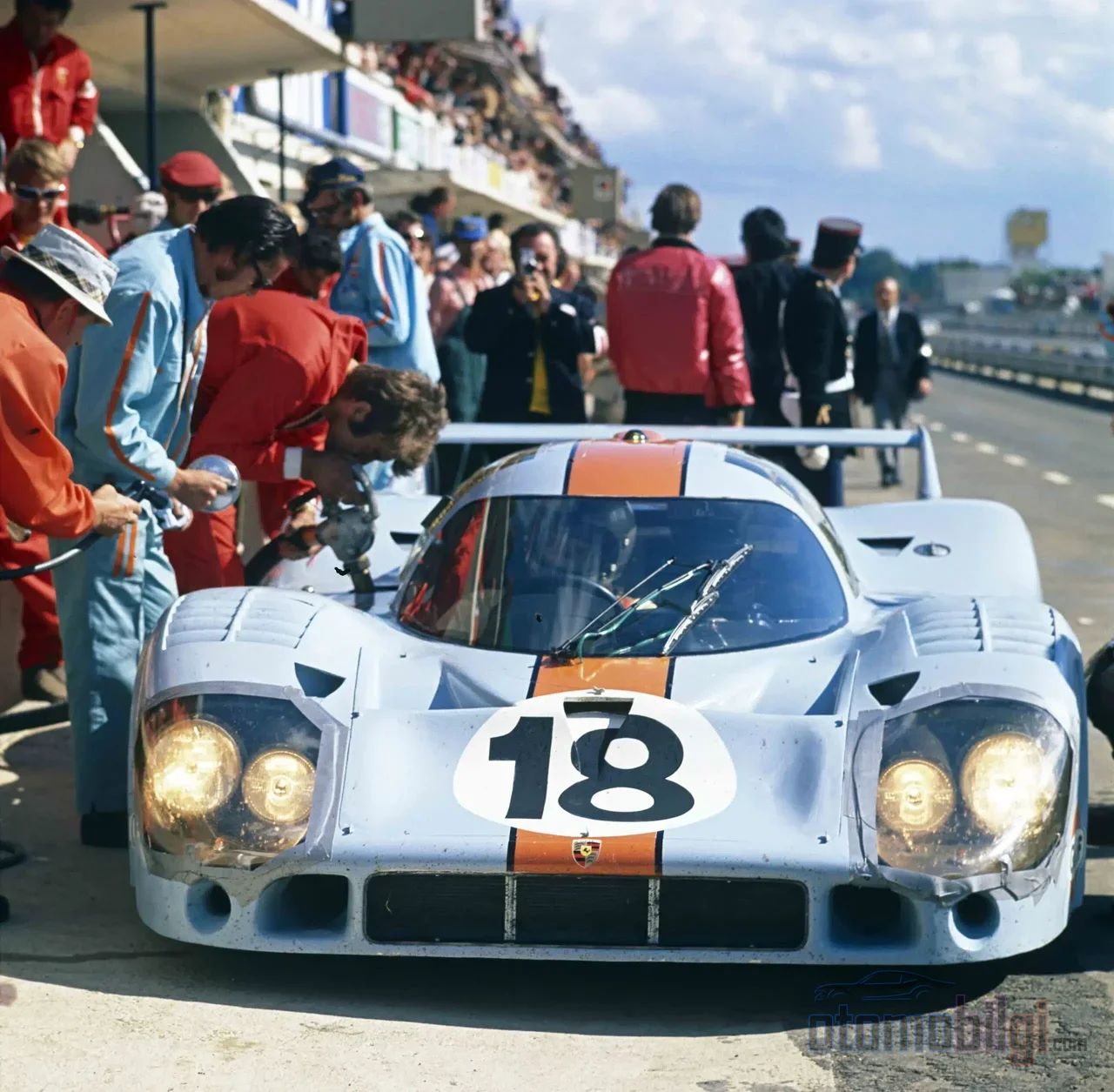
When the 917 was introduced in the spring of 1969, everything did not look rosy. Underneath was an air-cooled 180° flat-12 engine signed by Hans Mezger, an engine that started at 4.5 liters and would grow to as much as 5.0 liters over time. But the problem was not in the engine, it was in the body: The first Langheck (long tail) body was an enlarged copy of the smaller 907 and 908 LH. Sounds practical, right? That is exactly the trap of practicality; because those little siblings had reached their final form without wind tunnel testing, and the 917's engine was many times more powerful than theirs.
The result? In 1969, the 917 LH was unstable at racing speeds. Imagine a car: you can handle it when accelerating in a straight line, but when the tires grip and you lift off the throttle, the rear of the car wanders on its own. Ask racing drivers about this, and you'll understand what I mean. Porsche wrestled with spring rates and suspension geometry, but there was no time to change the body before Le Mans. The small fins on the original body didn't help either; moreover, after Le Mans they also became contrary to FIA rules.
So how was the crisis overcome? In October 1969, John Wyer's team tested at Zeltweg and the picture was very clear: with the same chassis and engine, the Spyder version was about 4 seconds faster per lap. The rear of the K was cut away with aluminum sheets and a fake tail was made, and thus the Kurzheck, that is, the 917 K, was born. At the end of November, in the 26-hour test at Daytona, the Ks broke the lap record by about 7 seconds. If you ask how the rear of a car gets thrown in the trash, the answer lies here: by completely redesigning it. Some factory drivers preferred the old 908 rather than driving that first 917; the problem was only solved when it was identified during a comprehensive test session at Spielberg and the rear of the car was completely redesigned.
The Mulsanne Straight: The True Face of 350 km/h
The Circuit de la Sarthe of that era was 13.469 km and contained about a 6 km stretch of the Mulsanne straight without a single chicane. If you know that two chicanes sit on that straight today, let me tell you in advance: the chicanes came in 1990; in 1970, that section was nothing short of a speed laboratory.
During the June 11, 1970 practice session, Kurt Ahrens set a 3:19.08 lap in the 917 LH, 3 seconds faster than his teammate on pole. Ahrens later recounted that, as long as the tires held up, he never felt tension above 350 km/h. But pay attention, here's the rest of the sentence: at those speeds, the tires were known to shed their treads. In other words, sheer madness! Just think: where your phone's speedometer app is, versus where the 917's needle was. And this was done not with the safety measures of the era, but with courage and engineering audacity.
Meanwhile, straight-line speed wasn't everything. In 1971, Jackie Oliver managed the first lap averaging over 250 km/h at Le Mans (3:13.60). I said average; not the peak on the straights, but the average over the entire lap. It's hard not to lose your mind, I know.
The 917 K's Technical Sheet: What Made This Thing Tick?
Let's lay the 1970-spec 917 K on the table, shall we? If you ask why this engine is so special: it's an air-cooled, 180° configuration flat-12. It started out at 4.5 liters (Type 912/00), was enlarged to 4.9 liters in April 1970 (Type 912/10; 4907 cc) and went from 560 bhp up to 600 bhp. It had Bosch mechanical injection, two ignition distributors for 24 spark plugs, and a 10.5:1 compression ratio. To put it in perspective: a normal road car doesn't need two ignition distributors; keeping 24 spark plugs in sync is a craft of its own.
The chassis wasn't conventional either: a pressurized-by-gas, ultra-light tubular alloy spaceframe. Double wishbone suspension, Bilstein dampers, magnesium axle housings, and ventilated disc brakes (ATE, later Girling). The wheels were 15-inch center-lock magnesium; widened from 9 to 10.5 inches at the front, and from 12 to 15 inches at the rear. The 917 K's top speed was around 305 km/h (190 mph); roughly 30 mph below what the 1969 LH reached at Le Mans. So the short tail meant a sacrifice in speed, a gain in stability.
| Specification | Value |
|---|---|
| Engine | Air-cooled 180° flat-12 |
| Displacement (1970) | 4.9 liters (4907 cc) |
| Power | 560-600 bhp @ 8000 rpm |
| Injection | Bosch mechanical |
| Compression | 10.5:1 |
| Chassis | Gas-pressurized lightweight tubular alloy spaceframe |
| Top speed (K) | Approximately 305 km/h |
1970: First Absolute Victory Against the Ferrari 512
Eight 917s and eleven Ferrari 512s entered the 1970 Le Mans. Let's also recall the lead-up to the season: the season opened with John Wyer's team taking a one-two at Daytona, and Ferrari (Giunti/Vaccarella/Andretti) answered at Sebring; but in the wet at Brands Hatch the 917s swept the top three, and the Wyer team also won at Monza and Spa. So the two giants entered Le Mans with their strengths measured.
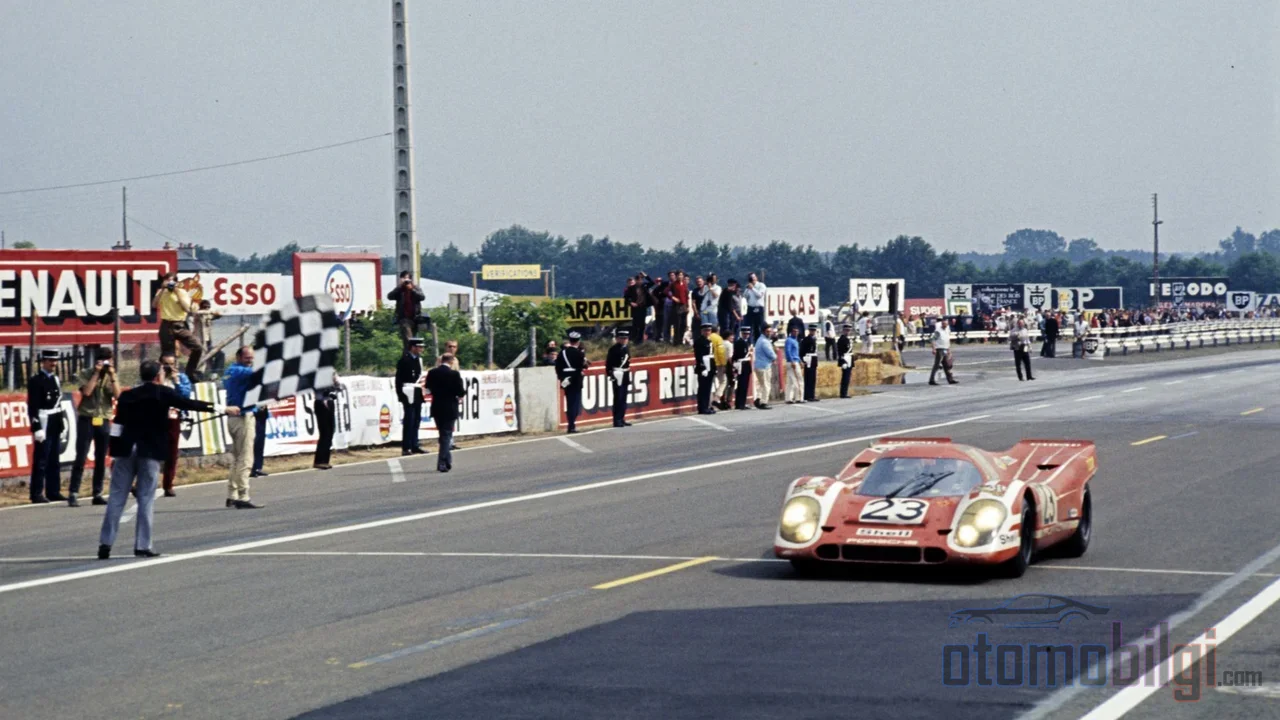
Porsche's game plan was surprisingly clever: Elford/Ahrens' #25 LH was used as a leading decoy to wear down their Maranello rivals. The pace car was eliminated on Sunday morning at 08:35 after 226 laps when an intake valve broke; but it had done its job. The real victory went to Hans Herrmann and Richard Attwood in an almost stock-spec 4.5-liter car: The #23 917 K of Porsche KG Salzburg. This was Porsche's first outright Le Mans victory, and it came in a wet race. The reason Wyer chose the Ks over the LHs was also clear: The LH was unsettled in fast corners and prone to aquaplaning in the wet, and both examples had been destroyed in test accidents.
The runner-up in the race was also a Porsche: The LH of Gerard Larrousse and Willy Kauhsen, famous for its tail, finished 5 laps behind the winner. Let's add that in March 1970, Kurt Ahrens destroyed an LH with aquaplaning at VW's Ehra-Lessien test track; that car was truly that delicate and fast.
The Langheck Persistence: Piech, SERA, and the Quest for Speed Without Wings
Here is the most interesting debate on this page: while some settled for the K and took the shortcut, Ferdinand Piech never gave up on the low-drag solution and worked with Charles Deutsch's aerodynamic consultancy firm SERA. The 1970 LH was almost entirely recreated with SERA's touch; only the windshield, doors, and roof remained the same. But there were problems again: At the April Test Days, Ahrens/Elford reported nose lift above 150 mph; although the LH reached 226 mph on the Mulsanne, the front was floating, and above 190 mph it was unacceptably unstable, especially when the throttle was lifted. For the race, front precautions were added along with a rear wing hung between vertical fins; but the drag of this configuration was 9% higher than the 1969 car. Vic Elford's assessment was clear: The LH was drivable but still not fully stable compared to the K; on a 3:20 lap it was only 1-1.5 seconds faster than the K.
The 1971 LH, however, was completely rethought: the rear wheels grew from 15 to 17 inches, a wide and flat tail was designed to cover the upper half, sickle-shaped openings were added for tire cooling, the wheel arches were lowered, NACA ducts were added, and the springs were stiffened; the body is foam-cored and its average weight without fuel is around 841 kg. The result was astonishing: At the 1971 Test Days, while the LH ran a 3:17, Jackie Oliver went down to a 3:14, recorded 239 mph on the Mulsanne, and found the car stable to the very end. The Pink Pig, famous for its comical appearance and developed with SERA as Piech's wingless alternative, also ran at the 1971 Le Mans; yes, a car that looked like a pig deserving of its name but was a serious engineering experiment.
The 1971 Victory: The Fastest Car Didn't Win, the Smart One Did
The 1971 race was run in completely dry conditions, and the LHs led comfortably through the first 4 hours; the only rival was Penske's Ferrari 512 M. Then came dropouts one by one: Elford/Larrousse at the 5th hour with a cooling fan that broke apart; Siffert/Bell and Rodriguez/Oliver were eliminated with engine and rear wheel bearing failures. The view that the LH had not matured enough to last 24 hours was defended for many years afterwards by the race's engineer, John Horsman; some commentators also suggest that the retirements may have been caused by the excessively dry, hot pace of the event.
The victory went to Gijs van Lennep and Helmut Marko, in the magnesium-chassised Martini #22 917 K. It was not the fastest car on track; yet it set distance records that stood for days and won with a reliability strategy that could be summed up as "at all costs." Such is the irony of endurance racing: in 24 hours, the winner is not the fastest, but the one that breaks down the least. Do you think this is fair, or does it mean speed is not loved? I think it's both; and it is precisely this tension that makes Le Mans Le Mans.
Steve McQueen and the Legend That Reached the Screen
The 917 has another legacy that extends beyond the track: the 1971 film Le Mans. In the film, Steve McQueen appears as Michael Delaney, driver of the #20 Gulf-Porsche 917 K; his rival is Siegfried Rauch, playing Erich Stahler in a Ferrari 512S. An interesting detail: McQueen had actually planned to drive the car himself, alongside Jackie Stewart. Also, the actual 1970-winning #23 chassis was later painted in Gulf-JW colors for a TV production; so the stories kept blending into one another. Its echo in the world of collecting is also remarkable: at Monterey 2021, it was announced that a 1970 Le Mans veteran 917 K could sell for $18 million.
Legacy: How Did the 917 Change the Regulations?
Let's ponder a question: how is a car's legacy measured? By the number of victories, the speed record, or the rules it forced upon later generations? With the 917, the answer is all three. Porsche holds a record 19 outright victories at the 24 Hours of Le Mans, and the door to that number opened in 1970 with the 917. Moreover, the 917 also won economy awards in 1970 and 1971; it was so fast and so efficient over 24 hours that it is one of the rare cars where the two can be mentioned together.
When the FIA lowered the prototype engine limit to 3.0 liters, Porsche withdrew from the top level of endurance racing and the 917 turned to Can-Am. In other words, the rules that opened the 5-liter class with the mid-1967 regulation change cut that power just a few years later; the 917's story lived precisely within the ups and downs of these rules. The Le Mans straights, the very reason for the LH's existence, were also eliminated by the two chicanes added in 1990; speeds dropped to the 320-340 km/h range after that date. The all-time Mulsanne record, meanwhile, belongs to Roger Dorchy and the WM-Peugeot P88 in 1988: radar-measured 405 km/h. Later, the track became winding where the old straights used to be; the Porsche 956/962, with its high downforce and low-drag body, succeeded under this new order.
So here is the answer: The Porsche 917 was the car that, for the first time on track, genuinely exceeded 350 km/h and turned that speed into action - despite stability problems, with aerodynamic persistence, and through the K versus LH philosophy clash. Two outright victories, hard-to-break distance records, an efficient rivalry against the Ferrari 512, and a cult film shot with McQueen's cameras... In short, the 917 was a milestone that raised the speed ceiling of endurance racing and shaped the prototype regulations that followed. Next time you watch Le Mans, remember that just beyond that first chicane once roared a monster whose tire treads were tearing off. That's why, I think, this story is still being told.
Sources
- Porsche 917 - Wikipedia
- SERA And The Porsche 917, Part Two
- 3:19.08 min. - Porsche Newsroom/Christophorus
- Guide: Porsche 917 K / 70
- Why is the Porsche 917 such a motorsport icon?
- Porsche 917's secret advantage: winning Le Mans in 1971
- The Mulsanne Straight, a stage for speed records
- Le Mans (film) - Wikipedia
- Porsche 917 - A Brief History
- Porsche - Wikipedia (19 outright wins)