The 100-Year Legacy of Le Mans 24: The Trace of Legends at Sarthe
Share This Page
The 24 Hours of Le Mans, held since 1923 in France's Sarthe region, is the oldest endurance race still held in the world. The winner is determined by whichever car covers the greatest distance within 24 hours, and modern winners typically complete it covering more than 5,000 km - that's roughly 18 times an F1 Grand Prix! While even driving for a single day is exhausting, it's dizzying just to think about doing it on track at speeds of 300 km/h, isn't it?
Highlights
- First race Held on 26-27 May 1923; the winner was the Chenard-Walcker Sport. it was held; the winner was the Chenard-Walcker Sport.
- Circuit 13.626 km long, with 38 corners and full throttle for 85% of the lap.
- Porsche leads the manufacturers' standings with 19 victories at the top.
- Most successful driver with 9 victories Tom Kristensen.
- The Mazda 787B, in 1991, was the first and only Japanese car to win Le Mans.
From 1923 to Today: A Century-Long Endurance Story
It all began in 1923 with the question posed by the Automobile Club de l'Ouest (ACO): "Which car can run the most reliably for 24 hours straight?" There were 33 cars in the first race, and André Lagache and René Léonard took victory in a Chenard-Walcker Sport, completing 128 laps. The idea was simple but revolutionary: Races until then had been short-distance duels of speed. Le Mans asked a different question - you can be fast, but can you stay fast?
The race's history hasn't always been sunny, of course. It was not held in 1936 due to a strike, and between 1940 and 1948 because of World War II; in total it was cancelled ten times. The 1955 disaster was the darkest day of the race: Pierre Levegh's car crashed into the crowd and more than 80 people lost their lives. After this tragedy, the pit complex was demolished and moved back. Safety comes at a high price but must never be neglected - such is the lesson; Le Mans, too, has such bitter pages.
Today's picture is much brighter: The race is part of the Motorsport Triple Crown (alongside the Monaco GP and the Indianapolis 500) and the Endurance Triple Crown (alongside the 24 Hours of Daytona and the 12 Hours of Sebring). It has been on the FIA World Endurance Championship calendar since 2012, and the 2025 race was watched from the grandstands by 332,000 people in full. Just imagine that number: A small French city turns into the capital of car enthusiasts for a weekend.
Circuit de la Sarthe: The Legendary Circuit Made of Public Roads
Here's the part that excites me the most! The Circuit de la Sarthe consists of a combination of permanent circuit sections and public roads temporarily closed off. In other words, on the kind of road you drive to the supermarket every weekend, the world's best drivers pass at 300 km/h. Do you know what it means that 85% of the lap on this 13.6 km circuit with 38 corners is driven at full throttle? It means almost no rest, with the pedal pressed down constantly.
Mulsanne Straight: The Temple of Speed
The Mulsanne Straight is actually an ordinary departmental road, the D338. But in 1988, Roger Dorchy, in a WM P88, reached 407 km/h reached a speed - a record that has never been broken to this day. The race record is 366 km/h. More than three times the speed of an ordinary highway journey! The speeds involved were so dangerous that when the FIA decided not to approve straights longer than 2 km, two chicanes were added to the 6 km straight in 1990 and the straight was split into three sections. Today race cars travel through these sections at around 320 km/h - it still gives me goosebumps.
Other Iconic Sections
- Dunlop Curve and Tertre Rouge: Created by shortening the section of the track that enters the city of Le Mans; critical points that test braking ability after a fast section.
- Porsche Curves: Added in 1972; in the same period the track also gained a double chicane in front of the pits. Whoever can get through these corners while maintaining speed becomes the hidden hero of the race.
The Ford-Ferrari War: Revenge on the Track
This story is almost a movie script - in fact, a movie was made of it! It all started when Ferrari backed out of a deal with Ford. The dispute between Henry Ford II and Enzo Ferrari turned into a personal feud, and Ford sought its answer on the track. In 1966, it took its first overall victory by beating Ferrari with the Ford GT40 Mk II, and even captured the 1966 Manufacturers' Championship from Ferrari with a 1-2-3 finish. Ford then went on to win four consecutive victories until 1969, ending Ferrari's dominance. And the best part: the GT40 won these victories with an engine taken from a road car!
But 1966 also has a heartbreaking story. While Ken Miles's car was in front, the Bruce McLaren/Chris Amon car, which had started further back, was declared the winner by an 8-meter margin because the ranking was made according to the rule of "greatest distance covered from the starting position." Miles thus lost his chance to win Sebring, Daytona and Le Mans all in the same year. It may have been a technically correct decision by the rulebook, but one cannot help feeling Miles's bitterness.
There is also an unforgettable celebration moment: after Dan Gurney and A.J. Foyt's victory in 1967, Gurney spraying the champagne went down in history as the first champagne celebration broadcast on television. So that iconic champagne shower we see on every podium today came out of Le Mans!
Mazda 787B and the Audi Era: The Rise of New Powers
There is no need to memorize 1991: the Mazda 787B became the first and still the only Japanese car to win Le Mans. And as the only overall victory achieved with a rotary-engine car! The #55 car, weighing just 830 kg and equipped with a four-rotor engine, completed 362 laps to win. In my opinion, this victory is the reason the rotary engine is still a topic of passionate discussion.
A few years later it was the diesels' turn: the Audi R10 TDI became the first diesel-powered car to win Le Mans. Audi's dominance lasted for years, and in the teams' standings Joest Racing with 15 victories is leading the way. Looking further back: the 1970s were dominated by the Porsche 917/935/936; in 1978, the Renault Alpine A443 brought the turbocharged engine its first victory; and in 1980, Jean Rondeau won a privateer team victory with a chassis bearing his own name. During the Group C era (1980s), the Porsche 956/962 won six years in a row; Jaguar intervened in 1988 and 1990, and Mercedes with the Sauber C9 in 1989, while the Peugeot 905 took the stage in 1992-93. In short, Le Mans has always been the stage for the next big name.
Technologies Le Mans Brought to Road Cars
Don't think of Le Mans as just a race; it's actually a massive rolling laboratory. Many of the technologies you use in your car today without even realizing it were born or matured on this track. Think of the disc brakes that allow you to stop when you press the brake pedal: Jaguar solved this problem back in 1953 by fitting revolutionary disc brakes to their C-Types. Mercedes' 1952 win with the gullwing 300 SL featured direct injection technology - that year goes down in the ACO calendars as the year of the "direct injection engine." The race also played host to halogen headlights in its early days.
The list goes on: aerodynamics, diesel, disc brakes, fog lights, front-wheel drive, fuel injection... All of them trickled down from Le Mans to road cars. From the 2000s onward, hybrid systems (flywheel, supercapacitor, or battery combined with gasoline or diesel) were supported in the Le Mans Prototype category. Today's major innovations also focus on powertrain systems that harvest energy under braking. In the LMDh hybrid system, the electronic distribution of the rear braking circuit balances electrical torque against hydraulic brake torque - meaning you charge your battery while braking. Storing energy by braking the air is, in my opinion, one of engineering's most elegant tricks.
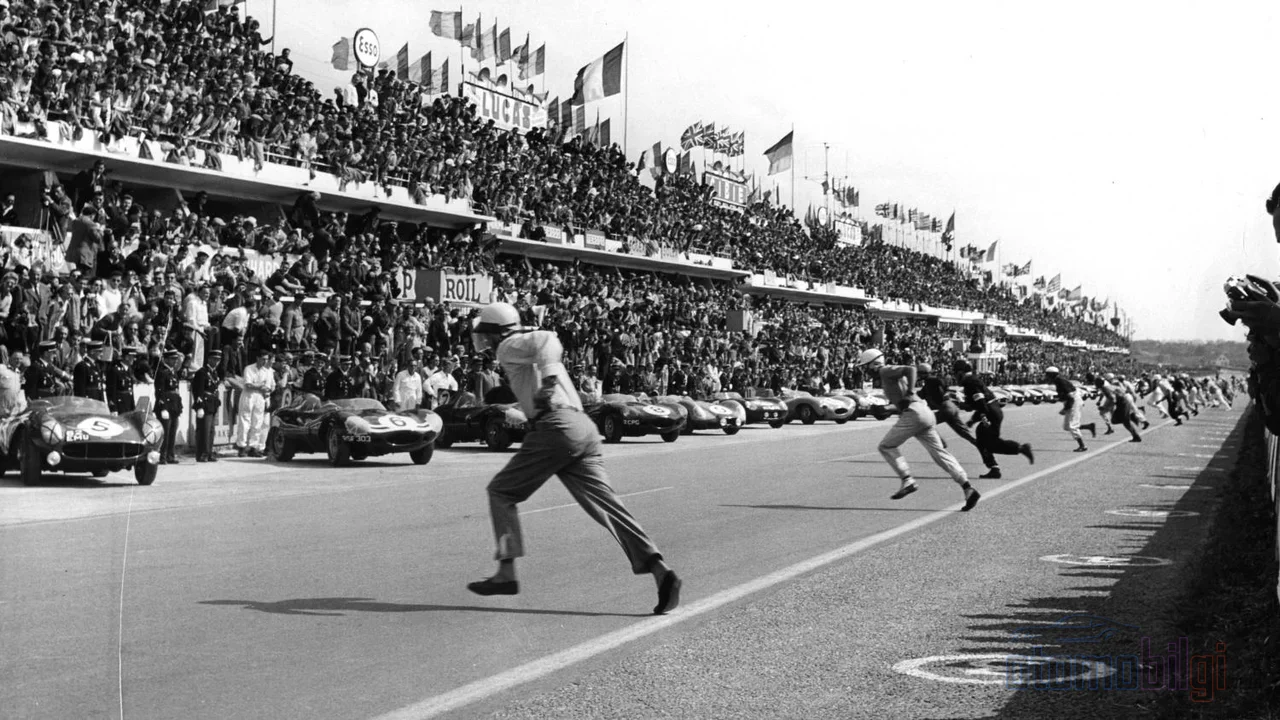
And there's a small but charming detail: until 1970, drivers ran across the far side of the track to get to their cars. In this style of start, the driver had to run to the car and start the engine immediately - this was also the inspiration for Porsche placing the ignition key to the left of the steering wheel. For safety reasons, drivers started from inside the car in 1970, and a rolling start has been used since 1971.
The Hypercar Era: Balance, Competition and Winning Strategies
Introduced in 2021 as the successor to LMP1, the Hypercar class (LMH or LMDh) allows technical diversity while preventing cost escalation. But how do cars with all these different approaches race fairly? This is where Balance of Performance (BoP) comes in: Each car's power and weight are adjusted to ensure equal competition. It's as if you're having a tug-of-war with friends of different sizes and the middle of the rope is pulled to a fair point for everyone. This regulation drew manufacturers like Porsche, Ferrari and Peugeot into the race; in 2026 there will be a full 18 Hypercar entries and looking at the first WEC races of the 2026 season, nearly all manufacturers appear to have a chance of winning.
Today's classes offer a three-tier structure: Hypercar, LMP2 (ORECA/Ligier/Dallara/Multimatic-Riley chassis + 4.2 l Gibson V8) and LMGT3. Since 2019, 62 cars have been racing. There is also the Garage 56 program: since 2012 it has opened the door to concept cars for testing experimental technologies; these cars are classified in the results but are not expected to compete. Isn't having a separate door for experimentation a very clever idea?
How Does Strategy Work?
Winning in the Hypercar era is not just about being fast; the details are decisive. Today, three drivers per car are mandatory and the driving rules are strict: a maximum of 4 hours within a 6-hour period, with a total driving limit of 14 hours. If the air temperature is 32 °C or above, a rule of 80 minutes of consecutive driving / 30 minutes of rest may be applied. There is no trickery in pit stops either: the engine must be off while refueling and mechanics cannot work on the car. To be classified, a car must complete at least 70% of the distance covered by the winner. So the golden rule at Le Mans is this: It is not the fastest car that wins, but the car that stays on its feet for 24 hours.
| Record Holder | Category | Value |
|---|---|---|
| Porsche | Manufacturer victories | 19 |
| Joest Racing | Team victories | 15 |
| Tom Kristensen | Driver victories | 9 |
| 2010 record | 24-hour distance | 5,410 km |
| WM P88, 1988 | Highest speed at Mulsanne | 407 km/h |
The 94th race, run on 13-14 June 2026, was won by Toyota after a great battle in front of a record-breaking crowd. Even after more than a century, this race continues to write new chapters. If it were you, which legend would you wave to from the Pit Lane - the GT40 or the 787B?
Sources
- 24 Hours of Le Mans
- A century of racing: the 24 Hours of Le Mans is 100 years old!
- May 27, 1923 - The winner of the first 24 Hours of Le Mans
- 24 Hours of Le Mans | Research Starters
- Circuit de la Sarthe
- Le Mans - racingcircuits.info
- 1966 24 Hours of Le Mans
- Ford v Ferrari: the real story of Le Mans '66 & Ken Miles
- Le Mans Victory Commemorative Site - Mazda
- 24 Hours of Le Mans - Great innovations (1951-1967)
- Nine ways Le Mans racing tech has filtered into road cars
- Le Mans Daytona hybrid system - Bosch Motorsport
- The 2026 Hypercar class preview
- 24 Hours of Le Mans 2026 - FIA WEC