The Formula for Victory in 24 Hours: The Strategies That Won Le Mans
Share This Page
The formula for winning the 24 Hours of Le Mans seems simple: the car that covers the most kilometers over 24 hours takes the victory. But the interesting part is that it is not the fastest team that wins this distance race, but the team with the smartest plan. Pit cycles, driver rotation, night stints, and failure management... On this four-legged stool, if one leg is short, the race is over. Let's break down this tactical layer one by one; because at Le Mans, strategy, not the stopwatch, is king.
Highlights
- The race has been run at the Circuit de la Sarthe since 1923; the track is 13.626 km long.
- Winning cars usually cover more than 5,000 km of distance; the record is 5,410 km.
- Each car takes on fuel about 30 times over 24 hours; the goal is to spend less than one hour in total in the pits.
- Limit per driver: a total of 14 hours, with a maximum of 4 hours in any 6-hour window.
- The manufacturer record belongs to Porsche: 19 overall wins.
How is the 24 Hours of Le Mans won? Not the fastest, but the smartest wins
In a classic race, the finish line is fixed; whoever crosses it first wins. At Le Mans, however, the finish line is drawn at hour 24, and the car that has covered the most distance up to that moment lifts the trophy. So the only way to win here is to be able to stay at the highest possible tempo for the longest time. Going full throttle is the easy part; the hard part is carrying the car, the drivers, and the fuel plan to the finish point over 24 hours without losing them.
The founding philosophy of the race was designed exactly for this: the organization wants to reward not the fastest car, but the manufacturer that produces both sporting and reliable vehicles. This approach even had a side effect unique to the tracks; fuel efficiency innovation was born from the lasting competitiveness of endurance racing. As one team official summarized: "In a 24-hour race, what really matters is maintaining the tempo in the end; ensuring the car stays as solid as possible."
Pit cycle: the math of 30 stops in 24 hours
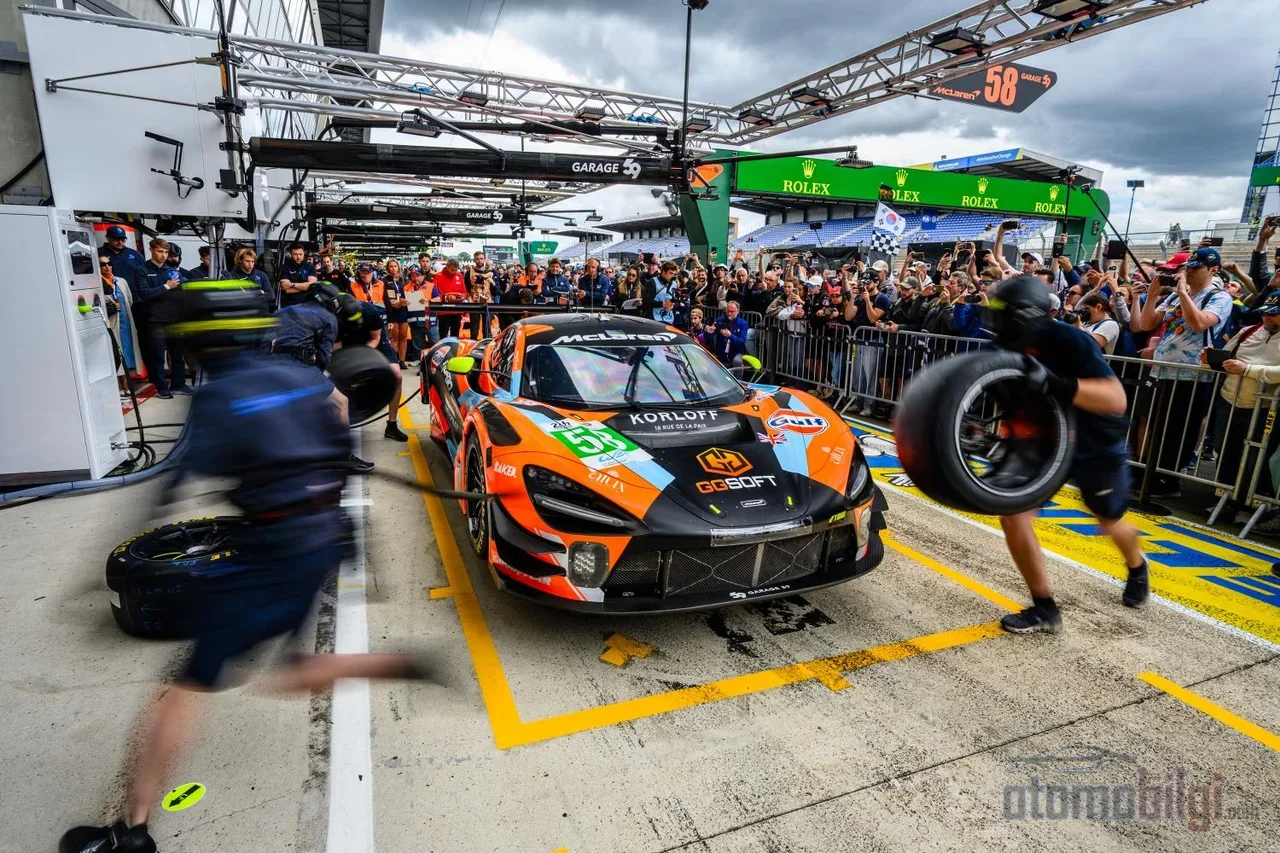
Think of it this way: imagine a journey where you stop at a gas station once every hour, and at each stop you have to turn off the engine. Every car at Le Mans has to take on fuel about 30 times over the race. The engine must be off while fuel is being transferred, and the mechanics cannot work. That means the pit lane is one of the most vulnerable moments of the race; seconds accumulate here.
The goal of winning teams is clear: to spend less than one hour in the pits in total. One hour in a 24-hour race is a huge amount coming out of your pocket; whoever minimizes it gains the edge. That is why teams constantly innovate in pit efficiency. Fuel strategy is also the heart of the pit plan: stop early and escape traffic, or push the tires and fuel to their limits and gain the advantage with long stints? Both approaches have won. Toyota successfully applied the aggressive early strategy, gaining time on a clean track by fueling earlier than its rivals; other teams preferred to reduce the number of pits with long stints.
Triple driver rotation and stint planning
At Le Mans, at least three drivers per car is mandatory and the rules cover everyone: a driver may drive a maximum of 4 hours, a driver may be behind the wheel for a maximum total of 14 hours during the race. History also explains why this rule exists; in the past, attempts by drivers like Pierre Levegh and Eddie Hall to finish the race solo were later banned. Fairly so: 24 hours of sleepless driving is not heroism, it is a recipe for disaster.
Air temperature 32°C If it exceeds that, the stewards step in: a maximum of 80 consecutive minutes behind the wheel and a mandatory minimum 30-minute break can be imposed. This is a physiological necessity, especially in closed-cockpit cars; cabin temperatures can be quite exhausting in the summer heat.
How is stint length determined?
A stint is the portion of the race during which a driver stays behind the wheel for as long as the fuel tank allows. At Le Mans, a stint can reach 2-3 hours and each driver usually completes 4-5 stints. The rule details are such that it is even possible to finish the race with two drivers through careful stint management; but the overwhelming majority of teams insist on three drivers. The logic is simple: a fresher driver, fewer mistakes, faster laps.
Squad composition is also part of the strategy. For example, in the LMGT3 class, at least one bronze-category driver and a bronze/silver combination are mandatory; in other words, teams do the math like a points table even when building their lineups.
Night stages: the quietest but most critical hours of the race

The race starts at 15:00 and is run close to the summer solstice. That means the night is the shortest night of the year; but being short does not make it easy. Quite the opposite, in the dark the balance between speed and safety takes on its most fragile form. In closed-cockpit cars, the heat accumulated during the day pushes the drivers to their physical limits; rain is also a frequent guest.
The tactical importance of the night stage is a bonus on top of all that. On the 13.6 km circuit, the risk you take in the dark is the kind that can make the difference in the morning or pin you against the wall. Winning teams generally spend the night in "survive and hold your position" mode; big moves are saved for the daylight hours.
How do safety car chaos and fuel strategy get disrupted?
Here is the endurance race's least beloved mystical character: the safety car. A full-course safety car lines up all the cars ahead in a single file and erases the gaps between them. In other words, the pit plan built over hours, the fuel windows, the stint calculations... can all become invalid in an instant. In the 2026 race, 41 lead changes occurred and the first safety car period came in the 8th hour; Toyota's early pit strategy stood out during this period.
After the new procedures caused chaos in 2023, the organizers switched to using a single safety car. This made the flow of the race a bit more predictable, but it did not end the debate; whether full-course safety cars disrupt the nature of endurance racing is still a heated subject of discussion among fans. The fair question is this: does zeroing the gaps fairly reset the advantage built over 24 hours?
Speed or endurance? The common instinct of winning teams
Looking at history, you see the same reflex in all the winners: finish first, then speed up. The most dramatic lesson of this philosophy 1966 came from Ford. Ford matched Ferrari with a 1-2-3 victory sweep; but the finish itself became a tactical lesson. Because of the "greatest distance" rule, the McLaren/Amon car that started further back on the grid 8 meters was counted as the winner by that margin, and Ken Miles was denied the Triple Crown. So at Le Mans, even the finish line is part of the strategy: where you start can be just as important as where you finish.
In the modern era, this reflex turned into technology. The Porsche 919 example is great: the regeneration strategy that sent 400 hp to the front wheels with the push of a button on the steering wheel released energy exactly when it was needed most. Hybrid energy deployment, together with BOP (Balance of Performance) equations against the non-hybrids, became a separate layer of race strategy.
The 2026 victory: Toyota's lesson in temperature management
The 2026 race (June 13-14) was like the latest edition of the tactical playbook. Toyota took its sixth overall win by passing BMW and Cadillac; managing the pace in high temperatures was critical. At the finish there were four cars, three manufacturers and only 32 seconds of difference; meaning 24 hours of effort was rewarded by half a minute. 1,547 pit stops and 5 Full Course Yellow periods sum up just how tactical a chess game the race is. Genesis Magma Racing, competing for the first time, hit its target: by finishing the GMR-001 Hypercar, it reached its first Le Mans goal.
Le Mans' golden rules: tactical summary
| Tactical area | Rule / goal | Why it is critical |
|---|---|---|
| Pit cycle | ~30 fuel stops, total pit time under 1 hour | Engine off during refueling, mechanics cannot work |
| Driver rotation | 14 hours total, 4 hours within a 6-hour window | Three drivers mandatory, racing alone is forbidden |
| Hot weather rule | Above 32 degrees C: 80 minutes of driving / 30-minute break | To limit driver fatigue |
| Stint planning | 2-3 hour stints, 4-5 stints per driver | Adjusted according to fuel and weather conditions |
| Finishing requirement | Complete the final lap and cover at least 70% of the winner's distance | Required in order to be classified |
In short, Le Mans is not a test of speed but a test of planning. Whoever can manage their fuel, drivers, temperature and luck in a single chart for 24 hours lifts the trophy. Which do you think is harder: building the fastest car, or making the plan that will keep it running for 24 hours? I think the latter; but tell us in the comments, I am curious.
Sources
- Pit stop tactics: a major factor at the 24 Hours of Le Mans
- 24 Hours of Le Mans
- Can a driver race "single-handed" at the 24 Hours of Le Mans
- Le Mans 24 Hours safety car procedure: a full guide
- Toyota wins 24 Hours of Le Mans by outlasting BMW and Cadillac
- Reliability - The key to winning Le Mans
- Le Mans victory for TOYOTA RACING
- How to Win at Le Mans, Porsche 919 Style
- The REAL Story of the Twisted "Ford v. Ferrari" Finish
- Genesis Magma Racing Le Mans debut
- The headlines after 8 Hours at Le Mans
- Le Mans 2026: How Works Drivers Train for the 24 Hours