How Do Tires Last 24 Hours at Le Mans?
Share This Page
Tires at Le Mans last 24 hours because teams manage the tire not on its own, but embedded within the fuel cycle, pit strategy and weather conditions: going two or three stints on the same set with the right compound means every unnecessary pit stop is inevitable lost time, which directly determines the outcome of the race. In this article I explain both how the track punishes tires and the calculation running through strategists' heads.
Highlights
- Circuit de la Sarthe 13.626 km in length; average race speed 240 km/h or thereabouts.
- In the late 1980s on the Mulsanne straight, cars were reaching 400 km/h and sometimes even exceeding it.
- In the Hypercar class, the race-long tire allowance per car is limited to 56 tires .
- In a Hypercar, one stint is about 45 minutes; roughly 32 pit stops are made over 24 hours.
- Michelin has 33 overall victories at Le Mans, plus a streak of consecutive wins maintained since 1998.
Let's Clarify One Thing First: What Exactly Is a Stint?
In the racing world, a stint refers to the time a driver spends at the wheel until entering the pit. At Le Mans this duration varies by class: about 45 minutes in Hypercars, and about 42 minutes in LMGT3. So over 24 hours a Hypercar pits roughly 32 times; the cars take on fuel about 30 times during the race. The Hypercar that won the 2025 race, AF Corse's Ferrari 499P, made exactly 32 stops, for example.
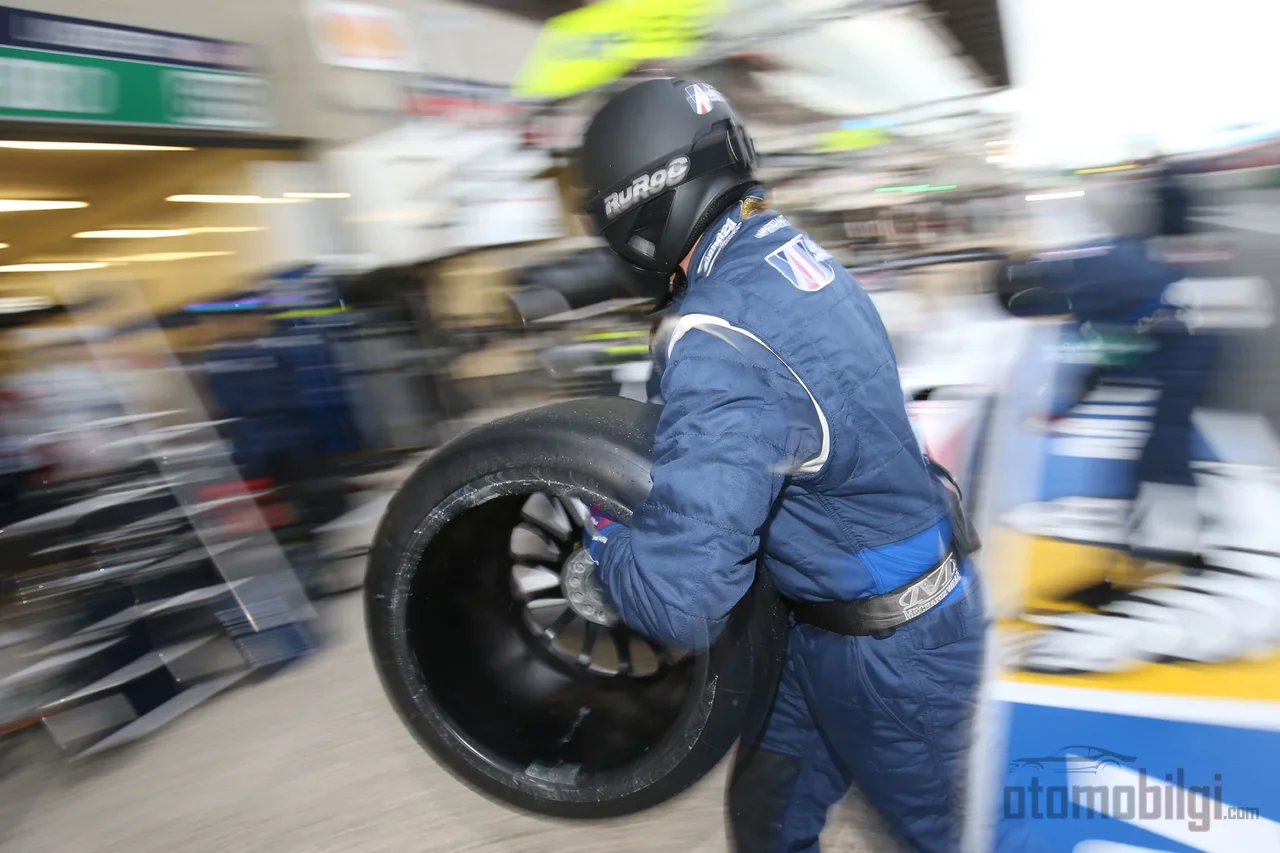
So where do the tires fit into all this? Here's the critical point: tires are changed while refueling takes place, and the driver change is made at the same time. In other words, changing tires normally doesn't cost extra time - the mechanics prepare the wheels in the final 10 seconds of the fueling operation. The problem starts with how many stints a tire can last on one set. Every tire change means a stop that could in theory have been avoided.
400 Kilometers Per Hour, Twice: How Does Mulsanne Punish Tires?
Picture a tire on a normal track; then take it to the Circuit de la Sarthe. It's a place where the average speed is 240 km/h , meaning the tire almost never gets a rest. In the late 1980s, on the 6-kilometer Mulsanne straight, cars were reaching 400 km/h and even exceeding that. At that speed, a massive air film pressure builds up on the tire: on one hand the tire carries the weight of the car, on the other it spins at hundreds of thousands of revolutions while working against the wall of pressurized air coming from outside. This combination of high speed and high downforce repeatedly caused tire and engine failures back then. 1989 was the last year the straight had no chicane - that speed was let go, but the load placed on tires still remains in the track's DNA.
Then there's the night's business. At Le Mans, as the hours pass the air cools, and cool temperatures extend tire life. That's why teams build their tire strategy not in isolation but together with the track's 24-hour temperature curve. That long night that looks like a white blanket has an aspect worth gold to strategists: extending the night stints.
Tire Quotas: 56 Tires and Rules Class by Class
You can't take as many tires as you want. The Hypercar class's sole tire supplier has been appointed as Michelin by the FIA and the ACO, while Goodyear is the sole supplier in LMP2. In the main race, Hypercars are limited to a per-car allocation of 56 tires to share - meaning the number of tires at your disposal for the 24-hour race is set from the start. A rough calculation over four wheels says this quota must be spent only where each tire is truly needed.
But that's not the interesting part. While teams at WEC's other rounds are limited to just two slick tire types, the Le Mans rules allow the use of all three slick compounds. Why? Because the track can be scorching during the day and ice-cold at night; teams are given the flexibility to choose according to the temperature range. Additionally, before the race each tire manufacturer submits a list to the stewards containing all the tire references that may be used. Since the Centenary race, Michelin tires have also carried colored markings on their sidewalls showing which car is using which compound - making the tire difference visible to anyone watching from the grandstands.
Tire Strategy: How Many Stints Per Set?
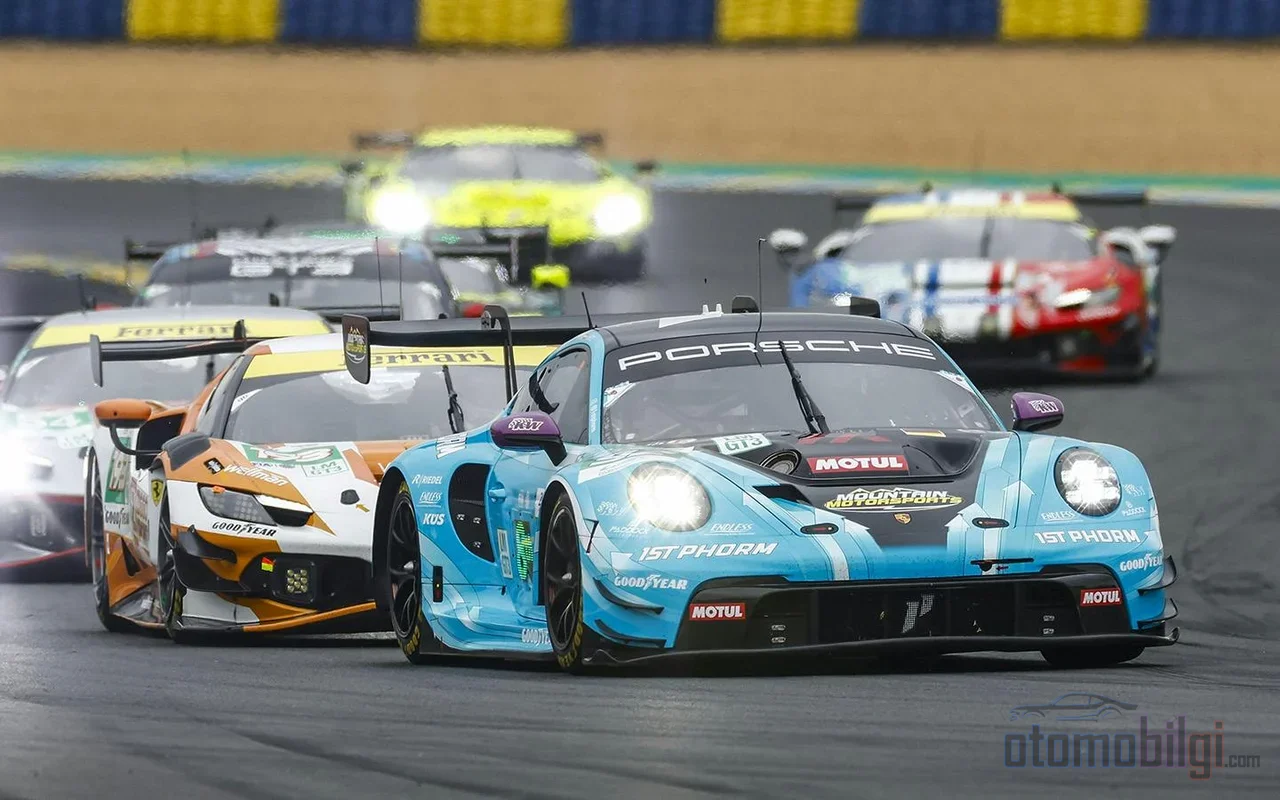
Teams build their tire plan around their stint plan: single-, double-, triple- and quadruple-stint. In other words, will you use one set of tires for one stint, two stints, three stints, or four? Since the cool nighttime temperatures don't strain the tire, the quadruple stint is common during night stints and saves serious time: every tire change you skip means more than roughly half a minute avoided in the pit lane - a huge difference over a 24-hour race.
The main deciding factor here is actually fuel capacity: a car with a tank that holds more fuel can keep turning laps on the same set of tires for longer before pitting. Even saving a single extra lap counts as a major strategic advantage at Le Mans. The endurance-focused tires could allow teams to go up to 5 stints on a single set (about 600 km, roughly 65 laps); on the LMP2 side, some tires were seen covering nearly five stints' worth of distance on one set. That's the upper limit: no, a single set of tires doesn't last the entire race.
So is stretching it always the right call? The counterargument is strong too: lap times drop on worn tires, and beyond a certain distance that loss starts to offset the pit loss of fitting new tires. The 2017 hot race taught this dilemma almost like a lesson: should you save the tires capable of five stints for the night when temperatures fall, or use them right away? That's exactly the calculation running through strategists' minds. The wild weather conditions of 2024, on the other hand, left it all to guesswork - that year, Hypercars could run slicks in the rain and rain tires in the dry, and pure strategy gave way to flexibility.
Michelin's Endurance Engineering: The Secret Is Hidden on the Surface
Since 2023, the Hypercar class tire has been in Michelin's hands, and the French giant takes the job seriously: at Le Mans, 33 overall victories and there is a winning streak that has continued since 1998. In the WEC Hypercar class, it won every round of the premier series of world endurance racing. Roughly 1,000 hp Hypercar prototypes - Toyota, Peugeot, Ferrari and Isotta Fraschini on the LMH side; Porsche, Cadillac, Lamborghini, Alpine and BMW on the LMDh side - these tires were specially developed for, and were used on all 18 Hypercars in the 2026 race.
2026 Pilot Sport Endurance tire brings a clever design twist: the construction information normally hidden in the tire's inner layers has this time been made visible on the surface as a percentage pattern. In other words, there is no need to cut the tire open to understand what is inside - Michelin wrote it into the pattern itself. There is also the sustainability front: the 2026 slicks contain 50% recycled and renewable materials, a figure ahead of the company's own target. When durability and green credentials meet in the same tire, the picture is pleasing: a race with fewer tire changes means less waste.
Is a Pit Stop Worth All This Strategy?
Now let's look at the big picture. A winning car spends a total of less than 1 hour in the pits over 24 hours. That is an incredible number: nearly all of the 24 hours is pit-free, full throttle. That is why tire strategy is so critical - every pass through the pit lane counts seconds, and every tire change eats into that narrow budget. Fitting tire changes into the fuel cycle, that is, changing the tire only at a moment when you would be stopping anyway, is at the heart of Le Mans strategy.
The driver-side rules also shape the strategy: it is permitted to hold the wheel for at most 240 minutes in a stint, a minimum of 6 hours of driving is required per driver, no more than 4 hours may be driven in each 6-hour window, and a driver may stay at the wheel for a total of at most 14 hours in the race. In temperatures above 32 degrees C, the upper limit drops to 80 minutes in cars without air conditioning, with a mandatory 30-minute rest. So tire change timing also has to shake hands with driver rotation.
Races That End in Explosion: The Tire's Bad Day
Strategy is nice, but sometimes the tire does not like the plan. The terrifying tire blowout the Sauber-Mercedes C11 experienced at Le Mans has been documented on video, and the mark that such sudden, catastrophic blowouts leave on a driver's mind can last for years. The combination of high speed and downforce on the Mulsanne causing tire failures is proof that in the classic era blowouts genuinely affected race results. Some races are remembered not for the winner but for the exploding tire - and that is no risk to be underestimated on this circuit.
Then there is the rain factor. In 1999, as rain returned to the track, a car being left on slick tires is one of the classic examples showing how fine a line tire selection is. The right compound at the right moment; if a stop is delayed, a slick tire on a wet surface is about as useful as a parachute burning merrily away.
Final Word: Victory Is a Percentage of Tires
The winning team at Le Mans is usually not the fastest one, but the team that makes the fewest mistakes. Tire management is exactly the concrete form of this: know your limit, spend your sets at the right stint, use the night wisely, and convert every second you save in the pits into an advantage on track. At the end of 24 hours, the car that crosses the finish line is usually the one living most peacefully with its tires. Next time you watch Le Mans, check whether there's a tire change at the pit exits - the fate of the race is often decided right there, in those few seconds.
Sources
- Pit stop tactics: a major factor at the 24 Hours of Le Mans
- What is a stint in racing? F1 and Le Mans meaning
- 24 hours of Le Mans: everything you need to know
- Michelin, exclusive tire supplier for the WEC's Hypercar class
- The secret of the new 24 Hours of Le Mans Hypercar tyre design
- Michelin's new Le Mans tyre hides its secret on the surface
- Michelin at the 24 Hours of Le Mans: A Legacy of Endurance and Innovation
- Why the 2026 Le Mans race matters more than ever for Michelin
- Michelin designs a greener hypercar tire for 2026
- Le Mans Hypercar tires: Michelin tech, rules and numbers
- WEC About 2023
- Mulsanne Straight
- 1989 Le Mans recounts the Mulsanne straight without chicanes
- How does the 24 Hours of Le Mans work? A beginner's guide
- Focus on the 24 Hours of Le Mans regulations: Pit stops
- Le Mans 2017: The tyre challenge
- LMP2 Could Go "Two Laps a Stint Longer" at Le Mans
- Inside the Goodyear tyre strategy at the 24 Hours of Le Mans
- Sauber-Mercedes C11 suffers terrifying tyre blowout at Le Mans