How Did the Closest Finish in Le Mans History Unfold in 1969?
Share This Page
The 1969 24 Hours of Le Mans witnessed the closest finish in race history: Jacky Ickx and Hans Herrmann entered the final corner on the last lap separated by only about 120 meters, and the victory went to the Gulf-liveried Ford GT40. But what truly made this race legendary was not the final corner; it was Ickx's refusal to make a running start, which sent the traditional Le Mans start into history. This duel, run on June 14-15, 1969, is remembered both as a one-second finale and the birth moment of a safety revolution.
Highlights
- Winner: Jacky Ickx and Jackie Oliver finished first, completing 372 laps in the #6 Gulf Ford GT40.
- Finishing margin: Only about 120 meters ahead of Herrmann's Porsche 908 - the closest finish in race history.
- Ickx started the race from the back of the grid for protesting the running start.
- This race was the last time the traditional Le Mans start, where drivers ran across the track, was used.
- The Porsche 917s, which led for about 90% of the race, were eliminated due to technical failures.
Why Is the 1969 Le Mans Still Talked About?
Ask yourself this: If the outcome of a 24-hour race is decided by a moment shorter than even a second, how valuable would that moment be? The 1969 24 Hours of Le Mans delivered exactly that. The 37th running of the race and the 8th round of the International Championship for Makes, where John Wyer Automotive's Ford GT40 finished practically side by side with the Porsche 908 of Hans Herrmann and Gérard Larrousse. The margin? According to some measurements, 2 seconds - that is, a few car lengths at the end of the straight. This was something never seen in more than half a century of Le Mans history.
But what truly binds me to this race is not the finish line, but the start line. Because in 1969, two completely different stories unfolded at the same time: on one side, the clash between Porsche's massive new weapon, the 917, and Ferrari's comeback; on the other, a safety rebellion started single-handedly by a young Belgian. The influence of both extends to today's endurance races.
To Jump In Running, or to Walk? The Protest That Changed the Start
For those unfamiliar with the Le Mans start, let me explain: the cars line up on one side of the track, and the drivers wait on the other side. As soon as the flag drops, the drivers run across the track, jump into their cars, and set off. Sounds great, doesn't it? Now think: what would a driver who wants to gain a few seconds do? Starts the car without putting on the helmet, without fastening the belts. In other words, you jump into one of the fastest race cars in the world with no safety measures at all. By today's standards, this is almost impossible to believe.
For Jacky Ickx, this was unacceptable. A year earlier, in 1968, his teammate Willy Mairesse had crashed while trying to quickly close the door at Mulsanne, and his career had ended. In 1969, at the start, while everyone else ran, Ickx chose to walk calmly. He put on his helmet, fastened his belts properly, and then got into the car. The result? He dropped to the back of the grid. In my opinion, this is one of the most meaningful finishes in motorsport history.
And hard to believe, but the protest actually worked. The running start was never used again after that year; the rules were changed and drivers now started inside their cars, with their belts fastened. Ickx's few seconds of sacrifice may have saved dozens of lives in the decades that followed. Indeed, the very first minutes of the race showed everyone just how real that danger was.
The Dark Shadow of the First Lap: The John Woolfe Crash
To understand just how justified the protest was, one only needs to look at the first lap. Privateer racer John Woolfe was competing in his Porsche 917, which he had bought only days earlier. Woolfe, who said the car's power frightened him, lost control near the Maison Blanche corner and crashed into the trees. He was not wearing a seatbelt, was thrown from the car, and lost his life. The burning fuel tank landed right in front of Chris Amon's Ferrari 312P; Amon's car caught fire and his race was over in the very first lap.
This crash was the most painful proof of how right a decision Ickx's morning walk had been. The difference between having a seatbelt and not is life itself - everyone learned that painfully that day.
Porsche 917 vs Ferrari 312P: The Clash of the Giants
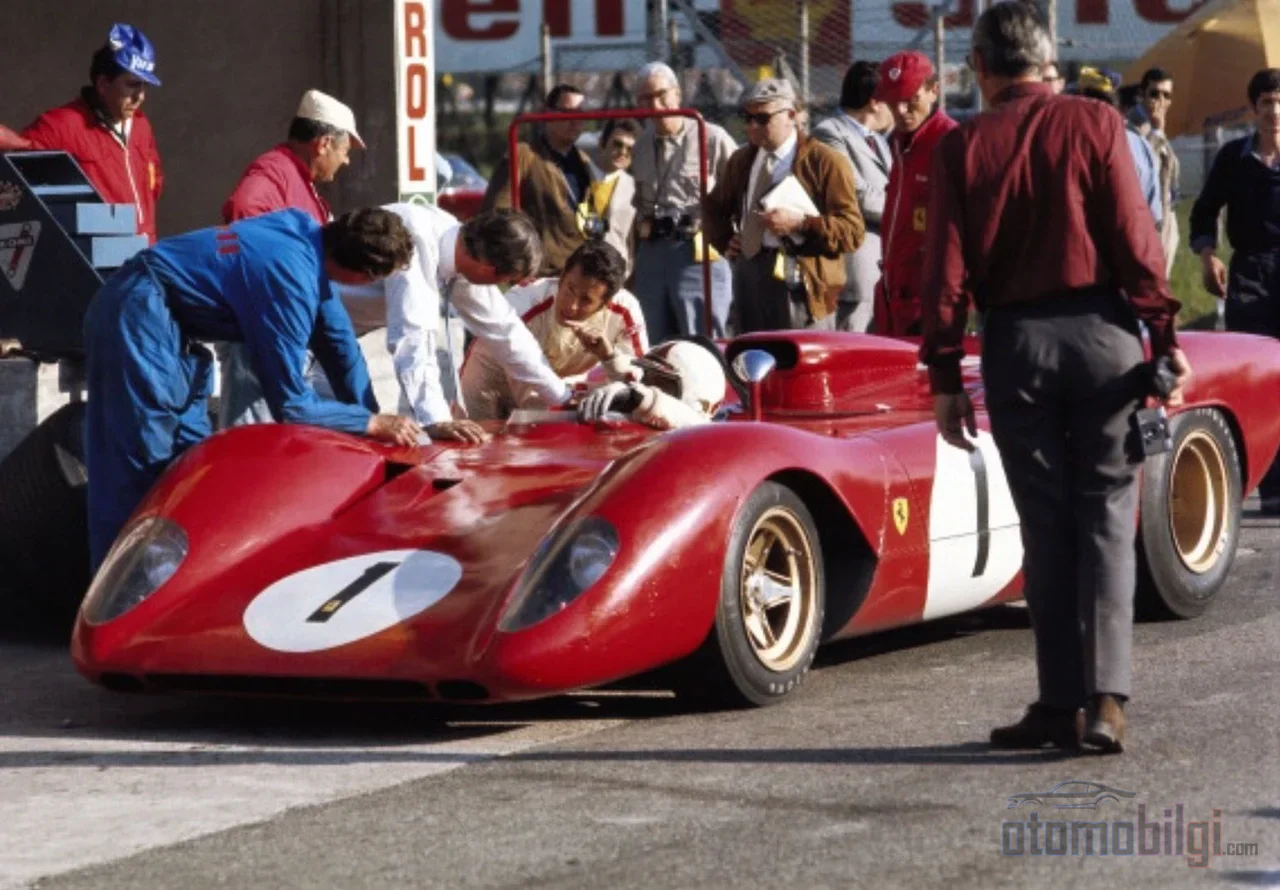
Now let's get to the real technical story. Porsche took advantage of the minimum requirement of 25 cars imposed by the homologation rules and produced only 25 units in 10 months of the Porsche 917. Just imagine: a 4.5-liter flat-12 engine with 520 horsepower, and it is said that Porsche nearly went to the brink of bankruptcy for it. This was nothing short of a gamble.
Ferrari, after a one-year break, returned with the 312P powered by a 3-liter V12 engine. Producing 430 horsepower, this car was less powerful than the 917 but more mature and better balanced. So it was a classic showdown: raw power versus experience. Unfortunately, fans could not see this duel through to the champagne - neither Ferrari finished, one of them eliminated due to the Woolfe crash on the first lap. The 917s led for about 90% of the race, but their gearboxes and drivetrains could not hold up. Both factory 917s were out of the race. In my opinion, this is one of the finest examples of the phrase "raw power isn't enough" in motorsport.
| Specification | Porsche 917 | Ferrari 312P |
|---|---|---|
| Engine | 4.5-liter flat-12 | 3-liter V12 |
| Power | 520 horsepower | 430 horsepower |
| Pole position | Yes (Stommelen, 3:22.9) | No |
| Race result | Mechanical failure, eliminated | Did not finish |
Stommelen took pole position in the 917 with a lap time of 3:22.9; that was 0.7 seconds faster than the Mk IV record set in 1967. So the 917 was truly flying - but it was untested, and it was known to be unstable at high speeds during the Le Mans test day. On top of that, when the FIA banned movable wings, Porsche was left in a difficult position; at the last moment before the race, the wings were allowed again. Even this regulatory chaos was a drama of its era in its own right.
An Old Lady's Revenge: The Ford GT40's Final Triumph
So who took the victory? The Gulf-liveried #6 Ford GT40 of the John Wyer Automotive team. This car was so special that its chassis (number 1075) had won the race the previous year too; it even had a nickname: "Old Lady", that is, the Old Lady. The same car winning Le Mans twice in a row was happening for the second time, after the 1929-30 Bentley Speed Six. With this victory, Ford also secured its fourth consecutive, and at the same time its final, overall win since 1966.
Ickx dedicated his victory to Lucien Bianchi, who had lost his life in a testing accident at the beginning of the year. To me, it has always felt meaningful that this story was crowned by the victory of a driver who advocated safety by walking at the start.
The Final Lap Duel: Ickx's Billiards Move
Now let's get to the real finale. With the 908s colliding in the morning hours, the Lins/Kauhsen car suffering a clutch failure, and Elford/Attwood's 917 gearbox breaking down, the lead passed to Ickx. The final three hours turned into a sprint, essentially a sprint race. After 24 hours of running, the two cars were on the track at almost the same speed - to me, this is the most romantic moment of endurance racing.
Entering the final lap, Herrmann was in front. And Ickx made a very clever move: At the start of the Mulsanne Straight, he deliberately let himself be passed, slowing down as if he had run out of fuel. Herrmann passed, but the price was very heavy. The 908's brakes were nearly exhausted on the straight exceeding three hundred kilometers. Ickx, using the GT40's slipstream - that is, the airflow left by the car in front - passed again at the end of the straight. Herrmann's brakes were now burned out, and he had no strength left to retake Ickx in the corner.
Ickx's own explanation is very clear: if he had entered Mulsanne in front, Herrmann would have passed him on the straight. But if the pass happened at the end of the straight, it was possible to complete the lap in front up to the corner. So this wasn't just speed, it was pure strategy. A one-second difference was the result of hours of calculation.
120 Meters: The Closest Finish in Racing History
So what exactly was the gap? The most widely accepted figure is approximately 120 meters, that is, a few car lengths on the straight. There are also measurements stating the gap was 150 meters, or that it corresponded to about 2 seconds; such differences naturally vary depending on where and how the finish line was measured. But the essence is the same: this is the victory decided by the smallest margin in Le Mans history.
Those who remember the controversial Ford finish at the 1966 Le Mans recall 1969 as history's closest "real" finish; because there the finish appeared staged by a team decision, while here it was won entirely on the track, entirely deservedly. Many people describe this race as Ickx's best race of his career, and to me it's not an exaggeration - separating two legends with a one-second move at the end of 24 hours is one of the sights to see in motorsport.
What Legacy Did This Race Leave Behind?
There are two great legacies extending from the 1969 Le Mans to today. The first is safety: the running start was abolished, safety belts became non-negotiable, and Ickx's walk that morning paved the way for drivers today fastening their belts in every race. The second is engineering courage: Although the Porsche 917 started with an unsuccessful season, it would become one of the most legendary race cars of the following years and would dominate Le Mans. Ferrari's 312P, meanwhile, played an unlucky role in this dramatic encounter.
So the next time you watch a Le Mans race and look at how drivers get into their cars, remember that morning of 1969. One person's choice to walk changed everything. Which do you find more impressive - a one-second difference, or a walk that ended a tradition? In my opinion, both were fascinating together in this race.
Sources
- 1969 24 Hours of Le Mans
- 24 Hours of Le Mans – Ickx marches to victory at the 1969 edition
- 24 Hours of Le Mans: Nine 9s – the 1969 race (5/9)
- Clash of the titans: Porsche vs. Ferrari
- Jacky Ickx – the Le Mans Legend Who Changed the Start of the Race
- How One Man Ended The Le Mans-Style Start
- Jacky Ickx protest when Drivers Lives Did Not Matter
- 1969 24 Hours of Le Mans – La Ronde Infernale Video