Does the Air Conditioning in Hybrid Cars Run on Electricity?

At a red light, the engine of a waiting hybrid sedan quietly dies; there is no warning on the instrument panel, and the cold air in the cabin keeps blowing just the same. In an internal combustion car, there could be only one explanation for this scene: the engine was actually running. In a hybrid, it was not. Here, contrary to what most drivers think, the air conditioning is the responsibility of the electrical system, not the engine, and this single difference directly affects the vehicle's comfort, consumption and even its range. So does the air conditioning in hybrid cars run on electricity, or does the belt have a hidden role?
The Difference Between a Belt-Driven Compressor and an Electric Compressor
In a traditional internal combustion car, the A/C compressor is bolted to the engine block and turned by the serpentine belt. The consequence of this architecture is simple: the compressor's speed depends on the engine's speed. If the engine idles at 800 rpm, the compressor turns slowly; if the engine revs up to 4,000 rpm, the compressor speeds up along with it. When the engine stops, the belt stops and cooling production is cut off entirely.
In hybrid cars, however, most vehicles built after 2010 have abandoned this architecture. The A/C compressor operates with no mechanical connection to the engine at all, driven by a brushless electric motor fed from the high-voltage battery system. The voltage is typically in the 200-650 V band depending on the vehicle; in systems like the first-generation Toyota Prius, the nominal value is around 206 V. The compressor's speed is now a function not of engine speed but of climate control demand: when needed, the compressor can reach its maximum speed even while the engine is idling.
Key Highlights
- In hybrids, the A/C compressor is driven not by a belt but by an electric motor running on 200-650 V high voltage
- Thanks to the electric compressor, the A/C provides cooling even when the engine is off
- Wrong compressor oil - even 1% PAG contamination - can cause a short circuit
- In extreme heat, hybrid fuel efficiency drops by 12.0%; the air conditioning is part of that load
- Hybrid compressor replacement costs $700-$1,700; notably more expensive than a conventional compressor
How Does an Electric Compressor Work Inside?
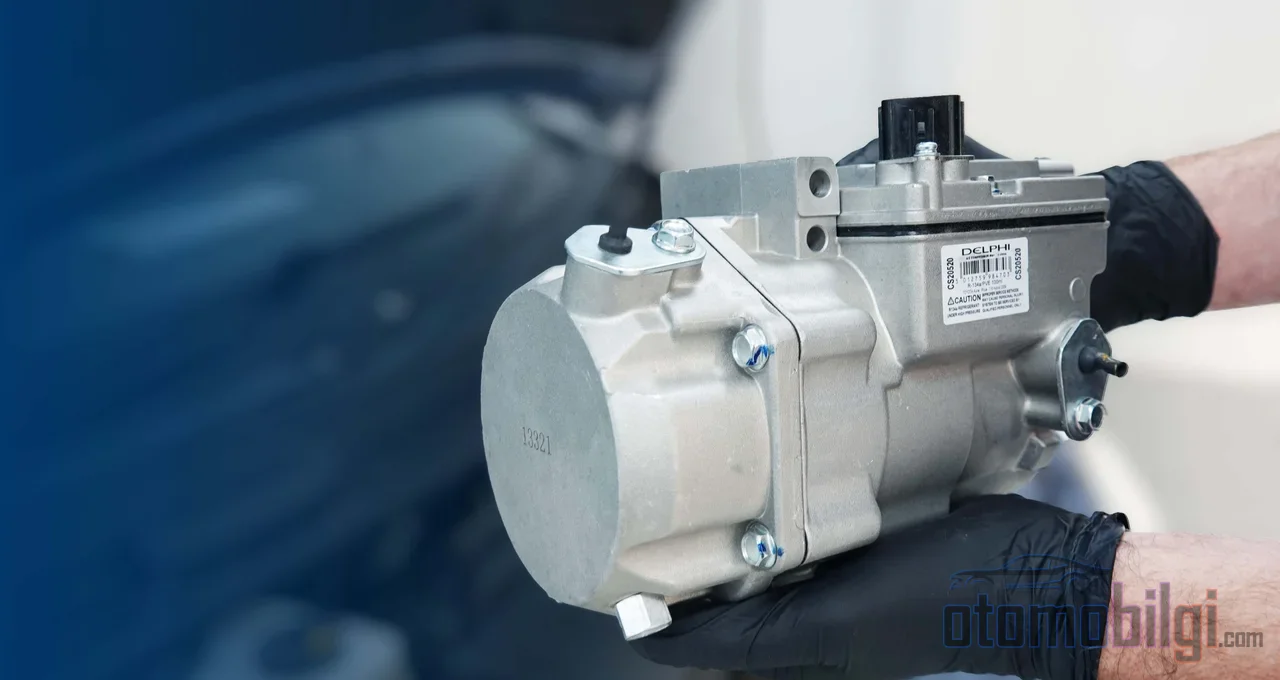
When you open up a hybrid A/C compressor, you actually encounter three modules. The first is the scroll-type compressor section that draws in, compresses and discharges the refrigerant into the system; the refrigerant is compressed by the intersection of a fixed spiral and a moving variable spiral. The second is the brushless DC electric motor, with a permanent magnet on its rotor and coils on its stator. The third is the vehicle's brain: the inverter feed that converts the high-voltage battery's direct current (DC) into the three-phase alternating current (AC) the motor needs.
This inverter layer is the most critical component of the system. The DC voltage from the battery is modulated into the three-phase synchronous motor on the instruction of the hybrid control unit; thus the compressor speed is continuously and precisely adjusted according to demand. A belt-driven compressor has no such flexibility, because its speed is imposed by the engine. With an electric compressor, high performance can be achieved even at low speeds, and this is a decisive advantage in terms of efficiency.
As an engineering detail, these types of compressors are self-cooled by a mixture of refrigerant and oil. In this environment that comes into contact with high voltage, conductive oil cannot be used; therefore electric compressors are hermetically sealed, have no shaft seal, and carry a lower risk of leakage compared to mechanical compressors.
The Air Conditioning Also Cools the Battery
In hybrid and electric vehicles, the air conditioning system does not only cool people. It also plays a vital role in the temperature control of the drive battery. If the air conditioning fails in an electric vehicle, the vehicle will not run; because when the battery temperature cannot be monitored, the system switches into self-protection mode. This turns the air conditioning from an unnecessary comfort feature in hybrid cars into a safety-related system.
Why Does the Cabin Stay Cool While the Engine Is Off?
The moment that surprises hybrid drivers most is when cool air keeps coming in stop-and-go traffic without the engine running. The explanation is entirely architectural: since the compressor is electric, when the vehicle shuts off the engine in stop-and-go mode, the air conditioning circuit continues to operate. At a red light the engine goes quiet, the compressor keeps turning on battery power, and the fan keeps the cabin cool.
In some hybrid systems there is a second solution that complements this capability: an evaporator core with cool air storage capability. This core stores the cold as a kind of thermal reserve while the compressor is running, and keeps blowing cool air even when the compressor is off; it typically remains effective for 30-45 minutes.
However, there is a practical limit here. When the electrical load rises, the hybrid system can moderately throttle the compressor output in order to preserve the battery charge and prevent the drive battery from draining rapidly. This is not a malfunction, but a strategy that manages the balance between cooling, battery protection and fuel economy. The driver may notice this as the blown air becoming slightly warmer during a long stop; when the vehicle starts moving again, the system returns to its normal cooling.
Cool While Driving but Blowing Warm When Stopped
There is a common complaint: the air conditioning cools well while moving, but the blown air warms up when the vehicle stops. Suspecting the compressor is the wrong direction. The most likely cause is a weak condenser fan. At idle, the condenser's heat rejection depends entirely on the electric fan; when the fan does not blow as it should, pressure rises and cooling capacity drops. The compressor may be perfectly fine in this scenario.
PTC Heater: The Half That Is the Exact Opposite of Cooling
The job of the air conditioning compressor is to draw heat, that is, to cool the cabin. So how does the cabin heat up in winter? In hybrids, since engine efficiency is high, engine coolant may not always be a sufficient heat source; in plug-in hybrid and electric vehicles there is no such source as exhaust heat to begin with. This is where the PTC heater fills the gap.
PTC stands for positive temperature coefficient. This heater generates heat through electrical resistance; as it heats up, its resistance increases and it operates safely by self-limiting. It has two practical advantages: it heats up quickly and protects itself against overheating. So why is a heat pump preferred in some vehicles? Because a resistive PTC heater converts electricity into heat at roughly a one-to-one ratio, while a heat pump can produce two to four times as much heat from the same electrical energy. Compressor-based cooling relies on compressing refrigerant, while PTC-supported heating relies on a resistive element. The two systems are not alternatives to each other; they are two different halves of the same climate control package, each working on different physics.
How Does Air Conditioning Affect Fuel Consumption and Range?
Having an electric compressor does not make the energy free; it simply allows it to be used more controlled. As the energy spent driving the compressor decreases, more energy remains for propulsion and usable range increases. There is also a flip side: when the air conditioning runs at full power, it draws significant power from the battery, and the system kicks in with the balancing strategy described above.
Temperature affects the picture significantly. A comprehensive field study published in May 2026 measured a 12.0% drop in fuel efficiency in hybrid vehicles and a 10.4% drop in electric vehicles under extreme heat. The interior temperature of a parked vehicle can exceed 65 °C; these conditions stress the traction battery, the inverter, and the air conditioning compressor all at once. The share of air conditioning in range and consumption should be read as part of this total load.
Two Simple Ways to Preserve Range
- Preconditioning the cabin before setting off in a plugged-in plug-in hybrid, meaning pre-cooling or pre-heating with the air conditioning, reduces the climate control load during driving and achieved longer range in tests.
- On mild days, in the roughly 21-27 °C range, driving with the outside air circulation mode without engaging the air conditioning compressor usually offers sufficient comfort.
The Service Side: Wrong Oil Means Short Circuit
The most critical service rule for the electric compressor is the oil. Conventional compressors use electrically conductive PAG oil; hybrid compressors, on the other hand, require non-conductive, high-voltage-safe POE (polyol ester) oil. Even around 1% PAG contamination in the system can impair the insulation resistance of the compressor motor windings; the result is a short circuit and compressor failure. For this reason, it is recommended that service equipment for hybrid and electric vehicles be kept separate from conventional air conditioning equipment.
The cost difference is clear: replacing a hybrid compressor typically falls in the range of $700-1,700; a conventional compressor is replaced for $500-800. The reason for the difference is not just the part price, but the high-voltage safety procedures and the requirement for specialized recovery equipment. Before replacement, the compressor must be disconnected from the high-voltage battery.
Short Answer: Do Hybrid Cars' Air Conditioning Run on Electricity?
Yes. In hybrid cars, the A/C compressor is not belt-driven by the engine; it runs on a brushless electric motor fed by the high-voltage battery and sped up by an inverter. This has three practical consequences: the air conditioning works even when the engine is off, compressor speed depends on demand rather than engine speed, and the A/C system is also responsible for cooling the traction battery. Its impact on fuel consumption is more manageable compared to modern belt-driven systems, thanks to its balancing strategy and efficiency advantage; however, in extreme heat conditions, the total thermal load measurably reduces efficiency.
When buying or using a hybrid, the real risk regarding the air conditioner is not cooling performance, but applying the correct oil and the correct safety procedures during servicing. A driver who knows the compressor is electric does not mistake the loss of cool air when the engine goes quiet for a malfunction; and when they go to the service shop, they know the name of POE oil. This page was written precisely to provide that awareness.
Sources
- How do the compressors differ in hybrid and electric vehicles?
- Hybrid AC Compressor Failing? 5 Signs & Repair Costs
- AAA Study Reveals Temperature Impacts on EV and Hybrid Performance, Efficiency and Costs
- Thermal management in electric and hybrid vehicles
- PTC Heater for Electric Vehicles and Plug-in Hybrid
- What Is a PTC Heater?
- Using Climate Control on Hybrids & PHEVs
- The Hybrid Compressor: Know the Difference
- How a Hybrid A/C Compressor Works
- Selecting an Electric Compressor for Off-Road Vehicles