Why Does a Permanent Magnet Motor Become Demagnetized?
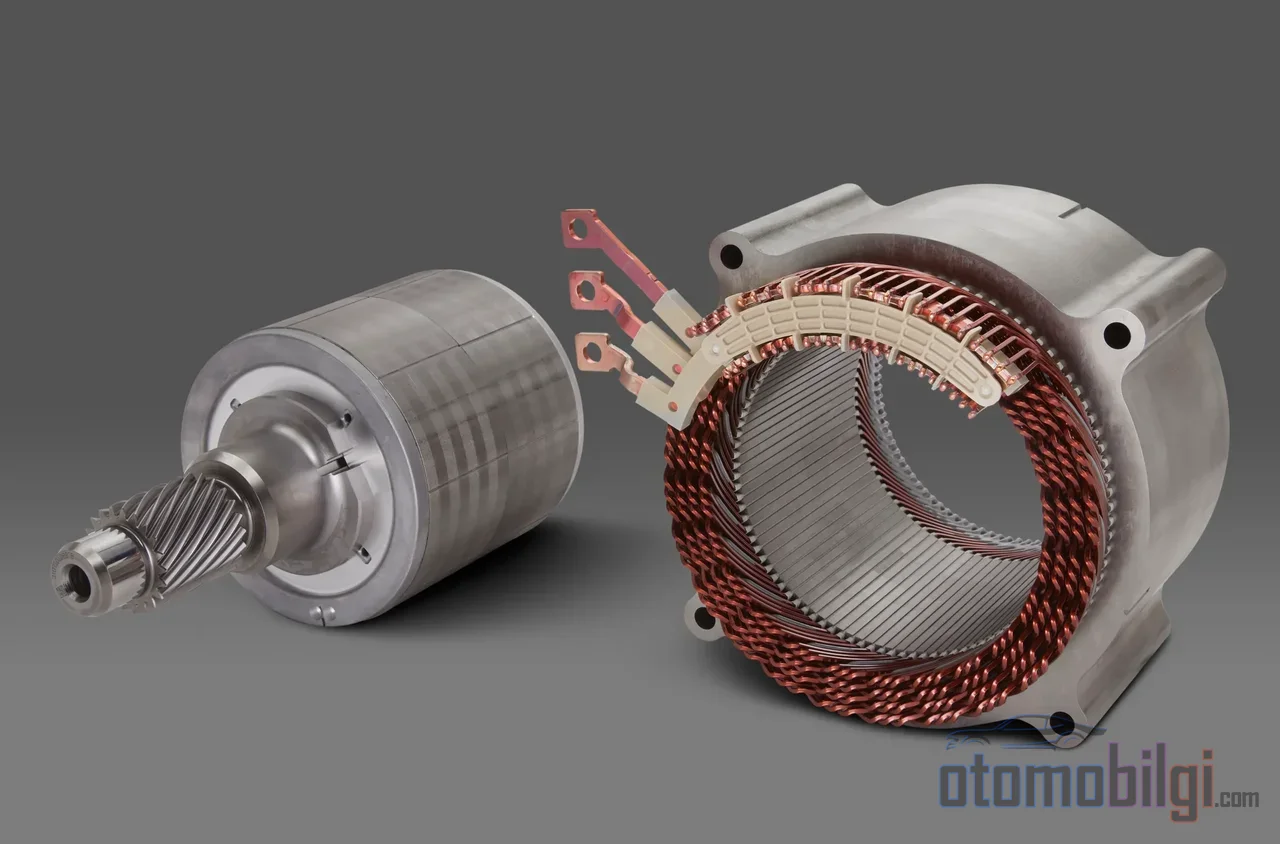
In most electric cars, synchronous motors draw their power from neodymium magnets embedded inside the rotor. These magnets may look like the heart of the vehicle, but they are actually a chemically fragile component: when exposed to the wrong conditions, they can silently and permanently lose their magnetism. The motor does not stop at that moment; it gradually weakens, heats up, and loses efficiency. So how is this loss triggered, why is it irreversible, and how do manufacturers manage this risk? On this page, we explain it step by step, starting from the physical origin of the problem.
What Is Demagnetization in a Permanent Magnet Motor?
In permanent magnet synchronous motors (PMSM) and in types with magnets buried in the rotor (IPMSM), torque comes from the magnetic field produced by the neodymium-iron-boron (NdFeB) magnets inside the rotor. The magnet's operating point is the intersection of the material's magnetization curve and the magnetic load line of the circuit. An externally applied reverse magnetic field or excessive temperature pushes this operating point backward along the curve.
The critical distinction here is the knee point on the curve. If the operating point stays above the knee, the loss is reversible: when the reverse field is removed, the magnet returns to its initial flux density. If the point drops below the knee, the situation changes: the magnet shifts to a new and lower operating line, and the flux density permanently decreases. This is irreversible demagnetization, and as a practical acceptance threshold, a reduction in back-EMF exceeding 3 percent is considered significant.
Highlights
- The Curie temperature of NdFeB magnets is only 312°C; permanent loss can begin far below that
- Standard N-type neodymium magnets permanently lose part of their magnetism at temperatures above 80°C
- In traction inverters, the overcurrent protection limit is typically 1.5-2.4 times the rated current
- In real-world driving cycle analysis, no irreversible demagnetization was observed in the motor with N45SH magnets
How Does Heat Weaken the Magnet?
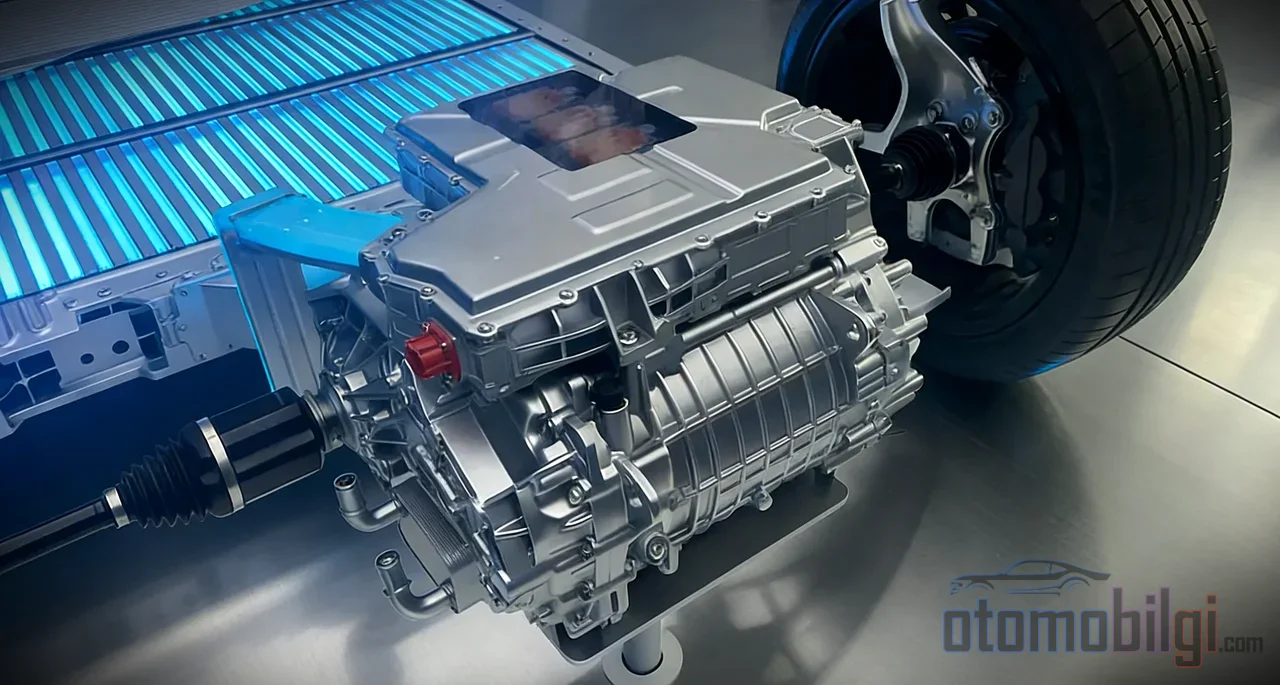
As temperature rises, two fundamental parameters of the magnet drop simultaneously: the residual flux density (Br) and the coercive force (Hcj). The latter measures the magnet's resistance to external influences. As the coercive force decreases, the knee point shifts to a more vulnerable region; in other words, a hot magnet is far more susceptible to loss under the same reverse field than in its cold state.
The Curie temperature of the basic phase of NdFeB material (Nd2Fe14B) is only 312°C and varies with composition. However, contrary to popular belief, reaching the Curie temperature is not necessary for the magnet to degrade. In sintered NdFeB magnets, even temperatures exceeding 100°C can cause major irreversible polarization losses at the operating point. Standard N-type neodymium magnets permanently lose part of their magnetism at 80°C (85°C for band products); for comparison, ferrite magnets can operate up to 250°C, and Alnico-type magnets up to 500-550°C. The technical literature has reported irreversible magnetic loss of up to 10 percent.
Electric vehicle traction motors reach coolant temperatures of 60-65°C during long drives; during hill climbs and sudden accelerations, they operate with currents exceeding twice the rated current. When heat and current are applied at the same time, the margin narrows. If the Curie temperature is exceeded, the loss is definitively irreversible; the two cases do not exclude each other - they are thresholds, one of which arrives much earlier than the other.
Overcurrent and Fault Moments: Short Circuit, Active Short Circuit, Regeneration
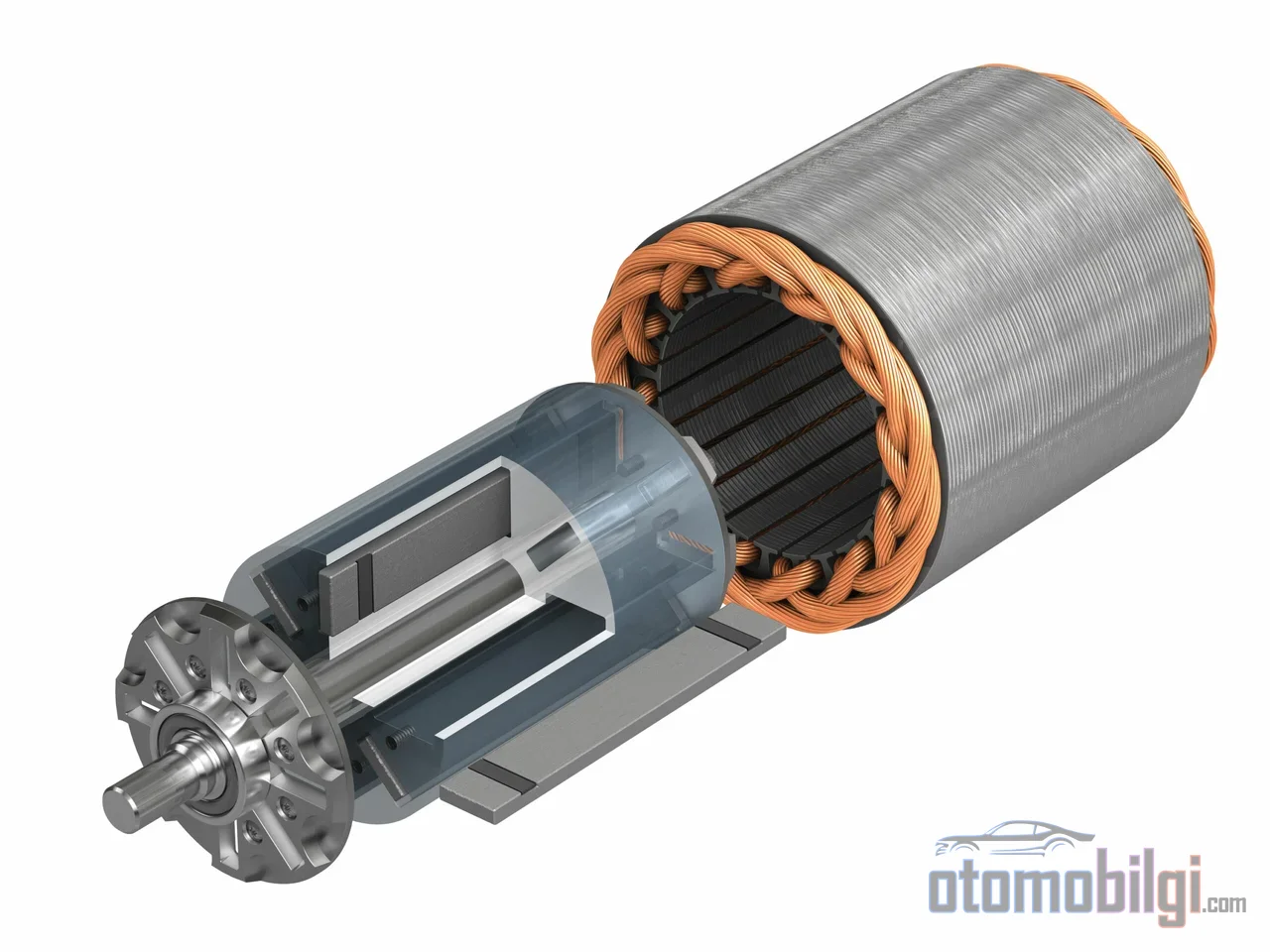
The current passing through the windings produces a magnetic field opposing the magnet field. The additional current created when a small number of turns in the stator winding short-circuit is not enough on its own to damage the magnet; as the number of short-circuited turns increases, the opposing field reaches the power to suppress the magnetic flux, and the large current passing through the short-circuited circuit also generates heat. Single-phase asymmetric short circuits create fault currents that are more severe and of higher amplitude than symmetric ones.
A more insidious scenario is the active short circuit (ASC) used for safety purposes. In this method, which the inverter resorts to as a way of shutting down the motor safely when humans cannot intervene in the vehicle, high transient currents can be generated, carrying the risk of irreversible demagnetization in the magnets. The solution is to direct the current vector into the safe operating area through field-oriented control or direct current vector control, and to apply the active short circuit within this limit.
Moments of hard regeneration also create a similar load: as speed increases, the induced back electromotive force grows, and the control software applies current in the opposite direction to the magnet flux to balance it. This is part of the design; the problem is the moment the limit is exceeded. In traction inverters, overcurrent protection typically engages at 1.5-2.4 times the rated current, and the hardware is scaled to withstand about 3 times the rated current.
The Chain Effect of Partial Demagnetization
Once a magnet has partially weakened, the motor continues to run quietly, but enters a thermodynamically deteriorating cycle. Torque drops; more current is required for the same output power; more current increases copper losses and temperature; rising temperature makes the magnet even more vulnerable. In addition, the destabilized magnetic field amplifies vibration and noise.
There is also a contribution on the mechanical side: in dynamic eccentricity, the length of the air gap becomes irregular around the rotor circumference, the flux density distribution is disrupted, and in interior permanent magnet motors this can progress to irreversible demagnetization. Since the magnets are embedded inside the rotor, they are also protected against centrifugal forces at high speeds; this is one of the fundamental advantages of the IPMSM architecture.
What Do Real Driving Conditions Show?
Outside the laboratory, the situation was put to the test in a real driving cycle. An IPMSM with 8 poles, 48 slots, V-type buried magnets and hairpin windings was analyzed on an electric vehicle using an N45SH-class magnet over the NEDC cycle; take-off and maximum speed points were selected as worst-case conditions. The result is reassuring: even at a 60°C starting temperature and under high current, the demagnetization rate stayed below 3 percent, and no irreversible loss was observed; the largest reduction in magnet energy product was 1.05 percent.
The same analysis, in comparing the N45SH magnet's curves at 20°C and 150°C, confirmed that flux density and coercive force drop as temperature rises. This electro-thermal coupled analysis also showed that in hairpin-wound motors, ohmic losses increase markedly with temperature and become the dominant heat source, with losses concentrating around the air gap and slot openings. A significant portion of the literature still works with arbitrary assumptions (fixed temperatures of 120-180°C, 1-10 times rated currents); analyses based on real driving data are taking its place.
How Do Manufacturers Manage the Risk?
Cooling design
The most direct measure is controlling heat: advanced cooling keeps the magnet temperature within a safe range, directly enlarging the demagnetization margin. In mass-production electric vehicles, a water jacket around the stator body and oil spraying onto the windings are widespread; a 50/50 ethylene glycol-water mixture is used as the coolant. Designs that pass fluid through channels containing the rotor magnets and cool them through direct contact have been patented; this approach makes it possible to select magnets with lower thermal endurance (and cheaper). With multiphysics simulation tools, designs are verified electromagnetically and thermally together before going into production.
Control software and current limiting
Protection at the software layer is based on managing the current vector. Negative d-axis current is deliberately used to weaken the magnet flux; demagnetization is protected against by jointly monitoring the speed-current map, control limits, DC bus voltage and magnet temperature. Algorithms that take rotor temperature into account and limit reverse field application accordingly have been verified through simulation and experiment; with observers based on the extended Kalman filter, the demagnetization current is precisely controlled during field weakening. Variable frequency drives continuously monitor the three-phase current and break the circuit in abnormal situations; patented approaches that define separate current limits for different driving conditions also exist. On the fault diagnosis side, since magnet flux linkage is proportional to magnet strength, the presence and degree of demagnetization can be detected through back-EMF measurement; methods for distinguishing eccentricity from demagnetization faults have been developed.
Magnet material and rotor architecture
On the material side, there are two approaches. First, adding heavy rare earth elements such as dysprosium and terbium to increase the magnets' thermal resistance; second, improving cooling so much that these expensive elements become entirely unnecessary. Bosch introduced permanent magnet motors that completely eliminate heavy rare earths by improving motor cooling. There is also a supply chain dimension to this: China mines 60 percent of the rare earths used in magnets, refines 91 percent of them, and produces 94 percent of permanent magnets. The rise in magnet prices and this dependency are pushing some manufacturers toward magnet-free architectures such as copper electromagnet rotors (in some models from Renault, BMW, and Nissan) or induction motors. Mechanical protection solutions such as thermoplastic composite rotor sleeves also aim to extend motor life.
In summary: Why and When Does a Magnet Lose Its Magnetism?
The short, quotable answer is this: A permanent magnet electric motor permanently loses its magnetism when heating and reverse-direction overcurrent, acting together, push the magnet's operating point below the knee point; this loss is measured as a reduction in back electromotive force exceeding 3 percent, and the magnet continues to operate on a new, weaker operating line.
For today's electric vehicles, the picture is not alarming. Thermally resistant magnet grades, buried rotor architectures, water and oil cooling, and control software that monitors temperature and current together suppress the risk at the design stage. Real-world driving cycle tests show that a well-designed motor operates within a safe margin even at the worst loading points. Demagnetization does not happen by chance; it is the result of an engineering calculation in cases where cooling is neglected, current limits are exceeded, or fault management is not properly designed, and this calculation is now under the manufacturer's control.
Sources
- Magnet Temperature Limits: Maximum Operating Temperature vs Curie Temperature
- Irreversible magnet demagnetization analysis of IPM type BLDC motor by stator turn fault
- Internal Permanent Magnet (IPM) Motor control
- Tolerance analysis of electrified vehicles on the motor
- Demagnetization fault diagnosis method for PMSM of electric vehicle
- Demagnetization analysis of an open-end windings 5-phase PMSM under transistor short-circuit fault
- Demagnetization in PMSM Rotors: Causes, Effects and Prevention
- Heat-Resistant Magnets: High-Temperature NdFeB, Ferrite
- NdFeB Curie Temperature and Applications in High Temperature Environments