Dual-Motor EV Logic: Why a Permanent Magnet Motor Is Used at the Front and an Induction Motor at the Rear?
Share This Page
The reason dual-motor electric vehicles use two different motor types on the front and rear axles is a simple engineering balance: the permanent magnet synchronous motor works on the continuously loaded axle because its peak efficiency is high, while the induction motor works on the reserve axle because it can spin nearly losslessly when not energized. An AWD EV thus stays efficient in cruise mode while also having the flexibility to draw power from all four wheels when torque is needed.
Highlights
- Permanent magnet motors reach a peak efficiency of 95-97%; induction motors typically stay in the 90-93% range.
- When the induction motor's stator supply is cut, the rotor spins freely; this makes it an ideal reserve axle in a dual-motor setup.
- An induction motor of equivalent power weighs 45-60 kg while a PMSM is around 22 kg; its torque density is 2-3 times higher.
- The Tesla Model 3 Dual Motor uses an induction motor on the front axle and an interior permanent magnet (IPM) motor at the rear; Mercedes-Benz EQ models prefer the opposite.
Why aren't both motors made with the same design?
Equipping both axles with permanent magnet motors seems logical on paper: after all, a more efficient, lighter and more compact motor. The problem is that the PM motor's magnetic field never switches off. The magnets in these motors' rotors produce a field at every moment; even when the vehicle is coasting, with the motor de-energized, the spinning magnetic rotor creates unwanted currents and core losses in the stator windings. In short, a PM motor literally cannot be "put to sleep".
In an asynchronous (induction) motor, however, the rotor current is induced indirectly by the stator. When the stator supply is cut, the rotor is left magnetically field-free and mechanically free, and drag losses drop to near zero. This single feature explains the fundamental logic of the dual-motor architecture: the unused axle must spin for free, and the motor that makes this possible is the induction motor.
The character of the two motor types: efficiency, weight, torque density
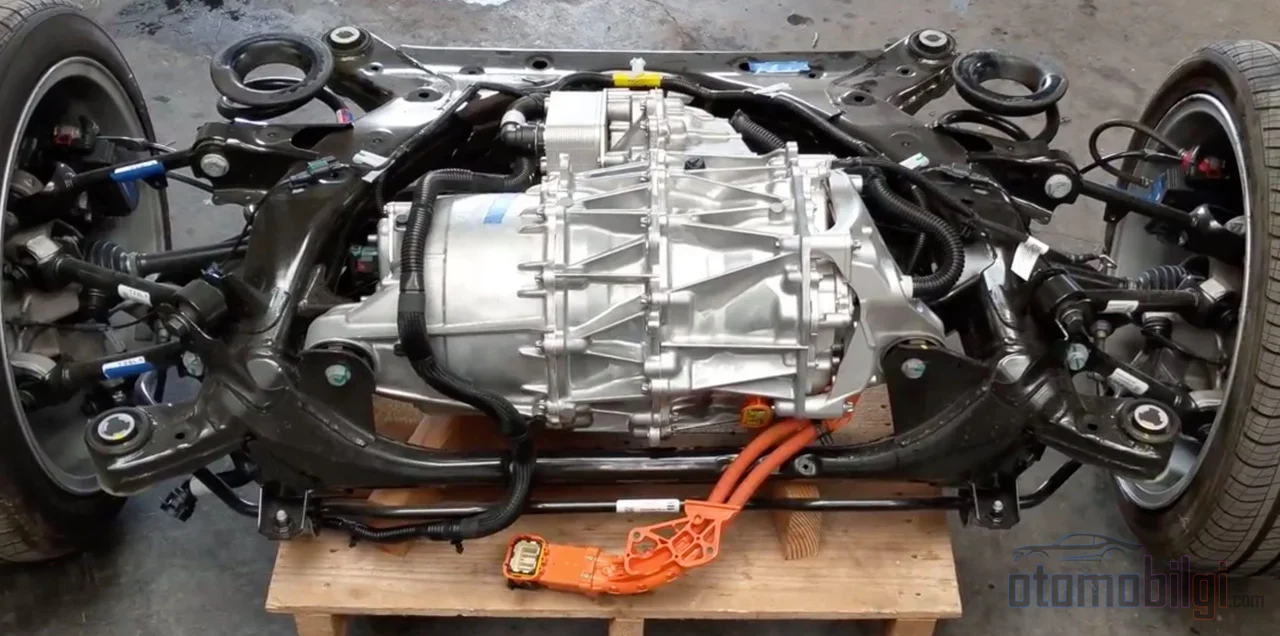
The superiority of the permanent magnet synchronous motor (PMSM) lies not just in peak efficiency, but in how that efficiency is distributed. Since there is no rotor current loss, it stays efficient across a wide speed and torque range; this is often more valuable in daily use than peak efficiency at a single fixed point. In an induction motor, some of the losses are entirely structural: as the rotor lags behind the stator field by the amount of the speed difference (slip), current - and therefore heat - is generated in the rotor. To produce the same flux, an induction motor requires more iron and copper - a 50 kW induction motor weighs 45-60 kg while an equivalent PMSM is 22 kg. The PM motor's torque density is also 2-3 times higher, meaning the same performance fits into a more compact package.
| Feature | Permanent magnet synchronous (PMSM) | Asynchronous (induction) |
|---|---|---|
| Peak efficiency | 95-97% | 90-93% |
| Free-spinning loss | Low but not zero (permanent magnet field) | Very low, spins freely in practice |
| 50 kW motor mass | Approximately 22 kg | 45-60 kg |
| Torque density | High (2-3 times) | Lower |
| Efficiency across the load range | Efficient across a wide range | Drops faster under variable load |
| Magnet requirement | Requires rare earth elements | Not required |
| Typical role | Continuously loaded axle | Secondary axle / additional power |
Matching logic on the efficiency map
Every electric motor has an efficiency map: a contour diagram showing how efficient it is in which region of the speed-torque plane. Losses come from three main groups - ohmic losses from winding resistance, iron losses arising from alternating flux in the iron, and in PM motors the additional losses created by the magnets themselves. A well-designed dual-motor setup aligns the most efficient regions of these maps with the points where the vehicle spends the most time in its typical usage profile.
The strategy works like this: while the vehicle cruises at a constant speed, only the PM motor runs, and its size is chosen precisely so that it sits on the most efficient island of the efficiency map in this low-load scenario. The induction motor is shut off with an inverter command; the rotor spins freely, and drag is nearly zero. When acceleration, a hill, or traction loss comes into play, the second motor starts producing torque. The vehicle software adjusts the torque split between the front and rear axles at every moment to optimize consumption; these torque allocation algorithms also lay the groundwork for basic torque vectoring and try to balance each axle's lateral force capacity.
There is asymmetry in regenerative braking as well: the PM motor transitions naturally into generator mode because its field is always ready. Using the induction motor as a generator is somewhat more complex; since the rotor field is created by indirect excitation, the control layer must first establish this field. Even so, in modern dual-motor vehicles both axles can participate in energy recovery.
Why do manufacturers choose which pairing?
Tesla: induction in front, IPM in the rear
The Tesla Model 3 Dual Motor is the most discussed example of this architecture: a three-phase, four-pole induction motor on the front axle; a three-phase, six-pole internal permanent magnet (IPM) motor on the rear axle. The company's historical curve is also instructive - the original Roadster and Model S were entirely induction; with the Model 3 and Y, the main drive unit switched to a PMSM base. The reason is clear: the higher cost of the PM motor is worth the efficiency gain it provides. Tesla also takes efficiency a step further by combining permanent magnets with reluctance design (magnet reluctance torque). In these motors, known as PMSR, traces of the IPM-SynRM hybrid architecture can be seen.
Mercedes-Benz: mirror image
Mercedes-Benz EQ models apply the same logic in reverse: a permanently excited synchronous motor on the rear axle, an induction motor on the front axle. This shows that there is no single correct answer to the question of "which axle should have the PM"; the decision is made based on the vehicle's weight distribution, typical driving load, and thermal management architecture. Since the rear axle carries the higher continuous power in most EVs, placing the PM motor at the rear ensures that the cruise load falls on the most efficient motor - essentially the same logic Tesla applies.
Industry-wide
Brands such as BYD, Toyota, Hyundai and Volkswagen rely predominantly on PMSM systems due to their high torque density and efficiency across a wide speed range. The vast majority of BEVs use permanent magnet motors; the Renault Zoe and the early Tesla Model S are known exceptions to this rule. Industry research indicates that PM motors will remain the dominant motor type for the foreseeable future; component giant Bosch has also introduced its new generation family of mass-production permanent magnet synchronous e-motors.
Is PM superior in every case? Areas where asynchronous still wins
The comparison is not one-directional. The asynchronous motor has three concrete advantages: it has no dependence on rare earth elements since it contains no permanent magnets, motor cost is typically 20-30% lower, and it is resistant to magnet demagnetization - there is no field loss problem even in environments above 120°C. In PM motors, however, high temperature must be factored in as a lifetime risk for the magnets. In addition, the rotation of the PM rotor produces a voltage opposing the applied voltage (back-EMF); this enables the motor to draw the current its load requires, but at high revs voltage and loss management become a critical design issue.
The magnitude of the efficiency difference is also not absolute: while a band of 5-7% is generally accepted, the gap narrows and widens depending on the load point. PM's advantage is particularly pronounced under variable loads; under continuous, steady load the difference shrinks considerably. The externally excited synchronous motor (EESM) is also on the table as a candidate: it is magnet-free and its excitability provides control flexibility, but its partial-load efficiency typically falls below that of the PMSM because it requires an excitation current that continuously feeds the rotor field.
Frequently asked questions: does a dual motor increase range?
The answer depends on the motor. When a single PM motor vehicle is compared with an AWD vehicle paired as PM + asynchronous, the dual-motor layout does not lose range - because the unused asynchronous axle spins freely and barely touches efficiency. The gain comes from distributing torque toward the axle that needs it, and from operating each motor in the most efficient region of its own efficiency map. If both axles had permanent magnets, the core losses continuously flowing at the edges would genuinely eat into the range; the pairing exists precisely to eliminate this loss.
So why don't all manufacturers use the same layout? The position of the PM axle varies by model and manufacturer; while some assessments describe the front motor as the more efficient PM, teardown analyses confirm that in the Model 3/Y the rear motor is the more efficient PM type under typical driving loads. What is constant is not the rule, but the principle: the cruise load should be carried by the most efficient motor, with the other asleep unless needed.
Conclusion: a deliberate asymmetry
Permanent magnet at the front, induction at the rear (or vice versa); this is not one motor technology being declared superior to the other, but a division of labor between two different characters. The PM motor carries the continuous load with its 95-97% efficiency across a wide load range, while the induction motor holds the standby axle loss-free thanks to its free-spinning capability. Factors such as magnet cost, thermal durability and independence from rare earth elements further solidify this pairing economically. For an engineer who wants all-wheel-drive traction without sacrificing range, this asymmetry remains the most balanced answer in current technology.
References
- PMSM vs Induction Motor: 3 Decisions That Save Your EV Build
- Comparison, Induction Vs. PM Motors for EVs
- Induction vs. Permanent Magnet Motors | Efficiency & Torque
- In a AWD Tesla Model 3, why is the front and back motor different
- Tesla Model Y vs Model 3: Electric Motor Tech Comparison
- Losses in Efficiency Maps of Electric Vehicles: An Overview
- Regenerative braking: A closer look at the methods and limits of regen
- Induction Motors in EV Powertrains
- Electric Motors for Electric Vehicles 2026-2036
- Bosch next-generation permanent-magnet e-motors