Why Are Axial Flux Motors a Topic of Interest in Electric Cars?
Share This Page
In axial flux motors, the magnetic flux flows in a direction parallel to the motor's rotational axis; unlike the radial (armature) direction flux in conventional radial flux motors, it travels in a straight line from pole to pole through a disc-shaped rotor. This short flux path and large active diameter make it possible to extract more torque and power from the same volume; that is why the axial flux architecture is increasingly talked about in performance-focused electric vehicles. So why is it used only in selected models, not in every vehicle?
Highlights
- With a suitable design, axial flux motors can be 2-4 times more torque-dense than their radial flux counterparts.
- In the laboratory prototype, 550 kW of power, 13.1 kg of mass and 42 kW/kg power density were reported.
- Mercedes-Benz began large-scale series production of axial flux motors in Berlin-Marienfelde in June 2026.
- Thermal management and manufacturing complexity remain the main bottlenecks of the architecture.
What Is Axial Flux, and How Does It Differ from Radial Flux?
In every electric motor, magnetic flux leaves the magnet, crosses the air gap to reach the windings, and returns along a closed path. The difference lies in the geometry of this path. In a radial flux motor - the dominant topology in electric vehicles today - the stator is a cylindrical pack, and the flux passes in the radial direction of the cylinder, i.e. perpendicular to the rotational axis. As the flux travels from a rotor pole to a stator tooth, from the stator's back iron (yoke) to another tooth, and from there to the other rotor pole, it covers a long path.
In an axial flux motor, however, the rotor and stator turn into discs lined up side by side along the shaft; the air gap is also planar. The flux goes from pole to pole directly through the air gap, parallel to the axis. This short path reduces the reluctance of the magnetic field, keeps it strong, and pushes up efficiency and power density. Moreover, since the flux path is one-directional, grain-oriented electrical steel can be used; this material offers higher permeability and, by reducing iron losses, can provide efficiency gains of up to 2%.
Common Configurations
Axial flux machines are produced in three basic arrangements:
- Single stator - single rotor: The simplest structure, but the one-sided magnetic attraction strains the rotor and requires a yoke.
- Double stator - single rotor: Two stators embrace the rotor from both sides; the magnetic attraction is balanced, and it is the most common choice in high-power applications.
- Single stator - double rotor: It eliminates the need for a yoke; offering a lighter and more efficient structure.
Why Does More Torque Come Out of the Same Volume?
Torque is the product of force and radius. In a radial flux motor, since the active material is located inside a cylindrical pack, the torque-producing surfaces scale with the square of the diameter. In an axial flux design, on the other hand, the active material can spread over a wide area toward the disc's outer radius, and torque increases with the cube of the rotor diameter. For the same installed volume, the magnetic surface and cooling surface are also larger.
Let's look at the numbers: depending on the motor, axial flux motors can be 2-4 times more torque-dense than standard radial flux motors. The most striking prototype example is 550 kW (738 hp) producing and weighing only 13.1 kg a motor with a 42 kW/kg power density, presented as the highest figure ever announced. For comparison, one of its range- and efficiency-focused rivals has a 500 kW motor weighing 31.4 kg at around 16 kW/kg. A production-oriented example is more modest: a stackable motor weighing 37 kg, with 800 Nm of torque and 98 mm axial length, delivering a density of over 5 kW/kg.
| Motor | Peak Power | Mass | Power Density |
|---|---|---|---|
| Axial flux prototype motor (2025) | 550 kW | 13.1 kg | 42 kW/kg |
| Radial flux reference motor (premium segment) | 500 kW | 31.4 kg | 16 kW/kg |
| Production-oriented axial flux motor | - | 37 kg | >5 kW/kg |
| Aerospace-grade axial flux motor (example range) | - | - | 4.58-5.02 kW/kg |
The takeaway from the table is clear: axial flux is distinctly ahead in peak power density, but this advantage does not hold for every rpm and every operating point. At low rpm, axial flux offers better torque, while at high rpm, radial flux can produce more power. Moreover, axial flux is not automatically more efficient at every operating point; efficiency depends on the design, materials, speed, and cooling strategy.
Why Are Axial Flux Motors in Electric Cars a Hot Topic?
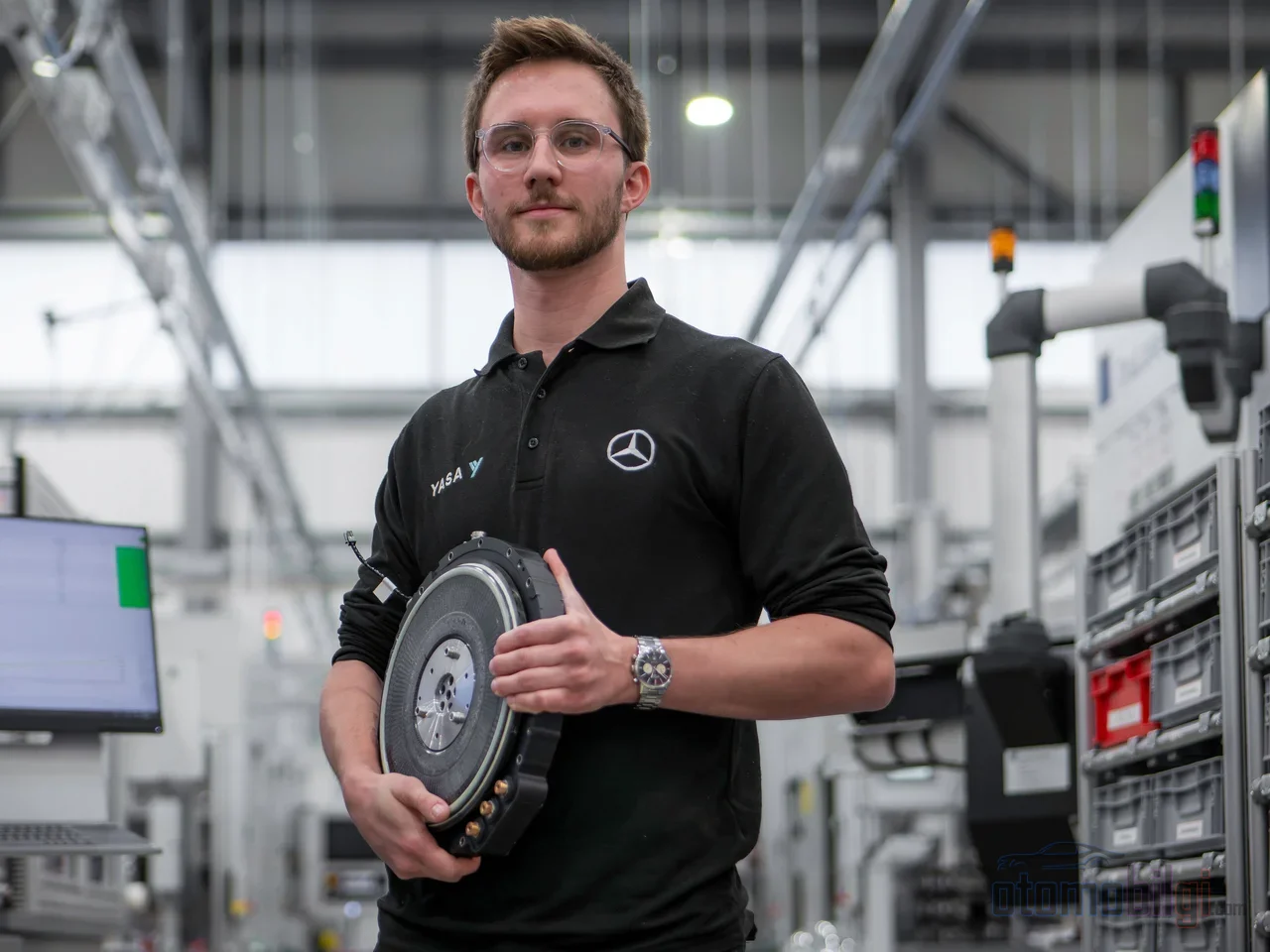
Because tangible products in the performance segment are now on the way. Mercedes-AMG GT 4-Touring Coupe stands out as one of the first production applications with axial flux motors; its variant was announced to produce 860 kW (1,169 hp) of peak power with three axial flux motors. The company began large-scale series production of these motors at its Berlin-Marienfelde plant in June 2026, noting that manufacturing requires extraordinary precision, process reliability, and automation. At the concept stage, the motors of the AMG GT XX Concept carrying three axial flux motors were announced to have three times the power density and one-third lower mass; the AMG.EA platform combines these motors with directly cooled battery cells.
The second reason is the packaging freedom the topology offers. Axial flux motors can be stacked as thin discs; a short axial length of just 98 mm allows a motor to be embedded inside an actively crowded drivetrain. The same geometry is also appealing for in-wheel motors: their low mass, since it does not excessively increase the unsprung mass in the suspension, makes axial flux one of the strongest candidates for in-wheel architecture - although rival developers are also working on unironed, dual-rotor radial flux wheel motors, and this architectural debate continues.
The third reference is aviation. An aircraft that set the electric speed record flew with three axial flux motors; motor suppliers are working toward 50 kW/kg targets for the aircraft class. The convergence of automotive and aviation on the same topology is fueling the engineering community's interest and public curiosity.
Following in YASA's Footsteps
YASA - the name comes from the Yokeless and Segmented Armature architecture and today is a Mercedes-Benz subsidiary - is the most visible name in axial flux for automotive. Its motors were Koenigsegg Regera, Ferrari SF90 Stradale and 296 GTB, Lamborghini Revuelto and McLaren Artura used in hybrid and electric performance vehicles such as these; Jaguar C-X75 also featured in the concept. That all of these vehicles are in the performance segment is no coincidence: the technology is still expensive and hard to manufacture, so it enters the upper segment first.
Barriers to Series Production
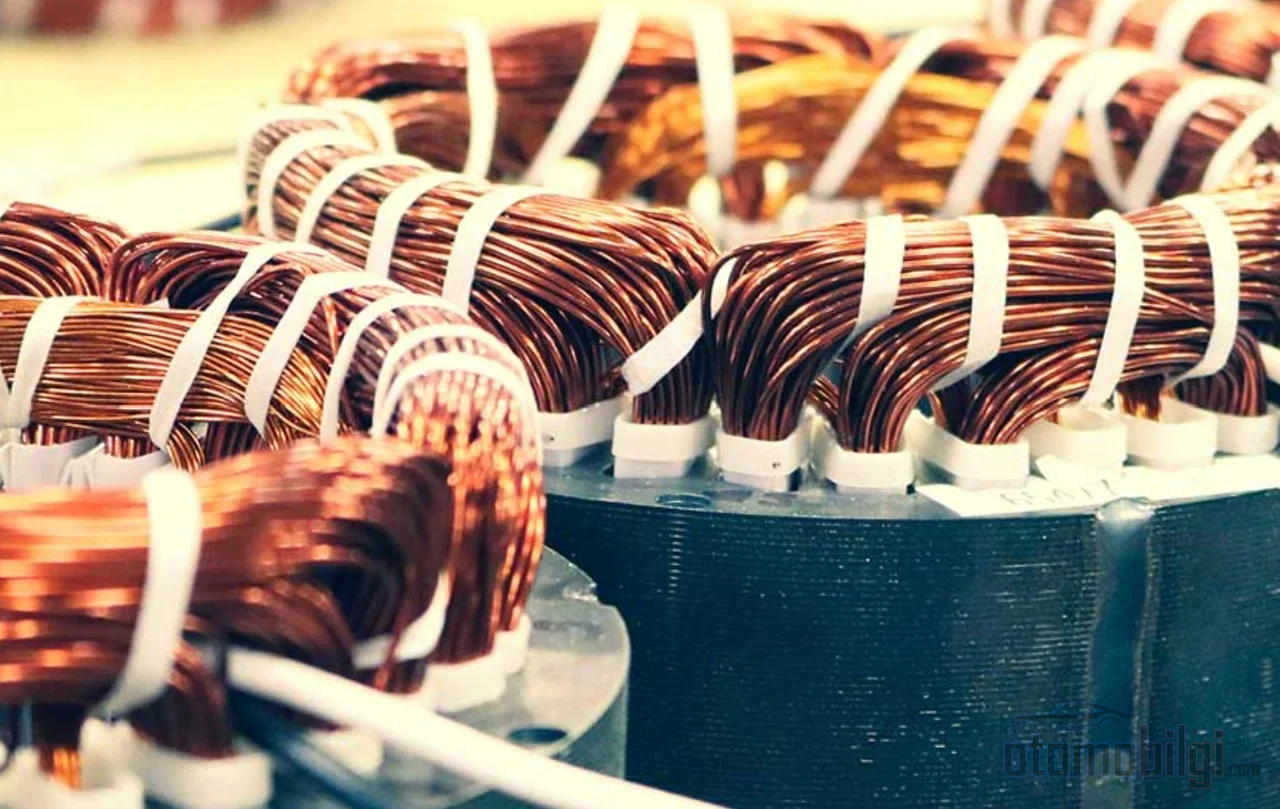
Electromagnetic advantage is one thing; scaling it to hundreds of thousands of units is another. There are concrete reasons why axial flux cannot be unleashed:
- Mechanical limits: The wide rotor disc creates high inertia and serious centrifugal forces; it can limit maximum speed. Rotor discs must withstand mechanical stress and tight air gap tolerances.
- Manufacturing precision: Flatness, concentricity, balance and tolerance control are more critical than with radial flux. Wedge-shaped segments can lead to uneven flux distribution, and segments that taper toward the center restrict the winding space.
- Cost: Expensive bonding and assembly processes have prevented many concepts from reaching series production. Automotive manufacturers await long-term reliability proof for series production.
- Maturity gap: Radial flux motors have decades-old production chains with numerous suppliers; axial flux production equipment is less mature.
Thermal Management: The Binding Constraint
The compact axial configuration narrows the surface available to dissipate heat. For continuous performance, thermal management is identified in the literature as a named binding constraint; liquid cooling solutions are being worked on due to high heat density. Having a larger cooling surface for the same volume provides an advantage, but the geometry of the heat sources differs from radial flux, and placing the cooling channels in the disc plane creates a separate design problem. Practical consequence: axial flux motors comfortably deliver their peak power for short durations, while their continuous power rating is set by the thermal limit.
Cogging Torque and Acoustics
In permanent magnet axial motors, cogging torque - torque ripple arising from the rotor's tendency to align with the stator teeth of the magnets - can be a source of vibration and acoustic noise at low speeds. Reduction techniques such as alternative magnet pole arc widths are available; this is an added design optimization layer on top of manufacturing tolerances.
Current Developments and Unverified Limits
The architecture's frontier is expanding. In June 2026, Chinese researchers at 18,000 rpm achieved 25.73 kW/kg'and reportedly achieved about 50% weight reduction compared to conventional motors along with reduced axial dimensions; these figures are based on secondary reports that have not yet been independently confirmed. Claims circulating on social media, such as 0-100 km/h acceleration times, are also awaiting official verification. On the other hand, there are more solid steps on the aviation side: in 2025, a cargo aircraft developer officially announced it would purchase motors from a specialized axial flux motor supplier.
Topology experts have an important warning: The question of whether axial flux is electromagnetically superior is, on its own, the wrong question. The motor is a system element; if it does not create system value together with the inverter, cooling, transmission, and manufacturing costs, the advantage does not materialize automatically. For this reason, most analysts predict that radial flux will remain the mainstream workhorse, while axial flux will gain ground in performance and niche segments.
Conclusion: The Advantage Is Real, the Road Is Long
The axial flux architecture rests on a well-founded physical justification: a short flux path, a large active diameter, and torque growing with the cube of the diameter. Prototype values reaching 42 kW/kg show that this advantage is not just a story. But the same physics also brings a wide rotor, challenging thermal management, and demanding manufacturing tolerances. The situation today is this: Radial flux motors carry the mainstream with their efficiency, cost, and manufacturing maturity; axial flux is advancing as a strong alternative wherever high torque and power density are decisive - performance cars, in-wheel architectures, and electric aviation. Mercedes-Benz's large-scale series production starting in 2026 will be the first serious test of the topology's move out of its niche.
Sources
- Axial flux motor - Wikipedia
- Large-scale production of electric axial flux motor - Mercedes-Benz Group
- AMG.EA E-Performance - Mercedes-AMG
- Advantages of Axial Flux Machines over Radial Flux - EMWorks
- Axial Flux vs Radial Flux Motors: A Comprehensive Comparison - MECHTEX
- Radial vs. Axial vs. Transverse Flux Motors | Design Guide - Horizon Technology
- Why Axial Flux Motors? - Turntide
- Advantages and Disadvantages of Axial Flux Motors - Stanford Magnets
- Power and torque density - eMobility Engineering
- Advancements and Challenges in Axial Flux Motor Manufacturing - Brogen
- Cost-Efficient Manufacturing of Axial Flux Motors - PowerTransmission
- How to save time when developing an axial-flux motor - Magcam
- Axial Flux Motors For EVs - PatSnap Eureka
- Cogging Torque Reduction Techniques in Axial Flux PM Machines - MDPI
- The Secrets Behind YASA's Extremely Power-Dense Motor - Road & Track
- Three axial flux motors deliver 860 kW in Mercedes-AMG GT 4-Door Coupe
- High-performance axial flux breakthrough: Chinese team - CarNewsChina