Why Doesn't One-Pedal Driving Work the Same for Everyone? The Secret of Regeneration Settings
Share This Page
One-pedal driving doesn't work the same way in every electric vehicle brand, because the depth of regenerative braking and the pedal's stopping behavior are entirely shaped by software, according to the manufacturer's engineering preferences: some models bring the vehicle to a complete stop when the accelerator is released, while others let it coast.
Highlights
- Releasing the accelerator yields ~0.2 g of deceleration: the force produced by an aggressive one-pedal model is roughly 20% of full braking
- Regenerative braking can recover about 22% of the available energy in EVs
- Switching from Eco to Sport mode typically causes a 10–20% loss in range
- GB 21670-2025 standard: brake lights are mandatory when deceleration exceeds 1.3 m/s²
How Is Regenerative Braking Configured in Software?
The basic physics is the same in every vehicle: during braking, the electric motor acts as a generator, converting the wheels' kinetic energy into electricity and storing it in the battery. With conventional braking, this energy is lost as heat. When the motor switches to generator mode, the resulting magnetic resistance creates a braking force in the drivetrain. And this is exactly where the difference arises: software decides how strongly this force will be felt.
The software defines how much negative torque is commanded to the motor when the accelerator is released. In some brands this is a fixed, aggressive curve, while in others it is divided into levels the driver can select. A strong calibration can allow the accelerator pedal to bring the vehicle to a complete stop; a soft calibration slows the vehicle down and lets it coast. So the physical mechanism under the pedal is similar in all models; what varies from brand to brand is the mapping that translates pedal movement into motor torque.
A technical limit is also important: regenerative braking alone is not sufficient to stop the vehicle safely. Its effectiveness decreases at low speeds, so it must work together with friction braking. This is one of the reasons why manufacturers make different choices even in stopping behavior.
Blended braking: the quiet cooperation of two brakes
On the first press of the brake pedal, regeneration kicks in, and when the pedal is pressed deeper, the system smoothly transitions to the friction brake. The software defines, together, the braking system's response to conditions, the regeneration–friction blend, and the pedal feel. A historically interesting note: the first production car to combine regeneration and friction braking was the GM EV1, which pioneered brake-by-wire technology with two patents in the late 1990s. The concept has matured since then, but the manufacturer's calibration choice is still decisive.
Why Does One-Pedal Driving Bring Some Vehicles to a Complete Stop but Not Others?
Describing one-pedal driving as the most fragmented-that is, the most differentiated between brands-EV feature is no coincidence. Every manufacturer uses regenerative braking; but not all of them are keen to offer it as one-pedal driving. The difference comes down to the answers given to three separate engineering questions: how much deceleration is applied when the accelerator is released, whether the vehicle will be held stationary after it stops, and whether the driver can adjust this balance themselves?
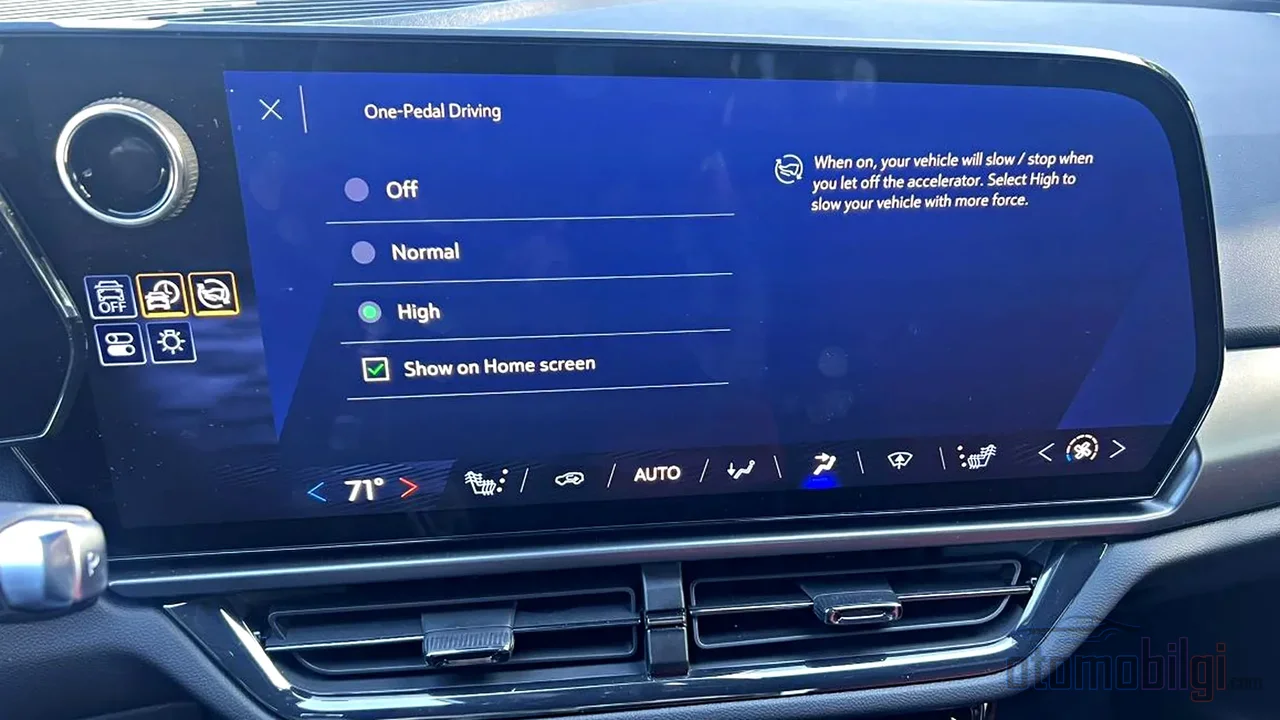
To give a concrete example: The Chevrolet Bolt applies approximately 0.2 g of deceleration when the accelerator pedal is released - about 20% of full braking force - and can come to a complete stop on level ground. After the stop, the hydraulic brakes hold the vehicle in place; on slight inclines, the motor alone may suffice. In some models, however, the vehicle is not held at all after stopping: a physical parking brake is required to prevent rolling on a slope. This is the physical counterpart of the distinction between "stop completely" and "let it roll" approaches.
| Approach | How It Works |
|---|---|
| Complete stop (e.g. Chevrolet Bolt) | ~0.2 g deceleration when the accelerator is released, complete stop on level ground, then held by hydraulic brakes |
| Adjustable steps (e.g. Kia) | Regeneration level from 0 to 3 is selected with the steering wheel paddles |
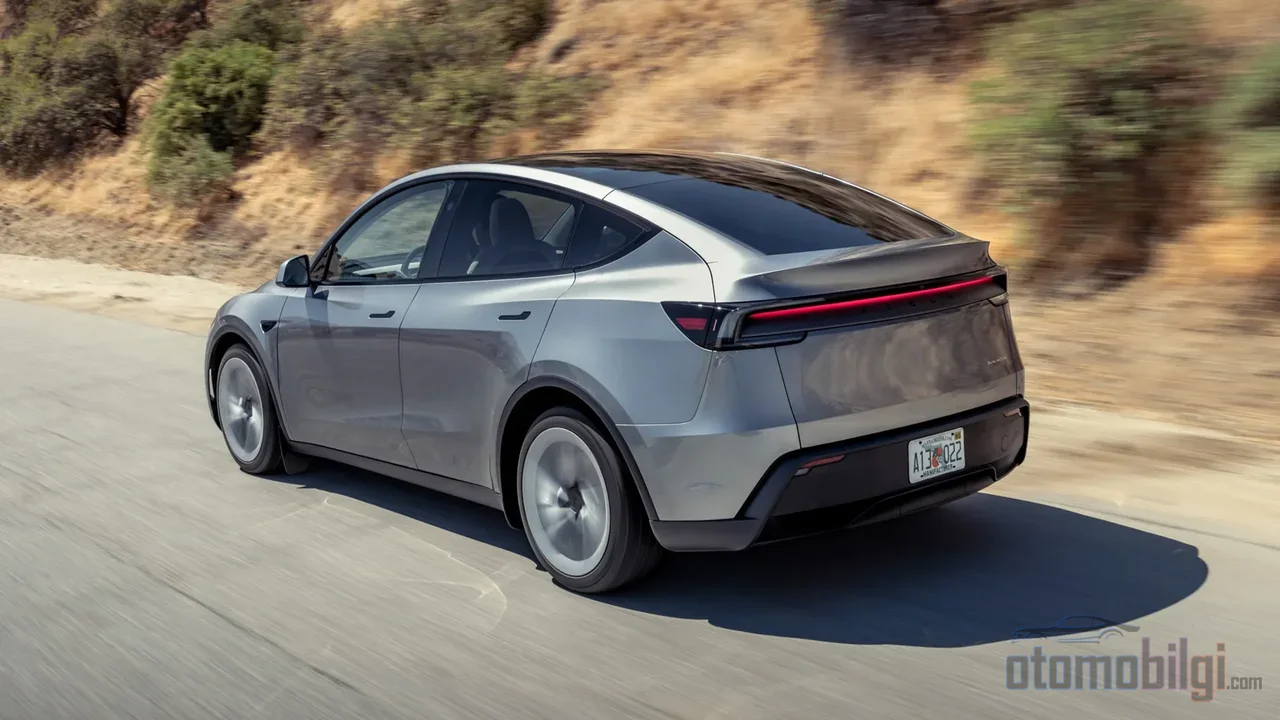
| Adjustable from the screen (e.g. Tesla Model Y) | Rolling mode is changed from the touchscreen |
| Model that holds (e.g. Honda) | One-pedal driving is only active in D mode and stays active until the driver manually turns it off |
| Model that does not hold | After stopping, the vehicle is not held; a parking brake is needed on inclines |
The level system: calibration handed over to the driver
Some manufacturers prefer to hand control over to the driver instead of a single fixed behavior. Systems offering regeneration levels from 0 to 3 via the steering wheel paddles allow step-by-step adjustment of lift-off deceleration. Another approach is four levels that can be customized according to driving style. While the Nissan Leaf (2026) offers adjustable regeneration settings that let you choose how aggressive energy recovery will be, the Toyota bZ (formerly bZ4X) has added a regenerative braking support mode. In the Honda, one-pedal driving is only valid in D mode and remains active until the driver manually turns it off. So the assumption that "one-pedal is the same for everyone" is not only wrong, it also conceals the manufacturers' philosophical distinction.
Smart Regeneration: The New Role of Software
The latest step is the transition from fixed level logic to condition-sensitive calibration. With the smart regeneration system it introduced in November 2025, GM automatically adjusts braking intensity according to hill gradient and traffic patterns; no driver intervention is needed. This shows that regeneration is no longer just pedal mapping but has become a control problem fed by navigation and sensing data.
Safety regulations are also keeping up with this change. The GB 21670-2025 standard mandates that the brake lights come on when deceleration in regenerative braking exceeds 1.3 m/s². In contrast, most current regulations do not impose this requirement, and on some models the brake lights do not illuminate - this raises a safety debate, since the vehicle behind the driver receives no brake warning. The answer to the question of how the lights behave when one-pedal driving brings the car to a complete stop without the brake pedal ever being pressed is also clear: when the accelerator pedal is released, the brake lights illuminate just as they would with hydraulic braking.
How Do Drive Modes Change Engine Character?
Eco, Normal and Sport modes change not only the way the car accelerates but also its regeneration behavior. The permanent magnet synchronous motors common in modern EVs can produce torque the instant they operate, which makes the accelerator pedal mapping extremely critical: Sport mode delivers instant throttle response, Normal softens the power delivery, and Eco softens it even further. In a sense, these three modes are three different character profiles of the same motor, drawn with software.
On the regeneration side as well, the modes change function. In the case of the Nissan Leaf, Eco mode increases regeneration compared to D mode; B mode provides even more than both, that is, maximum regeneration. In another model, regeneration in Sport mode is faster and greater. This inconsistency shows that manufacturers define the modes not as a standard specification but as scenarios designed around their own drivetrains. Dynamic vehicle controls such as torque vectoring can also be part of the drive modes: the driver can shape how the car behaves in corners through mode selection.
However, the efficiency cost of mode selection is tangible: switching from Eco to Sport mode typically results in a 10-20% reduction in range - on a 300-mile range, that means a loss of 25-50 miles. The appeal of Sport mode, with the electric motor's instant torque, is a preference paid for from the energy budget.
Is One-Pedal Driving Really More Efficient?
The contribution of regenerative braking to range is especially high in stop-and-go traffic; its effect at a constant highway speed is low. As a data point, 2024 data from the US Department of Energy shows that regenerative braking recovers approximately 22% of the available energy back to the battery in EVs. According to MotorTrend, brake regeneration can contribute up to 20% to range depending on vehicle architecture and driving conditions. It is important to distinguish that these two figures are different metrics: one measures the proportion of energy returned to the battery, the other measures range extension.
The efficiency question, however, is a more nuanced debate. The view that one-pedal driving is not necessarily the most efficient driving method is voiced as a strong counterargument; that said, some drivers argue that one-pedal driving does not compromise efficiency, and that what really matters is driving style. The view that the regeneration level has little effect on efficiency and that the real issue is driver preference and terrain is also widespread in community discussions. Another interesting observation: there are also debates questioning the assumption that "Eco always wins," arguing that due to regeneration differences, non-Eco modes can in some cases be more efficient. Efficiency is determined not so much by the pedal mechanism as by the number of energy conversions.
On the safety side: fatigued pedal reflexes and sudden acceleration
One of the counterarguments against one-pedal driving is safety-related. The fact that releasing the accelerator slows the car rapidly, or even brings it to a complete stop in some situations, can be considered a legal risk. The more widely discussed concern is the possibility that, in a moment of stress, the driver mistakes the accelerator for the brake, leading to sudden unintended acceleration (SUA). There is also a conceptual objection raised within the community: those who see the one-pedal experience as one point on a broader engineering spectrum describe the perception that "true one-pedal" means aggressive/maximum regeneration triggered by releasing the accelerator as a major fallacy. Finally, a practical warning: one-pedal driving or the regeneration paddle should not be used on slippery surfaces; the brake pedal is preferred instead.
Which Regeneration Setting Is Right for You?
The right answer depends on your usage profile rather than the vehicle. In stop-and-go traffic, aggressive lift-off regeneration can be an uncomfortable upside, both gaining range and reducing brake pad wear; but if you drive a coasting vehicle in hilly areas, parking brake discipline is a must. In predominantly highway driving, level preference is a matter of comfort rather than efficiency: choosing the regeneration level is a setting with little efficiency impact but one that directly determines driving comfort. During a test drive, it is enough to try three things: whether the full-stop calibration gives you confidence, whether the graduated paddle control enhances the feeling of control, and whether automatic systems like smart regeneration reduce your intervention.
Regenerative braking is the most standard, visible feature of electric vehicles; but one-pedal behavior, pedal mapping, and mode design are the signature of each manufacturer's powertrain philosophy. The answer to "Why doesn't it work the same for everyone?" lies in these signatures: the same physics, different software decisions.
Sources
- What is One-Pedal Driving and How Does it Work?
- What Is One-Pedal Driving? Why It Might Be the Most Fragmented EV Feature Yet
- Regenerative braking - Wikipedia
- Braking and Stopping - Tesla Model Y Owner's Manual (EU)
- Controlling the Regenerative Braking Level | Quick Tips
- Regenerative braking - Honda
- How to Use One-Pedal Driving - Chevrolet
- One-Pedal Driving Isn't Necessarily the Most Efficient Way
- Regenerative braking in EVs - evkx.net
- electric hybrid driving modes