Electric Car Motor Selection: Synchronous, Asynchronous, and Permanent Magnet
Share This Page
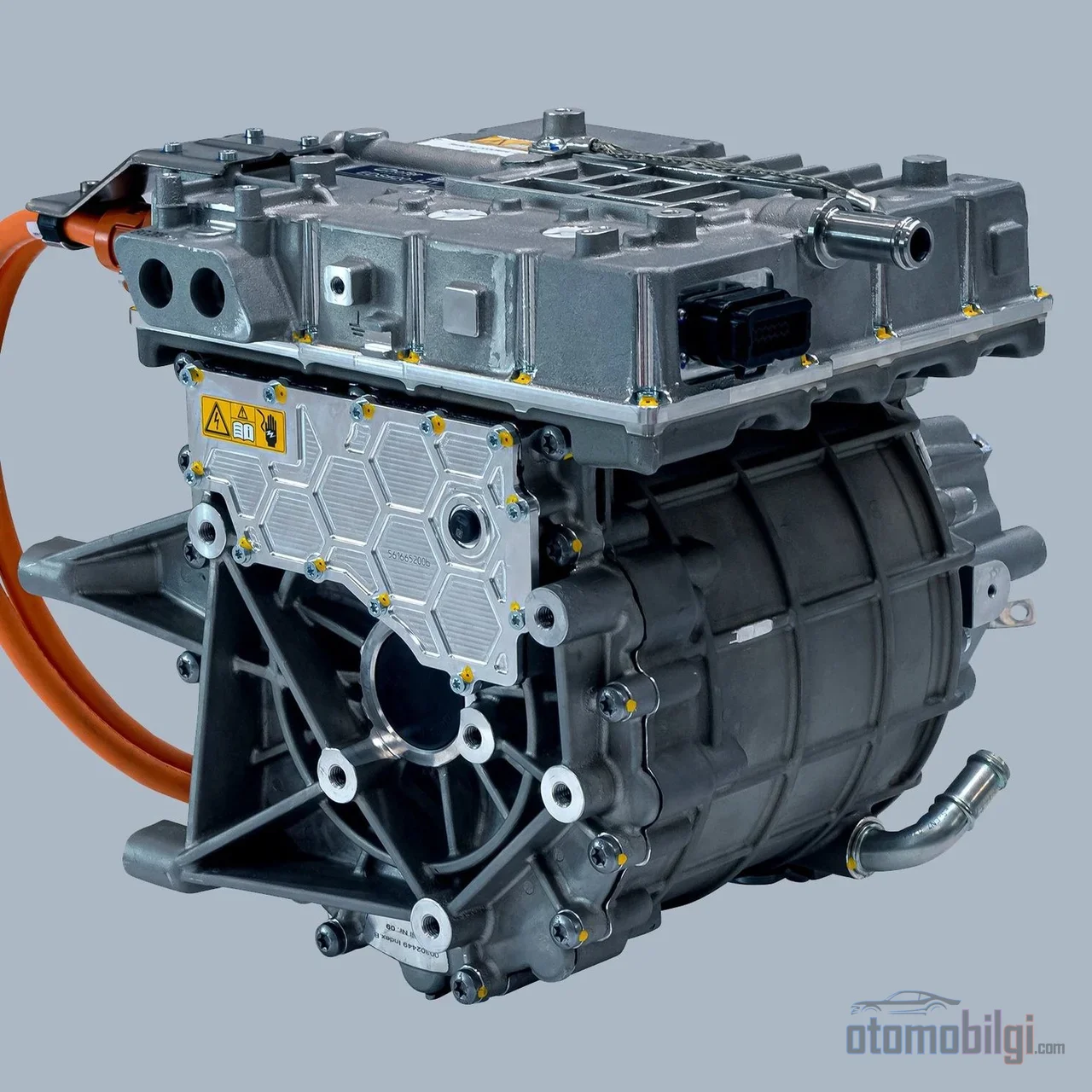
Electric cars use three main motor types: permanent magnet synchronous motor (PMSM), asynchronous (induction) motor, and externally excited synchronous motor (EESM). The PMSM offers the highest efficiency and power density, the asynchronous motor stands out for its robustness and magnet-free design, and the EESM for its precise torque control; the choice is an engineering decision made among efficiency, cost, and dependence on rare earths.
Highlights
- PMSM peak efficiency 95-97%; asynchronous motors operate in the 90-93% range.
- An efficiency difference that appears to be 5-7% magnifies the cost difference when reflected in battery size.
- The most common motor in modern EVs is the permanent magnet synchronous motor.
- The Tesla Model 3 and Model Y use a hybrid design that combines reluctance torque with magnet torque.
- Manufacturers are rapidly developing motor alternatives that reduce the use of rare earth metals.
The Physics of the Motor: How Does a Rotating Magnetic Field Produce Torque?
All traction motors are based on the same physical principle. A conductor carrying current produces a magnetic field; a change in this field induces a new current in a nearby conductor. The Lorentz force acting on the rotating part works in a direction perpendicular to both the magnetic field and the direction of motion, turning the rotor. The difference between motor types lies in where this magnetic field comes from and how the rotor relates to the rotating field.
Every motor has two fundamental components: the stationary stator , fed by three-phase alternating current, and the rotating rotor. The stator produces a rotating magnetic field whose frequency is determined by the inverter. Whether the rotor stays in sync with this field or lags slightly behind determines the motor's class.
Asynchronous (Induction) Motor: Robust, Cheap, Magnet-Free
The rotor of an asynchronous motor has a "squirrel cage" structure consisting of aluminum or copper bars embedded in iron laminations. The stator's rotating field induces voltage and current in the rotor bars; the magnetic field produced by these currents interacts with the stator field to create torque. The rotor can never catch up with the rotating field: its speed is always somewhat lower, and this difference is called slip (slippage). Without slip there is no induction, and no torque either.
The strengths of this structure are concrete: no permanent magnets, no sliding contacts, hence low maintenance requirements and reasonable production cost. The motor is robust. In return, efficiency falls behind synchronous designs, especially at partial load and low speed; inducing current in the rotor means a continuous loss. Speed control is also less precise, and a frequency converter is always required to control the motor.
Tesla's earlier Model S and Model X models are known for their asynchronous motors; in some earlier versions, an asynchronous motor was used on the front axle and a permanent magnet motor on the rear. Across the industry, however, due to rising copper prices and the efficiency gap, the asynchronous motor's share is being steadily transferred to synchronous designs.
Synchronous Motors: The Rotor Rotates Along with the Field
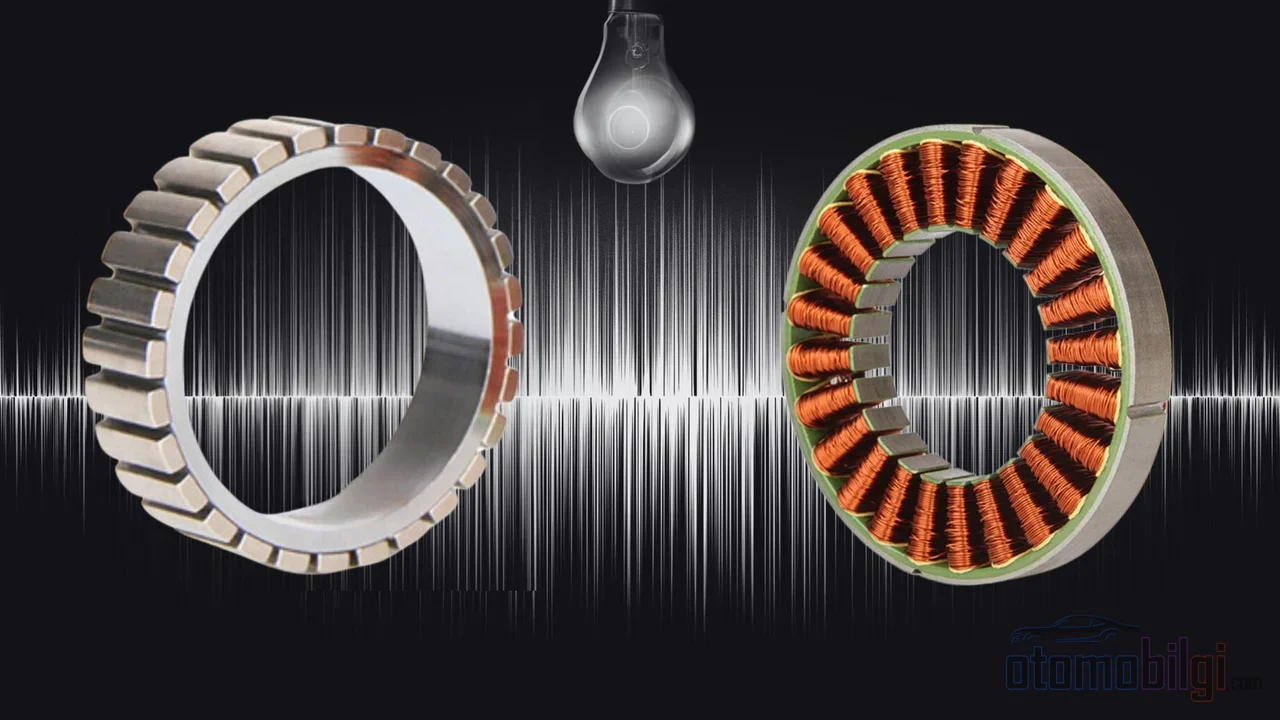
In a synchronous motor, the rotor spins at the same speed as the stator's rotating field; the motor's speed depends directly on the frequency of the stator current. This lockstep provides high efficiency, high power density, precise speed control and good dynamic behavior. VW's MEB platform, and models such as Audi, Škoda and the Porsche Taycan are fed from the synchronous motor family. However, "synchronous" is not a single design; it is divided into two types depending on where the magnetic field comes from.
Permanent Magnet Synchronous Motor (PMSM): Why Is It the Dominant Technology?
In a PMSM, permanent magnets embedded in the rotor produce a constant and strong magnetic field without the need for external excitation. Since there is no need to induce rotor current, the efficiency potential is high; peak efficiency falls within the reported range of 93-95% to 95-98%. The differing values stem from measurement and definition differences: which speed and load point counts as "peak" varies from manufacturer to manufacturer. What really matters is not the peak value, but the fact that the PMSM can remain in its high-efficiency zone across most typical vehicle operating conditions - at low and medium speeds, both efficiency and power density stand out markedly.
The cost has a price: rare earth magnets are the main cost element of the PMSM. It also carries a risk of demagnetization at high temperatures; heat management is therefore a critical issue in the design. The BMW i3, VW ID.3 and ID.4, and the newer Nissan Leaf models are well-known examples using PMSM.
Interior Permanent Magnet (IPM) Design: Why Are the Magnets Inside the Rotor?
In IPM motors, the magnets are not on the rotor surface but embedded inside the rotor. This arrangement allows better use of magnetic flux, increases power density, widens the usable speed range and reduces susceptibility to demagnetization. In return, rotor production is complex. The rear axle of the Porsche Taycan and the Audi e-tron GT are road applications of this design.
Externally Excited Synchronous Motor (EESM): The Magnet-Free Synchronous Solution
In an EESM, the rotor's magnetic field is produced not by permanent magnets but by a separate winding with an additional power source. This gives the engineer great maneuvering room: the strength of the rotor field can be adjusted according to operating conditions, torque-speed control is very good, and a wide speed range is achieved in the field weakening region. Its efficiency is slightly behind that of the PMSM and the design is more complex; in its classic form it requires slip rings or brushes. It is an architecture attracting renewed interest today because it eliminates dependence on rare earths.
Reluctance Motors: Winding-Free, Magnet-Free Rotor
In reluctance motors, torque arises from a much more fundamental tendency: magnetic flux always follows the path of lowest magnetic resistance (reluctance). The rotor tries to turn toward this low-resistance position, and torque emerges. The rotor has neither winding nor magnets - hence there is neither rare earth content nor rotor loss. There are two main types: the switched reluctance motor (SRM) and the synchronous reluctance motor (SynRM).
The cost is on the control side: control electronics are complex, and noise plus torque ripple are pronounced in SRMs. Even so, the cost and sustainability advantages are significant; with advancing control electronics, these motors are expected to become widespread. An academic review highlights that the SRM's low weight, high reliability, and fault tolerance make it suitable for EVs.
The most interesting application in the field, however, is the hybrid approach: in the Tesla Model 3 and Model Y, permanent magnet torque is combined with reluctance torque. The Hyundai Kona Electric also relies on reluctance technology. The SRIPM design, which combines reluctance with an interior permanent magnet, uses less magnet material than a PMSM, reducing cost and rare earth dependency; while the PMSM leads in peak efficiency and high speed, the SRIPM is balanced, robust, and cost-effective across various operating conditions.
Efficiency and Performance: Comparing with Numbers
Efficiency figures alone are misleading; the real question is how efficient the motor is in the low-to-medium speed region, which reflects the vehicle's actual usage profile. The table below summarizes the character of the three main motor types.
| Feature | Induction | PMSM | EESM |
|---|---|---|---|
| Peak efficiency | 90-93% (90-95% in some measurements) | 93-98%, typically 95-97% | Slightly below PMSM |
| Rotor field source | Induced current | Permanent magnets | External winding |
| Rare earths | Not required | Required (neodymium, dysprosium) | Not required |
| Robustness / maintenance | Very robust, low maintenance | Good; temperature sensitive | Complex design |
| Weak point | Efficiency drops at partial load | Cost, demagnetization risk | Complex design, slip rings |
The scale of the numbers must be put into perspective: an efficiency difference that appears to be 5-7% grows when it translates into the battery size needed to maintain the same range. A concrete example shows how well the PMSM does this - the Model 3's magnet-reluctance hybrid motor, with a 75 kWh battery, delivered range equivalent to the 100 kWh capacityModel S 100D. In return, the induction motor has its own unique efficiency role: the induction motor on the front axle of the AWD Model 3can spin freely without actually consuming electricity when it is not needed, giving an all-wheel-drive vehicle an unexpected range advantage.
Rare Earth Dependency: The Issue Reshaping the Industry
The PMSM's market dominance is intertwined with the geography of materials. The supply of rare earth elements is largely in the hands of a single country; this dependency has prompted manufacturers to move in two directions. The first approach, as framed by IEEE Spectrum, is developing permanent magnets free of rare earths (such as iron-based alternatives); the second is turning to entirely magnet-free motor types - induction or reluctance.
The examples are striking: Tesla switched to rare earth-based motors in 2017, but announced that its next-generation motors would once again be rare-earth-free. Toyota, concerned about supply shortages, up to 50% are developing motors that contain less rare earth metal. India has accelerated tests of high-density reluctance motors, which generate magnetic force with tightly wound metal coils instead of magnets, in the face of China's export restrictions. The interesting thing is that, amid this tension between efficiency and material cost, the market continues to invest in permanent magnet motors: high power and torque density are, for now, valuable enough to offset the cost.
Inverters and Power Electronics: What Really Determines Motor Character?
The battery provides direct current (DC), while the traction motor is fed with alternating current (AC). The inverter handles the conversion in between; a smooth AC output is produced via PWM (pulse width modulation), and the motor's efficient operation depends on the quality of this output. Every improvement in the inverter translates directly into range, performance, and cost. The high-frequency whine heard while driving comes precisely from this high-frequency switching.
The inverter also makes torque vectoring possible in multi-motor vehicles: each motor is controlled by a separate inverter, and torque is distributed precisely between the axles. SiC (silicon carbide) and GaN (gallium nitride) based power electronics provide higher switching frequency, lower losses, and higher efficiency. On the other hand, high-voltage architectures have a cost on the motor side too: motors operating at 800 V and above are more prone to partial discharge, which can adversely affect winding insulation. The direction of the industry is integration - hairpin windings, oil cooling, and integrated drive units that combine the motor, transmission, and power electronics in a single unit.
Which Motor in Which Vehicle: How Is the Selection Decision Made?
Motor selection is not a search for a single "best" option; it is a matter of prioritization:
- Range and efficiency-priority vehicles: PMSM or IPM; superior efficiency in the low-to-medium speed range compensates for battery cost.
- Performance and precise control-priority vehicles: The synchronous family; high power density and good dynamic behavior are decisive.
- Multi-motor AWD vehicles: Magnet-equipped on the rear axle, induction on the front axle combination; efficiency from the magnet motor at low-to-medium speeds, near-zero drag from the unused induction motor.
- Manufacturers facing supply chain risk: EESM or reluctance-weighted designs; eliminates rare earth dependency.
The result is a clear engineering balance: PMSM dominates today because it is at the peak of efficiency and compactness, the induction motor continues to live on in certain roles thanks to its robustness and lack of magnets, while EESM and reluctance designs are on the rise for reasons of both performance and supply security. When looking at an electric vehicle's range figures, asking about the motor type is as meaningful as asking about the battery's capacity.
Sources
- Electric motors in electric vehicles: An overview
- Powerful and Efficient Electric Motor Technology
- Review of Traction Motors for Electric Vehicle Application
- PMSM vs Induction Motor: 3 Decisions That Save Your EV
- PMSM vs Induction Motor Performance for EV
- China's rare-earth dominance keeps EV makers dependent
- India revs up alternate EV motor tests as China curbs rare earths
- Developing electric motors less dependable on rare earth magnets
- How to Build EV Motors Without Rare Earth Elements
- The EV Market Doubles Down on Permanent Magnets
- What Is an Inverter in an Electric Vehicle?
- EV Inverter Technology: Latest Advances and Trends
- Two Types of Tesla Model 3 Motors
- Permanent Magnet Motor in Model 3 Tesla