E-Axle: Motor, Inverter and Reduction Gear in a Single Unit
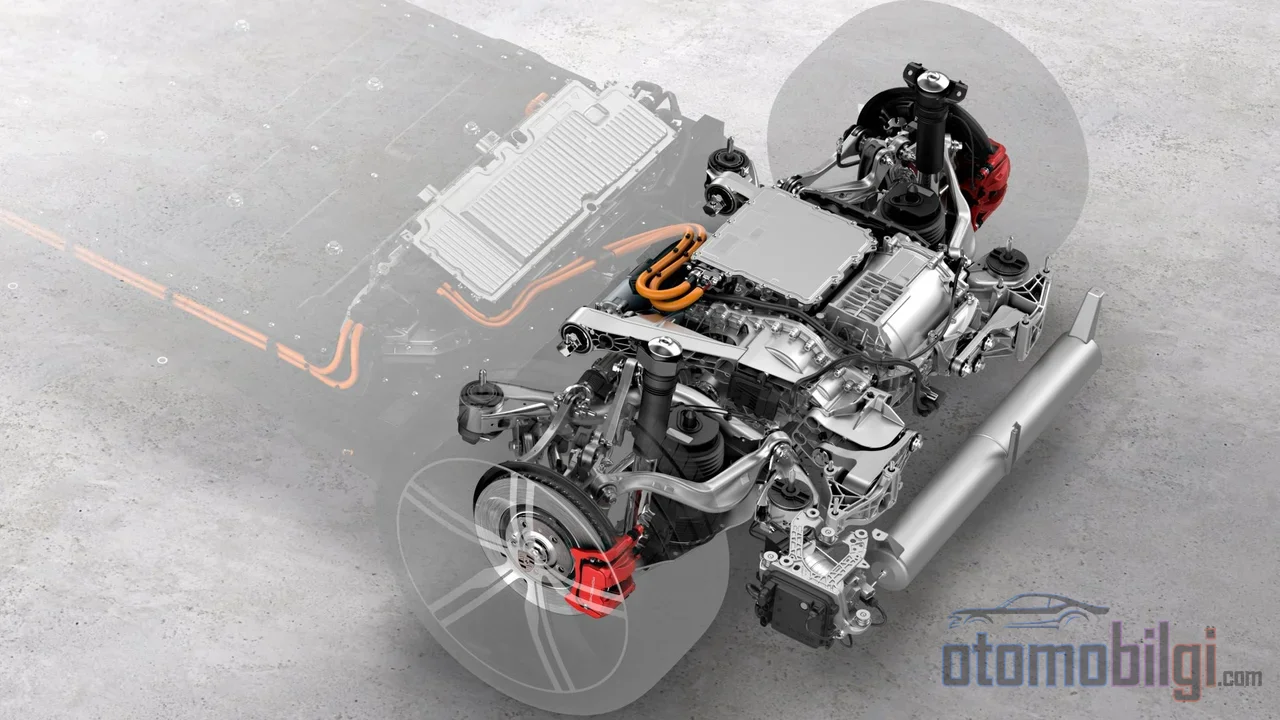
Looking down at an electric vehicle's powertrain from above, the view is surprisingly simple: a huge battery, an electric motor, and a few axles running down to the wheels. Yet behind this simplicity lies one of the most important engineering decisions of the past decade: combining the motor, inverter, and reduction gear into a single housing. This approach allows manufacturers to cover a wide range of vehicles with the same unit, from a passenger car to a commercial truck; but it also brings the risk that a fault in a single component can disable the entire system.
So is squeezing three components into one housing truly an inevitable evolution, or is it a space and weight advantage gained at the expense of thermal management and maintenance? On this page, we examine the e-axle approach, from its operating logic to the manufacturer ecosystem and the trade-offs to watch out for.
What Is an E-Axle and How Does It Work?
An e-axle is a self-contained propulsion unit that combines an electric motor, inverter, and reduction gear - and in most designs the differential as well - in a single compact housing at a vehicle's axle. It takes over the direct propulsion of the axle; instead of motor power being carried along a long shaft, it is transferred directly to the wheels. Conceptually, it is the electric equivalent of the transaxle in front-wheel-drive vehicles: motor, gear set, and differential are gathered in one package, running on electrons instead of fuel.
This integration has a measurable payoff. An integrated e-axle can fit into a volume smaller than half that of comparable conventional engine and transmission setups. On the manufacturing side, the logic is the same: a unit delivered as a single piece means savings on three separately connected components on the assembly line, plus the expensive high-voltage cables between them.
EDU vs. EDM
In common terminology, two abbreviations are frequently confused. EDU (Electric Drive Unit) is the general term covering the motor, reduction gear, and inverter in their entirety, and it can be mounted on the axle or elsewhere in the vehicle. EDM (Electric Drive Module) usually refers to a motor-reduction gear combination without an inverter or with less integration; in hybrid and plug-in hybrid vehicles, the power electronics are kept as a separate module due to cooling and space constraints. In common usage, 2-in-1 systems combine the motor and reduction gear, while 3-in-1 systems combine the motor, power electronics, and reduction gear in a single structure.
Highlights
- An e-axle combines the motor + inverter + reduction gear (and usually the differential) in a single housing
- It can reach a volume smaller than half that of a conventional engine-transmission arrangement
- Bosch's e-axle platform, combining six components in a single housing, offers 93% efficiency and a power range of 70-300 kW
- The cost of integration: shared thermal management, NVH, and lubrication complexity
- Key independent suppliers include Bosch, ZF, BorgWarner, Nidec, Magna, GKN, Valeo, and Aisin
Why a Single Housing? Manufacturer Logic and Advantages
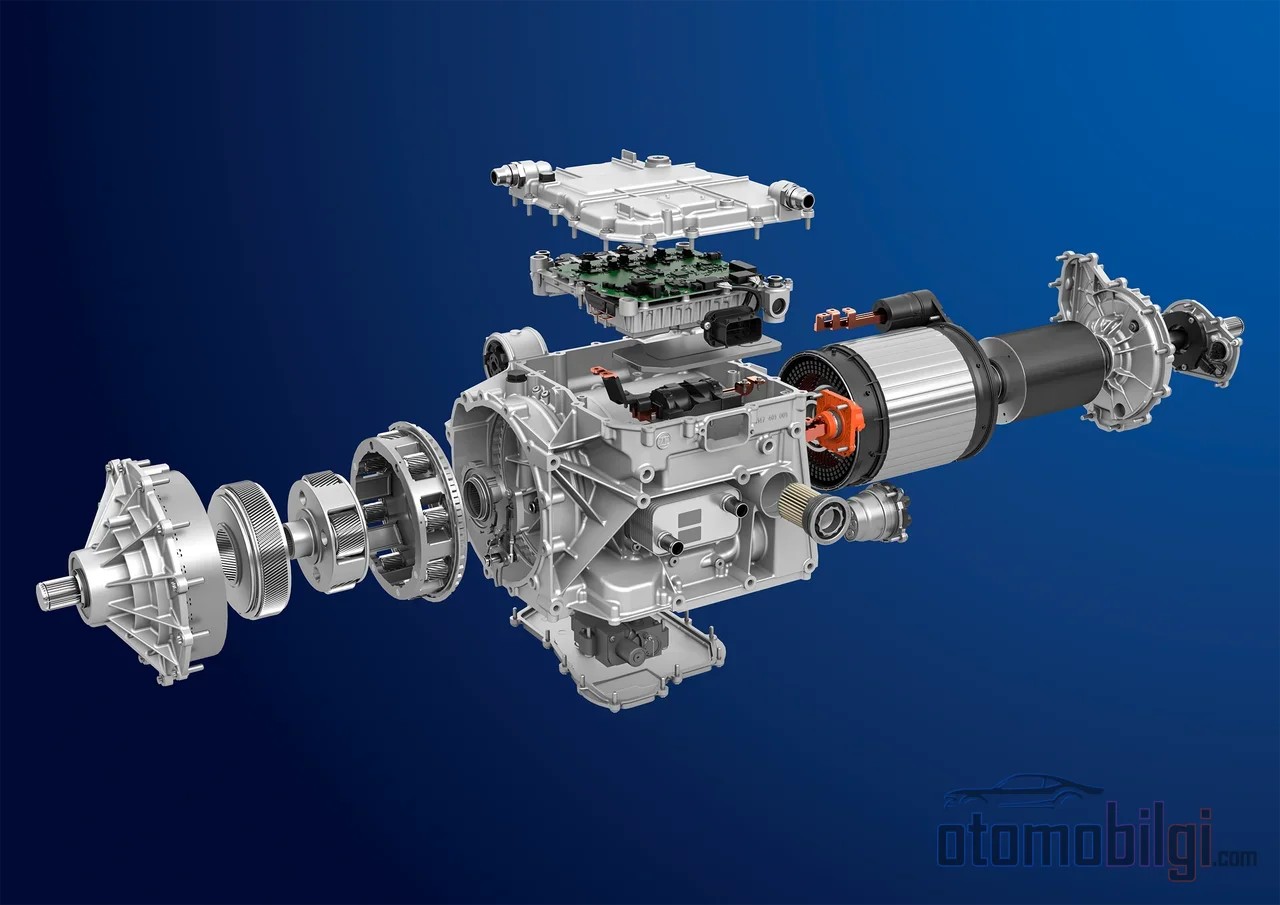
There are four fundamental reasons that force integration, and each one rests directly on engineering calculations.
- Packaging efficiency: Instead of a long driveshaft, having the motor sit directly on the axle shrinks the volume and weight occupied by the powertrain; it frees up passenger cabin and cargo space.
- Scalability: The same unit can be added to the front, the rear, or both axles; the transition from a single-motor car to a dual-motor setup or a distributed axle architecture is made with minimal changes.
- Cost: A single combined unit reduces the assembly of separate components, connecting cables, and logistics; the powertrain becomes cheaper.
- Performance: Because the power path from motor to wheel is shorter, torque delivery happens faster; the integrated structure also reduces drag resistance, preventing unnecessary energy consumption.
On the numerical side, the picture becomes even clearer. Bosch's e-Axle platform, which combines six components into a single system body, measures 93% efficiency in global driving cycles and covers power between 70-300 kW. It is stated that well-optimized integrated assemblies can achieve up to 40% mass reduction compared to separate equivalent components - this figure is based on secondary sources, so it should be approached with caution, but the direction is clear: integration pulls weight down.
In practice, the feasibility of this approach has been proven across a wide spectrum. From first-generation electric cars to hybrid models and commercial trucks, the same unit can be used with minimal changes. Aisin's track record in this field began in 1993, when it combined the motor and reducer in a single unit in the electric version of the Toyota Crown Majesta; the electric 4WD unit was used in hybrids like the Prius, and in 2022 the jointly developed new-generation e-Axle was carried over to the Toyota bZ4X and the new Crown.
Thermal Management: Integration's Toughest Test
The motor, inverter, and reducer all generate heat - but of very different characters. The motor heats up in its copper windings and magnets; the power semiconductors in the inverter emit intense heat in small areas; the reducer, in turn, releases friction heat at gear contact points. As separate components, each would live with its own cooling arrangement. In a single body, however, one common thermal management system has to handle all of them at once.
This is one of the most critical integration challenges of the design. Studies conducted with finite element analysis focus on comparing different thermal management approaches in integrated drive units; research published in a peer-reviewed journal in 2026 identifies effective thermal management as critical for the long-term reliability and performance consistency of electric powertrains. Motor-reducer integration itself is a design cornerstone that directly affects efficiency.
One of the ways to solve the heat problem is oil. While electric vehicles do not require engine oil in the internal combustion engine sense, lubrication is essential for the reliable operation of the E-Axle; some designs also use oil for cooling purposes. There are separate engineering debates about the pros and cons of mechanical lubrication - because in a single housing, the oil must manage both the gears and the thermal balance of the electrical components.
Disadvantages: Service, Diagnostics and Noise
The cost of integration is directly proportional to the volume and weight gains it provides. An integrated E-Axle combines the motor, reducer, differential, inverter, cooling and lubrication system, housing and controls in a single compact structure. The natural consequence of this density: component-level serviceability and the diagnosis of individual faults become more difficult. In separate components, an inverter failure only requires replacing the inverter, while in an integrated structure the same fault can bring up the disassembly of the entire unit.
Noise, vibration and harshness (NVH) behavior is another area that becomes more complicated with integration. The coming together of three heat and vibration sources in a single housing creates new acoustic matching problems; as power density increases, this trade-off becomes even more pronounced. Manufacturers validate E-Axles by testing them separately under the headings of torque, efficiency, NVH, durability, thermal behavior and system integration.
The common myth on the maintenance side is that electric vehicles require zero maintenance. The reality is more nuanced: electric drivetrains truly require minimal scheduled maintenance, and thanks to regenerative braking, the brakes last longer; however, lubrication and electrical faults for the motor and inverter still persist as maintenance items. E-Axle oil and change intervals are also among the issues that must be managed according to manufacturers' recommendations.
Integrated versus Separate Components Comparison
| Criterion | Integrated E-Axle | Separate (Standalone) Components |
|---|---|---|
| Volume and weight | Smaller and lighter; claims of up to 40% mass reduction | Bulkier; extra connections and cabling |
| Cost | Single unit, single assembly; savings on components and cabling | Separate production and assembly cost |
| Thermal management | Shared system; high design difficulty | Each component with its own cooling |
| Service and diagnostics | Component-level servicing is difficult | Fault diagnosis and replacement of separate components is easy |
| Scalability | Front/rear axles, reuse across different platforms | Separate packaging for each application |
The summary of the table is this: the E-Axle is clearly ahead on the production and packaging side; on the service and thermal design side, it shifts the risk to the manufacturer's own engineering quality. Which side weighs more depends on the vehicle's segment and use scenario.
Manufacturer Ecosystem and Architecture Debates
The E-Axle is today one of the central products of the automotive supply chain. Among independent suppliers, Bosch, ZF, BorgWarner, Nidec, Magna, GKN, Valeo and Aisin stand out. Bosch is running a global E-Axle platform that offers fast time-to-market with standardized modules and production locations worldwide. ZF introduced its fourth-generation drive focused on modular integration and weight reduction, and has developed a two-speed electric propulsion unit for passenger vehicles. BorgWarner's integrated drive modules based on high-voltage hairpin motor technology and Schaeffler's space-saving solutions also point in the same direction.
On the technology front, the trend is clear: the addition of 800V architectures and silicon carbide (SiC) power electronics to integrated propulsion platforms, along with the quest to reduce dependence on rare earth elements. Projects to develop heavy rare-earth-free three-in-one propulsion units are a concrete example of this quest.
Parallel-Axis or Coaxial?
Two distinctions are being discussed at the architectural level. The first is in-body placement: in parallel-axis systems the motor and gear assembly are lined up side by side, while in coaxial systems the motor sits on the same axis as the shaft; thanks to its compact body and short power transmission path, the coaxial design claims high efficiency. Second is the comparison of central propulsion with electric axles, especially in heavy commercial vehicles: a distributed E-Axle architecture can provide a fully low-floor rear layout and more usable interior space - a decisive advantage in buses and trucks.
In summary: What Does the E-Axle Approach Mean?
The E-Axle is an integrated design approach that combines the electric motor, inverter, and reduction gear in a single body, transforming the drivetrain into a single self-contained propulsion unit; it reduces volume and weight, lowers manufacturing costs, and speeds up torque delivery - in return, it increases engineering complexity in thermal management, NVH, and serviceability.
This balance shows that the E-Axle is not a temporary solution but a permanent cornerstone of electric vehicle architecture. Combined with forecasts of double-digit market growth in the coming years, the picture becomes clear: the path to designing tomorrow's electric vehicles goes through bringing the three components together in one body and managing heat, noise, and service with the same discipline. No matter how much battery technology evolves, the engineering of that short power path from motor to wheel will remain at the center of the stage.
Sources
- eAxle - Bosch Mobility
- The eAxle, a core component of electric vehicles - AISIN
- Did You Know: What is an e-Axle? - ENEOS Garage
- eAxle FAQ's - The Lee Co
- Electric drive axle systems in new energy vehicles - Frontiers in Mechanical Engineering
- A Design-Oriented Scoping Review - MDPI
- Thermal Management Approaches for Integrated Traction Drives - ORNL
- E-Axle Integration: NVH, Lubrication, and Power-Density Tradeoffs - PatSnap Eureka
- Maintenance and Safety of Electric Vehicles - AFDC
- Parallel-Axis vs Coaxial eAxle Systems - Brogen Motors