How Does the e-CVT in Hybrids Actually Work?
Share This Page
The e-CVT in hybrid cars is not a transmission in the classical sense: it contains no belt, pulleys, or gear teeth. Instead, it is a power split device consisting of a single planetary gear set and two electric motors; by combining engine power and generator power in continuously varying ratios, it delivers a gear feel independent of vehicle speed. That is exactly why there is almost no such thing as gear shifting in hybrids.
Highlights
- There is no belt and pulley in the e-CVT; at the center there is a single planetary gear set is present
- The system uses two motor-generators: MG1 as the generator, MG2 as the main drive motor
- Engine speed is recalculated many times per second, independent of vehicle speed
- There is no mechanical reverse gear; the phase sequence of MG2 is reversed
- The belt wear found in a classic CVT is absent here; the fluid only lubricates the bearings and gears
How Does the e-CVT Actually Work?
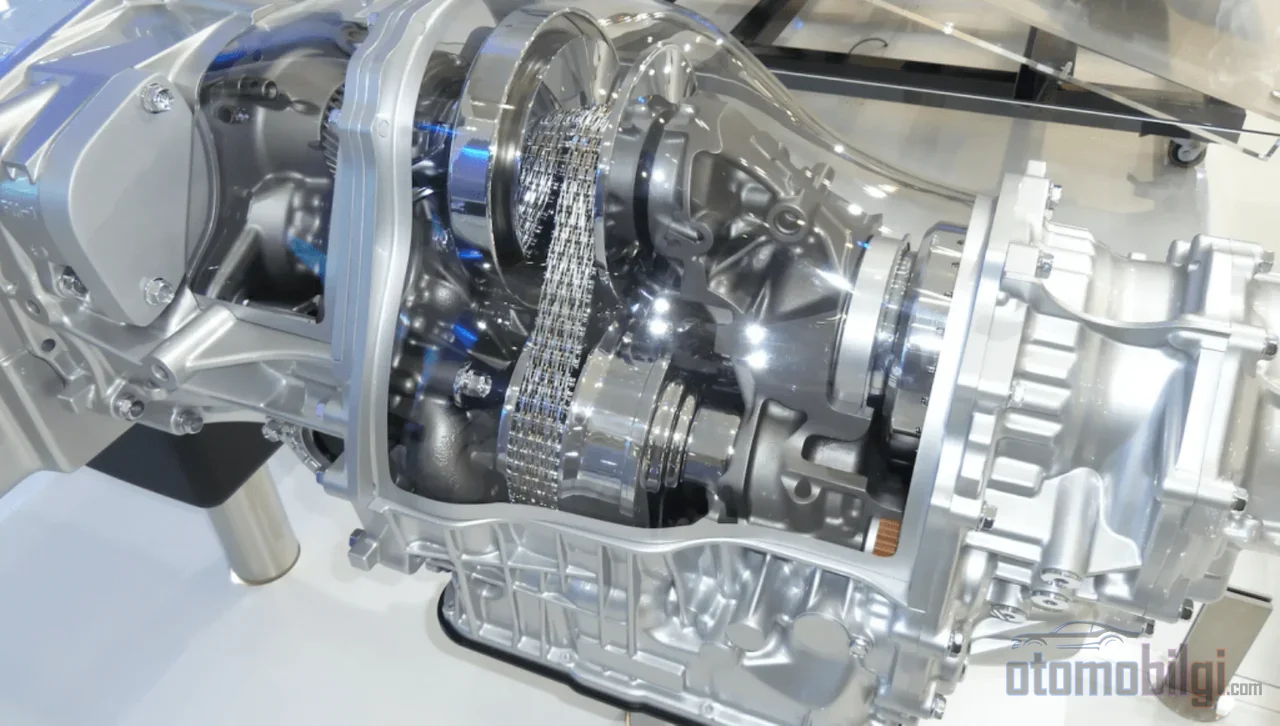
The "CVT" part of its name is misleading. "Electronic continuously variable transmission" is the name Toyota chose to classify its power split device in regulatory standards; it has no mechanical kinship with a belt-driven CVT whatsoever. Let's list what you find inside the box: a compact planetary gear set, two electric motors, power electronics, and a control computer. All of it is housed in a single transaxle casing bolted to the engine.
The planetary gear, the heart of the system, consists of a central sun gear, planet gears rotating around it, and a ring gear enclosing them. The engineering magic is this: by connecting a different source to each of these three elements, infinitely many gear ratios can be obtained from a single gear set. In the hybrid application, the generator (MG1) is connected to the sun gear, the main drive motor (MG2) to the ring gear, and the internal combustion engine as well. The engine, generator, and drive motor thus meet at the same mechanical node, and the system operates in parallel hybrid mode.
MG1 and MG2: Division of Labor
The job description of the two motor-generators is clear. MG1 is a permanent magnet AC machine; it acts as a starter motor to crank the internal combustion engine and as a generator to charge the high-voltage battery. Its truly critical role is more interesting: by regulating the electricity it produces, it effectively controls the entire transmission. MG2 is generally the more powerful of the two, the main drive motor; it delivers torque to the wheels and converts into a generator during braking when needed.
The entire system operates on drive-by-wire logic: there is no direct mechanical connection between the accelerator pedal and the engine; the pedal and gear lever send only electrical signals to the computer. Recalculating the optimal power split many times per second, the computer maintains the balance between torque and efficiency.
How Does It Differ from a Classic CVT?
A traditional CVT provides continuous ratios with a steel belt running between two cone pulleys. This design has well-known weaknesses: belt and pulley wear in stop-and-go traffic, the feeling that engine rpm rises while acceleration lags behind, and a droning noise caused by constant high rpm. The e-CVT mechanically eliminates all of these problems, because there is no belt that can wear out. Toyota's design contains no friction elements; fluid only lubricates the bearings and the continuously meshing planetary gears.
| Feature | Classic CVT | e-CVT |
|---|---|---|
| Ratio mechanism | Cone pulleys and belt | Planetary gearset + two electric machines |
| Wearing element | Belt and pulleys | No friction element |
| Acceleration feel | Delayed, droning | Linear, instant electric torque |
| Gear shifts | None (belt varies the ratio) | None (electronic ratio control) |
This difference is also reflected in the ownership experience. The frequent oil change intervals recommended for classic CVTs do not apply to hybrid transmissions in the same way, since material wear is far lower. Nevertheless, the vehicle's official maintenance manual should be followed for periodic maintenance intervals.
How Is Engine RPM Kept Independent of Vehicle Speed?
An internal combustion engine runs most efficiently within a narrow rpm range. Fixed-gear-ratio transmissions drag the engine outside this range, into inefficient rpm. The e-CVT's solution is to completely sever the link between engine speed and wheel speed: while wheel speed increases during acceleration, the computer continuously adjusts the generator load through MG1, keeping the engine in its optimal fuel consumption zone. The engine also does not idle in stop-and-go traffic; if unnecessary, it shuts off completely.
If you notice the engine suddenly raising its rpm while cruising on the highway, this is not a sign of a fault; it is a transition to the optimal region on the system's efficiency map. Similarly, the seamless acceleration feel in the city comes from here: MG2's instant torque provides a natural and linear push without gear changes. Since engine speed is managed independently of vehicle speed, the shift-and-jerk cycle of classic transmissions disappears.
In Which Modes Does the Power Split Device Operate?
The same mechanical hardware, thanks to the control software, handles very different driving situations with a single unit:
- EV mode: At low speeds and moderate torque, the internal combustion engine is completely off. If there is sufficient charge, the system can offer roughly 1.6 km of fully electric driving below 40 km/h.
- Battery charging: The engine is started while the vehicle is stationary and electricity is drawn from MG1; it kicks in, for example, while waiting in traffic or when the catalytic converter needs to warm up.
- Low gear equivalent: During acceleration, extra engine rpm goes to MG1 as a generator, and the generated power is converted to motor power at MG2, adding torque to the shaft.
- High gear equivalent: On the highway, the engine produces more torque than needed while spinning slower than the wheels; this time MG2 becomes the generator, and the power is delivered to MG1 as a motor, increasing wheel speed.
- Regenerative braking: Energy flows from the wheels to MG2, and from there to the battery; the conventional brakes are sized smaller and last longer.
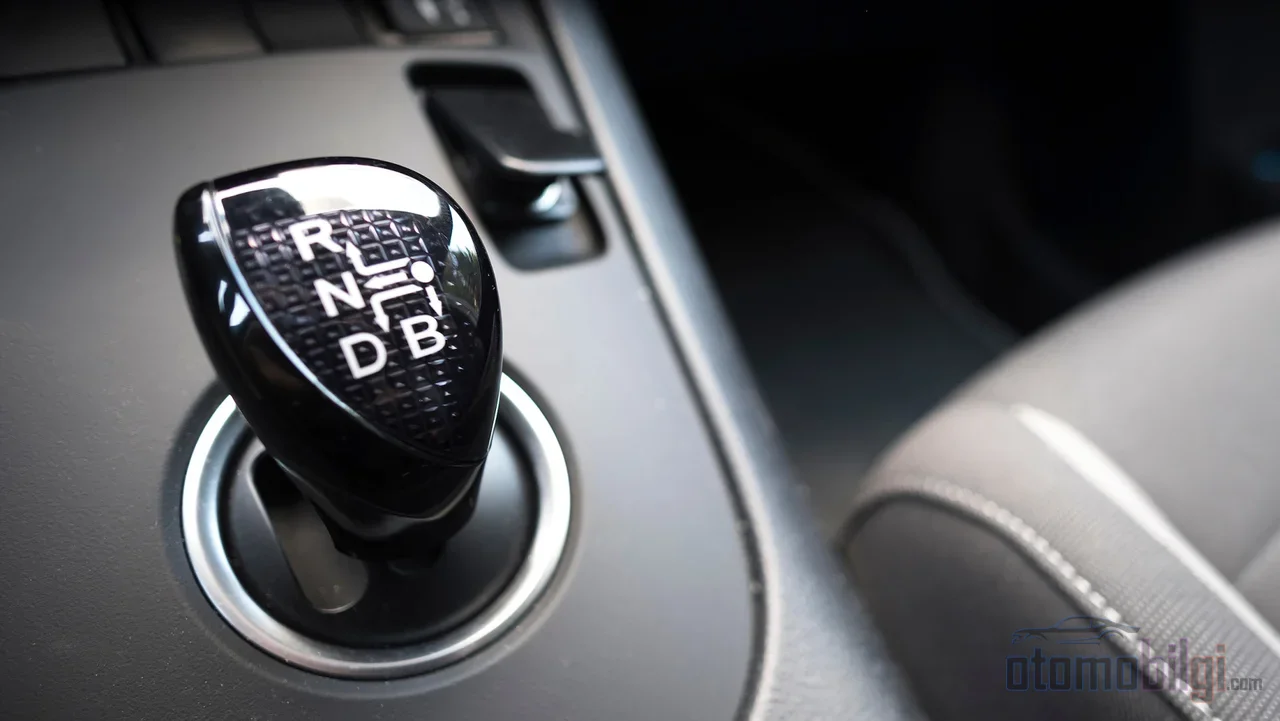
- B mode: On downhill slopes it provides engine braking; when the battery approaches a high charge level, the system automatically switches from MG2 to MG1.
Directing electric power between the two motor-generators in this way brings one more additional advantage: the internal combustion engine can be downsized and designed more efficiently for the average load; the battery covers instantaneous torque demands. As for reverse, there is no mechanical gear at all; the computer reverses the phase sequence of MG2 to apply negative torque. When gasoline is completely depleted, the system can in principle keep running on electricity; in practice, it is possible to travel another 1-2 miles with the remaining energy.
Maintenance and Service Life Expectancy
The maintenance schedule of a hybrid with an e-CVT is similar to that of a conventional vehicle: oil and filter changes are for the engine, and there is no routine intervention schedule for the transaxle. On the hybrid side, the items of attention are elements such as the battery cooling filter, coolant, and spark plugs. Manufacturers' maintenance calendars cover intervals extending, for example, from 5,000 miles up to 150,000 miles; this calendar requires no special procedure for the transaxle.
Regarding life expectancy, ambitious figures circulate in online communities; however, since there is no verified independent data, statements like "it lasts 500,000 miles" should not be taken as definitive information. The solid assessment is this: this design, which has no belt to wear out mechanically, structurally eliminates the main weak point of an ordinary CVT. Let us also add a practical warning arising from naming: carrying the preconceptions of the word "CVT" from classic belt-driven transmissions to hybrids is unnecessary; the only thing these two mechanisms share is the idea of continuous ratios.
Drawbacks and Controversial Aspects
An honest technical evaluation must also admit that the system is not without controversy. In the power-split architecture, constant conversion takes place between mechanical power and electrical power; in some engineering debates, it is argued that this conversion chain may cause greater losses compared to series hybrid approaches. The view that alternative two-motor architectures reduce internal friction losses with their simpler gear structure is also part of the same debate. As for the efficiency of regenerative braking, it should not be forgotten that even under ideal conditions only a portion of kinetic energy can be converted into electricity.
On the other hand, the architectural simplicity of power splitting cannot be ignored: with a single planetary gear set, two electric machines, and a computer, the entire work of a classic transmission, alternator, and starter motor is done. The small number of parts, the distribution of mechanical load, and the absence of friction elements make this design extremely elegant from an engineering standpoint.
Conclusion: Not a Gearbox, but an Intelligent Power Distributor
Trying to evaluate the e-CVT as a gear system is to miss the essence of the matter. It is not a box that mechanically fixes or shifts the ratio between the engine and the wheels; it is a distribution node that mathematically splits and combines the power of the engine, the generator, and the drive motor according to instantaneous need. Its structure, free of belts, gears, and friction elements, produces both seamless acceleration in the city and quiet cruising on long journeys from a single mechanism. For a buyer considering a hybrid, the "CVT fear" loses its meaning here; what needs to be understood is not so much a transmission as a well-engineered energy management system.
Sources
- Hybrid Synergy Drive
- How the Toyota Hybrid System Works: A Beginner's Guide
- What Is An E-CVT And How Is It Different From A CVT?
- e-CVT vs. CVT Transmission: What's the Difference?
- What Is E-CVT?
- Inside Toyota's Hybrid Synergy Drive
- Hybrid Vehicles - University of Tennessee at Chattanooga
- Toyota's Develops New Hybrid System
- The Complete Toyota Hybrid Maintenance Schedule
- Don't Hate - eCVTs Are Genius Transmissions!