What Is the Atkinson Cycle and Why Is It Preferred in Hybrid Engines?
Share This Page
The Atkinson cycle is an internal combustion engine operating principle that deliberately keeps the compression ratio smaller than the expansion ratio to make fuller use of combustion energy, in exchange for sacrificing low-end power. The reason it is preferred in hybrid vehicles is simple: because the electric motor covers the power deficit that comes with the efficiency loss, the engine can operate in its most economical zone under all conditions.
Highlights
- The cycle was patented in 1882 by the English engineer James Atkinson.
- In modern applications, the intake valve remains open until 20-30% of the compression stroke is completed.
- The first mass-produced Atkinson-cycle hybrid drivetrain came in 1997 with the Toyota Prius.
- With a gasoline engine it announced in 2014, Toyota reported a maximum thermal efficiency of 38%.
- This valve technique combined with forced intake is called the Miller cycle.
How Does the Atkinson Cycle Work?
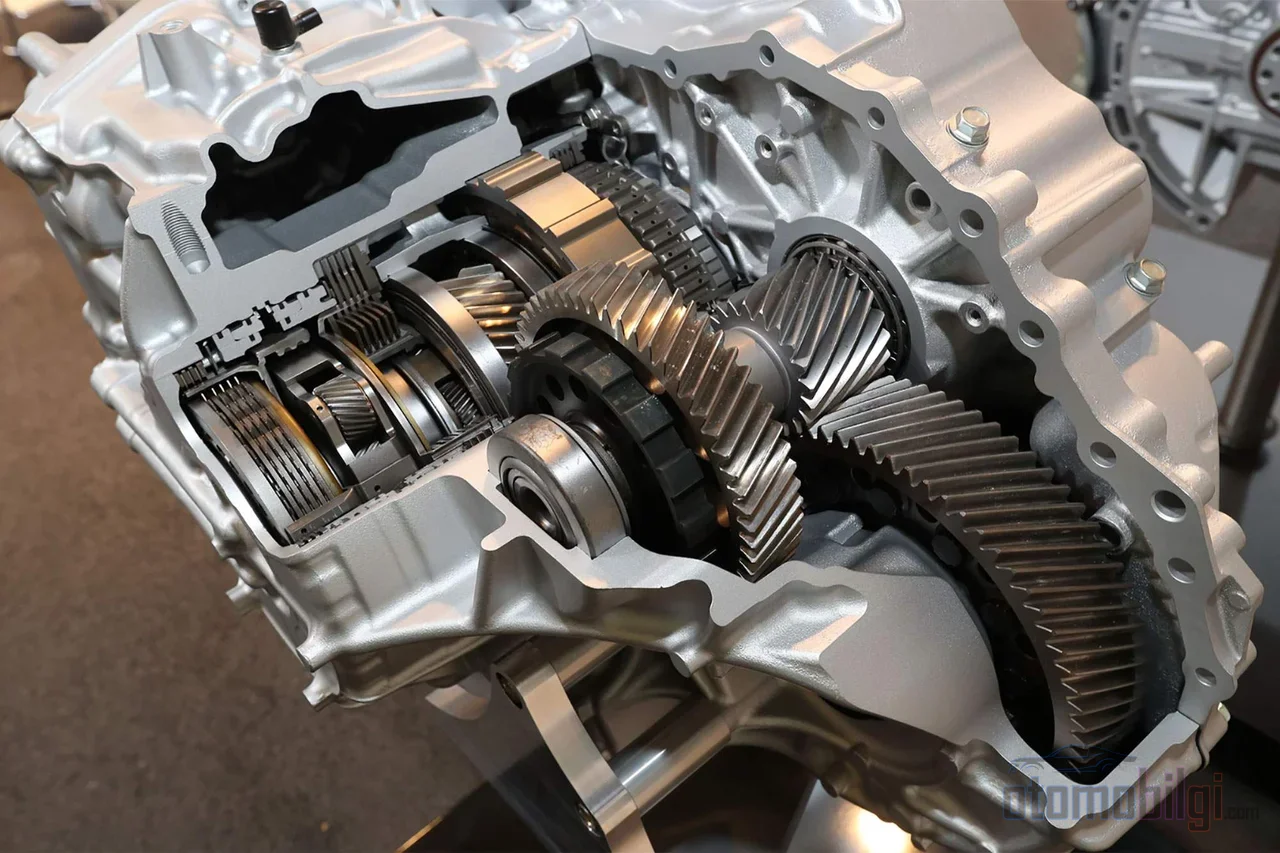
In an Otto engine, the logic of the four-stroke cycle is clear: as the piston rises it compresses the mixture, the mixture ignites, and as the piston descends it produces work. The critical point is this: the compression ratio and the expansion ratio are equal to each other, because you use the same cylinder volume for both compression and expansion. The Atkinson cycle breaks this equality. The goal is to bring the gas pressure in the combustion chamber as close to atmospheric pressure as possible at the end of the power stroke; in other words, to convert the pressure energy within the combustion products into mechanical energy before sending it to the exhaust.
James Atkinson solved this mechanically in the 1880s. His first engine, the differential engine, was an opposed-piston design. The Cycle Engine design of 1887, meanwhile, used an over-center linkage mechanism to complete all four strokes within a single crankshaft revolution; this solution was also developed to avoid infringing the Otto patents. His third design, the Utilite Engine (1892 English patent), had a shorter compression and a longer expansion stroke. These engines failed to achieve commercial success; but the thermodynamics of the cycle lives on today, especially in hybrids.
Simulation with valve timing in modern engines
None of the Atkinson-cycle engines you see on the road today carry Atkinson's linkage mechanisms. The modern approach is far more elegant: the intake valve is held open until the piston completes roughly 20-30% of the compression stroke. As the piston begins to rise, part of the fresh mixture in the cylinder is pushed back into the intake manifold. The result: the cylinder is never completely filled and the effective compression ratio drops. In contrast, the expansion stroke remains geometrically at its full length. This approach entered mass production with the 1NZ-FXE engine of the first-generation Toyota Prius and is used today in many engines, including Toyota's Dynamic Force family. The same effect can also be achieved by offsetting the crankshaft from the cylinder axis (desaxe design) instead of valve timing.
This situation, where the expansion ratio is greater than the compression ratio, is called over-expansion in the literature. Academic model studies show that, under the same operating conditions, the Atkinson cycle can achieve higher thermal efficiency than the Otto cycle; the price is less air entering the cylinder, i.e. lower power density.
Why Is the Atkinson Cycle Preferred in Hybrid Engines?
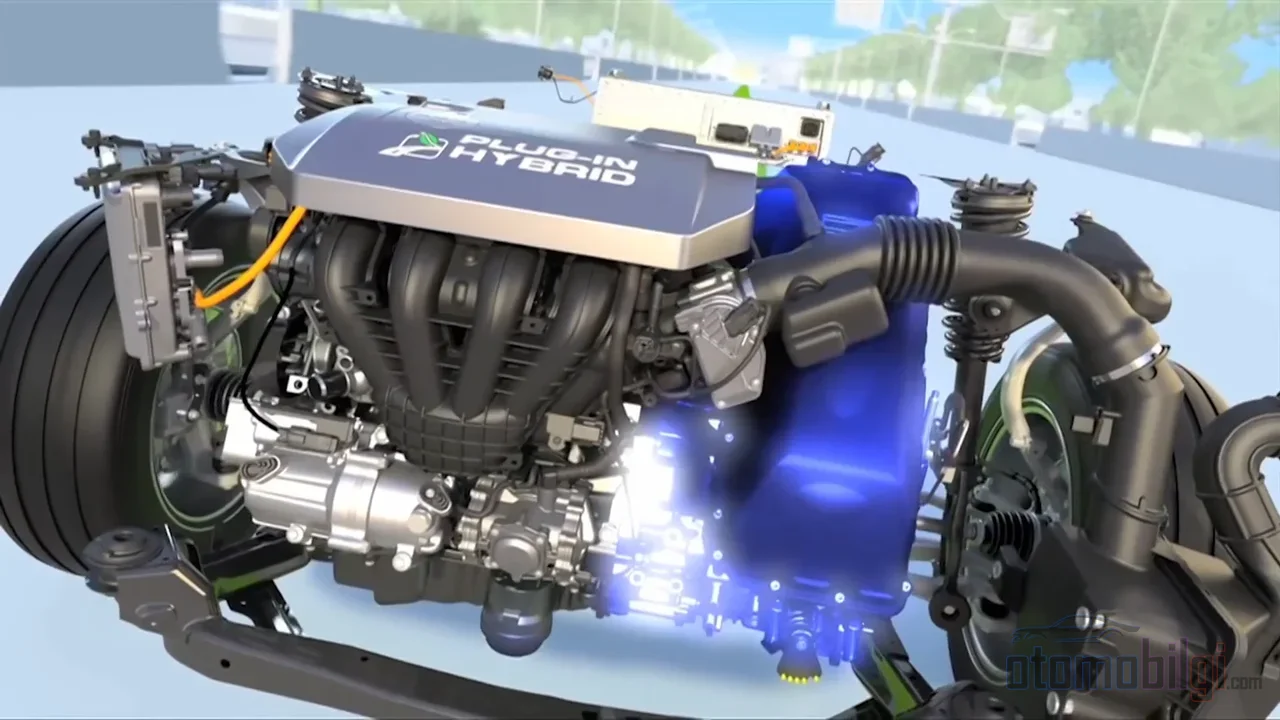
The engineering logic here is built on a trade-off. The Atkinson cycle is more efficient but weaker: because it takes in less air than an Otto engine of the same size, it loses torque and power, especially at low revs. In a normal vehicle this loss is immediately noticed by the driver and would be unacceptable. However, in a hybrid powertrain you have an electric motor that can be engaged at any moment. The electric motor instantly provides the extra torque needed at startup, on hills, or for acceleration requests; meanwhile, the gasoline engine keeps operating in its most efficient region. When the Atkinson cycle's power deficit is covered by the electric motor's torque, the best sides of the two technologies are combined.
Moreover, in a hybrid usage profile the power demand is already intermittent: at steady cruising the engine only produces sustaining power, and the electric motor kicks in during acceleration. This makes the Atkinson cycle's weak point rarely visible in practice. The first mass-production hybrid powertrain built on this logic reached the roads at the end of 1997 with the Toyota Prius; since that day the cycle has been used not only in the Prius family but also in the Ford Fusion Hybrid, Ford C-Max Hybrid and many Lexus models. As a concrete indicator of how well the two technologies fit together: Toyota announced that the new-generation gasoline engine it unveiled in 2014 reached a maximum thermal efficiency of 38%; this was one of the highest values recorded in series production at that time.
What about non-hybrid vehicles?
Thanks to variable valve timing, it is possible to use this cycle as a part-time mode even in a conventional engine: Atkinson mode for economy, conventional power character in Otto mode. Nevertheless, an engine fully dedicated to the Atkinson cycle is generally seen only in hybrids, because its displacement per unit of power is low; requiring a larger displacement to deliver equivalent performance does not make it sensible for every vehicle.
What Is the Difference Between the Otto, Atkinson and Miller Cycles?
These three cycles are often confused with one another, yet the distinctions are clear. Let's gather the comparison in a single table:
| Feature | Otto | Atkinson | Miller |
|---|---|---|---|
| Compression / expansion ratio | Equal to each other | Small compression, full expansion | Split like Atkinson |
| Implementation method | Conventional valve timing | Intake valve that stays open longer or a mechanical linkage | The same valve technique plus forced induction |
| Turbocharger / supercharger | Not required | Typically absent | Identifying component |
| Low-rev power | High | Low | Compensated with forced induction |
| Typical use | Most gasoline engines | Hybrids | Supercharged efficiency-focused engines |
It targeted the greatest weakness of the Atkinson approach in the cycle Ralph Miller patented in 1957, namely the loss of low-rev power. His solution was a supercharger or turbocharger providing pressurized and intercooled intake: pressurized filling restores the volume loss caused by the shortened effective compression. The Miller design also envisioned a compression control valve that relieved excess intake pressure. The cycle's best-known series-production application was the Mazda Millenia, which went on sale in 1994. You can summarize the practical formula as follows: an Atkinson engine running with forced intake is, by definition, a Miller engine. An early example very close to Atkinson's own idea is the Charon cycle in its non-supercharged version; the French engineer Charon patented it in 1888 and exhibited it at the 1889 Paris Exposition.
Why Doesn't Every Vehicle Use the Atkinson Cycle?
The answer lies in power density. An Atkinson-cycle engine produces less power than an Otto engine of the same cylinder volume because it pumps less air. In a vehicle without electric assistance, this deficit would have to be made up with either a larger engine or higher revs; both weaken the logic of fuel savings. Since in the vast majority of cars the driving task belongs solely to the internal combustion engine, manufacturers prefer to strike the balance between efficiency and performance on the Otto side, using tools such as valve timing, compression ratio, and forced intake. The Atkinson cycle truly wins only when the electric motor sits at the table as a backup power source.
How big is the efficiency gain?
It is hard to give a single precise figure, because the gain varies depending on engine architecture, compression ratio, and operating conditions. The available data gives an idea of the magnitude: an academic experimental study reported a 12.8% increase in thermal efficiency in an engine tuned to the Atkinson cycle, while a 2024 optimization study reported an improvement of up to 7.67% in fuel economy. On the Miller side, a more efficient arrangement compared to Atkinson is possible because forced induction reduces the loss of compressed air. The common denominator of these figures is this: the gain is real but conditional, and none of it can be applied to an entire vehicle lineup without altering driving character, absent the electric motor's torque support.
Conclusion: A Deliberate Trade-Off Between Efficiency and Power
The Atkinson cycle represents one of engineering's oldest and most elegant ideas: if you cannot use all the power, use the energy you have left completely. By keeping the intake valve open a few degrees longer, it shortens compression, retains expansion in full, and minimizes the pressure energy going out with the exhaust. This alone is not enough, because the efficiency earned through hard work is paid back as low-rev power. The hybrid drivetrain pays this debt with electric torque, so the equation balances out; from the first Prius in 1997 to today's hybrid lineup, this is precisely the thermodynamic logic behind the success of this duo.
Sources
- Atkinson cycle
- What Is the Atkinson Combustion Cycle, and What Are Its Benefits? - Car and Driver
- Atkinson Cycle Engines - DieselNet
- Miller cycle - Wikipedia
- Comparison of performances of air standard Atkinson and Otto cycles - ScienceDirect (Hou, 2007)
- Effect of Atkinson cycle coupling compression ratio - ScienceDirect (Zhu, 2024)
- Theoretical and Experimental Investigation of the Performance of an Atkinson Cycle Engine - ResearchGate
- Toyota Gasoline Engine Achieves Thermal Efficiency Of 38 Percent - Green Car Reports
- Why does Toyota use Atkinson cycle engines? - Toyota UK Magazine
- Atkinson-Miller cycle - MVWautomotive
- Miller vs Otto vs Atkinson Cycle Engines - TorqueCars