EV Batteries Last Longer Than Measured in the Laboratory

Charging and discharging a lithium-ion cell at a constant current in a laboratory setting is like testing the simplest scenario of a battery's life: a static, predictable rhythm that resembles no real driver. Yet an electric vehicle starts the morning with short trips, accelerates in traffic, partially recharges itself through regenerative braking, and rests in a parking lot for hours. A study that tested 92 commercial cells for more than two years using precisely these realistic rhythms produced an unexpected result: under real-world conditions, an EV battery can last about 38% longer than laboratory estimates. So where does this difference come from, and what does it mean for drivers?
Highlights
- The study, published in December 2024, measured a 38% lifetime gain with realistic discharge profiles.
- When converted into range, the gain means up to 314,000 km of extra use.
- The longest lifespan was achieved when the cell was discharged within the C/4-C/5 range, that is, at a consumption rate of 4-5 hours.
- In real fleet data, average capacity loss was only 2.3% per year.
- Short, sharp accelerations do not wear cells down; quite the opposite, they can slow degradation.
How Do Laboratory Tests Imitate Real Driving?
The battery industry's standard measurement method is constant-current cycling: the cell is fully discharged at a constant rate, fully recharged again, and this charge-discharge cycle is repeated thousands of times. The method is extremely consistent in terms of measurement; when you want to compare two cells with the same criterion, you have a clear number in hand. Here is the problem: this profile imitates buses running on continuous routes or industrial vehicles that never stop day or night. The rhythm of a personal car is never like that.
In real use, the vehicle is mostly parked. Short trips, frequent acceleration, energy recovered through braking, and rest periods lasting hours paint a picture that none of the standard test's tools can capture. To close this gap, the research team developed three new protocols: one protocol using short charge pulses that mimic rest periods and regenerative braking, one based on synthetic data generated from real-world driving data, and one fitted to data collected from autonomous electric vehicles operating both in urban traffic and on highways. In all three, degradation progressed more slowly than in the classic constant-current test.
Why Is Dynamic Cycling Good for the Battery?
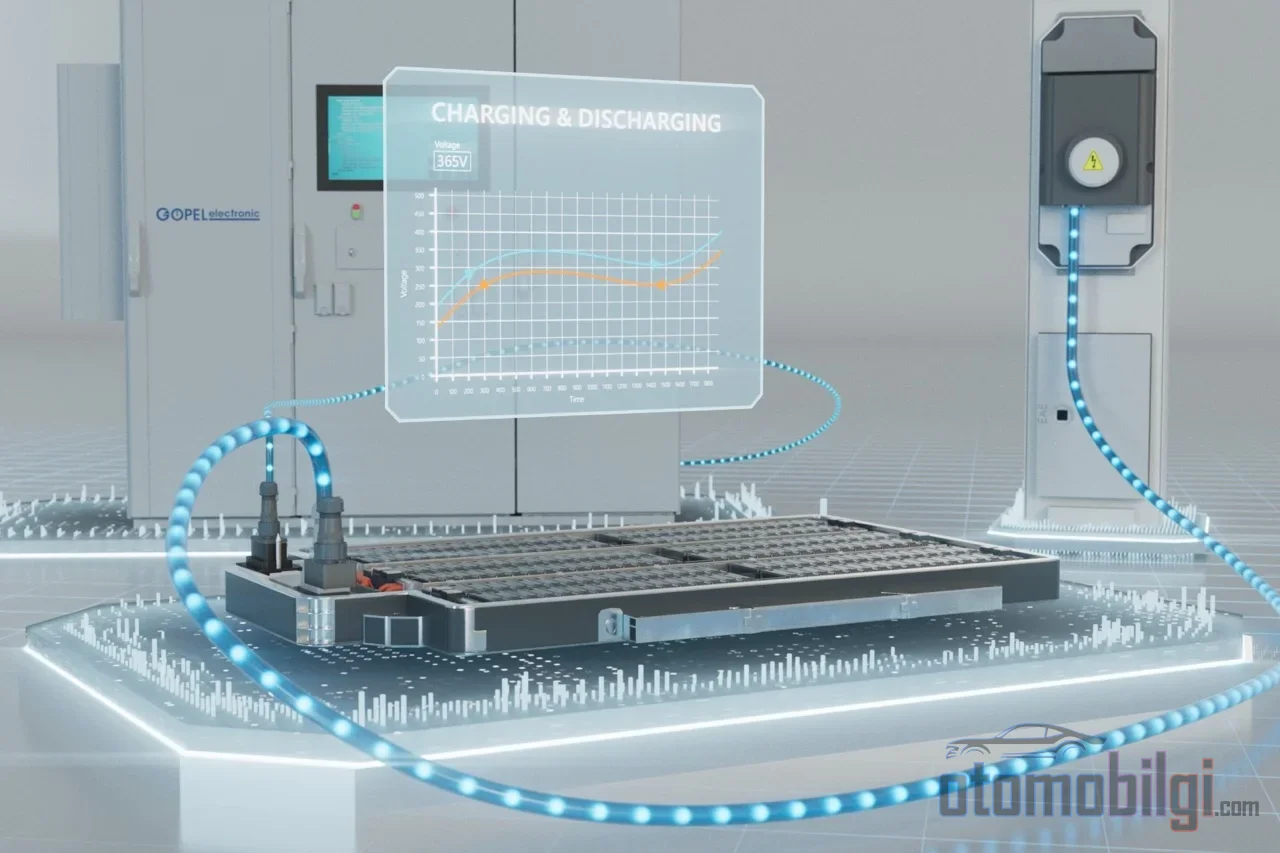
The team at Stanford University's SLAC-Stanford Battery Center tested 92 commercial lithium-ion cells under four different discharge profiles for more than two years, in a study published in Nature Energy on December 9, 2024. The result was clear: the more similar the discharge profile was to real driving, the longer the cell's life. The team made this relationship concrete in a single measurable range: Cell capacity being consumed by 4 to 5 hours of continuous use, i.e. a discharge rate between C/4 and C/5, turned out to be the scenario that extends lifespan the most. Surprisingly, this range almost exactly matches the daily usage of an average consumer.
A long-standing assumption was that hard accelerations produce high current peaks for the battery and therefore wear out the cells rapidly. The tests showed the exact opposite: a correlation was measured between short, sharp accelerations and slower degradation. A machine learning algorithm trained on data collected by the team through periodic measurements of different resistance forms in the cells helped disentangle the effect of dynamic discharge profiles on degradation. The explanation for the mechanism is that rest and partial charging pulses from regenerative braking reduce stress inside the cell.
Cycle Aging or Calendar Aging?
A lithium-ion cell ages through two parallel mechanisms. Cycle aging, as the name suggests, is capacity loss caused by the number of charge-discharge cycles. Calendar aging, on the other hand, is the loss created by time and internal chemical processes even when the cell is not in use. The two operate simultaneously, on top of one another. The dominant engineering assumption for years was that cycle aging was the predominant factor.
This assumption still holds largely true for commercial fleets: buses and delivery vehicles are used or charged almost continuously. By contrast, a typical personal vehicle sits unused for most of the day and stays away from charging; in the car of a commuter who picks up children from school and stops by the grocery store, time becomes the dominant cause of aging over cycles. Precisely for this reason, real-world profiles that include rest periods produce better results than laboratory estimates: the test never accounted for the mechanism that actually determines the vehicle's lifespan.
Do Real Fleet Data Support the Same Picture?
The study's predictions are consistent with real-world usage data from fleet telemetry. In an assessment analyzing data from more than 22,700 electric vehicles across 21 makes and models, average battery degradation was measured at 2.3% per year; in some scenarios this rate could rise to as much as 3.0% per year. According to the same data set, batteries retain more than 90% of their capacity even after 160,000 km. An earlier analysis of 10,000 vehicles also found that most batteries last 15-20 years and lose about 1.8% per year in temperate conditions.
The factors linking these figures also emerge from the same analyses: high temperature accelerates degradation by increasing chemical activity and mechanical stress inside the cell; the quality of thermal management and the frequency of DC fast charging are the main variables at play in this picture. 160,000 km, the warranty that EV manufacturers typically offer for EV batteries, reads not as a healthy baseline but as a cautious lower bound when these real-world loss rates are taken into account.
| Measurement | Value | Source data |
|---|---|---|
| Additional lifetime vs. lab prediction | Up to 38% | 92-cell controlled test, four discharge profiles |
| In terms of additional use | Up to 314,000 km | The same test expressed as range |
| Longest-lived discharge rate | C/4-C/5 (4-5 hours) | Controlled cycle tests |
| Real-world fleet average loss | 2.3% per year | More than 22,700 vehicles, 21 brands and models |
| Capacity after 160,000 km | More than 90% | Same fleet data |
| Typical warranty coverage | 160,000 km | Manufacturer warranty standards |
Does Hard Use Really Kill the Battery?
The study's most debated finding reverses a belief long embedded in driver culture: short, sharp acceleration bursts can slow measured degradation. Battery experts expected intermittent charging pulses to deplete cells faster than continuous charging models; the assessment of academics unconnected to and not involved in the study was also that this result was surprising even within the field. It is clear that understanding of how EV batteries age is still lacking; the discovered relationship shows the size of the remaining gap.
Another important takeaway concerns the software side. Degradation progressing so differently depending on the profile means manufacturers could further maximize real-world lifespan by updating their battery management software. The researchers' forward-looking emphasis points in the same direction: new battery chemistries and designs should be evaluated with realistic demand profiles rather than constant-current tests, and advanced control algorithms targeting these profiles could be developed. The same principles are thought to be applicable to many fields where aging is critical, from solar cells to biomaterials.
What Do These Findings Mean for Drivers?
The widespread perception that EVs are not as long-lived as their gasoline counterparts is shaken in light of this data. Another analysis showing that the lifespan gap between gasoline cars and EVs is closing supports this. In daily practice, the picture can be summarized as follows: typical city use, consisting of frequent stop-and-go, short trips, and rest periods, creates a profile that protects rather than wears down the battery. The warranty limit of 160,000 km is not an endpoint; the battery keeps working in vehicles that have long passed this mileage, only its state of health value declines.
The limits of the evidence must also be honestly noted. The controlled test was performed on a single commercial battery type, and cell chemistry and materials directly affect the ideal discharge rate; whether different chemistries deliver the same gain must be verified separately. Still, the main message does not change: laboratory standards assume worse-than-real-world usage, and electric vehicle owners' batteries may stay with them for many more years than projected on paper. You don't need to change your driving habits - you're probably already doing it right.
Sources
- Dynamic cycling enhances battery lifetime - Nature Energy
- Existing EV batteries may last up to 40% longer than expected
- EV Batteries Last Way Longer Than Expected
- EV batteries can last 38% longer than expected - study
- EV Battery Health: Key Findings from 22,700 Vehicle Data
- EV Battery Health Insights: Data From 10,000 Cars