High Voltage Risk in Hybrid Cars After an Accident
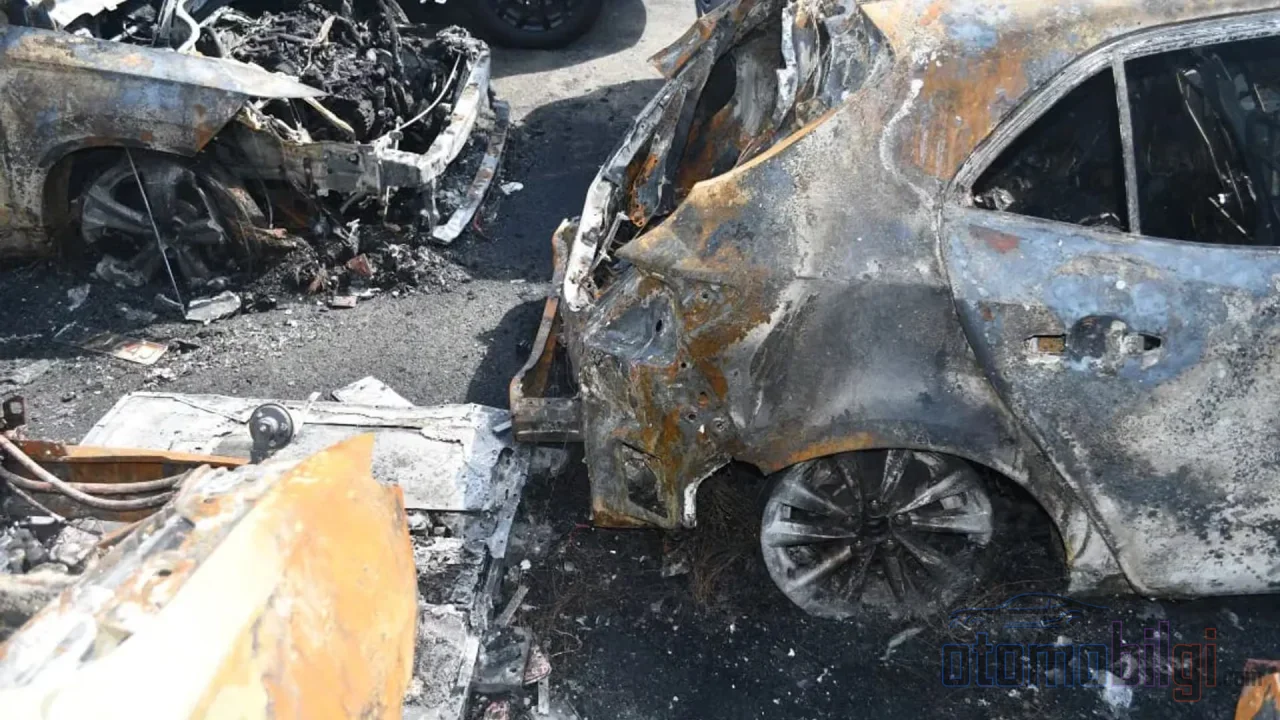
Most drivers don't know what a hybrid vehicle does within seconds of a collision: the vehicle is designed to automatically shut down its several-hundred-volt electrical system. High-voltage risk after an accident is a real engineering matter; but it is not left to chance. This guide lays out what the driver who exits the vehicle after the accident, the rescue teams that intervene, and the owner who will have it towed need to know, by understanding the logic of how the system works.
How Does the High-Voltage System in a Hybrid Vehicle Work and What Happens in a Crash?
Hybrid and electric vehicles have two separate electrical systems. The high-voltage battery - commonly nickel-metal-hydride in hybrids, and lithium-ion in plug-in hybrids and fully electric vehicles - powers the electric motor and typically operates in the range of 200-800 volts. The 12-volt lead-acid battery next to it runs the lighting, the wipers, basic controls, and safety systems such as the airbag. This dual structure is critical to understanding post-accident risk: because most rescue procedures target not the high-voltage system, but the 12-volt system.
Automatic protection kicks in at the moment of impact. High-voltage battery systems are equipped with redundant automatic sensors; in a serious crash, these sensors leave the contact relays in the open position, disconnecting the battery from the vehicle's electrical network. In other words, when the sensors are triggered, the system isolates itself. The result of this design is clear: because the high-voltage system is isolated from the vehicle chassis, touching the vehicle after a severe crash generally poses no risk. Approaching the casualty, opening the door, or leaning on the vehicle does not by itself carry a risk of electric shock.
However, two warnings apply. First, even if the vehicle is shut off, some components such as the airbag may remain energized and can still be triggered. Second, the high-voltage cables and connectors marked in orange, and any part carrying a high-voltage warning label, must never be touched. The orange cable is the only visible open high-voltage indicator on a vehicle after an accident, and staying away from it is a simple but indispensable rule.
Highlights
- The hybrid high-voltage system operates in the range of 200-800 V; it is isolated from the chassis
- Crash sensors automatically isolate the system by opening the contact relays
- At least 1 minute should be waited before touching high-voltage components
- Orange cables are never cut; the negative cable of the 12V battery is disconnected
- Thermal runaway in a damaged battery can begin even days later
How Do Rescue Teams Safely Isolate the System?
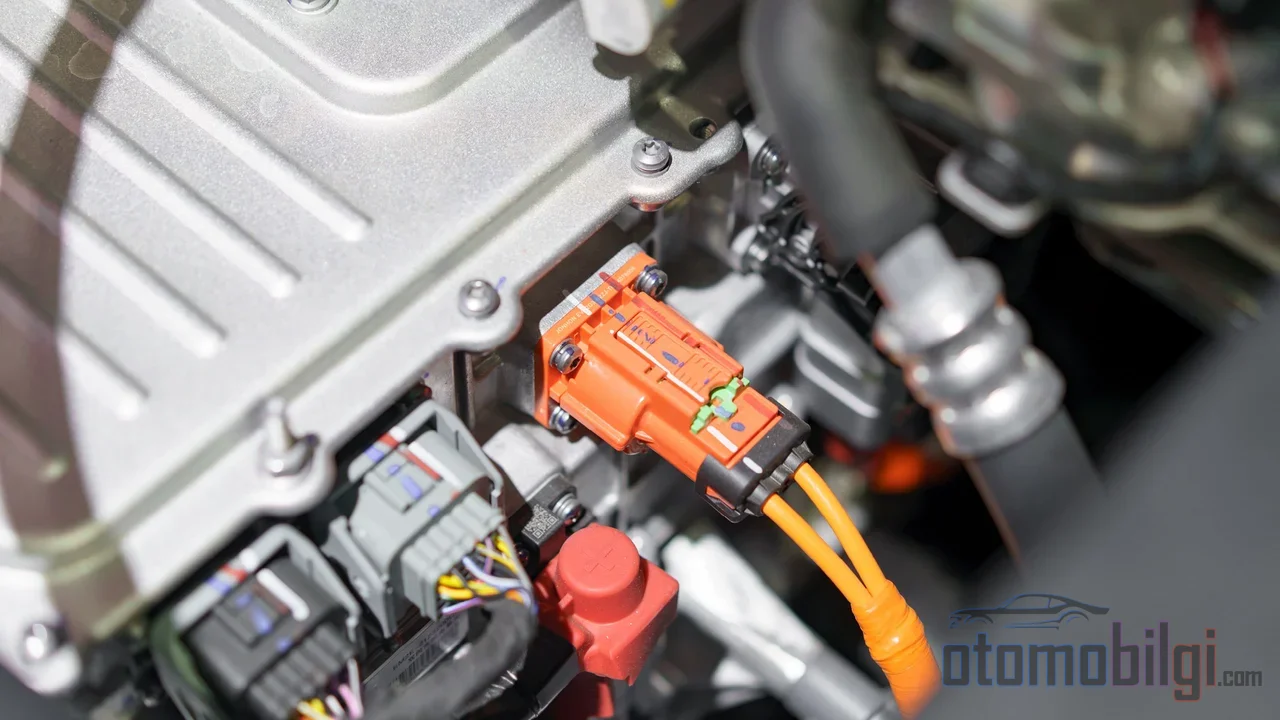
Automatic isolation is the first line of defense; professional intervention completes the second line. If normal shutdown is possible, rescue teams cut the control currents of the high-voltage system by disconnecting the negative cable of the 12-volt low-voltage battery. The same isolation is achieved in emergencies by removing the manual service disconnect (MSD) or cutting the low-voltage cable in the front compartment. The logic here is simple: even when the high-voltage relays are open, residual energy remains in the system - voltage waiting to be discharged. For this reason, after isolation, one must wait at least 1 minute before touching any high-voltage component.
Whether the system is truly dead is verified by measurement, not assumption. Before the high-voltage circuit is disconnected, the voltage is checked with a voltmeter; on the AC side, values below 30 volts, and on the DC side, values below 60 volts are accepted as the safe working threshold. Technology developers aiming to reduce the risk of fatal shock after a collision also reference this same 60-volt threshold. Insulated equipment for personnel working with these components is also defined: insulated gloves and tools rated up to 1 kV, footwear rated up to 18 kV, and an insulation mat rated up to 10 kV.
The most common and most dangerous mistake is attempting to cut the orange cable. First responder teams must not cut high-voltage cables; cutting creates an additional shock risk and does not reliably de-energize the system. In addition, manufacturer manuals define no-cut zones: high-voltage components, gas cylinders, gas struts, and SRS, i.e. airbag components. Zones reinforced with ultra-high-strength steel can only be cut with the proper tool.
Extrication, i.e. Vehicle Rescue Steps
In a hybrid vehicle, the rescue of a casualty is carried out according to a sequential protocol. The steps are as follows:
- The vehicle is identified as a hybrid and the orange cabling is located.
- The vehicle is immobilized and stabilized.
- Access to the passenger compartment is gained.
- The gear selector and parking brake are set.
- Ongoing safety steps are applied and the extrication is completed.
If a casualty is inside, immediate evacuation of the occupants is essential; if neither door opens, in some models the emergency release mechanism inside the trunk serves as an alternative exit route. When lifting with a crane or supporting the vehicle, only the manufacturer-designated lifting points must be used - pressure from a crane or jack on the battery pack under the vehicle is one of the most common sources of hidden damage.
Rescue Sheet: Why Is the Rescue Sheet Vital?
The rescue sheet is a technical drawing that shows a vehicle's high-voltage components, cut and no-cut zones, airbag locations, and lifting points on a single page. In the US, the national highway safety authority publishes emergency response guides for electric, hybrid, and fuel-cell vehicles that can be filtered by make and model. These guides arose from the need to look up, rather than guess, which cable is located where at an accident scene.
Standardization in this field is maturing rapidly. All safety devices on rescue sheets are identified with the symbols of the ISO 17840 standard, and the same labels are usually found on the vehicle itself. The joint operational guide published by international firefighting organizations in December 2025 systematically addresses electrical risk management in roadside rescue operations. Manufacturers such as Tesla and Ford operate official resource pages for first response teams; Ford's resources cover lifting, stabilization and high-voltage rules. Rescue sheets are now also accessible via mobile apps: there are apps offering extensive emergency response guide databases for first responders and towing professionals.
From the vehicle owner's perspective, the practical takeaway is this: knowing the emergency information in your manual or on the label in the trunk saves minutes at the accident scene. A team without a rescue sheet has to search for the orange cable and find where it needs to be properly isolated; the rescue sheet reduces this time to seconds.
Thermal Runaway: A Risk That Can Start Days After the Accident
Even after the high voltage has been cut off, the battery itself can still be a source of risk. Thermal runaway is an uncontrolled self-heating state that begins with a chemical chain reaction when heat cannot be dissipated within the cell; its consequences are the release of flammable and toxic liquid-gas, fire and explosion. The critical point is timing: in damaged batteries, thermal runaway can appear even hours, days, or even weeks later. Damage is not always visible; a collision, especially submersion in salt water or a manufacturing defect can trigger this process.
The warning signs are clear: liquid leakage, smoke, sparks, flames, or unusual sounds from the battery such as rumbling, banging or hissing. If any of these is detected, the area must be evacuated immediately. Smoke from a burning lithium-ion battery contains toxic components such as carbon monoxide, nitrogen oxides, hydrogen chloride, hydrogen cyanide and hydrogen fluoride; that is why response teams work with full protective equipment, including breathing apparatus.
A numerical perspective is enough to correct the exaggeration: according to industry data, the risk of an electric vehicle fire is far below one in a thousand and is statistically an exceptional event. The scenario that really requires attention is the reignition of the battery pack after the initial extinguishing - there are recorded incidents where this caused damage or injury. For this reason, teams adopt an isolate-and-watch approach instead of extinguishing the fire: if the battery pack is burning, it is continuously cooled with large amounts of water, it is allowed to burn out in a controlled manner if conditions permit, the temperature is monitored with a thermal camera, and after it goes out the vehicle is moved to a safe, isolated area.
Towing and Storage: What the Vehicle Owner Needs to Pay Attention To
The process after an accident does not end the moment the vehicle is towed; in fact, most of the critical decisions are made at this stage. Electric and hybrid vehicles can be damaged by incorrect towing methods: in a hybrid towed from its active axle, the rotation of the drive wheels can cause the electrical system to unintentionally generate energy. The correct method is lifting with a suspension and the drive wheels must be off the ground.
| Situation | Towing rule |
|---|---|
| No safety risk, battery intact | Can be towed with a tow truck |
| Battery deformed, leaking or emitting smoke | The risk must be eliminated first |
| Vehicle after a fire or recovered from underwater | Towing prohibited; a carrier is used |
| Post-fire parking | At least 15 m away from buildings and flammable materials |
Safety distances vary by vehicle class: for vehicles with damaged battery packs, 4 meters is recommended for passenger cars, 8 meters for buses, and 5 or 12 meters for other classes. The recommendation that vehicles with damaged batteries be kept under observation for at least 30 days also stems from this risk of delayed ignition. In addition, a damaged battery may leak lithium electrolyte and coolant fluid; these chemicals must not be touched, and their mixing into sewage or waterways must be prevented.
The questions the owner should ask during the insurance and towing process have become clear: does the tow truck operator have hybrid experience, will platform transport be provided, and will the vehicle not be parked in an enclosed area or next to other vehicles before the battery damage is assessed? During the insurance process, requesting that the battery pack's damage record be separately assessed is the foundation of protecting against future delayed risks and preserving second-hand value.
How Is the System Restarted After an Accident?
On the repair side, the job is more comprehensive than it appears. As voiced in repair circles, reactivating the high-voltage system after a collision generally requires clearing the collision records in multiple control modules and replacing the explosive, i.e. pyrotechnic, fuse. This means that damage repair involves special procedures for the battery and electrical network; it is not limited to body and paint repair.
In short, the clear answer: after an accident, the high-voltage risk in a hybrid vehicle means that in most cases it is safe to touch the car because the collision sensors isolate the system; the remaining risks are the orange cables, airbag components that may remain energized, and the possibility of delayed thermal runaway of the damaged battery. A driver who knows these three risks manages the entire process safely with a tow truck that has the correct setup and transports on a platform.
Sources
- CCOHS - Battery Safety: High-Voltage Batteries in Electric, Hybrid, or Plug-in Hybrid Vehicles
- MG HS PHEV Emergency Rescue Manual
- NHTSA - Emergency Response Guides
- ScienceDirect - Electric vehicle post-crash recovery: stranded energy (Zhang, 2022)
- GOV.UK - Recovery operators: working with electric vehicles
- USFA - Electric Vehicle Fire/Rescue Response Operations
- evfiresafe - Towing a burnt electric vehicle: the risks