How Long Does a Hybrid Battery Last, and When Should It Be Replaced?
Almost everyone considering buying a hybrid vehicle has the same question in mind: how many years does the battery last, and at how many kilometers does it give out? The notion circulating online that "the battery is replaced every 3-5 years" is a prejudice left over from the first-generation hybrids of the early 2000s. Yet today's lithium-ion and nickel-metal hydride (NiMH) batteries, thanks to advances in manufacturing standards, age along with the vehicle without ever being replaced by most drivers. Even so, the battery's real lifespan is not a single number; climate, usage patterns, and the vehicle's brand shift that number significantly. In this article, we build a concrete framework based on years, kilometers, and cycle counts, and cover how capacity loss can be noticed and how to tell when the battery has reached the point of replacement.
How many years and kilometers does a hybrid battery last?
When manufacturer data and real-world usage examples come together, a consistent picture emerges. Hybrid vehicle batteries typically have a lifespan in the range of 8-15 years or 160,000-240,000 km. Manufacturer guides give a range of around 100,000-150, miles (~160,000-240,000 km), while real-world examples show that this limit can be exceeded: in full hybrid systems, especially in brands like Toyota and Honda, 200,000-300,000 km and 10-15 years of trouble-free use is a common scenario. Toyota's NiMH batteries can last beyond 250,000 km with proper use; in real-world use, they most often run trouble-free well beyond 200,000 km.
One reason these ranges are so wide is the definition of "lifespan" itself. A battery usually does not collapse suddenly; its capacity gradually erodes. Therefore, "the battery is done" usually means "capacity has fallen to the point where it can no longer comfortably operate the vehicle." Although performance decline often begins around 160,000 km, the vehicle can still be used far beyond that, albeit with reduced efficiency.
Key Takeaways
- Hybrid batteries typically last 8-15 years or 160,000-240,000 km; many batteries age along with the vehicle and are never replaced.
- The average capacity loss is around 2-3% per year; at this rate, battery life exceeds 13 years.
- Extreme heat is a leading cause of premature battery failure; in hot climates, lifespan can drop to as low as 10-12 years.
- A hybrid vehicle to be parked for a long period should be left at a ~50% charge level and driven for 30-60 minutes every 2-3 weeks.
At what rate does capacity loss progress?
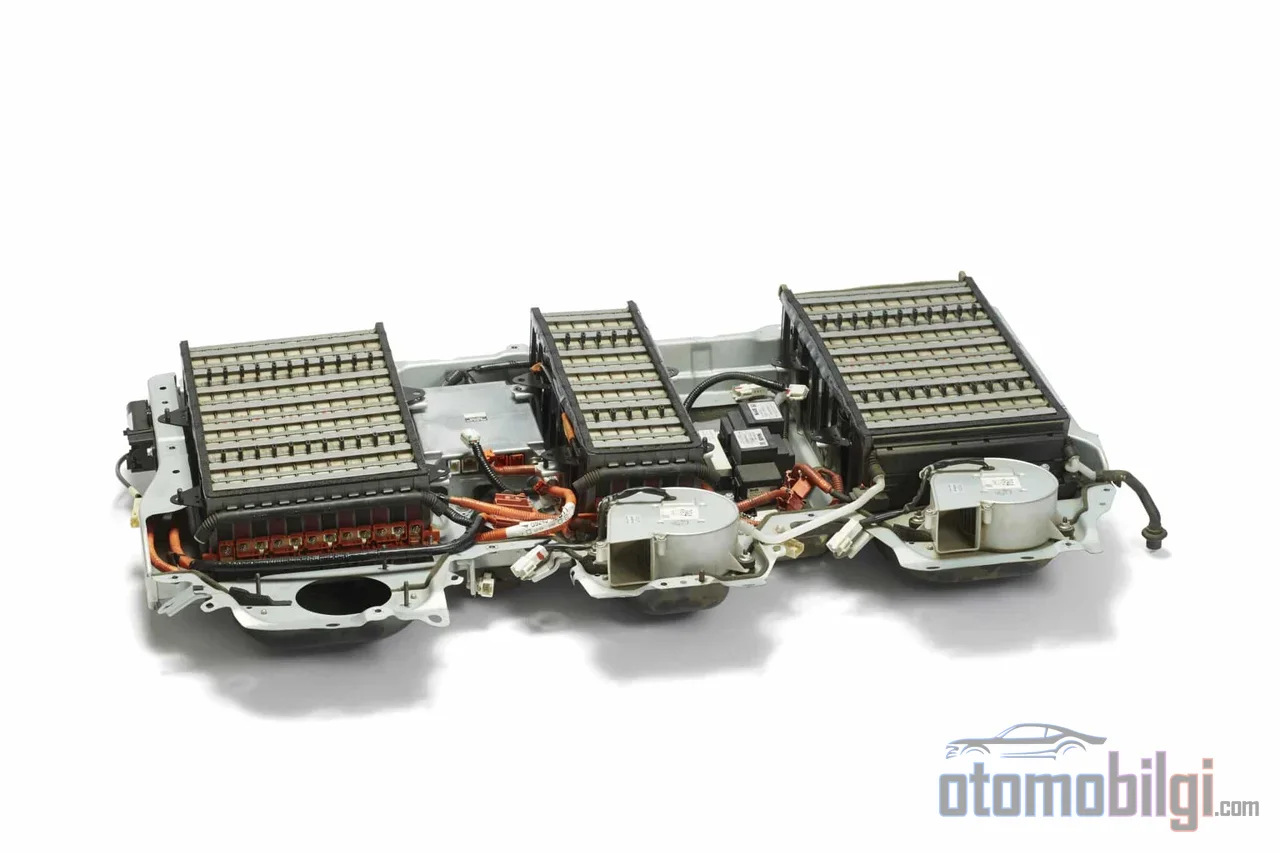
Battery degradation is a chemical process that begins from the day of manufacture. Extensive telemetry data collected from vehicles on the road shows that the average annual capacity loss is around 2.3%; at this rate, a battery remains usable for more than 13 years. According to used electric vehicle data, average loss runs between 2-3% per year, and after five years most vehicles still have capacity in the 85-90% band.
There is an important engineering detail here: capacity loss is not linear with time. In the early years, battery cells "settle" and capacity drops relatively fast; for example, some electric vehicle data shows a loss of around 5% within the first 50,000 km, whereas even in vehicles exceeding 200,000 km capacity has remained above 90%. After the early-period drop, annual loss slows to 1-2% and a long stable phase begins. This is why the degradation curve of lithium-ion batteries is S-shaped: an initial settling drop, a long and slow linear wear in the middle, and a sharp drop only at the very end of life.
Almost all vehicles on the road are in this stable phase. Excluding major recalls, battery replacement occurs in less than 4% of all electric vehicles; in modern vehicles after 2022, this rate drops to as low as 0.3%. The high rate seen in first-generation vehicles (~8.5%) is becoming history thanks to today's cell chemistries and advances in battery management systems. On the hybrid side, the picture is even more reassuring: according to manufacturer data, most hybrid drivers never replace their battery.
How do charge-discharge cycles affect battery life?
A "full cycle" is defined as charging the battery from 0% to 100% and then discharging it back to 0%. However, what matters for lithium-ion chemistry is not so much the number of cycles as the depth of each cycle. A battery operating with shallow discharge - for example, using only 30% of its capacity per cycle - shows a noticeably longer cycle life. Use kept within the 20-80% range can result in thousands of cycles.
Hybrid vehicles have a natural advantage here. Hybrid battery management systems deliberately operate the battery within a narrow charge window; the system typically keeps the cells within the 20-80% band, and if the level drops below 20% while parked, it engages the internal combustion engine to recharge. This protection, left to the charging habits of the electric vehicle driver, is provided in a hybrid by the vehicle's own control software. The result: the same cell chemistry experiences less stress in hybrid application than in an electric vehicle, and cycle count ceases to be a metric that alone explains lifespan.
In terms of mileage, there are seller-sourced claims that capacity reconditioning performed at a certain mileage restores lost capacity and reduces the risk of early failure; it should be noted that this claim has not been verified with independent data. The main principle is this: rather than trying to calculate hybrid battery life by cycle count, it is more meaningful to look at usage conditions - especially heat.
Excessive temperature and prolonged parking: two factors that shorten lifespan
The cost of heat to the battery
In hot climate regions, the leading cause of hybrid battery failures is the vehicle's prolonged exposure to extreme cabin and battery temperatures. According to measurements, hot climates add approximately an extra 0.4% capacity loss per year; user experiences show that lifespan drops to 10-12 years in hot regions and approaches 15 years in temperate climates. Heat can cause swelling and electrolyte degradation in NiMH cells; it also accelerates the battery's self-discharge. After parking in a hot spot, the battery keeps working longer to cool down and may not return to its comfortable temperature range.
The way to protect it is simple: parking in the shade or in a closed garage and using a reflective sunshade significantly lowers both cabin and battery temperature. For a hybrid owner living in a hot region, these two habits are the cheapest investment that can be made in battery life.
The effect of leaving the car parked for a long time
If a hybrid vehicle stays immobile for weeks, the battery level drops; the vehicle may become unable to start. A hybrid that will be parked for weeks should be left at approximately a 50% charge level. In a relatively new vehicle, a 30-60 minute drive every 2-3 weeks is enough to keep both the high-voltage battery and the 12-volt battery in shape. This intermittent use also helps keep the cells active; a battery left immobile for a very long time wears out faster than an equally old one that is used regularly.
How do you know when a hybrid battery is failing?
Battery degradation is the gradual loss of stored energy capacity; it is hard to notice in its early stages, but the symptoms become clearer over time. The main signals to watch for are:
- A noticeable drop in fuel economy - as battery support decreases, the internal combustion engine runs longer.
- Shorter duration and distance traveled in pure electric mode.
- A noticeable increase in how long the internal combustion engine runs.
- Power loss felt especially during acceleration; warning lights and diagnostic codes such as "Check Hybrid System" or "Service Hybrid Battery".
- Unusual noises and declining fuel efficiency.
The battery's behavior at the end of its life varies by model: while some vehicles experience a gradual performance decline, some older hybrid models may come to a complete stop. For this reason, symptoms alone are not enough for a diagnosis. Hybrid systems do not respond well to conventional battery load tests and simple voltage checks; a specialized battery capacity test is required to detect cell-level loss. Battery health (SOH) can be monitored regularly with modern diagnostic tools and OBD-based apps; a new battery's starting reference is accepted as 100%, and even after a year or two of use it is normal for the value to be below 100% - this is not a fault, but the settling drop described above.
A concrete framework: how long can you use your vehicle with confidence?
When we combine all the data, we can give this clear answer: a well-maintained modern hybrid battery used in a temperate climate can be used safely with the vehicle for 10-15 years and 200,000-300,000 km; hot climate and neglected usage habits can pull this range down to 8-12 years. Since this lifespan is roughly on the same scale as the vehicle's body and internal combustion engine, the perception that "the battery is replaced every few years" has no counterpart in today's manufacturing standards. Since most of the road data comes from new vehicles sold after 2023, it should honestly be added that the true ultimate lifespan is not yet fully known - but every measurement to date points below the estimate, not above it.
The list of practical recommendations is short: park your vehicle in the shade or in a garage if possible, leave it at about a 50% charge if it will sit for weeks, and use it at least half an hour every 2-3 weeks. If you notice a noticeable drop in fuel consumption and electric mode duration, monitor the SOH value via OBD and have a cell-by-cell capacity test performed. If you are buying a used hybrid, a pre-sale battery health report and a test drive are your strongest cards in the negotiation. The battery is ceasing to be the most feared item of hybrid ownership and is turning into its most predictable part - as long as you show it the same care regarding heat and inactivity.
Sources
- How Long Does a Hybrid Battery Last?
- EV Battery Health: Key Findings from 22700 Vehicle Data
- New Data: How Long Do Electric Car Batteries Last?
- Battery Degradation in Used EVs
- What is the Typical Hybrid Battery Life?
- EV Battery Charge-Discharge Cycles
- Battery Cycle Life and Depth of Discharge
- Toyota Hybrid Battery Life and Maintenance
- Diagnosing a Bad Battery in Hybrid Models
- How to Reduce Degradation of Your EV's Battery