How Did the Christmas Tree Evolve from 1963 to Today?
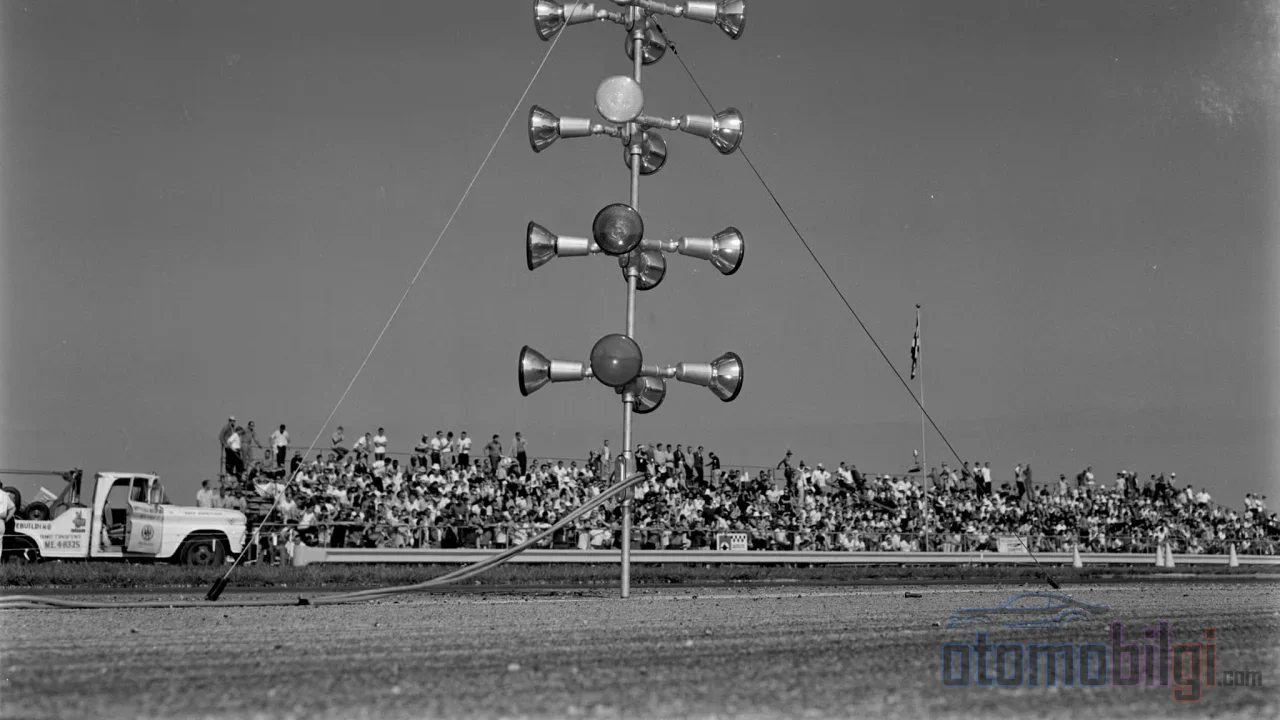
In September 1963 in Indianapolis, spectators at the U.S. Nationals saw something unusual at the starting line: instead of a thin pole standing between the two lanes, with lights flashing in sequence and a starting official performing acrobatics with a flag in hand... an electronic countdown. That day, the world of drag racing changed. So who was the inventor of this system, where did the name "Christmas Tree" come from, and how did today's LED-equipped, random-delay, TruStart-equipped giant trees come to be? If you're ready, we're diving into the 60-plus-year evolution story of drag racing's most iconic device.
On this page, we're not explaining the logic of the lights during a run, but the history of the system itself: who invented it, how it evolved, and which engineering problems gave rise to which solutions. In other words, what you'll read in the next section is the untold story of that pole you see on the track.
From Flagmen to Electronics: Why Was the Christmas Tree Invented?
Before the Tree, starts were given by human flagmen, and this job was far more complicated than it looked. The timing of raising and lowering the flag varied from person to person; the margin of error was high, and the system was unfortunately "gameable." Claims of early flags for favorite drivers, controversial foul start calls... in short, it guaranteed headaches for both drivers and spectators alike.
The transition to electronics was gradual. In the intermediate solution, the flagman pressed a button fixed to the ground with the tip of his flag, and the green light on it lit up. At the 1963 Winternationals, this hybrid system produced 80% fewer foul starts compared to the previous year's entirely flag-based Nationals. The number was right there in the middle: human reflexes couldn't compete with machine consistency.
Highlights
- First Christmas Tree introduction: 1963 U.S. Nationals, Indianapolis
- Original system: 5 amber, 1 red, 1 green lights; no pre-stage/stage
- Amber lights reduced to three: 1986 revision
- Transition from incandescent bulbs to LED: 2003
- Random delay code: 2009, TruStart: 2016
Who Was the Inventor? A Debate That Continues to This Day
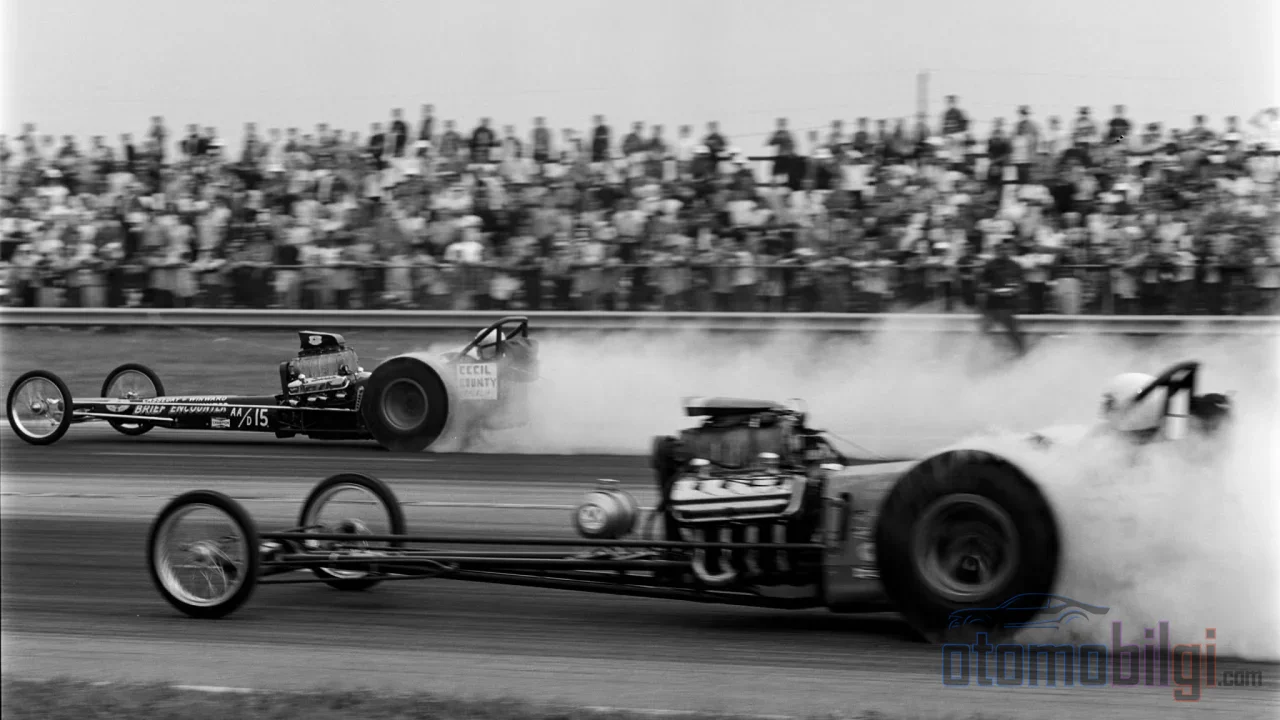
Here's the mysterious part of the story: there is still no clear answer today as to whose idea the Tree was. According to the most common account, Oliver Riley, founder of Chrondek Corporation, went to NHRA National Field Director Ed Eaton in 1962 with the idea of a step-by-step countdown of lights, and the Chrondek system was introduced at the 1963 U.S. Nationals. NHRA Division 1 Director Lew Bond also had a hand in its development.
But things aren't that simple. The automotive magazines of the era, which closely followed the September 1963 introduction, describe the system directly as Ed Eaton's idea; they write that Drag-Tronics, the company whose name appeared on the equipment, was founded by Lew Bond, an electronics technician from Maryland. In other words, there is a strong narrative saying "the idea was Eaton's, the production was Bond's."
A third claim goes even further back: Wilfred H., founder of the Pel State Timing Association in Lafayette, Louisiana... David Jr. is said to have built the first Tree himself in the late 1950s and sold the rights to Chrondek for mass production a few years later. There is even a tale that the name "Christmas Tree" came from the small glass Christmas tree bulbs David used on his miniature prototype. There is also a claim circulating that Harry Steele and Jerry Tyson built the first prototype in South Florida, but this latter one remains at the level of a rumor that never got further than forums. The short answer: the debate over the true inventor continues and probably will continue.
From 1963 to 1986: Early Stages and the Big Revision
What Did the Original Tree Look Like?
The 1963 Tree was both busier and simpler than today's: on a thin pole between the two lanes there were five amber lights, one red and one green; the pre-stage and stage bulbs did not yet exist. Each amber lit up at 0.5 second intervals, and all classes, professionals included, launched with a full five-bulb countdown. It is perfectly natural for someone looking at today's Tree to ask "where are the blue lights?"
A small but critical addition came at the 1964 Winternationals: the pre-stage and stage bulbs. Introduced under the name "Automatic line-up system," this setup was initially not on the Tree itself but on the starting line; over the next few seasons it was gradually moved onto the pole.
The Pro Tree and the Three-Amber Era
The professionals' relationship with the Tree changed gradually. According to NHRA records, at the 1970 Supernationals, Top Fuel, Funny Car, Pro Stock and Top Gas drivers saw only the fifth, that is the last, amber before green for the first time. The general consensus is that the Professional Tree was fully established in the 1971 season - the dates shift slightly depending on the source, but the direction is clear: an accelerated start for the professionals.
The real big revision came in 1986, and its reason was, in a sense, aerodynamics: the growing hood scoops on Pro Stock cars were blocking the drivers' view of the lower amber. The solution was radical - two ambers were removed from each side, leaving three. Shortening the Sportsman countdown to three ambers saved roughly 1 second per pairing per weekend run, a total of about 4 minutes of time. Though it looked small, it was an improvement that made a difference at a national race weekend where hundreds of pairings were run. On the Professional Tree, meanwhile, the three ambers now began to light up together: the Pro Tree we know today was born.
2003: The LED Revolution and the Reaction Time Standard
The 2003 season was the clearest technological leap in Tree history: the switch from incandescent bulbs to LEDs. Though the reason was amusing, the result was serious: the exhaust vibrations of Top Fuel cars were breaking the filaments of the incandescent bulbs, and an average of 20 bulbs were replaced per race. LEDs, immune to vibration, solved this problem at its root and brought a bonus: since the lights lit up instantly, reaction times dropped too.
That same year, the perfect reaction time standard also changed, and the era of the .000 threshold began; before then, a .400 was considered perfect in Pro Tree and a .500 in Sportsman Tree. As the NHRA began using LED ambers at national events that same year, many tracks also switched to LED. Reaction time, meaning the time between the green light flashing and the car's front tires leaving the staging beam, was now being measured far more precisely. Imagine that: a sport that speaks in thousandths of a second now had that same precision in its vehicles.
2009 and 2016: Anti-Cheating and TruStart
Until 2009, the system had an interesting weakness: the Tree was triggered by the starter manually, and some drivers had learned to read the moment the official pressed the button. When code was added that produced a random delay before the lights started after the second vehicle was staged, this "sixth sense" became a thing of the past. No unused advantage remained; everyone now truly had to react to the light.
In 2011, a small but neat innovation arrived: the tiny amber pre-stage/stage bulbs were replaced with two blue LED half-circles (top half for pre-stage, bottom half for full stage). This arrangement, which made it easier to follow opponents' staging progress in four-lane races, was first showcased at the Four-Wide Nationals, then spread across the entire calendar. Four-lane tracks like Charlotte and Las Vegas use special arrangements with four horizontal blue bulbs.
In 2016, CompuLink activated the TruStart system at selected bracket races. Before then, if the first driver left before the green, the light automatically turned red while the other driver was shown green regardless of the violation. TruStart redesigned this logic and made the starting rulings fairer in matchups with staggered starts.
Today: The Tree's Ongoing Evolution
So what about now? The NHRA has officially been using CompuLink timing systems in its professional series since 1984. Chrondek was sold to Daktronics in the 1980s, its parts are no longer produced, but incredibly, a few tracks still run the old Chrondek system. Even in the 2026 NHRA Mission Foods season, two tracks - US 131 Motorsports Park and Rockingham Dragway - still use the old-style Accutime Tree. Manufacturers like Accutime, TSI, PortaTree and RaceAmerica are also in the market.
Would you like to see the chronology together? Here are the Tree's milestones:
| Year | Change |
|---|---|
| 1963 | First Tree, U.S. Nationals debut |
| 1964 | Pre-stage/stage bulbs added |
| 1970/71 | Pro Tree: only the last amber |
| 1986 | Three ambers instead of five |
| 2003 | Switch to LED, .000 perfect RT |
| 2009 | Random delay code |
| 2011 | Two blue LED half-circles |
| 2016 | TruStart system |
Short Answer: How Did the Christmas Tree Evolve?
To sum up: The Christmas Tree was born in 1963 as a five-amber experimental device, took on the identity of a controversial inventor, was simplified in 1986, redefined the reaction time standard with LEDs in 2003, shut down cheating with a random delay in 2009, and made bracket logic fairer with TruStart in 2016. That slender pole, which replaced a flagman, has transformed over sixty-plus years into drag racing's most finely tuned electronic judge.
The next time you watch a race, take another look at the Tree: each of those lights carries a fragment of the story above. Realizing that you are not just watching the green light, but also the dozens of engineering decisions that made that moment possible - that is when the privilege of watching drag racing rises to another level.