Before Entering the Racing Strip: A Drag Racer's Preparation Routine
Share This Page
The few minutes before entering the lane are actually drag racing's most hidden race. Top Fuel and Pro Stock drivers prepare with a routine that lasts far longer than that 3.6-second run: the engine is warmed up in the pit, the tires are heated and softened with a wet burnout, and the car is placed on the staging beams with millimeter precision. Here is the full content of that preparation discipline that unfolds in the seconds before the green light comes on.
Highlights
- A Top Fuel pass, including warm-up, burnout, and staging, takes approximately 3 minutes in total
- The engine is warmed up for about 80 seconds , then the oil is changed and fuel is added immediately before the run
- The water used for the wet burnout dries completely from tire heat before the green light comes on
- In a Pro Tree, there are 0.4 seconds from amber light to green; human reaction time is ~300 ms
- In Türkiye, drag races are run under two federations, with TOSFED and TMF rules
What Happens Before the Green Light? The Behind-the-Scenes of Preparation
Here's a question for you: when does the run of a car that exceeds 547 km/h and covers 1,000 feet in 3.641 seconds actually begin? At the green light? Absolutely not. That run starts minutes before leaving the pit, or even earlier, as part of a regular routine. In Top Fuel, the class of the fastest-accelerating race cars in the world, every detail is executed in sequence, predetermined like measurements in a recipe.
This routine is so strict that a single "lap," meaning a full pass - including engine warm-up, burnout, staging, and the actual run - takes approximately 3 minutes in total. Three minutes! But in every second of those three minutes, there are steps taken to ensure that thousands of horsepower grip the ground safely. Now let's go step by step.
The Run That Starts in the Pit: The Engine Warm-Up Routine
Everything starts with firing up the engine in the pit. This is not a show; it is the very essence of system control. While the engine warms up, the team selects the clutch pack configuration and sets the fuel and ignition maps. Let me make a simple analogy: just as you scan your notes one last time before a morning exam, the team "scans" the engine. The engine is warmed up for approximately 80 seconds .
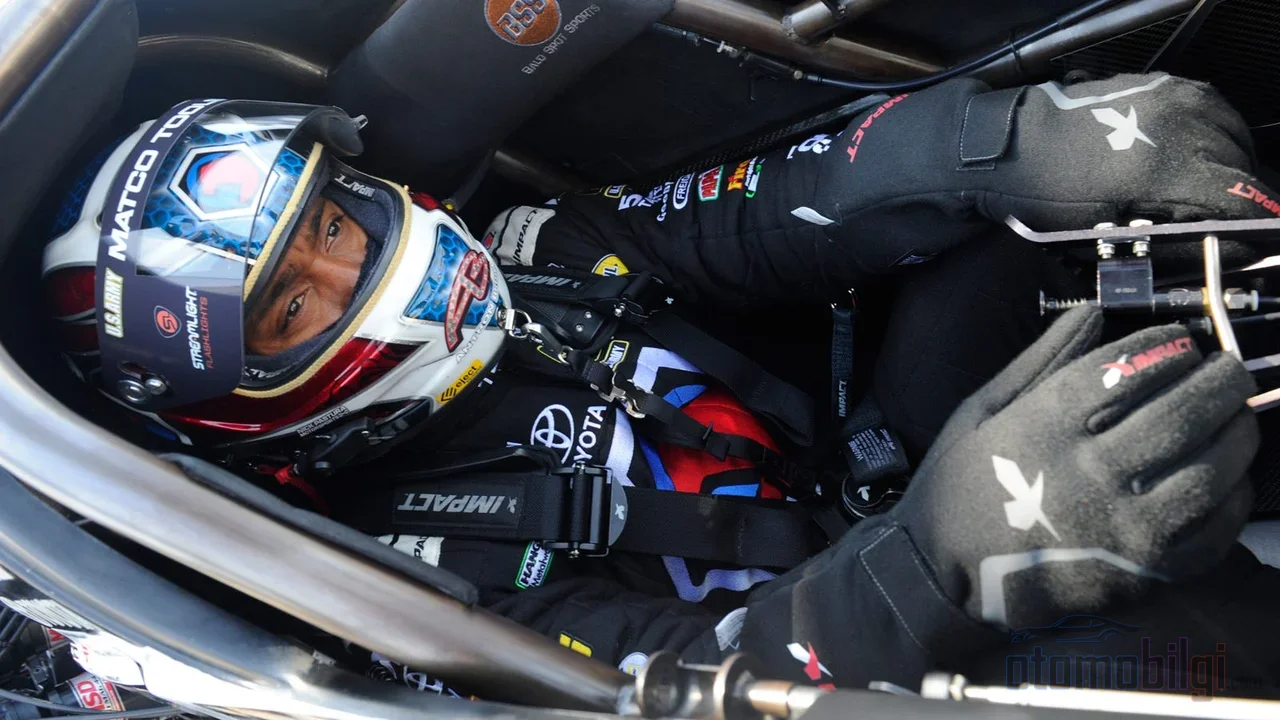
Then things speed up: the valve covers come off, the oil is completely changed, and the car takes on fuel. And here is a critical detail - the fuel mixture, at the ratio of 90% nitromethane / 10% methanol , which is the limit set by the NHRA after 2015, is carefully added immediately before the run. Why at the last moment? Because this mixture evaporates; if you fill it early, the "meal" you prepared simply evaporates away. After fueling, the pilot puts on their gear and gets ready for the lane.
The numbers tell how much this routine consumes: in a typical pass, including warm-up, burnout, staging, and the run, 12 to 22.75 gallons (that is 45-86 liters!) of fuel are consumed. On the power side, the engine is legendary: approximately 8,500-10,000 hp is produced, and in some tests peak power has been measured above 11,000 hp. The exhaust produces about 150 dB at full throttle - that's why even spectators in the grandstands are advised to use earplugs.
The Wet Burnout: The Art of Tire Heating
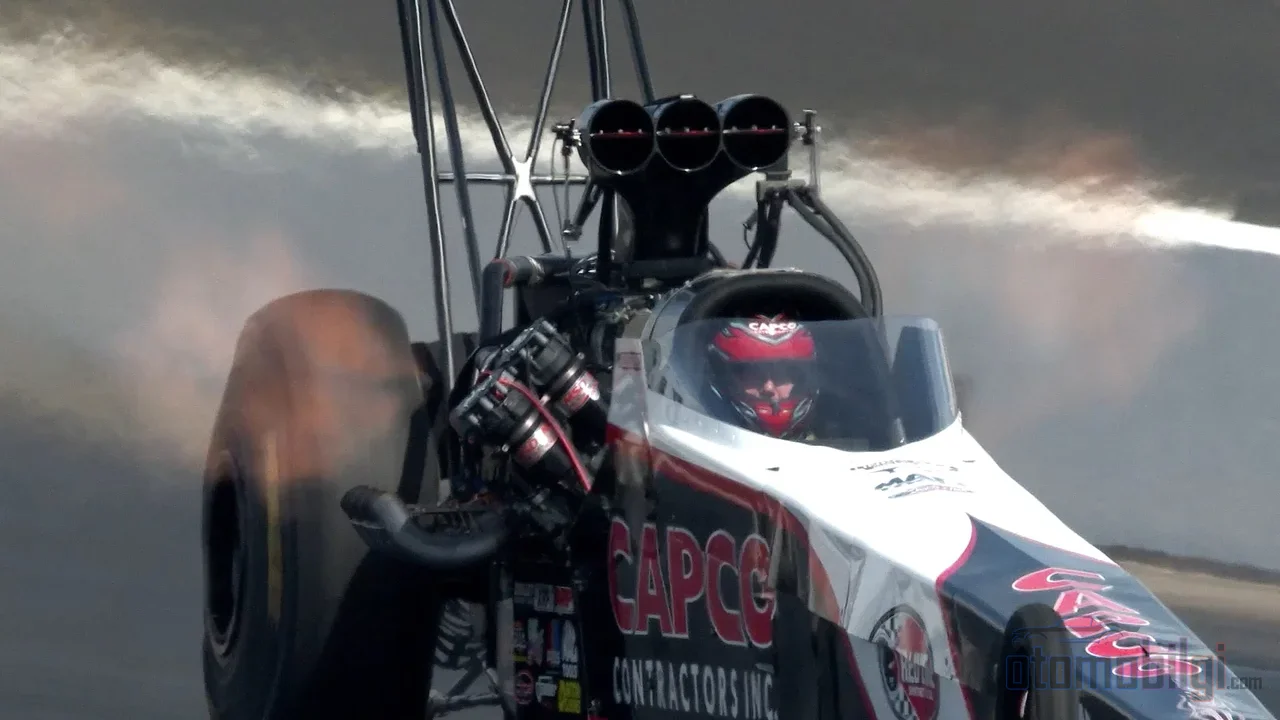
Now we come to the most visual, loudest, and in my opinion the coolest part of the whole affair: the burnout. The vehicle entering the lane first drives into a wet area called the "water box." The water cleans the tires and makes it easier for them to spin. Then the driver floors the throttle and the tires spin in a cloud of smoke - but this is not just for show, it is pure science.
The burnout has three purposes:
- Cleaning the tires
- Heating and softening the tires (a warm tire is softer than a cold one and delivers better performance)
- Leaving a fresh layer of rubber on the track surface to increase traction at launch
Now I know the question on your mind: "The tire is wetted with water, so what's stopping it from sliding during the run?" The answer is quite elegant: the small amount of water left on the tire after a wet burnout dries completely from tire heat long before the green light comes on. In addition, the amount of water under the tire directly affects the burnout; when spinning begins, white smoke appears first - that is actually steam, not burnt rubber. For this reason, full-tread tires with less grip (such as street tires) may not always be suitable for a wet burnout instead of classic drag tires; the dry burnout debate is still ongoing, especially in amateur classes.
Staging and the Christmas Tree: The Game of Thousandths of a Second
The burnout is done, and now comes the most nerve-wracking and most exciting moment of the race: staging. Every drag race begins with an electronic starting device called the "Christmas Tree." There are six lights on each side of the Tree, and at the top a small circle of blue lights.
Sportsman Tree or Pro Tree?
There are two different countdown styles. In the Sportsman style, three amber lights 0.5 seconds apart light up in sequence - a total 1.5-second countdown in which the driver catches a rhythm. In the Pro Tree (the ".400" tree), the three amber lights come on all at once and the green light arrives only 0.4 seconds later. Heads-up classes, meaning classes racing side by side, use this system. Think about it: it takes the human brain about 300 ms to send a signal to the thumb. The window allotted to you in the Pro Tree is 400 ms! This is where that debate begins - is driver skill or vehicle setup the deciding factor? This question is still alive in the community.
Shallow or Deep?
There is also the relationship between the front tires and the light beam, a detail that determines thousandths of a second. In "shallow staging," the front tires barely break the Stage beam; the vehicle sits farther back from the starting line, but the light turns red later, so the reaction time starts with an advantage. In "deep staging," the tire rolls deeper into the beam. Reaction time is the driver's response time to the green light and is measured in thousandths of a second; if you leave early, you commit a foul start and the red light comes on. In the NHRA power rankings, all reaction times faster than 0.200 are included in the average calculation - meaning a reaction below two hundredths of a second is now considered "elite."
Final Communication with the Crew Chief: The Power Tuning Game
The heroes of this routine aren't just the drivers. In the pit, while the engine warms up, the crew is preparing the motor, and burnout and staging management is also handled by the team. The really delicate work belongs to the crew chief: making power adjustments according to the track surface's friction, with power always set just below the limit of tire grip. Because once the tires start to slip - drivers call it "smoke the tires" - the race is most likely lost. Think about it: holding thousands of horsepower just below the limit of what the tires can grip is like filling a glass to the brim without spilling it. That's exactly on the edge of the glass where this sport lives.
Mental Preparation: The First Race Inside Your Head
The physical routine is complete, but the mind must also be ready. Elite drivers use specific pre-race routines and positive self-talk to manage anxiety. Among proven techniques are breaking the race into sections and focusing energy only on things that are "controllable." Mental preparation is taken as seriously as physical training: visualization and focus routines are its core components.
And a simple but effective technique: a breathing exercise. 4 seconds in, 6 seconds out - in a quiet environment, eyes closed, attention on a single point. You've probably tried something similar before an exam or a penalty kick; the principle is the same. When the body calms down, reflexes sharpen too, which means everything within the Pro Tree's 400 ms window.
The Same Routine on the Turkish Drag Scene, Different Conditions
But what's the situation on our own scene? In Türkiye, drag races are run under two separate federation structures: TOSFED regulates street auto drag rules, while TMF runs motodrag races. The TMF Türkiye Drag Championship in 2026 is held at the Antalya Kepez New Drag Strip; for example, the 3rd round of the Motodrag Championship is scheduled for September 19-20, with qualifying on Friday, December 5, and the race on December 6.
The basic routines - warming up the engine, preparing the tires, entering staging carefully - apply in Türkiye too. But the conditions are quite different from the NHRA's:
| Topic | NHRA | Türkiye |
|---|---|---|
| Governance | One federation, one rulebook | TOSFED (auto drag) and TMF (motodrag) as separate structures |
| Class level | Top Fuel, speeds over 547 km/h | Amateur and motodrag-oriented classes |
| Season | A long, multi-round series | Narrow climate and calendar window; weather delays can cause licensing visa issues |
| Logistics | Corporate processes | Licensing visa, insurance fee, and receipt processes; registration is not accepted with an incorrect receipt |
Let's be honest about this too: there isn't much readily available primary source material on how wet burnout and staging discipline at the Top Fuel level are applied one-to-one by Turkish racers; this comparison is largely being made cautiously through rule texts. The IHRA also publishes drag rules, but there is no Türkiye connection in that material. In other words, our routine on the local scene works on the same principles, but the scale and infrastructure are different. Istanbul Park primarily hosts circuit championships - our information on permanent, large-scale drag infrastructure is limited. There is also movement on the NHRA side in 2026: in the Mission Foods Series, four lanes will be used together in qualifying, and all cars will make runs in every lane. Additionally, the Mid-West Drag Racing Series allowed up to a 92.5% nitromethane mixture in Funny Car for 2026 - that old tension between safety and cost never ends.
Closing: The Race Is Already Won Before Entering the Lane
Did you see it? By the time the green light comes on, the most critical moves of the race have actually already been made. The 80-second engine warm-up, the burnout performed with the right amount of water in the water box, the choice between shallow or deep staging, the crew chief's final power adjustment, and the driver's four-count breathing rhythm... All of these are the foundation of the 3.6-second run. Next time you watch a drag video, don't watch the smoke - watch what comes before the smoke - the real story is there. Which of these routines did you find most surprising? Personally, I love the steam part of the burnout.
Sources
- Top Fuel - Wikipedia
- NHRA 101
- The anatomy of an NHRA pass: Top Fuel champion Antron Brown breaks it down – Autoweek
- Top Fuel: The Ultimate Guide – Competition Plus
- Burnouts 101 – The Dragtime News
- Drag Racing Traction: Making a Pass – CarTech Books
- Burnouts Serve a Purpose – RaceRamps
- Reaction Time Tips – Hot Rod
- Power Rankings – NHRA
- NHRA Racer – 2026–2027 Rulebook Amendments
- 2026 NHRA Mission Foods Drag Racing Series – Wikipedia
- MWDRS Funny Car 2026 rule update
- TOSFED 2026 Local OtoDrag Rules
- TMF Drag Races
- TMF Drag Championship directive
- Drag Championship in Kepez – Kepez Municipality
- Mental Preparation for Racing Drivers 2026 – Sarah Moore Racing
- Mindfulness in Racing – Colin Queen Racing
- How a Top Fuel Dragster Works – HowStuffWorks