Can a Driver Who Red-Lights in Drag Racing Not Win? The Logic Behind Christmas Tree Lights
Share This Page
The light tower standing at the head of the drag strip, the Christmas Tree, is the race's official start button: two cars launch toward the quarter mile, accompanied by a light rhythm measured in thousandths of a second. Ambers, green and red are the language of this system; a driver who knows how to read them launches both faster and smarter than their opponent.
Highlights
- On the Sportsman Tree, the ambers light up 0.5 seconds apart; on the Pro Tree, all three ambers light up at the same time.
- The perfect reaction time is .000 seconds; in the Pro Tree format, this corresponds to .400.
- The first Christmas Tree was introduced at the 1963 U.S. Nationals; in 2003, incandescent bulbs were replaced with LEDs.
- After a driver stages, the opponent must light the stage light within 7 seconds.
- A red light does not always mean disqualification; if the opponent also fouls, the result is reversed.
What Is the Christmas Tree and How Does It Work?
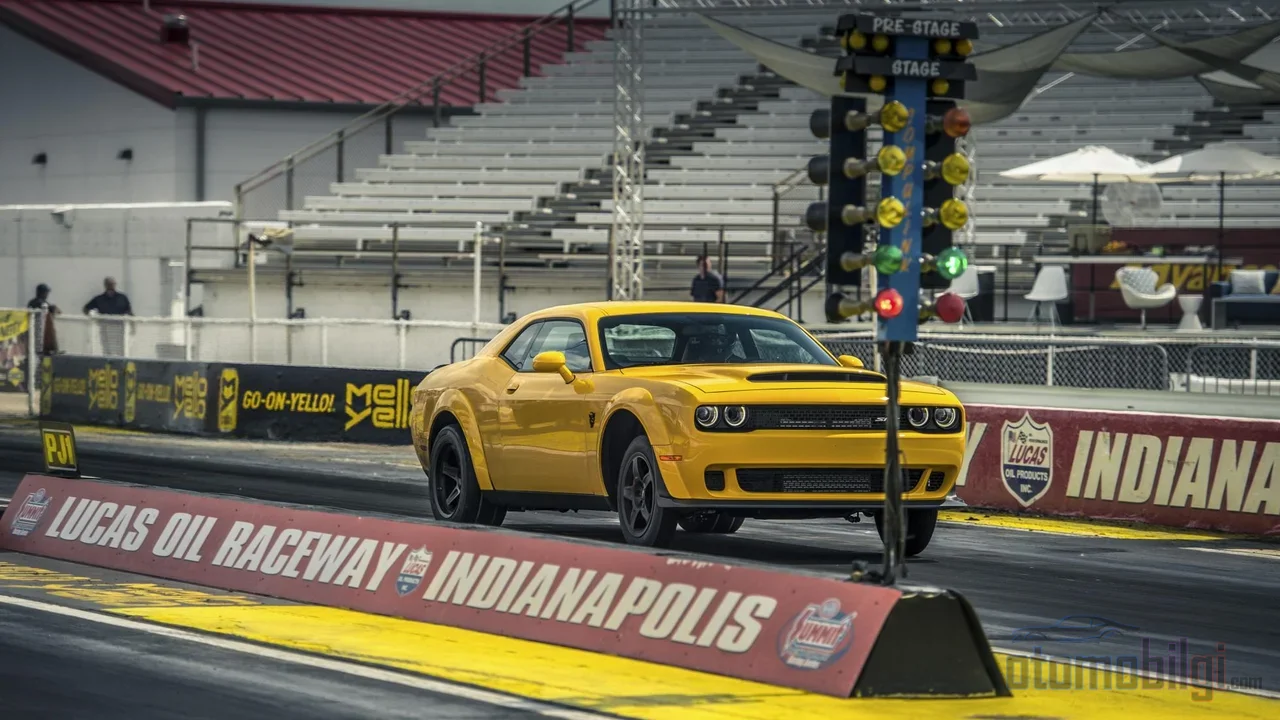
In the middle of every drag strip's starting line stands a light tower facing both lanes. Its name is fully deserved: the stacked colored lights, seen from a distance, resemble a small Christmas tree. The name was not given in vain - the first prototype actually used small glass Christmas tree bulbs.
This tree is, in fact, the face of a computer. There are two beams of light crossing the starting area of the strip, and trackside photocells that detect these beams. The moment the front wheel breaks a beam, the corresponding bulb on the tower lights up, and the timers in the control tower record everything. In other words, the system sees with its own eyes where the car is stopped and when it launches; nobody starts the race by waving a flag. Before this electronic system was born, flagmen did the job - it was both a safety risk and inconsistent in timing.
Each driver has a column of seven lights in their own lane: at the top, two small ambers (pre-stage), followed by three large ambers, one green and one red bulb. At modern NHRA national events, since 2011 the pre-stage and stage sections have been shown with blue LED sets; before that, four small ambers did the job.
What Do the Pre-Stage and Stage Lights Mean?
As the car approaches the starting line, when its front wheel breaks the first beam, the small light at the top comes on: pre-stage. This is the electronic way of saying 'you're close, but you're not quite in position yet.' At this point, the driver is about 7 inches (180 mm) behind the starting line.
Then the car gently moves forward another 7 inches, breaks the second beam as well, and the lower light comes on: stage. The front wheels are now exactly on the starting line, and the car is ready to race. The subtlety here is this: after one driver lights the stage light, the opponent must also stage within 7 seconds. If they don't - even in eliminations - they are automatically disqualified. After both cars have staged, the automatic starting system kicks in and fires the light sequence within at most 1.3 seconds. So there is nobody on the strip waiting around asking 'are you ready, I'm ready'; the tree is impatient.
What Is the Difference Between the Sportsman Tree and the Pro Tree?
Here is where the fight really begins. The same three ambers, two completely different rhythms. The Sportsman Tree (or Full Tree) is the world of beginners and bracket racers: the three ambers light up in sequence, each one 0.5 seconds apart, and 0.5 seconds after the last amber, the green comes on. From the first amber to the green there is a total of 1.5 seconds - a wide window for the driver to catch the rhythm.
The Pro Tree, on the other hand, is the fast game of the professional classes: the three ambers light up at the same time and, after a short pause, the green comes on. In most classes this pause is 0.4 seconds. Think about it: the race has practically started before you have even reacted. In the handicap starts of bracket racing, the Sportsman Tree has one more superpower: the light sequence for the slower vehicle category starts first, and the faster car's first amber lights up later by exactly the difference between the two cars' dial-ins. For example, an 11.30-second car enters its launch rhythm 0.600 seconds before a 10.70-second rival. At the finish line, the contest truly becomes a contest.
| Feature | Sportsman Tree | Pro Tree |
|---|---|---|
| Amber sequence | In sequence, 0.5 s apart | All three at once |
| First amber to green | 1.5 seconds | About 0.4 seconds |
| Who is it for? | Bracket and sportsman classes | Professional classes |
| Handicap start | The slower car's sequence starts first | Heads-up, equal launch |
Does a Red Light Always Mean Losing?
The red bulb lights up when a vehicle crosses the starting line before the green comes on. It is the driver announcing their impatience to everyone, and as a rule it means disqualification. But the coin has two sides: if the opponent also commits a foul in a heads-up launch - such as crossing the lane boundary or hitting the barrier - the red-light foul is canceled and the driver who lit the red can still win the round.
There is also a more serious offense: a vehicle that launches before the tree has even been activated, while the first amber is still lit, is disqualified regardless of what the opponent does. Also, in qualifying, a red-light foul does not count - the goal there is ranking, not elimination. In races with handicap starts, however, the green is shown even if it has been "skipped" for the first driver, and the red lights up in the lane of the more serious violator. In short, the red light is a penalty lamp; but to see the whole story, you have to look at the other lane too.
Deep Staging: Bold Progress, Bold Risk
When it comes to staging, drivers have their fine adjustments. In normal staging, both lights are lit and the car sits exactly on top of the beams. In deep staging, the driver, after both lights are lit, rolls the car a few centimeters further forward and extinguishes the pre-stage light. Why? Because in this position the front wheel is closer to the finish line and the tire's roll-out distance from the beams is shortened. The effect means less of a "rolling start" - in other words, a cleaner launch.
But every boldness has a price: a car that enters the beams excessively deep can in some cases be penalized directly with a red light. Drivers with naturally fast reactions can pull a red light even without doing a deep stage; some deliberately stage very shallow to guard against this. At some tracks, deep staging - that is, turning off the top stage bulb - results in an automatic red light; this rule varies from track to track. So anyone who wants to go deep first needs to read the track rulebook.
There are also moments when track culture gets satirized: when both drivers deliberately delay staging, it's called a 'burndown.' If neither driver stages, the starter steps in, sometimes shutting both engines off and ordering the pair to pass. There's also a maneuver called 'double-bulbing': the driver goes deep and lights both staging bulbs at the same time, leaving the opponent almost no preparation time. In the official rulebook, it is politely listed as 'gamesmanship.'
From the Flagman to the Computer: A Brief History of the Tree
The first Christmas Tree debuted at the 1963 U.S. Nationals. According to the official version of the story, NHRA National Field Director Ed Eaton proposed the idea of a 'stepped countdown of lights' to Chrondek's founder Oliver Riley in 1962. According to an alternative claim, the first tree was built in the late 1950s by W.H. David Jr. had done. The debate about being an inventor is still ongoing; but it is certain that pre-stage and stage bulbs were added at the 1964 Winternationals - the first tree had 5 amber lights and no staging lights at all.
The system then evolved rapidly. In 1971, the Pro Tree arrived for professional classes: only the fifth (final) amber bulb lit up, with the green coming on 0.4 seconds later. In 1986, Pro Stock cars' hood scoops obscured the lower amber bulb, so two ambers were removed and the three-amber system became standard. This change wasn't just for looks: In sportsman launches, one second gained per run saved roughly 4 minutes per day - serious money on race days.
The real revolution on the timing side came in 2003 at Pomona: The reason was very concrete - the vibration from Top Fuel and Funny Car burned out bulbs so easily that a single event could go through 20 bulbs. The LED transition also lowered reaction times; technology touched driver performance directly. One more subtle detail: Another subtle detail: Before 2009, the start tree was triggered manually, and experienced drivers could anticipate the moment it was triggered. To prevent this, a random delay code was added to the system once the second car was staged. Today, NHRA has officially been using CompuLink systems since 1984; Even in the 2026 season, two tracks still race with old-style Accutime trees, and at the Great Lakes Nationals in Michigan, drivers' struggle to adapt to this tree was one of the talking points.
Is Waiting for the Green the Biggest Mistake?
Here is the most striking lesson from the track: The best racers don't wait for the green. They start moving before the green comes on, because once human reaction time is factored in, anyone waiting for the green is always late. But then how does the rule work? Because the foul is only committed when the wheel leaves the beam before the green - if the driver has nudged the car forward before the green but the wheel has not yet left the beam, the launch counts as 'clean' as long as the reaction time does not go below .000. A perfect reaction time is .000 seconds; In Pro Tree format, this means launching exactly 0.4 seconds after the ambers come on.
That is why drivers read the tree not as a sequence of lights but as a rhythm. Much like singing a song: they internalize the interval of the ambers, count it, subtract their own reflex delay, and release right on time. Even for amateurs, it is possible to practice this rhythm at home - practice trees, as the training tools and devices are called, faithfully replicate Sportsman and Pro formats, even delay box and rollout settings. The situation is the same in Türkiye: The racer briefing of the Türkiye Drag Championship clearly states that a driver who moves before the green light comes on is considered to have fouled. With the new drag strip in Antalya Kepez opening alongside the Türkiye Drag Championship, this language of lights is now read on our own track as well.
The rest of the timing system is also tied to the tree: each lane's clock runs independently, and the clock does not start until the vehicle leaves the staging beams. Intermediate times are recorded at the 60, 330, 660, 1,000 feet and quarter mile points; speed is measured in the 'speed trap', the 66 feet after the finish line. For Top Fuel and Funny Car, the finish line is at 1,000 feet. In other words, the rhythm you catch on the tree binds you not just to the launch, but to the entire run.
Reading the Lights Wins
Next time you watch drag racing, take another look at the tree. You will see the gentle creep of the two cars before they pre-stage, the rhythm of the ambers after the blues, how deep each driver stages, and whose finger jumps early. Because a drag race ends at the finish line but is won - at the starting line. So, would you wait for the green, or catch the rhythm?
Sources
- NHRA 101
- Christmas tree (drag racing)
- How the NHRA Starting Lights Work
- Drag Race 101 - World Wide Technology Raceway
- Drag School: How to Stage Your Drag Car
- MSHS Staging Etiquette
- NHRA Racers Adjust to Accutime Differences at Michigan - Competition Plus
- Türkiye Drag Şampiyonası Yarışçı Bilgilendirmesi - TMF